
 100% FREE ACCESS
11th Standard CBSE Syllabus & Materials
11th Standard CBSE
CBSE 11th Economics PART-A - Presentation of Data - New Sample Question Papers Study Material - QB365 Set A
NEW11th Standard CBSE
CBSE 11th Economics PART-A - Organisation of Data - New Sample Question Papers Study Material - QB365 Set A
NEW11th Standard CBSE
CBSE 11th Economics PART-A - Collection of Data - New Sample Question Papers Study Material - QB365 Set A
NEW11th Standard CBSE
CBSE 11th Economics PART-A - Introduction to Economics and Statistics - New Sample Question Papers Study Material - QB365 Set A
NEW11th Standard CBSE
CBSE 11th Business Studies International Trade Sample Question Papers Study Material - QB365 Set A
NEW11th Standard CBSE
CBSE 11th Business Studies Evolution and Fundamentals of Business Sample Question Papers Study Material - QB365 Set A

Published on: 05/09/2019
Cell: The Unit of Life
Download CBSE Class 11th Standard CBSE Biology question papers, sample papers, important questions, and previous year solved papers in PDF format. Get free study materials, NCERT solutions, and exam preparation resources for Class 11th Standard CBSE Biology
Questions + Answers key
Take MCQ Biology Test
1.
Which four different sites in plant cells have ribosomes?
2.
What are the major functions of plant cell vacuoles?What is the covering membrane of the vacuoles called?
3.
Mention two functions of the centrioles.
4.
How do the ribosomes of prokaryotic cells differ from the ribosomes of eukaryotic cells? Also, tell what is similar about them?
5.
Give significance of glycocalyx.
6.
What are the disadvantage of multicellularity?
7.
Which layer of cell envelope is sticky in nature? Also give another name for this layer.
8.
In which organelle the proteins required for functioning of the nucleus are formed.
9.
Given one difference between the characteristic feature of Gram positive and Gram negative bacteria.
10.
Which pigment is mainly responsible for the colour of the carrot?
11.
Why mitochondrion and chloroplast are not considered in the endomembrane system?
12.
Both lysosomes and vacuoles are endomembrane structures, yet they differ in terms of their functions. Comment.
13.
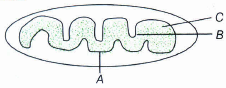
Fill in the blanks at A, B, and C as shown in diagram
14.
In what respect the mitochondria and plastids resemble the bacteria.
15.
Is extra genomic DNA present in prokaryotes and eukaryotes?If yes, locate their position in both types of organisms.
16.
Distinguish between chloroplast and chromoplast.
17.
Give the biochemical composition of the plasma membrane.How are lipid molecules arranged in the membrane?
18.
Name two cell-organelles that are double membrane bound. What are the characteristics of these two organelles? State their functions and draw labelled diagrams of both.
19.
Describe the structure of the following with the help of labelled diagrams.
(i) Nucleus
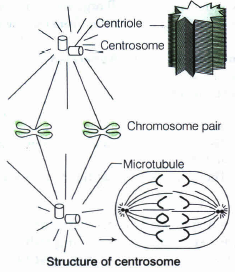
(ii) Centrosome
20.
The diagram shows some of the structures present in an animal cell.
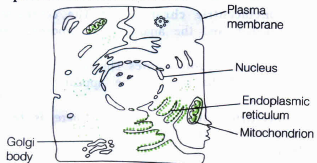
Which of these structures is responsible for
(i) Manufacture of lipids and steroids
(ii) Release of energy
(iii) Manufacture of hormones and digestive enzymes
(iv) Production of spindle fibres in cell division
(v) Endo and exocytosis?
1.
Ribosomes are found in plant cell at following different sites
(i) Freely in the cytoplasm
(ii) Attached to ER in the cytoplasm
(iii) Inside mitochondria.
(iv) Inside plastids (chloroplasts).
2.
Vacuoles in plant cell contain not only unuseful substances and water but also contains pigments and toxic molecules. Tonoplast is the covering membrane of the vacuoles.
3.
Functions of the centrioles are
(i) The centrioles play a vital role in cell division by forming spindle fibres, which act as guides for the alignment of the chromosomes as they separate later during the process of cell division.
(ii) The centrioles are also responsible for the formation of basal bodies, cilia and flagella.
4.
Ribosomes in the cytoplasm of prokaryotic and eukaryotic cells slightly differ. However, prokaryotes have 70S ribosomes, each consisting of a small 30S and a large 50S subunit whereas, each consists the large one.
Both prokaryotic and eukaryotic ribosomes are composed of ribosome RNA and ribosomal proteins. Their basic function is proteins synthesis.
5.
Glycocalyx is significant in the following ways
(i) It protects the cell from loss of water and nutrients
(ii) Serves as a protective layer against attack by phagocytosis and viruses.
(iii) Helps in attachment to a surface
(iv) Provides virulence.
6.
The disadvantage of multicellularity are
(i) Specialised cells often lose the power of division, so that injury is not repaired.
(ii) Regeneration ability of multicellular organisms decreases with specialisation.
(iii) Specialised cells may lose vital functions in order to carry out a specific activity.
7.
The sticky layer of cell envelope is called glycocalyx. It is also known as mucilage sheath.
8.
Proteins required are formed in the cytoplasm.
9.
Gram positive bacteria retain crystal violet dye and stain blue in colour, while Gram negative bacteria loose colour on washing.
10.
Carrots derive their color from pigment compounds called carotenoids. Orange carrots are colored by alpha- and beta-carotene. The red carrots get their color from lycopene, yellow from lutein, and purple from anthocyanin. These pigments also provide nutrition.
11.
They are not considered in the endomembrane system as their functions are not coordinated by other components of the cell as ER, lysosomes, Golgi complex, etc.
12.
Lysosome and vacuoles perform different functions in cells. Lysosome digests foreign materials and waste products. Vacuoles maintain tonocity of the plant cell and are important for excretion in bactria. Both of them function in coordination Whenever a foreign material comes inside the cell it is surrounded by a membrane to form vacuole. Even dead cell substances are surrounded by vacuoles. After sometime digestive enzymes are inserted into them and they become lysosomes. Even in amoeba, the engulfed food is first surrounded by membrane to make vacuoles and then the addition of enzyme converts the vacuole to lysosome. As their coordination is one of the important aspects of their function so they are kept under endomebrane system.
13.
A - Inner membrane,
B - Crista,
C - Matrix.
14.
Mitochondria and plastids are known as semi-autonomous organelles. They have their own genetic material i.e. DNA. They have their own matrix containing 70S type of ribosomes. That's why they resemble the bacteria.
15.
Yes, extra genomic DNA is present in both prokaryotes and eukaryotes.
In the case of eukaryotes, extragenomic DNA is present in two organelles e.g. Plastids and mitochondria. Both these organelles with the help of their own DNA, synthesise some of their proteins. Thus, these organelles are known as semiautonomous organelles.
In the case of prokaryotic cells, the extragenomic DNA is present in the form of plasmids. The plasmids are circular DNA molecules, which confer certain unique phenotypic characters to such bacteria. One such character is resistance to bacteria. This plasmid DNA is also used to monitor bacteria transformation with foreign DNA.
16.
| Chloroplasts | Chromoplasts |
| They contain mainly chlorophylls and some amount of carotene and xanthophyll | They contain mainly carotene and xanthophyll |
| They are present in the mesophyll of leaves | They are present in the petals of flowers, the skin of fruits, etc. |
| Their main role is to prepare food by the process of photosynthesis | Their main role is to impart coloration to plants |
17.
(i) The plasma membrane is composed of proteins, lipids (phospho glycerides) and some carbohydrales.
(ii) The lipids are arranged in a bilayer within the membrane, with their polar head towards the out of surfaces and the hydrophopic tails towards the centre of the membrane.
18.
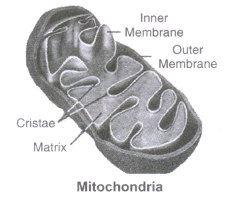
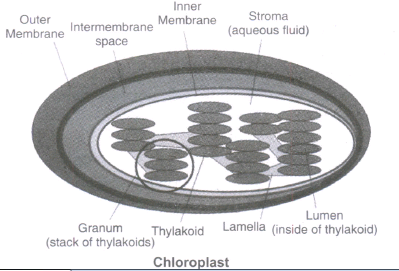
Two double membrane-bound cell organelles:
(a) Mitochondria. It has finger-like folds in the inner membrane called cristae. Mitochondria is the place for aerobic respiration.
(b) Chloroplast. Chloroplast is responsible for converting light energy into chemical energy. Chloroplast contains stacked thylakoid in its matrix.
19.
(i) Nucleus: It is a naked, round and slightly irregular structure, which is attached to the chromatin at a specific region. The content of nucleolus is continuous with the rest of the nucleoplasm as it is not a membrane bound structure.
It is a site for active ribosomal RNA synthesis.Larger and more numerous nucleoli are present in cells activitely carrying out protein synthesis.
(ii) Centrosome
20.
Structures responsible are
(i) Smooth endoplasmic Reticulim (SER) is responsible for the manufacture of lipids and steroids.
(ii) Mitochondrion is responsible for the release of energy.
(iii) Ribosomes is responsible for the production of hormones and digestive enzymes.
(iv) Centrioles is responsible for production of spindle fibres.
(v) Plasma membrane is responsible for endo and exocytosis.

11th Standard CBSE Syllabus & Materials
11th Standard CBSE
CBSE 11th Business Studies Forms of Business Organisation Sample Question Papers Study Material - QB365 Set A
NEW11th Standard CBSE
CBSE 11th Business Studies Business, Trade and Commerce Sample Question Papers Study Material - QB365 Set A
NEW11th Standard CBSE
CBSE 11th Physics Waves Sample Question Papers Study Material - QB365 Set A
NEW11th Standard CBSE
CBSE 11th Physics Kinetic Theory Sample Question Papers Study Material - QB365 Set A



CBSE 11th Standard CBSE Subjects
CBSE Standards









