
 100% FREE ACCESS
11th Standard CBSE Syllabus & Materials
11th Standard CBSE
CBSE 11th Economics PART-A - Presentation of Data - New Sample Question Papers Study Material - QB365 Set A
NEW11th Standard CBSE
CBSE 11th Economics PART-A - Organisation of Data - New Sample Question Papers Study Material - QB365 Set A
NEW11th Standard CBSE
CBSE 11th Economics PART-A - Collection of Data - New Sample Question Papers Study Material - QB365 Set A
NEW11th Standard CBSE
CBSE 11th Economics PART-A - Introduction to Economics and Statistics - New Sample Question Papers Study Material - QB365 Set A
NEW11th Standard CBSE
CBSE 11th Business Studies International Trade Sample Question Papers Study Material - QB365 Set A
NEW11th Standard CBSE
CBSE 11th Business Studies Evolution and Fundamentals of Business Sample Question Papers Study Material - QB365 Set A

Published on: 15/09/2018
Model Paper 2
Download CBSE Class 11th Standard CBSE Biology question papers, sample papers, important questions, and previous year solved papers in PDF format. Get free study materials, NCERT solutions, and exam preparation resources for Class 11th Standard CBSE Biology
Questions + Answers key
Take MCQ Biology Test
1.
Explain briefly the following terms with suitable examples:-
(i) protonema
(ii) antheridium
(iii) archegonium
(iv) diplontic
(v) sporophyll
(vi) isogamy
2.
(i) Why does the interior of bacterial cell appear simple and granular?
(ii) Which components make cell envelope of bacterial cell?
(iii) What gives gummy or sticky trait to bacterial cells and if it is not essential for survival, what are its functions?
3.
Sporozoans are parasitic protozoan protists which lack locomotory organelles atleast in trophozoite stage.
(i) Where are they found ?
(ii) What kind of nutrition they have?
(iii) Do they have nucleus ?
(iv) What is the made of reproduction ?
(v) List any four examples of sporozoans.
4.
Briefly describe the components of a typical bacteria cell
5.
Organise a discussion in your class on the topic – Are viruses living or nonliving?
6.
How do viruses resemble non - living things?
7.
Explain briefly the following terms with suitable examples - Diplontic
8.
Explain briefly the following terms with suitable examples - Archegonium
9.
Explain briefly the following terms with suitable examples - Antheridium
10.
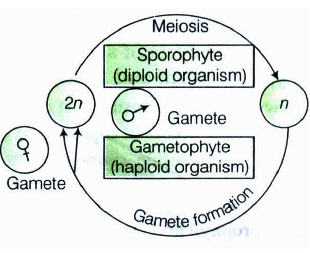
Demonstrate alternation of generations in plants through a diagram.
11.
Write few important features of mosses
12.
Write one feature each of liveworts and mosses.
13.
Write the types of thallus found in members of Rhodophyceae
14.
List any two advantage of artificial system of classification
15.
What is Kingdom - Plantae?
16.
Diploid sporophyte is dominant phase in the life cycle of which plant?
Angiosperm
Bryophyta
Pteridophyta
Algae
17.
Which of the following is used in making litmus solution?
Fungi
Algae
Lichen
Bryophyta.
18.
Which of the following division contains the largest number of plant species?
Gymnosperm
Angiosperm
Pteridophyta
Bryophyta
19.
Which of the following play an important role in soil formation?
Algae
Bryophyta
Pteridophyta
Gymnosperm.
20.
Which of the following is not among cryptogams?
Algae
Bryophyta
Pteridophyta
Gymnosperm
21.
Which of the following shows no segregation of plant parts?
Algae
Bryophyta
Pteridophyta
Gymnosperm
22.
Which is the most acceptable system of biological classification?
Two Kingdom Classification
Three Kingdom Classification
Five Kingdom Classification
Six Kingdom Classification
23.
Which of the following organisms is a good indicator of pollution in an environment?
Bacteria
Fungi
Algae
Lichens
24.
Which is the correct word for relationship between algae and fungi in lichens?
Parasitism
Symbiosis
Commensals
Pathogens
1.
(a) Protonema : A protonema is a thread-like chain of cells that forms the earliest stage (the haploid phase) of a bryophyte life cycle. When a moss or liverwort first grows from the spore, it grows as a protonema which develops into a leafy gametophore.
Example: Some mosses and all liverworts.
(b) Antheridium : An antheridium is a haploid structure or organ producing and containing male gametes. It is present in the gametophyte phase of lower plants like mosses and ferns, and also in the primitive vascular psilotophytes. Many algae and some fungi, for example ascomycetes and water moulds, also have antheridia during their reproductive stages.
(c) Archegonium : An archegonium is a multicellular structure or organ of the gametophyte phase of certain plants producing and containing the ovum or female gamete. The archegonium has a long neck and a swollen base. Archegonia are typically located on the surface of the plant thallus, although in the horned liverworts they are embedded.
(d) Diplontic : The major part of the life cycle is composed of gametophytic stage and gametophytes produce haploid male and female gametes. This happens in all the higher plants and animals. This kind of life cycle is called diplontic life cycle.
(e) Sporophylls : Sporophyll is a leaf that bears sporangia. Both microphylls and megaphylls can be sporophylls. In heterosporous plants, sporophylls bear either megasporangia (megasporophylls), or microsporangia (microsporophylls).
(f) Isogamy : Isogamy refers to a form of sexual reproduction involving gametes of similar morphology, differing only in allele expression in one or more matingtype regions. Since both gametes look alike, they cannot be classified as "male" or "female." Instead, organisms undergoing isogamy are said to have different mating types, most commonly noted as "+" and "-" strains. Fertilization occurs when "+" and "-" gametes fuse to form a zygote.
2.
(i) The interior of bacterial cell seems simple and granular because the membrane bound organelles are not present in it.
(ii) Mucilage, cell wall and plasma membrane are together called cell envelope.
(iii) Mucilage or glycocalyx gives gummy or sticky trait to cells.
Though it is not essential for bacterial survival, glycocalyx has several functions such as
(a) Protection from desiccation and toxins.
(b) Preventing host phagocytes to get attached to the bacterium.
(c) Holdings cells together.
(d) Storing chemicals for virulence.
3.
(i) Sporozoans are intracellular endoparasities of invertebrates and vertebrates.
(ii) They have nutrition which is mostly absorptive type and rarely digestive.
(iii) Sporozoans are commonly uninucleate.
(iv) Asexual reproduction occurs by multiple fission and sexual reproduction involves fusion of gametes.
(v) Examples Plasmodium, Toxoplasma, Monocystis and Eimeria.
4.
A bacterial cell consists of following components
Cell envelope : It is the outer covering of protoplasm of bacterial cell. It contains mucilage sheath, cell wall and plasma membrane.
Cytoplasm : It is a crystallo - colloidal complex that forms the protoplasm excluding its nucleoid. Membrane bound cell organelles are absent. Cytoplasm along with nucleoid are together called as protoplasm.
Nucleoid : It represents the genetic material of prokaryotes. Nucleoid consists of a single circular strand of DNA duplex which is super coiled with the help of RNA. No nuclear envelope is present.
Plasmids : these are self-replicating , extrachromosomal segments of double-stranded, circular, naked DNA.
Flagella : These are unstranded, equivalent to a single microtubular fibre. These help in movement and locomotion.
Pili and Fimbriae : Pili are longer, fewer and thicker tubular outgrowths made up of protein pilin. Fimbriae are small bristle-like fibres sprouting from cell surface in large number. Pili are helpful in attaching to recipient cell and forming conjugation tube. Fimbriae cause agglutination of RBC.They also help in mutual clinging of bacteria.
5.
Viruses are intermediate between living and non - living objects.
They resemble non - living objects in
(i) Lacking protoplast.
(ii) Ability to get crystallised.
(iii) High specific gravity which is found only in non - living objects.
(iv) Absence of respiration and energy storing system.
(v) Absence of growth and division.
(vi) Cannot live independent of a living cell.
They resemble living objects in
(i) Presence of genetic material (DNA or RNA).
(ii) Capable of mutation.
(iii) Irritability.
(iv) Can grow and multiply inside the host cell.
6.
Viruses are intermediate between living and non - living objects.
They resemble non - living objects in
(i) Lacking protoplast.
(ii) Ability to get crystallised.
(iii) High specific gravity which is found only in non - living objects.
(iv) Absence of respiration and energy storing system.
(v) Absence of growth and division.
(vi) Cannot live independent of a living cell.
They resemble living objects in
(i) Presence of genetic material (DNA or RNA).
(ii) Capable of mutation.
(iii) Irritability.
(iv) Can grow and multiply inside the host cell.
7.
Diplontic : The major part of the life cycle is composed of gametophytic stage and gametophytes produce haploid male and female gametes. This happens in all the higher plants and animals. This kind of life cycle is called diplontic life cycle.
8.
Archegonium : An archegonium is a multicellular structure or organ of the gametophyte phase of certain plants producing and containing the ovum or female gamete. The archegonium has a long neck and a swollen base. Archegonia are typically located on the surface of the plant thallus, although in the horned liverworts they are embedded.
9.
Antheridium : An antheridium is a haploid structure or organ producing and containing male gametes. It is present in the gametophyte phase of lower plants like mosses and ferns, and also in the primitive vascular psilotophytes. Many algae and some fungi, for example ascomycetes and water moulds, also have antheridia during their reproductive stages.
10.
Alternation of generations in plants
11.
Important features of mosses
(i) Erect, radially symmetrical leafy body produced from filamentous or thalloid juvenile stage is called protonema.
(ii) They bear multicellular branched rhizoids.
(iii) Sporophyte contains large amount of green tissue and is partially dependent upon the gametophyte
12.
In liverworts, the plant body is thalloid, eg., Marchantia. The thallus is dorsiventral and closely appressed to the substrate.
In mosses, the predominant stage is the gametophyte.
It has two phases
(i) Protonema stage which develops directly from a spore.
(ii) Leafy stage which develops from the secondary protonema as a leaf bud.
13.
The thallus structure in Rhodophyceae varies from unicellular to pseudoparenchymatous thallus.
(i) Unicellular thallus (Porphyridium).
(ii) Filamentous thallus (Polysiphonia)
(iii) Pseudoparenchymatous thallus (Gelidium).
14.
Two advantages of artificial system of classification are
(i) Artificial system is very easy to remember as it uses only one or a few characters for comparison.
(ii) The traits used are of interest to humans.
15.
Kingdom - Plantae includes multicellular eukaryotic organisms with the photosynthetic mode of nutrition, cell wall cellulose and plastids containing starch as the main reserve food.
16.
(a)
Angiosperm
17.
(c)
Lichen
18.
(b)
Angiosperm
19.
(b)
Bryophyta
20.
(d)
Gymnosperm
21.
(a)
Algae
22.
(c)
Five Kingdom Classification
23.
(d)
Lichens
24.
(c)
Commensals

11th Standard CBSE Syllabus & Materials
11th Standard CBSE
CBSE 11th Business Studies Forms of Business Organisation Sample Question Papers Study Material - QB365 Set A
NEW11th Standard CBSE
CBSE 11th Business Studies Business, Trade and Commerce Sample Question Papers Study Material - QB365 Set A
NEW11th Standard CBSE
CBSE 11th Physics Waves Sample Question Papers Study Material - QB365 Set A
NEW11th Standard CBSE
CBSE 11th Physics Kinetic Theory Sample Question Papers Study Material - QB365 Set A



CBSE 11th Standard CBSE Subjects
CBSE Standards









