
 100% FREE ACCESS
11th Standard CBSE Syllabus & Materials
11th Standard CBSE
CBSE 11th Economics PART-A - Presentation of Data - New Sample Question Papers Study Material - QB365 Set A
NEW11th Standard CBSE
CBSE 11th Economics PART-A - Organisation of Data - New Sample Question Papers Study Material - QB365 Set A
NEW11th Standard CBSE
CBSE 11th Economics PART-A - Collection of Data - New Sample Question Papers Study Material - QB365 Set A
NEW11th Standard CBSE
CBSE 11th Economics PART-A - Introduction to Economics and Statistics - New Sample Question Papers Study Material - QB365 Set A
NEW11th Standard CBSE
CBSE 11th Business Studies International Trade Sample Question Papers Study Material - QB365 Set A
NEW11th Standard CBSE
CBSE 11th Business Studies Evolution and Fundamentals of Business Sample Question Papers Study Material - QB365 Set A

Published on: 24/09/2019
Small Business
Download CBSE Class 11th Standard CBSE Business Studies question papers, sample papers, important questions, and previous year solved papers in PDF format. Get free study materials, NCERT solutions, and exam preparation resources for Class 11th Standard CBSE Business Studies
Questions + Answers key
Take MCQ Business Studies Test
1.
We need to give special attention for the growth of rural, backward and hilly areas. Why?
2.
It is right on moral grounds to give some special incentives to small scale industries. Do you agree? Justify your answer.
3.
What forms of support is offered to small industries by the government?
4.
Write a short note on SIDO.
5.
List out major industry groups in the small sector in India.
6.
Explain the meaning of small scale industry with its different categories.
7.
Explain the areas where small businesses feel threatened from global competition.
8.
What is the difference between small scale enterprise and cottage industry?
9.
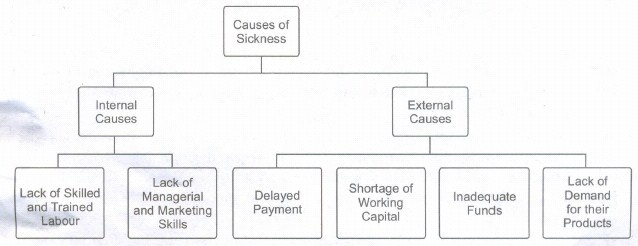
What are the causes of sickness in small industries?
10.
Write a short note on village and small industries sector.
11.
Small business is business at small scale. Do you agree? Explain.
12.
State the features of cottage industries.
13.
How would you differentiate between an ancillary unit and a tiny unit?
14.
What is the definition used by government of India for Small Scale Industries?
15.
What are the different parameters used to measure the size of business?
1.
It is rightly said that we need to give special attention for the growth of rural, backward and hilly areas because:
(a) Large scale business houses are unwilling to invest in these areas. It leads to lack of employment opportunities in these areas.
(b) There is disguised and seasonal unemployment in rural areas. This type of unemployment can best be tackled by developing small scale and village industries.
(c) It is the duty of the government to ensure balanced development in all corners of the country.
(d) It can help to make these areas developed and bring them at par with other areas of the country.
2.
Yes, I agree. There are many problems with SSIs. Major problems faced by the small scale industries are:
(1) Finance
(2) Raw Material
(3) Idle Capacity
(4) Technology
(5) Marketing
(6) Infrastructure
(7) Under Utilization of Capacity
(8) Project Planning.
Small scale industries play a vital role in the economic development of our country. This sector can stimulate economic activity and is entrusted with the responsibility of realizing various objectives, i.e., generation of more employment opportunities with less investment, reducing regional imbalances etc. Small scale industries are not in a position to play their role effectively due to various constraints. If government provides certain incentives in the form of incentives on land, power, tax holiday etc, it can grow well and can be able to compete with large scale enterrises.
3.
Government offers support to small industries in the following forms:
(a) Institutional support in respect of credit facilities;
(b) Provision of developed sites for construction of sheds;
(c) Supply of machinery on hire purchase system;
(d) Technical and financial help for technical upgradation;
(e) Special incentives for setting up of industries in backward areas;
(f) Provision for training facilities;
(g) Assistance for domestic and export marketing.
4.
It is the office of the Development Commissioner for Small Scale Industries. SIDO was established in 1954 on the basis of the recommendations of the Ford Foundation. It has over 60 offices and 21 autonomous bodies under its management. These autonomous bodies include Tool Rooms, Training Institutions and Project-cum-Process Development Centres.
Various services provided by SIDO to the SMEs:
1. Facilities for testing, toolmenting, training for entrepreneurship development.
2. Preparation of project and product profiles.
3. Technical and managerial consultancy.
4. Assistance for exports.
5. Pollution and energy audits.
SIDO also provides economic information services and advises Government in policy formulation for the promotion and development of SSIs. The field offices also work as effective links between the central and the state governments.
5.
The official definitions of the small scale unit are as follows:
(i) Small-Scale Industries:
These are the industrial undertakings having fixed investment in plant and machinery, whether held on ownership basis or lease basis or hire purchase basis not exceeding Rs 1 crore.
(ii) Ancillary Industries:
These are industrial undertakings having fixed investment in plant and machinery not exceeding Rs 1 crore engaged in or proposed to engage in,
(a) The manufacture of parts, components, sub-assemblies, tooling or intermediaries, or
(b) The rendering of services supplying 30 per cent of their production or services as the case may be, to other units for production of other articles.
(iii) Tiny Units:
These refer to undertakings having fixed investment in plant and machinery not exceeding Rs 23 lakhs. These also include undertakings providing services such as laundry, xeroxing, repairs and maintenance of customer equipment and machinery, hatching and poultry etc. located m towns with population less than 50,000.
(iv) Small-Scale Service Establishments:
These mean enterprises engaged in personal or household services in rural areas and town with population not exceeding 50000 and having fixed investment in plant and machinery not exceeding Rs 25 lakhs.
(v) Household Industries:
These cover artisans, skilled craftsman and technicians who can work in their own houses if their work requires less than 300 square feet space, less than 1Kwpower, less than 5 workers and no pollution is caused. Handicrafts, toys, dolls, small plastic and paper products, electronic and electrical gadgets are some of the examples of these industries.
6.
In Indian economy small-scale and cottage industries occupy an important place, because of their employment potential and their contribution to total industrial output and exports.
Government of India has taken a number of steps to promote them. However, with the recent measures, small-scale and cottage industries facing both internal competition as well as external competition.
There is no clear distinction between small-scale and cottage industries. However it is generally believed that cottage industry is one which is carried on wholly or primarily with the help of the members of the family. As against this, small-scale industry employs hired labour.
Moreover industries are generally associated with agriculture and provide subsidiary employment in rural areas. As against this, small scale units are mainly located in urban areas as separate establishments.
Definition: Small scale industry is defined as a unit in which investment in original value of plant and machinery should not exceed Rs 1.5 crore.
However, to facilitate technology upgradation and enhance competitiveness, the investment limit has been raised to Rs 5 crore in respect of 71 high tech export oriented items in drugs, pharmaceuticals, hand-tools and knitwear sectors, etc.
Different categories include:
1. Micro and tiny industries
2. Women enterprises
3. Cottage industries
4. Village industries.
7.
Given below are the areas where small businesses feel threatened from global competition:
(a) It is difficult to maintain quality standards, technological skills, financial credit worthiness, managerial and marketing capabilities of the large industries and MNCs.
(b) They have to face competition from giant sized MNCs along with medium and large scale enterprises. It brings cut throat competition for them.
(c) There is limited access to markets of developed countries because of stringent requirements of quality certification like ISO: 9000 etc.
8.
"Small Scale Industries are located in urban centers and produce goods with partially or wholly mechanised equipment employing outside labour, small in size, having little capital resources and a small labour force".
"Cottage Industries are mainly rural in character and are generally associated with agriculture involving operations mostly by hands and are carried on in the home either as a whole time or as a part time occupation, primarily with the help of members of the family."
Difference between the Small-Scale Industries and Cottage Industries:
The differences between the small scale and cottage industries are basically two:
(a) While small-scale industries are mainly located in urban centres as separate establishments, the cottage industries are generally associated with agriculture and provide subsidiary employment in rural areas.
(b) While small-scale industries produce goods with mechanised equipment employing outside labour, the cottage industries involve operations mostly by hand which are carried on primarily with the help of the members of the family.
9.
Causes of sickness in SSIs can be classified into internal as well as external categories.
10.
In India 'village and small industries sector' consists of traditional as well as modern small industries. It has eight sub-groups: Handlooms, Handicrafts, Coir, Sericulture, Khadi Industries, Village Industries, Small Scale Industries and Power looms. Small industries and power looms come in the category of modern industries and rest are included under traditional industries. Village and small industries together provide the largest employment opportunities in India.
11.
Yes, I agree. Scale of operations can be measured in terms of workers employed, capital invested or total output. Indian Government considers the criterion of capital invested in plant and machinery. Accordingly a business in which investment in plant and machinery is less than 1 core comes under small scale business.
12.
The following are a few important features of cottage industries.
(a) Ownership: These are rural-based industries owned and operated by individuals who invest their private resources in these units.
(b) Level of capital and production techniques: The amount of capital is very small, and the production techniques are highly labor-intensive and indigenous.
(c) Employment: These industries generally do not hire labour but employ the owners' family members.
(d) Talent and skills: Usually, the talent and the skills required for cottage industries are found restricted to particular families. The skills are passed on from one generation to the next. For instance, the art of pottery remains restricted to potter families.
(e) Market: Although the production is primarily carried out for self-consumption, a portion of the output is sold in the local market as well.
13.
| Basis of Difference | Ancillary Industrial units | Tiny units |
|---|---|---|
| Definition | Industrial units that have to supply a minimum of 50%of their production to their parent industries are termed ancillary industrial units. | Industries that have a maximum investment of f 25 lakh in their plant and machinery are termed as tiny industrial units |
| Obligation | Such units have to supply at least 50%of their production to their parent industries. | No such obligations. |
| Investment limit | The maximum level of investment is Rs 1 crore. | The maximum level of investment is Rs 25lakh. |
| Examples | Industries engaged in the production of machine parts, tools and other intermediate products. | Business units such as small shops, boutiques, STD (subscriber trunk dialling) booths and photocopy centres. |
14.
Government uses the criterion of size of capital employed in plant and machinery to define Small Scale Industries. It is depicted in the table given below:
| Type of Industry | Investment Limit (Rs) |
|---|---|
| Small Scale Industry | 1 crore (For 71 products it is 5 crores) |
| Ancillary Industry | 1 crore (50%of the output supplied to the parent unit.) |
| Tiny Enterprise | 25 Lakhs |
| Service and Business (Industry related Enterprise) | 10 Lakhs |
| Women Enterprise | Any of the above (51%of the holding by the women and managed by women |
| Export Oriented Units (EOUs) | 1 Crore (100% EOUs can sell 25% in domestic markets.) |
15.
Following parameters may be used to measure the size of business:
(a) Number of workers employed
(b) Size of plant and machinery
(c) Total output
(d) Inventory size.

11th Standard CBSE Syllabus & Materials
11th Standard CBSE
CBSE 11th Business Studies Forms of Business Organisation Sample Question Papers Study Material - QB365 Set A
NEW11th Standard CBSE
CBSE 11th Business Studies Business, Trade and Commerce Sample Question Papers Study Material - QB365 Set A
NEW11th Standard CBSE
CBSE 11th Physics Waves Sample Question Papers Study Material - QB365 Set A
NEW11th Standard CBSE
CBSE 11th Physics Kinetic Theory Sample Question Papers Study Material - QB365 Set A



CBSE 11th Standard CBSE Subjects
CBSE Standards









