
 100% FREE ACCESS
11th Standard CBSE Syllabus & Materials
11th Standard CBSE
CBSE 11th Economics PART-A - Presentation of Data - New Sample Question Papers Study Material - QB365 Set A
NEW11th Standard CBSE
CBSE 11th Economics PART-A - Organisation of Data - New Sample Question Papers Study Material - QB365 Set A
NEW11th Standard CBSE
CBSE 11th Economics PART-A - Collection of Data - New Sample Question Papers Study Material - QB365 Set A
NEW11th Standard CBSE
CBSE 11th Economics PART-A - Introduction to Economics and Statistics - New Sample Question Papers Study Material - QB365 Set A
NEW11th Standard CBSE
CBSE 11th Business Studies International Trade Sample Question Papers Study Material - QB365 Set A
NEW11th Standard CBSE
CBSE 11th Business Studies Evolution and Fundamentals of Business Sample Question Papers Study Material - QB365 Set A

Published on: 24/09/2019
Social Responsibilities of Business and Business Ethics
Download CBSE Class 11th Standard CBSE Business Studies question papers, sample papers, important questions, and previous year solved papers in PDF format. Get free study materials, NCERT solutions, and exam preparation resources for Class 11th Standard CBSE Business Studies
Questions + Answers key
Take MCQ Business Studies Test
1.
Which eight problems have been identified by the United Nations which cause damage to natural environment?
2.
Describe the obligations of business towards owners and shareholders.
3.
What are the responsibilities of business towards employees and customers?
4.
Give any four reasons against the social responsibilities of business.
5.
What obligation does a businessman have towards the government?
6.
How can a business enterprise improve its public image by performing social responsibilities?
7.
Explain the obligations of business towards owners and investors.
8.
Name any four elements of business ethics.
9.
What are the obligations of a business in the name of social responsibility?
10.
What are the core objectives of social responsibility of business?
11.
What are the major areas of social responsibility of business?
12.
Briefly explain (a) Air pollution, (b) Water pollution, and (c) Land pollution.
13.
What is business ethics? Mention the basic elements of business ethics.
14.
What is environment? What is environmental pollution?
15.
What do you understand by social responsibility of business? How is it different from legal responsibility?
1.
Following eight problems have been identified by the United Nations which cause damage to natural environment:
1. Ozone depletion
2. Global warming
3. Fresh water quality and quantity
4. Deforestation
5. Land degradation
6. Solid and hazardous waste
7. Water pollution
8. Danger to biological diversity.
2.
Social responsibility of business towards its shareholders or investors is most important of all other obligations.
If a business satisfies its investors, they are likely to invest more money in a project. As a result, more funds will flow in and the same can be utilized to modernise, expand and diversify the existing activities on a larger scale. Happy financiers can fulfill the rising demand of funds needed for its growth and expansion.
1. They need to give a fair return to shareholders.
2. They need to give true and fair information to shareholders.
3. They need to give them proper opportunity to participate.
3.
Social responsibility of business towards its employees: It is important because they are the wheels of an organization. Without their support, the commercial institution simply can't function or operate.
If a business takes care of the needs of its human resource (for e.g. office staff, employees, workers, etc.) wisely, it will boost the motivation and working spirit within an organization. A happy employee usually gives his best to the organization in terms of quality labour and timely output than an unsatisfied one. A pleasant working environment helps in improving the efficiency and productivity of working people. A good remuneration policy attracts new talented professionals who can further contribute to its growth and expansion.
Thus, if personnel are satisfied, then they will work together very hard and aid in increasing the production, sales and profit.
Social responsibility of business towards its consumers or customers: It matters a lot from sales and profit point of view. Its success is directly dependent on their level of satisfaction. Higher their rate of satisfaction, greater is the chances to succeed.
If a business rolls out good-quality products and/or delivers better quality services that too at reasonable prices, then it is natural to attract lots of customers. If the quality-price ratio is maintained well and consumers get worth for their money spends, this will surely satisfy them. In the long run, customer loyalty and retention will grow, and this will ultimately lead to profitability.
4.
Arguments against social responsibility
1. Violation of Profit Maximisation: As per this argument, business enterprises claim that our objective is profit maximisation. Business can reduce its cost and raise profits and then only it can meet its social responsibility.
2. Lack of Social Skills: Business enterprises neither have skill nor experience to solve all types of social problems. Therefore, it should be handled by specialised agencies.
3. Burden on Consumers: Many of the social responsibilities cost a lot and its burden falls on consumers only.
4. Lack of Broad Public Support: Business cannot operate successfully because of lack of cooperation and confidence from public to business enterprises.
5.
Social responsibility of business towards government's regulatory bodies or agencies is quite sensitive from the license point of view. If permission is not granted or revoked abruptly, it can result in huge losses to an organization. Therefore, compliance in this regard is necessary.
Furthermore, a business must also function within the demarcation of rules and policies as formulated from time to time by the government of state or nation. It should respect laws and abide by all established regulations while performing within the jurisdiction of state.
Some examples of activities a business can do in this regard:
(a) Paying fair taxes on time,
(b) Following labor, environmental and other laws, etc.
(c) Seeking permissions wherever necessary,
(d) Licensing an organization,
If laws are respected and followed, it creates goodwill of business in the eyes of authorities. Overall, if a government is satisfied it will make favourable commercial policies, which will ultimately open new opportunities and finally benefit the organization sooner or later.
6.
Public relations is a potent tool for shaping consumer perception and building a company's image. Corporations that actively promote their social responsibility activities often take steps to publicise these efforts through the media. Getting the word out about corporate donations, employee volunteer programmes, or other CSR initiatives is a powerful branding tool that can build publicity for you in both online and print media.
7.
It is the responsibility of a business to pay attention on the maintenance and expansion of returns for all of its shareholders on important management issue, and constantly strives to improve its business performance and financial structure. The company's dividend policy calls for maintaining stable dividends, and Casio determines the allocation of profit by taking into account all factors such as profit levels, financial position, the dividend payout ratio, and future business development and forecasts.
8.
Business ethics can be defined as the code of conduct that a business must follow, such that it takes up only those activities that are desirable from the viewpoint of society. The purpose of business ethics is to guide managers and other employees in an organisation in performing their jobs in a manner that is socially acceptable.
The following are some of the elements of business ethics.
(a) Top-level officers, such as the CEO's and other higher level managers, must sincerely follow the ethical code of conduct. They should also guide other employees in their organisation in adopting the code.
(b) An enterprise must clearly define the ethical code of conduct to be followed in the organisation. The code should include quality standards for work, laws governing production and employee's health and safety standards.
(c) In addition to setting performance standards, an enterprise must also devise a mechanism through which it can measure the actions of individual employees. This should be done in order to confirm whether the ethical standards are being met.
(d) The successful implementation of ethical standards depends to a large extent on the involvement of employees at different levels. This is because it is the employees who actually implement the ethical codes.
(e) Although it is difficult to measure the end results of implementation of ethical standards, the top management should take steps to monitor compliance. Also, it must take serious action against any unethical behaviour in the organisation.
9.
The social responsibility of business comprises of the following obligations:
(a) A business must give a proper dividend to its shareholders or investors.
(b) It must provide fair wages and salaries with good working conditions.
(c) It must provide a regular supply of good quality goods and/or services to its consumers/customers at reasonable prices.
(d) It must abide by all government rules and regulations, support its business related policies and should pay fair taxes without keeping any delays or dues.
(e) It must also contribute for the betterment of a local community by doing generous activities like building schools, colleges, hospitals, etc.
(f) It must take immense care to see that its activities neither directly nor indirectly create havoc on the vitality of its surrounding environment.
(g) It should maintain a stringent policy to curb or control pollution in regard to contamination of air, water, land, sound and radiation leakages. It must hire experienced professional individuals who are experts in their respective fields.
(h) It should also offer social-welfare services to the general public.
10.
The core objectives of social responsibility of business are as follows:
1. It is a concept that implies a business must operate (function) with a firm mindset to protect and promote the interest and welfare of society.
2. Profit (earned through any means) must not be its only highest objective else contributions made for betterment and progress of a society must also be given a prime importance.
3. It must fulfill its social responsibilities honestly in regard to the welfare of society in which it operates and whose resources and infrastructures it makes use of to earn huge profits.
4. It should never neglect (avoid) its responsibilities towards society in which it flourishes.
11.
Major areas for social responsibility of business are given below:
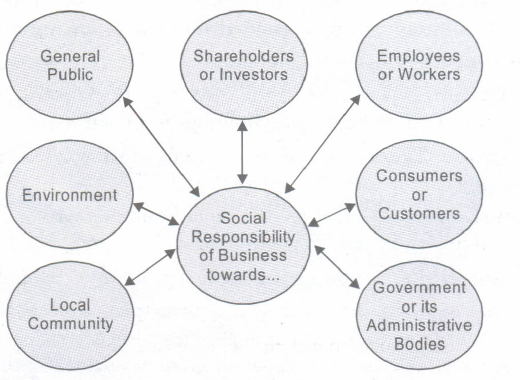
(a) Shareholders or investors who contribute funds for business.
(b) Employees and others that make up its personnel.
(c) Consumers or customers who consume and/or use its outputs (products and/or services).
(d) Government and local administrative bodies that regulate its commercial activities in their jurisdictions.
(e) Members of a local community who are either directly or indirectly influenced by its activities in their area.
(f) Surrounding environment of a location from where it operates.
(g) The general public that makes up a big part of society.
12.
(a) Air Pollution: This kind of pollution is caused by the emission of harmful gases into the atmosphere. Smoke and chemicals emitted by factories and vehicles degrade the air quality and causes air pollution.
(b) Water Pollution: Discharge of industrial and household wastes into rivers, streams or lakes causes degradation of the water quality. Over time, the increase in water pollution often results in the deaths of several animals and poses serious threats to human beings.
(c) Land Pollution: This is caused due to the dumping of toxic materials and wastes on land, which in turn damages the quality of land, making it unfit and unproductive for agriculture and crop plantation.
13.
Business ethics refers to the values and principles that govern the behaviour of individuals in an organisation such that the business activities are desirable from the viewpoint of society. The main purpose of business ethics is to guide managers and other employees to perform their jobs in a manner that is socially acceptable. The following are some of the elements of business ethics.
(a) Top management commitment: Top-level officers, such as CEO's and senior managers, must strongly follow the ethical codes and guide the other employees in adopting such behaviour.
(b) Publication of a 'code': Enterprises must clearly define the ethical code of conduct, which would include quality standards, laws governing production and health and safety standards for the employees.
(c) Establishment of compliance mechanism: In addition to standards, an enterprise must also devise a mechanism through which compliance with the code of conduct can be measured.
(d) Involvement of employees at all levels: The successful implementation of ethical standards requires the involvement of all the employees at all levels.
(e) Measurement of results: Although it is difficult to measure the end results of implementation of ethical standards, the top management should take steps to measure the degree of compliance with the ethical codes.
14.
By environment, we mean our surroundings, which have an impact on our lives. It is the sum total of the surroundings and resources, including both biotic resources (i.e., living creatures such as plants and animals) and abiotic resources (i.e., non-living things, such as air, water and land) that affect our existence and quality of life. However, because of the rapid increase in population and industrialisation, the excessive use of resources has resulted in their degradation and depletion. Also, the discharge of harmful substances into the environment has contributed towards pollution. Environmental pollution can be classified into the following four types.
(a) Air Pollution: It is caused by the emission of harmful gases into the atmosphere.
(b) Water Pollution: It is caused by the discharge of industrial and household wastes into the rivers, thereby degrading the quality of water.
(c) Land Pollution: This is caused by dumping toxic wastes on land, which in turn damages it, making it unfit for agriculture.
(d) Noise Pollution: It is caused by the noise from factories and vehicles, which may cause serious health problems such as loss of hearing or mental disorders.
15.
Social responsibility of business refers to its obligation to take those decisions and perform those actions which are desirable in terms of the objective and values of our society. It refers to the obligation of business towards various social groups like employees, consumers, investors, government etc. In the words of H. R. Bowen, "Social responsibility of business is to pursue those policies, to make those decisions or to follow those lines of action which are desirable in terms of the objectives and values of our society."
Legal responsibility is the responsibility that a business has by virtue of law.
Differences between Social and Legal Responsibility.
1. Legal responsibility is compulsory under any of the laws, acts and constitution. Social responsibility is not backed by legal provisions.
2. Legal responsibility is compulsion while social responsibility is a choice.
3. Many a time, legal responsibility is fulfilled in the name of social responsibility.
4. There are no punishments for organizations not following their social responsibility but legal action can be taken against organizations not following their legal responsibility.

11th Standard CBSE Syllabus & Materials
11th Standard CBSE
CBSE 11th Business Studies Forms of Business Organisation Sample Question Papers Study Material - QB365 Set A
NEW11th Standard CBSE
CBSE 11th Business Studies Business, Trade and Commerce Sample Question Papers Study Material - QB365 Set A
NEW11th Standard CBSE
CBSE 11th Physics Waves Sample Question Papers Study Material - QB365 Set A
NEW11th Standard CBSE
CBSE 11th Physics Kinetic Theory Sample Question Papers Study Material - QB365 Set A



CBSE 11th Standard CBSE Subjects
CBSE Standards









