
 100% FREE ACCESS
11th Standard CBSE Syllabus & Materials
11th Standard CBSE
CBSE 11th Economics PART-A - Presentation of Data - New Sample Question Papers Study Material - QB365 Set A
NEW11th Standard CBSE
CBSE 11th Economics PART-A - Organisation of Data - New Sample Question Papers Study Material - QB365 Set A
NEW11th Standard CBSE
CBSE 11th Economics PART-A - Collection of Data - New Sample Question Papers Study Material - QB365 Set A
NEW11th Standard CBSE
CBSE 11th Economics PART-A - Introduction to Economics and Statistics - New Sample Question Papers Study Material - QB365 Set A
NEW11th Standard CBSE
CBSE 11th Business Studies International Trade Sample Question Papers Study Material - QB365 Set A
NEW11th Standard CBSE
CBSE 11th Business Studies Evolution and Fundamentals of Business Sample Question Papers Study Material - QB365 Set A

Published on: 20/09/2019
Nature and Purpose of Business
Download CBSE Class 11th Standard CBSE Business Studies question papers, sample papers, important questions, and previous year solved papers in PDF format. Get free study materials, NCERT solutions, and exam preparation resources for Class 11th Standard CBSE Business Studies
Questions + Answers key
Take MCQ Business Studies Test
1.
What are the hindrances in the commerce? Which agencies are used to remove these hindrances?
2.
Differentiate between insurable risks and non-insurable risks.
3.
Explain political and legal causes of business risks.
4.
Can profits be the sole objective of a business? Justify your answer by giving suitable reasons.
5.
Distinguish between industry, trade and commerce.
6.
What are the functions of commerce?
7.
Differentiate between economic and non-economic activities.
8.
What is business risk? What is its nature?
9.
What is the role of profit in business?
10.
Explain any two business activities which are auxiliaries to trade.
11.
How would you classify business activities?
12.
Explain the concept of business.
13.
Why is business considered an economic activity?
1.
Following are the hindrances in commerce:
a) Lack of Personal Contact: This hindrance is removed by traders and middlemen.
b) Distance or Place: This hindrance is removed by transportation.
c) Finance: This hindrance is removed by banking.
d) Time or Storage: This hindrance is removed by warehousing.
e) Risk: This hindrance is removed by insurance companies.
f) Information: This hindrance is removed by advertisement or communication.
2.
| Basis | Insurable risks | Non-insurable risks |
|---|---|---|
| Meaning | Those risks which can be covered up by some type of insurance policy are called insurable risk. | Those risks which cannot be covered up by some type of insurance policy are called non-insurable risk. |
| Business Risks | Business risks are not insurable risks. | Business risks are non insurable risks. |
| Example | Risk of damage due to fire, accident, theft etc. | Risk of damage due to change in technology or change in government policy. |
3.
The causes of business risk include:
(a) Changes in government policies regarding foreign trade
(b) Entry of multinational companies
(c) Changes in laws affecting the business like licensing, taxation etc.
(d) Changes in consumer laws and labour laws.
For example, an increase in tax rates may reduce profit margin of the business or an increase in minimum wages may increase labour cost for the business.
4.
A layman may say that profits are the only objective with which a business is carried on but a good business man cannot keep profits as his only motive. A busines's organization is an economic unit which makes use of various factors of production. Capital is one of the factors of production. It pays interest in the form of profits. Urwick has put it beautifully, "Earning of profits cannot be objective of business any more than eating is the objective of living." There must be other objectives of a business which are non monetary but as important as monetary, like employee satisfaction, innovation, productivity, consumer satisfaction, etc.
The following reasons can be given to justify our opinion that profits cannot be the sole objective of a business.
(a) If we make profits to be only objective then interests of consumers, employees and society will be ignored.
(b) Maximum profits in the short run, may result worse for long term interest of the company.
(c) In present day scenario, when consumer awareness is increasing, labour laws are becoming stringent, social responsibilities of business is being highlighted, environment is being talked about, a business needs to set its objectives for satisfaction of consumers, employees, environmentalists, government etc.
5.
| Basis | Industry | Commerce | Trade |
|---|---|---|---|
| Meaning | Production of goods and services | Distribution of goods and services | Buying and selling of goods and services. |
| Capital requirement | Large amount of capital invested. | Comparatively lesser invested capital. | Less capital depending on the nature of business. |
| Scope | It includes primary, secondary and services industries | It includes trade and auxiliaries to trade. | It includes home and foreign trade. |
| Risk | It involves maximum risk. | Less risk as compared to industry. | Least risk involved. |
| Utility | Creates form utility. | Creates place and time utility. | Creates possession utility. |
6.
The functions of commerce are as follows:
1. Removing the hindrance of person and that means lack of information to producer about consumer and to consumer about the producer. It is removed by advertising.
2. Transportation removes hindrance of place.
3. Storage and warehousing activities remove the hindrance of time.
4. Banking removes the hindrance of finance.
5. Insurance removes the hindrance of risk.
6. Advertising removes the hindrance of information
7.
All human beings have different types of needs. So, in order to fulfill those needs, they have to perform some activities. Human activities are classified into economic and non-economic activities.
| Basis | Economic | Non-economic |
| Meaning | Those activities whose aim is to earn money. | Those activities whose aim is not to earn money, and to create wealth, but to satisfy social, psychological and emotional needs. |
| Example | A teacher teaching in a school. People working in factories. | A teacher teaches his/her son/daughter at home. A housewife cooks food for her family. |
8.
The term 'business risk' refers to possibility of inadequate profits or even losses due to uncertainties e.g., changes in tastes and preferences of consumers, strike, increased competition, change in Government policy etc. These are of two types-speculative and pure.
Nature of Business Risks
1. Business risks arise due to uncertainties: Natural calamities, change in demand and prices, change in technology etc. are some of the examples of uncertainty which create risks.
2. Risk is an essential part of every business: No business can avoid risk. Risk can be minimised but cannot be eliminated.
3. Degree of risk depends mainly upon the nature and size of business: For small scale business it is less and for large scale business it is more.
4. Profit is the reward for risk taking: An entrepreneur assumes risks and in consideration he gets reward which is called profit. Greater the risk higher is the chance of profit.
9.
Profits play a vital role in any business. Earning of profits is essential for any business because of the following reasons given below:
(a) Means of Livelihood: Profits act as a means of livelihood for the entrepreneurs. Without profits, entrepreneurs cannot continue with the business.
(b) Rewards for taking risks: It provides returns for taking risks.
(c) Funds for Growth: It would provide funds for growth of the business.
(d) Symbolic of efficiency and efficacy: Profits symbolise that management is efficient and business is operating in a healthy manner.
(e) Enhancement in goodwill: A business making higher profits has a better goodwill and reputation in the market.
10.
Two business activities which are auxiliary to trade are explained below:
(a) Transportation and Communication: The production of goods takes place at one place whereas these are demanded in different parts of the country. The obstacle of place is removed by the transport. Along with transport, communication is also an important service. It helps in exchange of information between producers, consumers and traders. The common communication services are postal service, telephone, fax, internet etc.
(b) Banking and Finance: Business needs funds for acquiring assets, purchasing raw materials and meeting other expenses. Necessary funds can be obtained from a bank. Finance is the life blood of any business. We cannot think of any business which does not need finance and providing finance to other businesses become another business. Finance is also required for consumption purposes.
11.
Business activities can be classified in the following ways
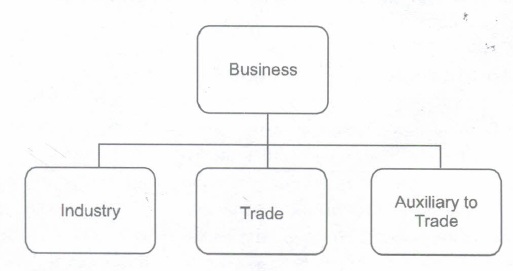
I. Industry: Different types of industries are as follows:
1. Primary Industry: The primary industry includes those activities through which the natural resources are used to provide raw materials to other industries. Primary industries are of two types.
2. Secondary Industry: Under this industry new products are manufactured by using the previously produced things e.g., producing cotton is a primary industry and manufacturing cloth out of cotton is a secondary industry. It is of two types.
3. Tertiary or Service Industry: It includes those services which help business to move smoothly e.g. transport, bank, insurance, storage and advertising.
II. Commerce: Commerce refers to all those activities which are concerned with the transfer of goods and services from the producers to the consumers. It embraces all those activities which are necessary for maintaining a free flow of goods and services. It includes trade and auxiliary to trade. Trade refers to buying and selling of goods and services with the objective of earning profit. It is classified into two categories.
(i) Internal Trade: It takes place within a country. Internal trade is classified into two categories-retail trade and wholesale trade.
(ii) Retail Trade: It refers to buying of goods and services in relatively small quantities and selling them to the ultimate consumers.
(a)External Trade: It happens between two or more countries. External trade can be classified into three categories.
(b) Import Trade: If goods are purchased from another country, it is called import trade.
(c)Export Trade: If goods are sold to other countries it is called export trade.
(d) Entrepot Trade: Goods are imported for export to other countries e.g.Indian firm may import some goods from America and export the same goods to Nepal.
III. Auxiliaries to Trade: All those activities which help in removing various hindrances which arise in connection with the production and distribution of goods are called auxiliaries to trade. An overview of these activities is given below:
1. Transportation and Communication: The production of goods takes place at one place whereas these are demanded in different parts of the country. The obstacle of place is removed by the transport. Along with transport, communication is also an important service. It helps in exchange of information between producers, consumers and traders. The common communication services are postal service, telephone, fax, internet etc.
2. Banking and Finance: Business needs funds for acquiring assets, purchasing raw materials and meeting other expenses. Necessary funds can be obtained from a bank.
3. Insurance: It provides a cover against the loss of goods, in the process of transit, storage, theft, fire and other natural calamities.
4. Warehousing: There is generally a time lag between the production and consumption of goods.This problem can be solved by storing the goods in warehouses.
5. Advertising: Advertising brings goods and services to the knowledge of prospective," buyers. It is through advertising that the customers come to know about the new products and their utility.
12.
Business: An economic activity involving the production and sale of goods and services undertaken with a motive of earning profit by satisfying human needs in society is called business.
Characteristics of Business
1. Economic activity: All business activities are economic activities and are done for the sole purpose of earning money.
2. Production and procurement of goods and services: A business activity involves the production or procurement of goods and services. A manufacturer is involved in production, while a shopkeeper is involved in procurement.
3. Sale and exchange of goods and services for the satisfaction of human needs: Sale and exchange of goods and services is done to satisfy human needs.
4. Dealing in goods and services on a regular basis: One time dealing in goods or services cannot be termed as a business. The business should happen on a regular basis.
5. Profit earning: Profit earning is the fundamental motive of doing a business. Other motives are there, but they depend on profit motive.
6. Uncertainty of returns: Returns can never be certain in business activity. This happens because of external factors which are outside the control of the business organization.
7. Element of risk: An element of risk is always present in business activity.
13.
Any activity is called an economic activity when it is done with a view to earning money. The motive of a business is to earn profit primarily. However, there are some other objectives as well like increasing market share, improvement in productivity, employee satisfaction, consumer satisfaction, social objectives, but the main and basic objective of a business is to make profits. Therefore, it is called economic activity.

11th Standard CBSE Syllabus & Materials
11th Standard CBSE
CBSE 11th Business Studies Forms of Business Organisation Sample Question Papers Study Material - QB365 Set A
NEW11th Standard CBSE
CBSE 11th Business Studies Business, Trade and Commerce Sample Question Papers Study Material - QB365 Set A
NEW11th Standard CBSE
CBSE 11th Physics Waves Sample Question Papers Study Material - QB365 Set A
NEW11th Standard CBSE
CBSE 11th Physics Kinetic Theory Sample Question Papers Study Material - QB365 Set A



CBSE 11th Standard CBSE Subjects
CBSE Standards









