
 100% FREE ACCESS
11th Standard CBSE Syllabus & Materials
11th Standard CBSE
CBSE 11th Economics PART-A - Presentation of Data - New Sample Question Papers Study Material - QB365 Set A
NEW11th Standard CBSE
CBSE 11th Economics PART-A - Organisation of Data - New Sample Question Papers Study Material - QB365 Set A
NEW11th Standard CBSE
CBSE 11th Economics PART-A - Collection of Data - New Sample Question Papers Study Material - QB365 Set A
NEW11th Standard CBSE
CBSE 11th Economics PART-A - Introduction to Economics and Statistics - New Sample Question Papers Study Material - QB365 Set A
NEW11th Standard CBSE
CBSE 11th Business Studies International Trade Sample Question Papers Study Material - QB365 Set A
NEW11th Standard CBSE
CBSE 11th Business Studies Evolution and Fundamentals of Business Sample Question Papers Study Material - QB365 Set A

Published on: 24/09/2019
Chemical Bonding and Molecular Structure
Download CBSE Class 11th Standard CBSE Chemistry question papers, sample papers, important questions, and previous year solved papers in PDF format. Get free study materials, NCERT solutions, and exam preparation resources for Class 11th Standard CBSE Chemistry
Questions + Answers key
Take MCQ Chemistry Test
1.
Arrange the following in increasing order of ionic character and also give the reason.
NaCl, CaCl2, MgCl2, MgO.
2.
(a) Explain the formation of ionic bond with two examples.
(b) Discuss the conditions which favour the formation of ionic bond
1.
Ionic character \(\alpha \) Lattice enthalpy and lattic enthalpy \(\alpha \) 1/Size of cation. Thus, the order of ionic character is CaCl2 < MgCl2 < MgO < NaCl.
2.
(a) An ionic or electrovalent bond is formed by the complete transferrence of one or more electrons from one atom to another.
Examples:
(i) Formation of (NaCl)
 \(\longrightarrow\)\(\left[ \underset { 2,8 }{ Na } ^{ + } \right] \quad \left[ \overset { .. }{ :\underset { ..\\ 2,8,8 }{ CI } } : \right] \) or NaCI
Formation of (CaF2)
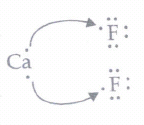 \(\longrightarrow\)\(\left[ \underset { 2,8,8 }{ Ca } \right] ^{ 2+ }\quad \left[ \overset { .. }{ :\underset { .. }{ F } : } \right] ^{ \\ - }\\ \quad \quad \quad \quad \quad \quad \left[ \overset { .. }{ :\underset { \quad ..\\ (2,8) }{ F } : } \right] ^{ - }\) or CaF2
(b) Conditions favourable for the formation of ionic bond:
(i) Lesser the ionization enthalpy, easier will be the removal of an electron i.e., formation of a positive ion and hence greater the chances of formation of ionic bond.
(ii) Higher is the electron affinity, more is the energy released and stabler will be the negative ion produced. Consequently, the probability of formation of ionic bond will be enhanced

11th Standard CBSE Syllabus & Materials
11th Standard CBSE
CBSE 11th Business Studies Forms of Business Organisation Sample Question Papers Study Material - QB365 Set A
NEW11th Standard CBSE
CBSE 11th Business Studies Business, Trade and Commerce Sample Question Papers Study Material - QB365 Set A
NEW11th Standard CBSE
CBSE 11th Physics Waves Sample Question Papers Study Material - QB365 Set A
NEW11th Standard CBSE
CBSE 11th Physics Kinetic Theory Sample Question Papers Study Material - QB365 Set A



CBSE 11th Standard CBSE Subjects
CBSE Standards









