
 100% FREE ACCESS
11th Standard CBSE Syllabus & Materials
11th Standard CBSE
CBSE 11th Economics PART-A - Presentation of Data - New Sample Question Papers Study Material - QB365 Set A
NEW11th Standard CBSE
CBSE 11th Economics PART-A - Organisation of Data - New Sample Question Papers Study Material - QB365 Set A
NEW11th Standard CBSE
CBSE 11th Economics PART-A - Collection of Data - New Sample Question Papers Study Material - QB365 Set A
NEW11th Standard CBSE
CBSE 11th Economics PART-A - Introduction to Economics and Statistics - New Sample Question Papers Study Material - QB365 Set A
NEW11th Standard CBSE
CBSE 11th Business Studies International Trade Sample Question Papers Study Material - QB365 Set A
NEW11th Standard CBSE
CBSE 11th Business Studies Evolution and Fundamentals of Business Sample Question Papers Study Material - QB365 Set A

Published on: 05/10/2019
Chemical Bonding and Molecular Structure
Download CBSE Class 11th Standard CBSE Chemistry question papers, sample papers, important questions, and previous year solved papers in PDF format. Get free study materials, NCERT solutions, and exam preparation resources for Class 11th Standard CBSE Chemistry
Questions + Answers key
Take MCQ Chemistry Test
1.
Describe the hybridisation in case of PCl5, Why are the axial bonds longer as compared to equatorial bonds?
2.
Discuss the orbital structures of the following molecules on the basis of hybridization
(i) BH3
(ii) C2H2
3.
Explain with the help of suitable example polar covalent bond.
4.
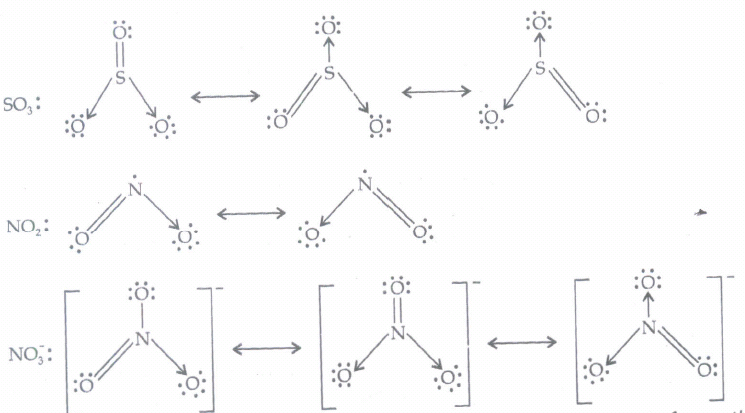
Write the resonance structures for SO3, NO2 and NO-3
5.
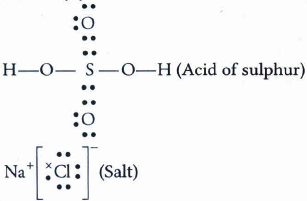
Rahul, a brilliant science student, was very keen to do experiments and get knowledge from them. One day he took some sugar and salt separately and added some acid of sulfur (which is generally used for toilet cleaning) and notice the changes. He got confused as he expected that the reaction of salt should be faster. Next day he asked about his experiment to his science teacher, who clarity the reason for the result he got. He got satisfied.
Draw the electron dot structure of acid of sulphur and salt.
6.
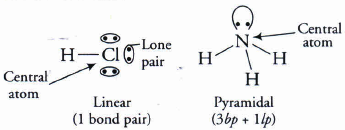
One day when Ravi was passing by his laboratory and felt some suffocating odour. He saw his laboratory attendant was preparing some chemical, named as ammonia. Suddenly, he saw that some chemical had fallen at the hand of the attendant. He run at once and take some highly diluted HCl and apply at the burned place.By this the attendent got relief.
Can you predict and draw the structures of these compound.Also mark the central atom and find out the bond pairs and lone pairs.
7.
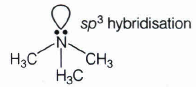
Give the geometry of (CH3)3N and [(CH3)3Si]3N state if they are isostructural?
1.
The ground state and excited state outer electronic configurations of phosphorus (Z = 15) are
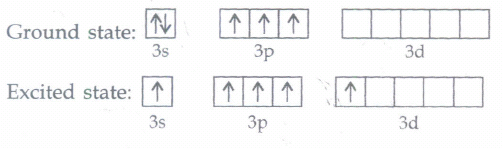
Phosphorus atom is sp3 d hybridized in the excited state. These orbitals are filled by the electron pairs donated by five Cl atoms as:
PCI5
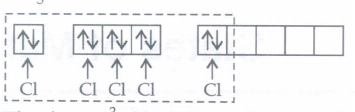
The five Sp3 d hybrid orbitals are directed towards the five corners of the trigonal bipyramidal. Hence, the geometry of PCI5 can be represented as:
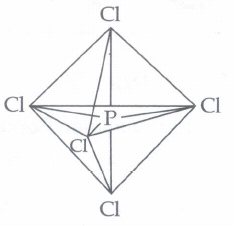
There are five P-Cl sigma bonds in PCl5 Three P-Cl bonds lie in one plane and make an angle of 120° with each other. These bonds are called equatorial bonds. The remaining two P-CI bonds lie above and below the equatorial plane and make an angle of 90° with the plane. These bonds are called axial bonds. As the axial bond pairs suffer more repulsion from the equatorial bond pairs, axial bonds are slightly longer than equatorial bonds.
2.
(i) Formation of BH3 (atomic No. of B is 5.)Both the carbon atoms are sp hybridised. Both the carbon atoms have also
two unhybridised orbitals which overlap sidewise with the similar o.tbitals of
the other carbon atom to form two 1t bonds
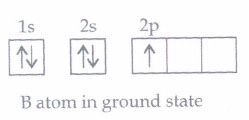
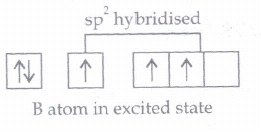
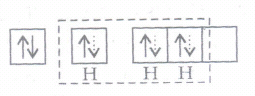
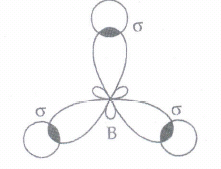
Orbital picture of BH3 molecule
B atom gets hybridised to form three equivalent hybrid orbitals directed towards three comers of equilateral triangle with B atoms in the centre. Bond angle = 1200
(ii) C2H2
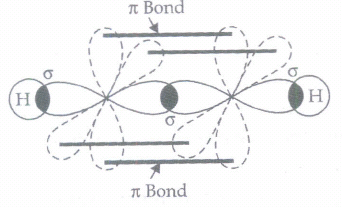
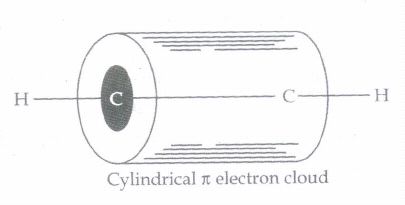
Both the carbon atoms are sp hybridised. Both the carbon atoms have also two unhybridised orbitals which overlap sidewise with the similar orbitals of the other carbon atom to form two \(\pi\) bonds
3.
When two atoms with different electronegativity are linked to each other by covalent bond, the shared electron pair will not in the centre because of the difference in electronegativity. For example, in hydrogen flouride molecule, flouride haspeater electronegativity than hydrogen. Thus, the shared electron pair is displaced more towards flourine atom, the later will acquire a partial negative charge (\(\delta ^{ - }\)).At the same time hydrogen atom will have a partial positive charge (\(\delta ^{ + }\)). Such a covalent bond is known as polar covalent bond or simply polar bond. It is represented as
\(\overset { { \delta }^{ + } }{ \underset { 2.1 }{ H } - } \overset { { \delta }^{ - } }{ \underset { 4.0 }{ F } } \)
4.
5.
6.
7.
\({ (CH }_{ 3 }{ ) }_{ 3 }\ddot { N } \) is trimethyl amine.It has pyramidal geometry as shown below
[(CH3)3Si]3 N has triangular planar geometry as shown in diagram below.
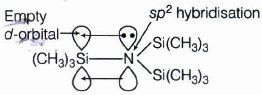
Due to the presence of empty d-orbital on Si, there is an effective back bonding.
Thus, the two species are not isostructural.In (CH3)3N, the N-atom assumes sp3 hybrid state where as in [(CH3)3Si]3N, the N-atom assumes sp2 hybridtate.

11th Standard CBSE Syllabus & Materials
11th Standard CBSE
CBSE 11th Business Studies Forms of Business Organisation Sample Question Papers Study Material - QB365 Set A
NEW11th Standard CBSE
CBSE 11th Business Studies Business, Trade and Commerce Sample Question Papers Study Material - QB365 Set A
NEW11th Standard CBSE
CBSE 11th Physics Waves Sample Question Papers Study Material - QB365 Set A
NEW11th Standard CBSE
CBSE 11th Physics Kinetic Theory Sample Question Papers Study Material - QB365 Set A



CBSE 11th Standard CBSE Subjects
CBSE Standards









