
 100% FREE ACCESS
11th Standard CBSE Syllabus & Materials
11th Standard CBSE
CBSE 11th Economics PART-A - Presentation of Data - New Sample Question Papers Study Material - QB365 Set A
NEW11th Standard CBSE
CBSE 11th Economics PART-A - Organisation of Data - New Sample Question Papers Study Material - QB365 Set A
NEW11th Standard CBSE
CBSE 11th Economics PART-A - Collection of Data - New Sample Question Papers Study Material - QB365 Set A
NEW11th Standard CBSE
CBSE 11th Economics PART-A - Introduction to Economics and Statistics - New Sample Question Papers Study Material - QB365 Set A
NEW11th Standard CBSE
CBSE 11th Business Studies International Trade Sample Question Papers Study Material - QB365 Set A
NEW11th Standard CBSE
CBSE 11th Business Studies Evolution and Fundamentals of Business Sample Question Papers Study Material - QB365 Set A

Published on: 27/09/2019
Environmental Chemistry
Download CBSE Class 11th Standard CBSE Chemistry question papers, sample papers, important questions, and previous year solved papers in PDF format. Get free study materials, NCERT solutions, and exam preparation resources for Class 11th Standard CBSE Chemistry
Questions + Answers key
Take MCQ Chemistry Test
1.
(a) Define eutrophication and pneumoconiosis.
(b) Write difference between photochemical and classical smog.
2.
What do you mean by greenhouse effect? What is the role of CO2 in the greenhouse effect?
3.
What is photochemical smog? What are its effects? How can it be controlled?
4.
How carbon monoxide acts as a poison for human beings?
5.
What do you mean by green chemistry? How will it help in decreasing environmental pollution?
6.
What are the major causes of water pollution? Explain.
7.
What are the reactions involved for ozone layer depletion in the stratosphere?
8.
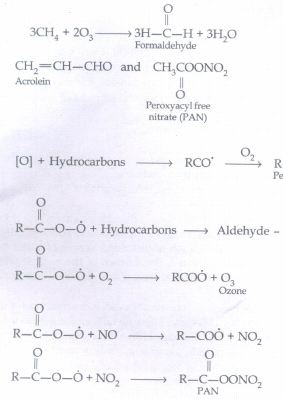
Write down the reactions involved during the formation of photochemical smog.
9.
What is smog? How is classical smog different from photochemical smog?
10.
Carbon monoxide gas is more dangerous than carbon dioxide gas. why?
11.
Explain the tropospheric pollution in 100 words?
12.
Sonu and Nilesh were friends. In winters, one day when they were going to school at 10:00 am Sonu felt irritation in his eyes and throat. He was also unable to breath.
Nilesh immediately took him to a doctor. Doctor gave him the proper remdy. When he became well, Nilesh asked reason for this Doctor answered him satisfactorily.
(i) Can you guess what reason was given by the doctor for the illness of Sonu.
(ii) Why such kind of polluting atmospheric change occurs?
(iii) What should be done to prevent the formation of smog?
(iv) What values are possessed by Nilesh?
13.
What do you mean by ozone hole? What are its consequences?
14.
How is the temperature effected as we go up the earth's surface? Explain
15.
What are pesticides and herbicides? Explain giving examples.
1.
(a) Eutrophication: When the growth of algaes increases in the surface of water, dissolved oxygen in water is reduced. This phenomenon is known as eutrophication. (Due to this growth of fish gets inhibited).
(b) Pneumoconiosis: It is a disease which irritates lungs. It causes scarring or fibrosis
of the lung.
| Photochemical smog | Classical smog |
| (i) It is formed as a result of photochemical decomposition of nitrogen dioxide and chemical carbon in cold climate. (ii) It takes place during .dry warm season in presence of sunlight (iii) It is oxidising in nature. |
(i) It is formed due to condensation of SO2 vapours on particles of carbon in cold climate. (ii) It is generally formed during winter when there is severe cold. (iii) It is reducing in nature |
2.
It is the phenomenon in which earth's atmosphere traps the heat from the sun and prevents it from escaping in outer space. Gases such as CO2, methane, ozone, CFCs are believed to be responsible for this effect.
Heat from the sun after being absorbed by the earth is absorbed by CO2 and then radiated back to the earth. Thus making the environment of the earth warm.
3.
This is a type of smog formed in warm, dry and sunny climate. They are formed when sunlight is absorbed by SO2, oxides of nitrogen and hydrocarbons. They act as oxidising agents.
Effects of photochemical smog.
(i) They produce irritation in the eyes and also in respiratory system.
(ii) They can damage many materials such as metals, stones, building materials etc.
(iii) NO2 present gives a brown colour to the photochemical smog which reduces visibility.
(iv) It is harmful to fabrics, crops and ornamental plants.
Control of photochemical smog
(i) By using catalytic converters in automobiles.
(ii) By spraying certain compounds into atmosphere which generate free radicals that can easily combine with the free radicals that initiate the reaction forming toxic compounds of photochemical smog.
(iii) Certain plants such as pinus, juniparus, Pyrus could be helpful in this matter.
4.
Carbon monoxide is poisonous because it combines with haemoglobin of R.B.C. to form carboxyhaemoglobin as.
CO + Haemoglobin ⇌ Carboxyhaemoglobin
It inhibits the transport of oxygen to different parts of the body. Thus the body becomes oxygen-starved.
5.
Green chemistry is a way of thinking and is about utilising the existing knowledge and principles of chemistry and other sciences to reduce the adverse effect of pollution.
For example:
(i) Automobile engines have been fitted with catalytic converters which prevent the release of the vapours of hydrocarbons and oxides of nitrogen into acrolein and peroxyacetyl nitrate.
(ii) CO2 has replaced CFCs as blowing agents in the manufacture of polystyrene foam sheets.
6.
Causes of water pollution:
(i) Pathogens: Pathogens include bacteria and other microorganisms that enter water from domestic sewage and animal excreta. Human excreta contain bacteria such as Escherichia coli and Streptococcus [,a.ecalis which cause gastrointestinal diseases.
(ii) Organic wastes: Organic wastes when added to water, as these are biodegradable, bacteria decomposes organic matter and consume dissolved oxygen in water. When the concentration of dissolved oxygen of water is below 6 ppm, the growth of fish gets inhibited. Breakdown of the organic wastes by anaerobic bacteria produces chemicals that have a foul smell and are harmful to human health.
(iii) Chemical pollutants: Some inorganic chemicals as an industrial wastes dissolve . in water like cadmium, mercury nickel etc. These metals are dangerous to humans and other animals. These metals can damage kidneys and central nervous system, lever etc. Petroleum products pollute many sources of water.
7.
The reaction can be shown as follows:
CF2CI2(g) + UV⟶ CI(g) + CF2Cl(g)
O(g) + O3(g) ⟶ CIO (g) + 02(g)
aO(g) + O(g) ⟶ CI + O2(g)
8.
Mechanism of formation of photochemical smog:
NO2(g) ⟶ NO(g) + O(g)
O(g) + O2(g) ⟶ O3(g)
NO(g) + O3(g) ) ⟶ NO2(g) + O2(g)
9.
The word smog is a combination of smoke and fog. It is a type of air pollution that occurs in many cities throughout the world. Classical smog occurs in cool humid climate. It is also called as reducing smog.
Whereas photochemical smog occurs in warm and dry sunny climate. It has high concentration of oxidising agents and therefore, it is also called as oxidising smog.
10.
Carbon monoxide combines with haemoglobin to form a very stable compound known as carboxyhaemoglobin when its concentration in blood reaches 3-4%, the oxygen-carrying capacity of the blood is greatly reduced. This results into headache, nervousness and sometimes death of the person. On the other hand CO2 does not combine with haemoglobin and hence is less harmful than CO.
11.
Tropospheric pollution occurs due to the presence of undesirable solid or gaseous particles in the air. The major gaseous and particulate pollutants present in the troposphere are
(i) Gaseous air pollutants These are oxides of sulphur, nitrogen, carbon, hydrogen sulphide, hydrocarbons, ozone and other oxidants.
(ii) Particulate pollutants These are dust, mist, fumes, smoke, smog, etc.
Gaseous air pollutants
(a) Oxides of sulphur These are produced when sulphur containing fossil fuel is burnt. SO2 gas is poisonous to both animals and plants.
(b) Oxides of nitrogen These are produced by the reaction of nitrogen and oxygen at high altitudes when lightning strikes.
\(
\mathrm{N}_{2}(\mathrm{~g})+\mathrm{O}_{2}(\mathrm{~g}) \stackrel{1483 \mathrm{~K}}{\longrightarrow} 2 \mathrm{NO}(\mathrm{g})\)
\(2 \mathrm{NO}(\mathrm{g})+\mathrm{O}_{2}(\mathrm{~g}) \longrightarrow 2 \mathrm{NO}_{2}(g) \)
\(\mathrm{NO}(g)+\mathrm{O}_{3}(g) \longrightarrow \mathrm{NO}_{2}(g)+\mathrm{O}_{2}(g)
\)
(c) Hydrocarbons Incomplete combustion of fuel used in automobiles is the major source for the release of hydrocarbons. These are carcinogenic and cause cancer. They also harm plants.
(d) Oxides of carbon Carbon monoxide is one of the most serious air pollutants. It is highly poisonous to living beings because it blocks the supply of oxygen to the organs and tissues. It is produced due to the incomplete combustion of carbon. Carbon dioxide is the main contributor for global warming. It is released in"l:o the atmosphere by respiration, burning of fossil fuels and by decomposition of limestone during cement manufacturing.
12.
(i) Sonu became ill because of photochemical smog which caused iritation in his eyes and throat
(ii) Smog is formed when sunlight is absorbed by O3, oxides of nitrogen and hydrocarbons.
(iii) Formation of smog can be prevented by controlling the emission of oxides of nitrogen and sulphur.
(iv) Nilesh is helpful, intelligent and curious.
13.
In the stratosphere, ozone is continuously created and destroyed by the sun's radiations. This results in an equilibrium concentration of ozone. In 1980s atmospheric scientists working in Antartica reported about the depletion of ozone layer commonly known as ozone hole over the South Pole.
14.
As we go up the earth's surface, from 0-11 km (called troposphere), temperature decreases and from 11-50 km (called stratosphere). temperature increases. From 50-85 km (called mesosphere), temperature again decreases and family from 85-100 km (called thermosphere), temperature again increases.
15.
Pesticides These substance are used to kill or block the reproductive processes of pests. These are basically synthetic toxic chemicals with ecological repercussions. Their accumulation in higher animals causes serious metabolic and physiological disorders. DDt, aldrin, dieldrin, organophosphates and carbonates are some examples of pesticides.
Herbicides These are weed killers i.e. they kill unwanted herbs growing along with crops e.g. sodium chlorate (NaCIO3) and sodium arsenite (Na3AsO3). These are toxic to mammals. Some herbicides cause birth defects. Now a days triazines, better herbicides are used for the corn fields.

11th Standard CBSE Syllabus & Materials
11th Standard CBSE
CBSE 11th Business Studies Forms of Business Organisation Sample Question Papers Study Material - QB365 Set A
NEW11th Standard CBSE
CBSE 11th Business Studies Business, Trade and Commerce Sample Question Papers Study Material - QB365 Set A
NEW11th Standard CBSE
CBSE 11th Physics Waves Sample Question Papers Study Material - QB365 Set A
NEW11th Standard CBSE
CBSE 11th Physics Kinetic Theory Sample Question Papers Study Material - QB365 Set A



CBSE 11th Standard CBSE Subjects
CBSE Standards









