
 100% FREE ACCESS
11th Standard CBSE Syllabus & Materials
11th Standard CBSE
CBSE 11th Economics PART-A - Presentation of Data - New Sample Question Papers Study Material - QB365 Set A
NEW11th Standard CBSE
CBSE 11th Economics PART-A - Organisation of Data - New Sample Question Papers Study Material - QB365 Set A
NEW11th Standard CBSE
CBSE 11th Economics PART-A - Collection of Data - New Sample Question Papers Study Material - QB365 Set A
NEW11th Standard CBSE
CBSE 11th Economics PART-A - Introduction to Economics and Statistics - New Sample Question Papers Study Material - QB365 Set A
NEW11th Standard CBSE
CBSE 11th Business Studies International Trade Sample Question Papers Study Material - QB365 Set A
NEW11th Standard CBSE
CBSE 11th Business Studies Evolution and Fundamentals of Business Sample Question Papers Study Material - QB365 Set A

Published on: 11/10/2019
Hydrocarbons
Download CBSE Class 11th Standard CBSE Chemistry question papers, sample papers, important questions, and previous year solved papers in PDF format. Get free study materials, NCERT solutions, and exam preparation resources for Class 11th Standard CBSE Chemistry
Questions + Answers key
Take MCQ Chemistry Test
1.
(a) Why are alkenes called unsaturated hydrocarbons?
(b) How will you test the presence of double bond in an alkene?
(c) Name the products formed when propene is subjected to ozonolysis.
2.
Discuss the preparation of alkanes by Wurtz reaction. What is the limitation of the reaction?
3.
(a) What type of isomerism is shown by methoxymethane and ethanol?
(b) How will you bring out the following conversions.
(i) Acetylene to ethane
(ii) Benzene to Toluene
(iii) Ethanol to ethene?
4.
(a) Define substitution reactions. Why do benzene undergo substitution reactions even though they contain double bonds?
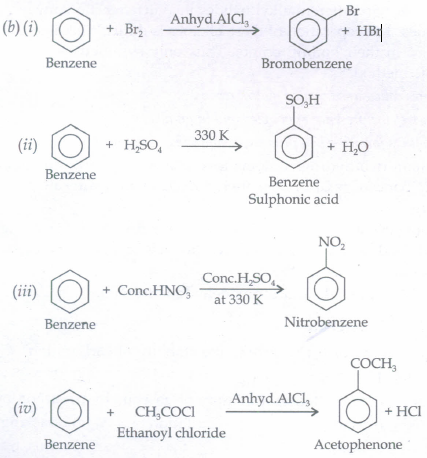
(b) What happens when benzene is treated with
(i) Br2 in presence of anhydrous AICl3
(ii) Conc. H2SO4 at 330K
(iii) Mixture of conc. H2SO4 and cone. HNO3 at 330 K
(iv) Ethanoyl Chloride in presence of anhydrous AICI3.
5.
Explain the term aromaticity. What are the necessary conditions for any compound to show aromaticity?
6.
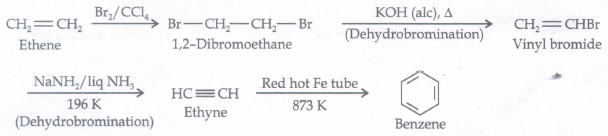
How would you convert the following compounds into benzene?
(i) Ethyne
(ii) Ethene
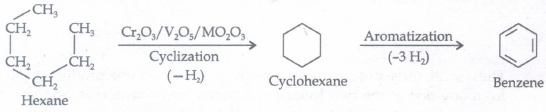
(iii) Hexane
7.
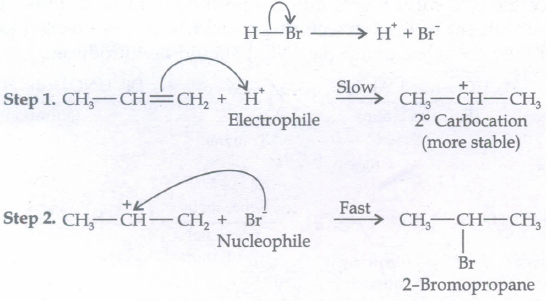
Addition of HBr to propene yields 2-bromopropane, while in the presence of benzoyl peroxide, the same reaction yields 1-bromopropane. Explain and give mechanism.
8.
How will you convert benzene into
(i) p-nitrobromobenzene
(ii) m- nitrochlorobenzene
(iii) p - nitrotoluene
(iv) acetophenone?
9.
Write IUPAC names of the products obtained by the ozonolysis of the following compounds :
(i) Pent-2-ene
(ii) 3,4-Dimethylhept-3-ene
(iii) 2-Ethylbut-1-ene
(iv) 1-Phenylbut-1-ene
10.
Arrange the following set of compounds in order of their decreasing relative reactivity with an electrophile, E+.
(i) Chlorobenzene, 2, 4-dinitrochlorobenzene, p-nitrochlorobenzene
(ii) Toluene, \(p-{ H }_{ 3 }C-{ C }_{ 6 }{ H }_{ 4 }-{ NO }_{ 2 },\)
\(p-{ O }_{ 2 }N-{ C }_{ 6 }{ H }_{ 4 }-{ NO }_{ 2 }\)
Also explain ur answer.
1.
a) Alkenes contain two hydrogen atoms less than alkanes and thus they contain C - C double bond (C = C) in their molecule. Thus they are called unsatujated hydrocarbons.
(b) Alkenes react with cold dilute KMnO4 solution to form gycols. Since bright purple colour of KMnO4 disappears during the reaction it is used as a test for the presence of double bond.
(c) A mixture of acetaldehyde and formaldehyde is formed.
2.
Wurtz synthesis: Higher alkanes are prepared by heating an alkyl halide (RX) with sodium metal in dry ether solution.
R - X + 2Na + XR \(\overset { ether }{ \longrightarrow } \) R - R + 2NaX
CH3Br + 2Na + BrCH3\(\longrightarrow \) CH3-CH3 + 2NaBr
Limitations: Use of two different alkyl halides in Wurtz reaction always leads to a mixture of alkanes. The separation of these alkanes is difficult because there is only a little difference in their boiling points. Thus only symmetrical alkanes can be prepared by this method.
3.
(a) Functional isomerism.
(b) (i) \(CH\equiv CH+{ 2H }_{ 2 }\overset { Ni }{ \underset { 573\ K }{ \longrightarrow } } \ { CH }_{ 3 }-{ CH }_{ 3 }\)
Acetylene Ethane
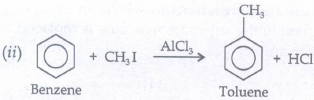
(iii) CH3CH2OH \(\overset { Conc.{ H }_{ 2 }{ SO }_{ 4 } }{ \underset { heat }{ \longrightarrow } } \) CH2 = CH2 + H2O
4.
(a) Substitution reactions are those reactions in which an atom or group of atoms directly attached to carbon in the substrate molecule is replaced by another atom or group of atoms, for example,
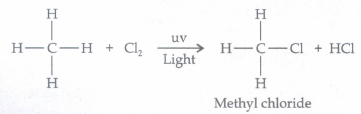
A hydrogen atom of the methane molecule is replaced by chlorine atom. Benzene undergoes electrophilic substitution reactions because benzene ring has delocalized electrons is an electron-rich system. It is attacked by electrophiles giving substitution products.
5.
The aromatic compounds apparently contain alternate double and single bonds in a cyclic structure, and resemble benzene in chemical behaviour. They undergo substitution reactions rather addition reactions. This characteristic behaviour is called Aromatic character or Aromaticity.
Conditions for Aromaticity:
(i) An aromatic compound is cyclic and planar.
(ii) Each atom in an aromatic ring has a p-orbital. These p-orbitals must be parallel so that a continuous overlap is possible around a ring.
(iii) The cyclic \(\pi\)-molecular orbital formed by the overlap of p-orbitals must contain (4n + 2) \(\pi\) electrons, where (n = 0, 1, 2, 3, 4 etc.)
6.
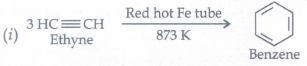
(ii) Ethene is first converted into ethyne and then to benzene as shown above.
(iii) When vapours of hexane are passed over heated catalyst consisting of Cr2 O3, MO2O3 and V2O5 at 773 K under 10-20 atm pressure, cyclization and aromatization occurs simultaneously to afford benzene
7.
Addition of HBr to propene is an ionic electrophilic addition reaction in which the electrophile, i.e., H+ first adds to give a more stable 2° carbocation. In the 2nd step, the carbocation is rapidly attacked by the nucleophile Br- ion to give 2-bromopropane.
In presence of benzoyl peroxide, the reaction is still electrophilic but the electrophile here is a Br free radical which is obtained by the action of benzoyl peroxide on HBr
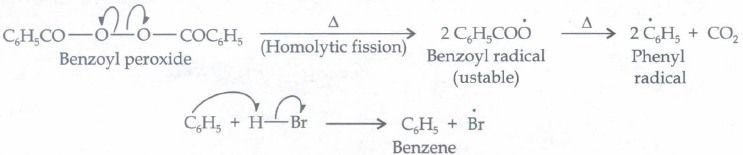
In the first step, Br radical adds to propene in such a way so as to generate the more stable 2° free radical. In the second step, the free radical thus obtained rapidly abstracts a hydrogen atom from HBr to give 1-bromopropane.
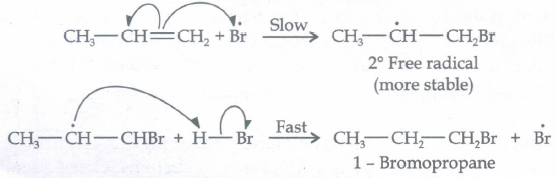
From the above discussion, it is evident that although both reactions are electrophilic addition reactions but it is due to different order of addition of H and Br atoms which gives different products.
8.
(i) The two substituents in the benzene ring are present at p-positions. Therefore, the sequence of reactions should be such that first an o, p-directing group, i.e., Br atom should be introduced in the benzene ring and this should be followed by nitration. Thus,
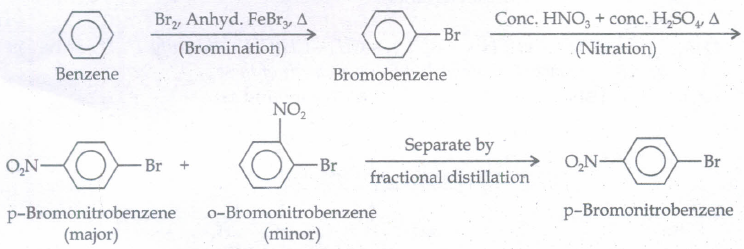
(ii) Here since the two substituents are at m-position w.r.t. each other, therefore, the first substituent in the benzene ring should be a m-directing group (i.e., NO2) and then other group (i.e., CI) should be introduced. Therefore, the sequence of reactions is:

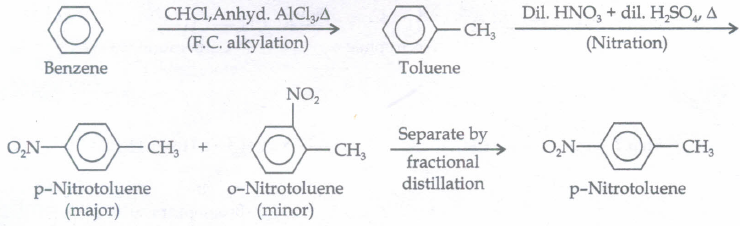
(iii) Here since the two substituents are at p-position w.r.t. each other, therefore, the first substituent in the benzene ring should be a o, p-directing group (i.e., CH3) and then the other group (i.e., NO2) should be introduced.
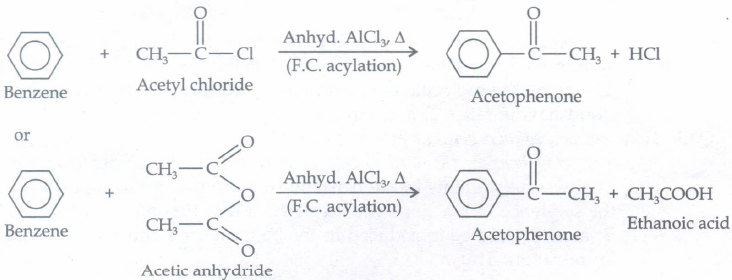
(iv) Acetophenone can be prepared by F.C. acylation using either acetyl chloride or acetic anhydride.
9.
(i) \(\overset { 5 }{ C } { H }_{ 3 }-\overset { 4 }{ C } H_{ 2 }-\overset { 3 }{ C } H=\overset { 2 }{ C } H\overset { 1 }{ C } { H }_{ 3 }\overset { (i){ O }_{ 3 }/{ CH }_{ 2 }{ CI }_{ 2 },196\quad K }{ \underset { (ii)\quad Zn/{ H }_{ 2 }O }{ \longrightarrow } } { CH }_{ 3 }-{ CH }_{ 2 }-CH=O+O=CH-{ CH }_{ 3 }\)
Pent-2-ene Propanal Ethanal
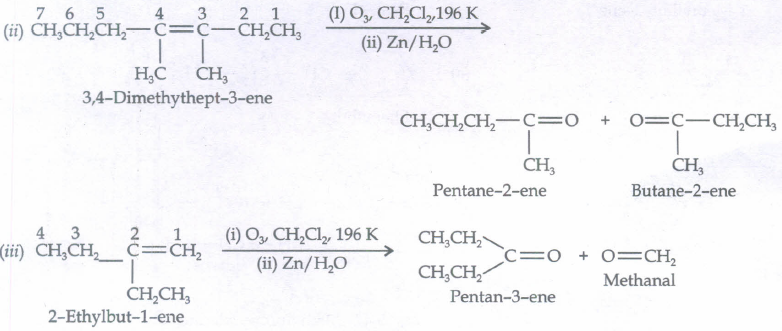
(iv) \({ \overset { 4 }{ C } }H_{ 3 }\overset { 3 }{ C } { H }_{ 2 }-\overset { 2 }{ C } H=\overset { 1 }{ C } { H }_{ 2 }-{ C }_{ 6 }{ CH }_{ 5 }\overset { (i){ O }_{ 3 },{ CH }_{ 2 }{ C1 }_{ 2 },196\quad K }{ \underset { (ii)Zn/{ H }_{ 2 }O }{ \longrightarrow } } { CH }_{ 3 }{ CH }_{ 2 }CH=0+0=CH-{ C }_{ 6 }{ H }_{ 5 }\)
1-Phenylbut-1-ene Propanal Benzaldehyde
10.
Presence of electron releasing group(or activating group) increases the electron density in benzene nucleus. Therefore, electrophile will attack
benzene nucleus easily. But, the presence of electron withdrawing group like -NO2 decrease the electron density in benzene ring. Therefore, electrophile will attack
benzene nucleus with difficulty. The order of reactivity towards electrophile, E+ in order of their decreasing relative reactivity is
(i) Chlorobenzene > p-nitrochlorobenzene > 2, 4- dinitrochlorobenzene
(ii) Toluene > \(p-{ CH }_{ 3 }-{ C }_{ 6 }{ H }_{ 4 }-{ NO }_{ 2 }>p-{ O }_{ 2 }N-{ C }_{ 6 }{ H }_{ 4 }-{ NO }_{ 2 }\)

11th Standard CBSE Syllabus & Materials
11th Standard CBSE
CBSE 11th Business Studies Forms of Business Organisation Sample Question Papers Study Material - QB365 Set A
NEW11th Standard CBSE
CBSE 11th Business Studies Business, Trade and Commerce Sample Question Papers Study Material - QB365 Set A
NEW11th Standard CBSE
CBSE 11th Physics Waves Sample Question Papers Study Material - QB365 Set A
NEW11th Standard CBSE
CBSE 11th Physics Kinetic Theory Sample Question Papers Study Material - QB365 Set A



CBSE 11th Standard CBSE Subjects
CBSE Standards









