
 100% FREE ACCESS
11th Standard CBSE Syllabus & Materials
11th Standard CBSE
CBSE 11th Economics PART-A - Presentation of Data - New Sample Question Papers Study Material - QB365 Set A
NEW11th Standard CBSE
CBSE 11th Economics PART-A - Organisation of Data - New Sample Question Papers Study Material - QB365 Set A
NEW11th Standard CBSE
CBSE 11th Economics PART-A - Collection of Data - New Sample Question Papers Study Material - QB365 Set A
NEW11th Standard CBSE
CBSE 11th Economics PART-A - Introduction to Economics and Statistics - New Sample Question Papers Study Material - QB365 Set A
NEW11th Standard CBSE
CBSE 11th Business Studies International Trade Sample Question Papers Study Material - QB365 Set A
NEW11th Standard CBSE
CBSE 11th Business Studies Evolution and Fundamentals of Business Sample Question Papers Study Material - QB365 Set A

Published on: 04/03/2020
11th Standard CBSE Chemistry Public Exam Important Question 2019-2020
Download CBSE Class 11th Standard CBSE Chemistry question papers, sample papers, important questions, and previous year solved papers in PDF format. Get free study materials, NCERT solutions, and exam preparation resources for Class 11th Standard CBSE Chemistry
Questions + Answers key
Take MCQ Chemistry Test
1.
The enthalpy of formation of methane at constant pressure and 300 K is - 78.84 kJ. What will be the enthalpy of formation at constant volume?
2.
Give a brief description of the principles of the following techniques taking an example in each case: Chromatography.
3.
The uncertainty in the position and velocity of a particle are 10-10 m and 5.27 x 10⁻²⁴ ms-1respectively. Calculate the mass of the particle.
4.
Give condensed and bond line structural formulas and identify the functional group(s) present, if any, for :
(a) 2,2,4-Trimethylpentane
(b) 2-Hydroxy-1,2,3-propanetricarboxylic acid
(c) Hexanedial
5.
The quantum numbers of six electrons are given below. Arrange them in order of increasing energies. If any of these combination(s) has/have the same energy lists:
1. n = 4, l = 2, ml = –2 , ms = –1/2
2. n = 3, l = 2, ml = 1 , ms = +1/2
3. n = 4, l = 1, ml = 0 , ms = +1/2
4. n = 3, l = 2, ml = –2 , ms = –1/2
5. n = 3, l = 1, ml = –1 , ms = +1/2
6. n = 4, l = 1, ml = 0 , ms = +1/2
6.
It is advised not to sleep in a closed room with burning coke angithi to warm up. Explain.
7.
Explain Silicon dioxide is treated with hydrogen fluoride.
8.
What happens when sodium hydrogen carbonate is heated
9.
Find out the value of Kc for each of the following equilibria from the value of Kp:
(a) \(2 \mathrm{NOCl}(\mathrm{g}) \rightleftharpoons 2 \mathrm{NO}(\mathrm{g})+\mathrm{Cl}_{2}(\mathrm{~g}) ; K_{p}=1.8 \times 10^{-2} \text { at } 500 \mathrm{~K}\)
(b) \(CaCO_{ 3 }(s)\leftrightharpoons CaO(s)+CO_{ 2 }(g); { K }_{ p }=167at1073 \ K\)
10.
A large flask fitted with a stop-cock is evacuated and weighted; it mass is found to be 134.567g. It is then filled to a pressure of 735 mm at 31oC with a gas of unknown molecular mass and then reweighted; it mass is 137.456 g. The flask is then filled with water and weighed again; its mass is now 1067.9 g. Assuming that the gas is ideal, calculate the molar mass of the gas.
11.
Calculate the critical constants of a gas whose van der Waals' constants are \(a=0.751L^{ 2 }\ atm\ mol^{ -2 }\ and\ b=0.0226\ L\ mol^{ -1 }\)
12.
Calculate
(5.7 x 10⁻⁵) \(\div \) (4.2 x 10⁻³)
13.
What are pesticides?
14.
Name the compounds used for the manufacture of washing soda by Solvay process
15.
If B-CI bond has a dipole moment, explain why BCl3 molecule has zero dipole moment.
16.
For the following bond cleavages, use curved-arrows to show the electron flow and classify each as homolysis or heterolysis. Identify reactive intermediate produced as free radical, carbocation and carbanion.
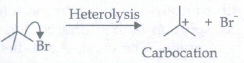
17.
What type of metals are used in photoelectric cells? Give one example.
18.
Assign oxidation number to the underlined elements in each of the following species - CaO2
19.
Express the following in the scientific notation:
(i) 0.0048
(ii) 234,000
(iii) 8008
(iv) 500.0
(v) 6.0012
20.
Which of the following compounds will show cis-trans isomerism?
CH2= CBr2
21.
On complete combustion, 0.246 g of an organic compound gave 0.198g of carbon dioxide and 0.1014g of water. Determine the percentage composition of carbon and hydrogen in the compound.
22.
What is the difference between the terms 'hydrolysis' and 'hydration'?
23.
One millilitre solution of 0.01M HCl is added to 1L of sodium chloride solution.What will be the pH of the resulting solution?
24.
Find out the value of equilibrium constant for the following reaction at 298 K.
\(2 \ NH_{ 3 }(g)+CO_{ 2 }(g)\leftrightharpoons NH_{ 2 }CONH_{ 2 }(aq)+H_{ 2 }O(l)\)
Standard Gibbs energy change, \(\Delta G^{ \circ }\) at the given temperature is -13.6 kJ mol-1.
25.
Which of the following pairs of elements would have a more negative electron gain enthalpy? F or Cl
26.
Wilhelm Rontgen showed that when electrons strike a material in the cathode ray tube, some rays are originated that can cause fluorescence in the fluorescent material placed outside the cathode ray tubes. He named these rays as X-rays as these were not deflected by electric and magnetic field. X-rays are used as a diagnostic tool in the treatment of disease and bone fracture. An intelligence officer, John catched a smuggler by using this X-ray machine. He was trying to smuggle the drugs while travelling abroad.
The approximate wavelength of X-rays is ............
27.
250 mL of 0.5 M sodium sulphate (Na2SO4) solution are added to an aqueous solution containing 10.0 g of BaCl2 resulting in the formation of white precipitate of BaSO4. How many moles and how many gram of barium sulphate will be obtained?
28.
Justify giving reactions that among halogens, fluorine is the best oxidant and among hydrohalic compounds, hydroiodic acid is the best reductant.
29.
Diamond is covalent, yet it has high melting point, why?
30.
Explain why ?
Mg3N2 when reached with water gives off NH3 but HCl is not obtained from msCl On reaction with water at room temperature
31.
Scientist of UK has designed the cars, working on hydrogen fuel cells instead of petrol engines. Here hydrogen is used as sources of electrical energy i.e. a reaction of hydrogen and oxygen is used to generate electrical energy. It has many advantages over the conventional fossil fuels and electric power generation.
Give two advantages of hydrogen over fossil fuels?
32.
Give ion electron equations for the reactions.
Oxidation of ferrocyanide ions to ferricyanide ions in acidic medium.
33.
What is the pH of 0.001M aniline solution? The ionization constant of aniline can be taken from Table . Calculate the degree of ionization of aniline in the solution. Also calculate the ionization constant of the conjugate acid of aniline.
34.
Two moles of a perfect gap undergo the following processes.
(i) a reversible isobaric expansion from (1.0 atm, 20.0 L) to (1.0 atm, 40.0 L)
(ii) a reversible isochoric change of state from (1.0 atm, 40.0 L) to (0.5 atm, 40.0 L)
(iii) a reversible isothermal compression from (0.5 atm, 40.0 L) to (1.0 atm, 20.0 L)
Answer the question related to the above processes.
Calculate the total work (W) and the total heat change (q) involved in the above processes.
35.
Mr.sharma, who was a teacher,explained the second law of thermodynamics by giving example of car in which heat energy produced by the combusion of a fuel is not completely converted into mechanical work.He also explained the working of refrigerator on the basis of this law.
(i) State the second law of thermodynamics
(ii) why the energy produced by the combustion of a fuel in the car engine is not completely converted into mechanical work?
(iii) could you explain the working of refrigerator on the basis of second law of thermodynamics?
(iv) What values are associated with Mr.Sharma?
36.
An iron cylinder contains helium at a pressure of 250 KPa at 300 K. The cylinder can withstand a pressure of \(1\times { 10 }^{ 6 }Pa\) . The room in which cylinder is placed catches fire. Predict whether the cylinder will blow up before it melts or not (mp of the cylinder = 1800 K).
37.
One day when Ravi was passing by his laboratory and felt some suffocating odour. He saw his laboratory attendant was preparing some chemical, named as ammonia. Suddenly, he saw that some chemical had fallen at the hand of the attendant. He run at once and take some highly diluted HCl and apply at the burned place.By this the attendent got relief.
Can you predict and draw the structures of these compound.Also mark the central atom and find out the bond pairs and lone pairs.
38.
Justify the given statement with suitable examples "the properties of the elements are a periodic function of their atomic number".
39.
A catalyst will increase the rate of a chemical reaction by ______.
shifting the equilibrium to the right
shifting the equilibrium to the left
lowering the activation energy
increasing the activation energy
40.
An isochoric process takes place at constant ______.
temperature
pressure
volume
concentration
41.
Which conformation of ethane has the lowest potential energy?
Eclipsed
Skewed
Staggered
All will have equal PE
42.
In a sodium atom (atomic number = 11 and mass number = 23) and the number of neutrons is _______.
equal to the number of protons
less than the number of protons
greater than the number of protons
none of these
43.
Viscosity of a liquid is a measure of
repulsive forces between the liquid molecules
frictional resistance
intermolecular forces between the molecules
none of the above
44.
Boron has an extremely high melting point because of
its ionic crystal structure
the strong binding forces in the covalent polymer
atomic size
allotropy
45.
In the organic compound CH2=CH-CH2-CH2-C\(\equiv \)CH, the pair of hydridised orbitals involved in the formation of: C2 - C3 bond is _____.
sp - sp2
sp - sp3
Sp2 - Sp3
sp3 - sp3
46.
Which of the following halogens do not exhibit a positive oxidation number in their compounds?
F
Br
I
Cl
47.
The species CO, CN- and N2 are ______.
isoelectronic
having coordinated bond
having polar bond
having low bond energies
48.
Hydrogen peroxide is used as
an oxidizing agent
a reducing agent
a bleaching agent
all of the above
49.
Which one of the following alkaline earth metal carbonates is thermally most stable
MgCO3
CaCO3
SrCO3
BaCO3
50.
In halogens, which of the following, increases from iodine to fluorine?
Bond length
Electronegativity
The ionization energy of the element
Oxidizing power
51.
The mass of an atom of nitrogen is _______.
\(\frac { 14 }{ { { 6.023\times 10 }^{ 23 } } } \)
\(\frac { 28 }{ { { 6.023\times 10 }^{ 23 } } } \)g
\(\frac { 1 }{ { { 6.023\times 10 }^{ 23 } } } \)g
14 amu
1.
The equation representing the enthalpy of formation of methane is:
\(C(s)_{ 2 }(g)\longrightarrow CH_{ 4 }(g); \ \triangle HH=-78.84 \ KJ\)
\(\triangle H=78.84\quad KJ; \ \triangle ^{ ng }=1-2=-1 \ mol\)
\(R=8.314\times { 10 }^{ -3 }KJ \ { K }^{ -1 }mol^{ -1 },T=300K\)
According to the relation, \(\triangle H=\triangle U+\triangle ^{ ng }RT\)
\(\triangle U=\triangle H+\triangle ^{ ng }RT\)
= (-78.84 KJ) - (1 mol) x 8.314 x 10⁻³ kJ K-1 mol-1) x 300K
= - 78.84 - 2.49 = - 81.35 kJ
2.
Chromatography: Chromatography is based on the principle of selective distribution of the components of a mixture between two phases, a stationary phase and a moving phase. The stationary phase can be a solid or liquid, while the moving phase is a liquid or a gas. When the stationary phase is solid the basis is adsorption and when it is a liquid the basis is partition. Chromatography is generally used for the separation of coloured substances such as plant pigments or dyestuffs.
3.
According to uncertainty principle,
\(\Delta x.m\Delta v=\frac { h }{ 4\pi } \) or \(m=\frac { h }{ 4\pi \Delta x\Delta v } \);h = 6.626 x 10⁻³⁴ kg m2s-1
\(\Delta \)x = 10-10,m; \(\Delta \)v = 5.27 x 10⁻²⁴ ms-1
m = \(\frac { (6.626\times10^{ -34 }kgm^{ 2 }s^{ -1 }) }{ 4x3.143\times (10^{ -10 }m)\times (5.27\times10^{ -24 }ms^{ -1 }) } \)= 0.1kg
4.
(a) 2, 2, 4-trimethylpentane
Condensed formula: (CH3)2CHCH2C (CH3)3
Bond line formula:
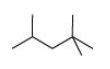
(b) 2-hydroxy-1, 2, 3-propanetricarboxylic acid
Condensed Formula: (COOH)CH2C(OH) (COOH)CH2(COOH)
Bond line formula:
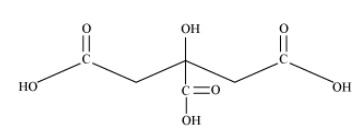
The functional groups present in the given compound are carboxylic acid (-COOH) and alcoholic (-OH) groups.
(c) Hexanedial Condensed Formula: (CHO) (CH2)4 (CHO)
Bond line Formula:

The functional group present in the given compound is aldehyde (-CHO).
5.
The electrons may be assigned to the following orbitals :
(i) 4s
(ii) 3d
(iii) 4p
(iv) 3d
(v) 3p
(vi) 4p.
The increasing order of energy is :
(v) < (ii) = (iv) < (vi) = (iii) < (i)
6.
As coke burns in a closed room, oxygen is used up and amount of oxygen in the room decreases. In the presence of carbon monoxide which is very poisonous because it combines with haemoglobin to form carboxy haemoglobin. This reaction takes place much more easily than reaction with oxygen to form oxyhaemoglobin. Thus supply of oxygen to body parts is hindered and this could be fatal.
7.
When SiO2 reacts with HF, silicon tetrafluoride is formed which dissolves in HF to from hydrofluorosilicic acid.
SiO2 + 4HF\(\longrightarrow \)SiF4 + 2H2O
SiF4 + 2HF \(\longrightarrow \)H2SiF6
8.
sodium ash is obtained
2 NaHCO3 \(\rightarrow\) Na2Co3 + H2O + CO2
9.
(a) \(2NOCl(g)\rightleftharpoons 2NO(g)+Cl_{ 2 }(g);\)
\( { K }_{ p }=1.8\times { 10 }^{ -2 }at500k\)
\(2 \mathrm{NOCl}(\mathrm{g}) \rightleftharpoons 2 \mathrm{NO}(\mathrm{g})+\mathrm{Cl}_{2}(\mathrm{~g}) ; K_{p}=1.8 \times 10^{-2} \text { at } 500 \mathrm{~K}\)
(b) \(CaCO_{ 3 }(s)\leftrightharpoons CaO(s)+CO_{ 2 }(g);\)
\({ K }_{ p }=167 \ at \ 1073 \ K\)
\( { \Delta n }_{ g }={ n }_{ p }-{ n }_{ R }=1\)
\( { K }_{ c }=\frac { { k }_{ p } }{ (RT)^{ \Delta n_{ g } } } =\frac { 167 }{ 0.0821\times 1073 } =1.89\)
10.
80.25 mol-1
11.
\({ P }_{ c }=\frac { a }{ 27{ b }^{ 2 } } =\frac { 0.751{ L }^{ 2 }atm \ mol^{ -2 } }{ 27\times (0.0226L \ mol^{ -1 })^{ 2 } } =54.5 \ atm\)
\( T_{ c }=\frac { 8a }{ 27Rb } =\frac { 8\times 0.75L^{ 2 }atm \ mol^{ -2 } }{ 27\times 0.082L \ atm \ K^{ -1 }mol^{ -1 } } \times 0.0226Lmol^{ -1 }=120K\)
\({ V }_{ c }=3b=3\times 0.0226L \ mol^{ -1 }=0.0678Lmol^{ -1 }\)
12.
Given, (5.7 x 10⁻⁵) \(\div \) (4.2 x 10⁻³)
(5.7 \(\div \) 4.2) x (10-5-(-3)) = 23.94 x 10⁻²
13.
Pesticides are the substances used to kill unwanted pests.
For example, DDT.
14.
NaCl, CaCO3 and NH3
15.
Boron in BCl3 is sp2 hybridised, due to this the shape of BCl3 molecule is trigonal planar. It is symmetrical in shape. The net dipole moment for symmetrical molecule is zero (because individual dipole moments cancel out due to the symmetry of the molecule).
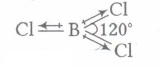
μ = 0
Thus, dipole moment of BCl3 is zero.
16.
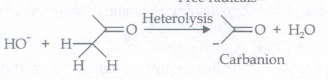
17.
The metals with low ionisation enthalpies are used in photoelectric cells. Caesium (Cs), an alkali metal belonging to group 1 is the most commonly used metal.
18.
Let the oxidation number of CaO2 be x
2 + 2x = 0
x = -1
Thus, oxidation number of in CaO2 = -1
19.
(i) 0.0048 = 4.8× 10⁻³
(ii) 234, 000 = 2.34 ×10⁵
(iii) 8008 = 8.008 ×10³
(iv) 500.0 = 5.000 × 10²
(v) 6.0012 = 6.0012
20.
For exhibiting cis-trans (or geometrical isomerism, a molecule must fulfil the following condition.
The groups attached to each double bonded carbon atom must be different.
21.
Percentage of carbon =\(\frac { 12\times 0.198\times 100 }{ 44\times 0.246 } =21.95%\) %
Percentage of hydrogen =\(\frac { 2\times 0.1014\times 100 }{ 18\times 0.246 } =4.58%\) %
22.
Interaction of H+ and OH- ions of H2O with the anion and the cation of a salt respectively to yield the original acid and the original base is called hydrolysis.
eg.
\(Na2CO3+2H2O\rightarrow 2NaOH+H_{ 2 }CO_{ 3 }\\ Salt\quad \quad \quad \quad \quad \quad Base\quad \quad \quad Acid\)
Hydration, on the other hand, means addition of H2O to ions or moleclues to form hydrated ions or hydrated.
\(KCl(s)+H_{ 2 }O(l)\rightarrow K^{ + }(aq)+cl^{ - }(aq)\\ Salt\)
\(\\ CuSo_{ 4 }(s)+5H_{ 2 }O(l)\rightarrow \ CuSO_{ 4 }.5H_{ 2 }O(s)\\ Colourless\quad \quad \quad \quad \quad \quad \quad \quad Blue\)
23.
NaCl is neutral, it simply dilutes the HCl solution from 1 ml to 1000mL so that
[H+] = \(\frac { 0.01 }{ 1000 } ={ 10 }^{ 5 }M \)
pH = log (10-5) = 5
24.
We know,
\(\log \ K=\frac { -\Delta _{ r }G^{ \circ } }{ 2.303RT } =\frac { (-13.6 \times 10^{3}J \ mol^{-1}) }{ 2.303( 8.314 JK^{-1} mol^{-1}) (298 K) } =2.38\)
Hence, K = antilog 2.38 = 2.4 x 10²
25.
Within a group, electron gain enthalpy becomes less negative down a group. but electron gain enthalpy of chlorine is more negative (-349 kJ\(mol^{ -1 }\)than that of the fluorine (-328 kJ\(mol^{ -1 }\)).
This is due to small size of fluorine as the electron-electron repulsions in relatively compact 2p-orbital is greater than that in the larger 3p-orbital and hence, the incoming electron feels greater repulsion in fluorine than in chlorine. That's why chlorine have more negative electron gain enthalpy that that of fluorine.
26.
0.1 nm.
27.
The balanced chemical equation is:
\(\mathrm{BaCl}_2(a q)+\mathrm{Na}_2 \mathrm{SO}_4(a q) \rightarrow \mathrm{BaSO}_4(\mathrm{~s})+2 \mathrm{NaCl}(a q)\)
Let us first calculate moles of \(\mathrm{Na}_2 \mathrm{SO}_4\) and \(\mathrm{BaCl}_2\)
0.5 M solution of \(\mathrm{Na}_2 \mathrm{SO}_4\) means that \(0.5 \mathrm{~mol}\) of \(\mathrm{Na}_2 \mathrm{SO}_4\) are present in 1000 mL of solution.
1000 mL of solution contain \(\mathrm{Na}_2 \mathrm{SO}_4=\frac{0.5}{1000} \times 250=0.125 \mathrm{~mol}\)
Moles of \(\mathrm{BaCl}_2\) in solution \(=\frac{10}{208}\)
(Mol. mass of \(\left.\mathrm{BaCl}_2=137+2 \times 35.5=208\right)=0.048\)
According to the balanced equation, \(1 \mathrm{~mol}\) of \(\mathrm{BaCl}_2\) reacts with \(1 \mathrm{~mol}\) of \(\mathrm{Na}_2 \mathrm{SO}_4\) Therefore, \(\mathrm{BaCl}_2\) is the limiting reactant, so only \(0.048 \mathrm{~mol}\) of \(\mathrm{Na}_2 \mathrm{SO}_4\) reacts with \(0.048 \mathrm{~mol}\) of \(\mathrm{Na}_2 \mathrm{SO}_4\).
Now, according to the equation, \(1 \mathrm{~mol}\) of \(\mathrm{BaCl}_2\) produces \(\mathrm{BaSO}_4=1 \mathrm{~mol}\)
\(0.048 \mathrm{~mol}\) of \(\mathrm{BaCl}_2\) produces \(\mathrm{BaSO}_4=1 \times 0.048=0.048 \mathrm{~mol}\)
Amount of \(\mathrm{BaSO}_4\) obtained \(=0.048 \times 233 =11.18 \mathrm{~g}\)
28.
Halogens have a strong tendency to accept electrons. Therefore, they are strong oxidising agents. Their relative oxidising power is, however, measured in terms of their electrode potentials. Since the electrode potentials of halogens decrease in the order: F2(+2.87V) > Cl2 (+1.36V) > Br2(+1.09V) > 12(+0.54V), therefore, their oxidising power decreases in the same order.
This is evident from the observation that F2 oxidises Cl- to Cl2' Br- to Br2, I- - to I2; Cl2 oxidises Br- to Br2 and r to I2 but not F- to F2. Br2, however, oxidises 1- to I2but not F- to F2' and Cl- to Cl2
F2(g) + 2Cl-(aq) \(\longrightarrow \) 2F-(aq) + CI2(g); F2(g) + 2Br-(aq) \(\longrightarrow \) 2F-(aq) + Br2(l)
F2(g) + 2I-(aq) \(\longrightarrow \) 2F-(aq) + I2(s);Cl2(g) + 2Br-(aq) \(\longrightarrow \) 2Cl-(aq) + Br2(l)
Cl2(g) + 2l-(aq) \(\longrightarrow \) 2Cl-(aq) +I2(s) and Br2(l) + 2I- \(\longrightarrow \) 2Br-(aq) + I2(s)
Thus, F2 is the best oxidant.
Conversely, halide ions have a tendency to lose electrons and hence can act as reducing agents. Since the electrode potentials of halide ions decreases in the order: F (-0.54 V) > Br" (-1.09 V) > Cl" (-1.36 V) > F (-2.87 V), therefore, the reducing power of the halide ions or their corresponding hydrohalic acids decreases in the same order: HI > HBr > HCl > HF. Thus, hydroiodic acid is the best reductant. This is supported by the following reactions. For example, HI and HBr reduce H2SO4 to SO2 while HCI and HF do not.
2HBr + H2SO4 \(\longrightarrow \) Br2 + SO2 + 2H2O; 2HI + H2SO4 \(\longrightarrow \) I2+ SO2 + 2H2O
Further T reduces Cu2+ to Cu+ but Br" does not.
2Cu2+(aq) + 4I-(aq) \(\longrightarrow \) Cu2I2(s)+ 12(aq);Cu2+(aq) + 2Br- \(\longrightarrow \) No reaction. Thus, HI is a stronger reductant than HBr
Further among HCl and HF, HCl is a stronger reducing agent than HF because HCI reduces MnO2 to Mn2+ but HF does not.
MnO2(s) + 4HCl(aq) \(\longrightarrow \) MnCl2(aq) + Cl2(g) + 2H2O
MnO2(s) + 4HF(I) \(\longrightarrow \) No reaction
Thus, the reducing character of hydrohalic acids decreases in the order: HI > HBr > HCl > HF
29.
Diamond has a three-dimensional network with strong C---C bonds, which are very difficult to break and thus, diamond has high melting point.
30.
Mg3N2 is a salt of strong base, Mg(OH)2and weak acid (NH3). Thats's why on hydrolysis it gives ammonia (NH3)
But MgCl2 (magnisium chloride) is a salt of strong base Mg (OH)2 and a strong acid (HCL). That's why it dose not hydrolysed to give HCl.
31.
It produce more energy per unit mass of fuel and does not create pollution.
32.
\(2K_{ 4 }[Fe(CN)_{ 6 }]+{ H }_{ 2 }SO_{ 4 }+{ H }_{ 2 }O_{ 2 }\rightarrow 2K_{ 3 }[Fe(CN)_{ 6 }]+{ K }_{ 2 }SO_{ 4 }+2{ H }_{ 2 }O\)
33.
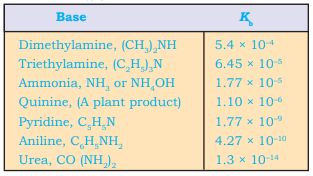
\({ C }_{ 6 }{ H }_{ 5 }{ NH }_{ 2 }+{ H }_{ 2 }O\rightleftharpoons { C }_{ 6 }{ H }_{ 5 }{ NH }_{ 3 }^{ + }+{ OH }^{ - }\)
\({ K }_{ b }=\frac { \left[ { C }_{ 6 }{ H }_{ 5 }{ NH }_{ 3 }^{ + } \right] \left[ { OH }^{ - } \right] }{ \left[ { C }_{ 6 }{ H }_{ 5 }{ NH }_{ 2 } \right] } =\frac { \left[ { OH }^{ - } \right] ^{ 2 } }{ \left[ { C }_{ 6 }{ H }_{ 5 }{ NH }_{ 2 } \right] } \)
\(\left[ { OH }^{ - } \right] =\sqrt { { K }_{ a }.C } =\sqrt { 4.27\times { 10 }^{ -10 }\times 0.001 }\)
\( \left[ { OH }^{ - } \right] =6.534\times { 10 }^{ -7 }\)
\(pOH=-log\left[ { 0H }^{ - } \right] =-log\left[ 6.534\times { 10 }^{ -7 } \right]\)
\( pOH=-0.8152+7=6.18\)
\(From,\ pH+pOH=14\)
\( pH=14-6.18=7.82\)
\({ C }_{ 6 }{ H }_{ 5 }{ NH }_{ 2 }+{ H }_{ 2 }O\rightleftharpoons { C }_{ 6 }{ H }_{ 5 }{ NH }_{ 3 }^{ + }+{ OH }^{ - }\)
\(Initial \ conc.\ C \ \ \quad 0\quad 0\)
\( Equili \ conc.C-C\alpha \quad C\alpha \quad C\alpha\)
\( { K }_{ b }=\frac { C\alpha .C\alpha }{ C(1+\alpha ) } \ [(1-\alpha )\approx 1 \ for \ weak \ base]\)
\( { K }_{ b }=C{ \alpha }^{ 2 }\)
\( or \ \alpha =\sqrt { \frac { { K }_{ b } }{ C } } \)
Degree of ionisation,
\(\alpha =\sqrt { \frac { 4.27\times { 10 }^{ -10 } }{ 0.001 } } =6.53\times { 10 }^{ -4 }\)
\( { K }_{ a } \ of \ conjugate \ acid \ of \ aniline,\)
\( { K }_{ a }=\frac { { K }_{ w } }{ { K }_{ b } } =\frac { { 10 }^{ -14 } }{ 4.27\times { 10 }^{ -10 } } =2.34\times { 10 }^{ -5 }\)
34.
The given 3 processes comprises a cyclic system ABC which is shown in the graph below.

Total workdone in cyclic process, W=WA→B+WB→C+WC→A
Workdone in A→B process :
It is a isobaric expansion (at constant pressure, P = 1 atm)
Initial volume, VA= 20 L
Final volume, VB = 40 L
Work done, WA→B=−P(VB−VA)
=−1(40−20)=−20 L.atm
Workdone in B→C process :
It is a reversible isochoric process. The volume is constant at 40 L so there is zero workdone during this process.
WB→C=0
Workdone in C→A process :
It is an isothermal compression (at constant temperature,T) process.
Initial volume, VC= 20 L
Final volume, VA = 40 L
Wordone for isothermal compression,
\( W_{C \rightarrow A}=2.303 \mathrm{nRT} \log \frac{V_C}{V_A} \)
\( =2.303 P_A V_A \log \frac{40}{20} =13.87 \text { L. atm }\)
Total workdone in cyclic process, \(\mathrm{W}=\mathrm{W}_{\mathrm{A} \rightarrow \mathrm{B}}+\mathrm{W}_{\mathrm{B} \rightarrow \mathrm{C}}+\mathrm{W}_{\mathrm{C} \rightarrow \mathrm{A}}\)
W=-20+0+13.87
\( =-6.13 \mathrm{~L} . \mathrm{atm} \)
\( =-\frac{6.13 \times 8.314}{0.0821} \mathrm{~J} \text { (in joules) } =-620.77 \mathrm{~J}\)
35.
(i) The second law of thermodynamics states that complete conversion of energy of one kind into another is not possible as some energy is always lost in the form of some other energy.
(ii) Because some energy may be used up in overcoming friction of wheels.
(iii) In refrigerator, heat flows from higher temperature to lower temperature in a compressor with mechanical work which is done by the compressor on the system.
The system consists of four components: compressor, condenser, expansion, value and evaporator. the following cycle is repeated over and again.
Refrigerant \(\overset { compressed }{ \underset { in \ compressor }{ \longrightarrow } } \) Gas form \(\overset { condensed }{ \underset { in \ condenser }{ \longrightarrow } } \)
Liquid form \(\overset { Allowed }{ \underset { to \ throttle \ through \ expansion \ valve }{ \longrightarrow } } \)
Gas form \(\overset { Allowed }{ \underset { to \ evaporate \ in \ evaporator }{ \longrightarrow } } \)Refrigerant.
(iv) Mr.sharma is scientific and practical
36.
According to Gay-Lussac's law, \(\frac { { p }_{ 1 } }{ { T }_{ 1 } } =\frac { { p }_{ 2 } }{ { T }_{ 2 } } \)
\(\frac { 250 }{ 300 } =\frac { { p }_{ 2 } }{ 1800 } or{ \ p }_{ 2 }=1500kPa\)
As the cylinder can withstand a pressure of \({ 10 }^{ 6 }\)
\(Pa=10^{ 3 }kPa\) = 1000kPa, hence, it will blow up.
37.
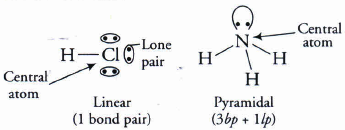
38.
There are numerous physical properties of elements such as melting points, boiling points, heats of fusion and vaporisation, energy of atomisation, etc., which show periodic variations. The cause of periodicity in properties is the repetition of similar outer electronic configuration after certain regular intervals. e.g. all the elements of 1s group (alkali metals) have similar outer electronic configuration, i.e. ns1.
3Li = 1s2, 2s1
11Na = 1s2, 2s2, 2p6 , 3s1
19K = 1s2, 2s2, 2p6 , 3s2, 3p6, 4s1
Therefore, due to similar outermost shell electronic configuration all alkali metals have similar properties. e.g., sodium and potassium both are soft and reactive metals. They all form basic oxides and their basic character increases down the group. They all form unipositive ion by the loss of one electron. Similarly, all the elements of 17th group (halogens) have similar outermost shell electronic configuration, i.e. ns2 np5 and thus possess similar properties.
9F = 1s2, 2s1 , 2p5
17Cl = 1s2, 2s2, 2p6 , 3s2 , 3p5
35Br = 1s2, 2s2, 2p6 , 3s2, 3p6, 3d10, 4s2 , 4p5
39.
(c)
lowering the activation energy
40.
(c)
volume
41.
(c)
Staggered
42.
(c)
greater than the number of protons
43.
(b)
frictional resistance
44.
(b)
the strong binding forces in the covalent polymer
45.
(c)
Sp2 - Sp3
46.
(a)
F
47.
(a)
isoelectronic
48.
(d)
all of the above
49.
(d)
BaCO3
50.
(c)
The ionization energy of the element
51.
(b)
\(\frac { 28 }{ { { 6.023\times 10 }^{ 23 } } } \)g

11th Standard CBSE Syllabus & Materials
11th Standard CBSE
CBSE 11th Business Studies Forms of Business Organisation Sample Question Papers Study Material - QB365 Set A
NEW11th Standard CBSE
CBSE 11th Business Studies Business, Trade and Commerce Sample Question Papers Study Material - QB365 Set A
NEW11th Standard CBSE
CBSE 11th Physics Waves Sample Question Papers Study Material - QB365 Set A
NEW11th Standard CBSE
CBSE 11th Physics Kinetic Theory Sample Question Papers Study Material - QB365 Set A



CBSE 11th Standard CBSE Subjects
CBSE Standards









