
 100% FREE ACCESS
11th Standard CBSE Syllabus & Materials
11th Standard CBSE
CBSE 11th Economics PART-A - Presentation of Data - New Sample Question Papers Study Material - QB365 Set A
NEW11th Standard CBSE
CBSE 11th Economics PART-A - Organisation of Data - New Sample Question Papers Study Material - QB365 Set A
NEW11th Standard CBSE
CBSE 11th Economics PART-A - Collection of Data - New Sample Question Papers Study Material - QB365 Set A
NEW11th Standard CBSE
CBSE 11th Economics PART-A - Introduction to Economics and Statistics - New Sample Question Papers Study Material - QB365 Set A
NEW11th Standard CBSE
CBSE 11th Business Studies International Trade Sample Question Papers Study Material - QB365 Set A
NEW11th Standard CBSE
CBSE 11th Business Studies Evolution and Fundamentals of Business Sample Question Papers Study Material - QB365 Set A

Published on: 04/03/2020
11th Standard CBSE Chemistry Public Exam Sample Question 2020
Download CBSE Class 11th Standard CBSE Chemistry question papers, sample papers, important questions, and previous year solved papers in PDF format. Get free study materials, NCERT solutions, and exam preparation resources for Class 11th Standard CBSE Chemistry
Questions + Answers key
Take MCQ Chemistry Test
1.
Explain the term aromaticity. What are the necessary conditions for any compound to show aromaticity?
2.
A colorless aqueous solution on adding water and on heating gave a white NH4Cl and NH4OH in excess resulted in the dissolution of some of the precipitate and a gelatinous precipitate is obtained.what is the hydroxide formed in aqueous solution?
3.
Starting with sodium chloride how would you proceed to prepare? Sodium peroxide.
4.
Dr.Sharma , cardiologist suggested his patienta to take more potassium ions for healthy heart. potassium ions are the most abundant cations within cell fluids, where they activate many enzymes, participate in the oxidation of glucose to pro duse ATP While sodiun ions are responsible for the transmission for nerve signals. What are the sources of potassium ?
5.
At the home of Mr.Kumar, Dalda ghee is generally used. He is suffering from high blood pressure and diabetes. Mr.Sharma, a friend of Mr.Kumar has advised him to change from ghee to vegetable oil like mustard oil.
Dihydrogen (H2) is used in the manufacture of vanaspati ghee by hydrogenation of polyunsaturated vegetable oils using nickel as a catalyst.
Vegetable oil \(\xrightarrow [ { H }_{ 2 } ]{ Ni } \) vanaspati ghee
Should we use vegetable oils for cooking? why?
6.
When 20.0 g of ammonium nitrate (NH4NO3) is dissolved in 125 g of water in a coffee cup calorimeter. (Treat heat capacity of water as the heat capacity of the calorimeter and its contents).
7.
The reaction of cyanamide, NH2CN (s), with dioxygen was carried out in a bomb calorimeter, and ∆U was found to be –742.7 kJ mol–1 at 298 K. Calculate enthalpy change for the reaction at 298 K.
\({ NH }_{ 2 }CN(s)+\frac { 3 }{ 2 } { O }_{ 2 }(g)\rightarrow { N }_{ 2 }(g)+{ CO }_{ 2 }(g)+{ H }_{ 2 }O(l)\)
8.
A balloon is filled with hydrogen at room temperature. It will burst if pressure exceeds 0.2 bar. If at 1 bar pressure the gas occupies 2.27 L volume, upto what volume can the balloon be expanded?
9.
One day when Ravi was passing by his laboratory and felt some suffocating odour. He saw his laboratory attendant was preparing some chemical, named as ammonia. Suddenly, he saw that some chemical had fallen at the hand of the attendant. He run at once and take some highly diluted HCl and apply at the burned place.By this the attendent got relief.
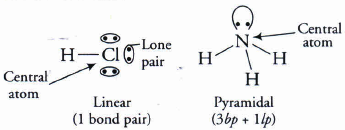
Can you predict and draw the structures of these compound.Also mark the central atom and find out the bond pairs and lone pairs.
10.
Chemical reactivity of elements is highest at the two extremes of a period and is lowest in the center. Highly reactive elements do not occur in nature in free state, they usually occur in nature in free state, they usually occur in combined state. Some students are highly aggressive and keep on fighting with each other like highly reactive elements. Some students are sober and help each other and do not fight.
(i) Elements of which group are most reactive?
(ii) Which group elements are least reactive and why?
(iii) What are the harmful effects of being aggressive?
(iv) What values are possessed by sober people?
(v) Which kind of people pick up fight, while driving on the road in case of accidents? What are its consequences? What should we do?
11.
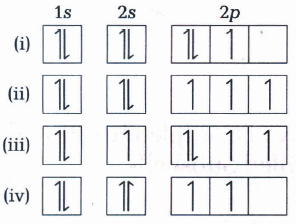
Which of the following representation of electronic configuration is excluded by the Aufbau principle? Which by the Pauli exclusion principle? Which by Hund's rule? Which is correct? Explain how a principle or rule is violated in the others.
12.
30 ml of dil. HCl is neutralised completely with 40mL of 0.5 M NaOH. What is the molarity of HCl?
13.
The solubility product constant of Ag2CrO4 and AgBr are 1.1 × 10⁻¹² and 5.0 × 10⁻¹³ respectively. Calculate the ratio of the molarities of their saturated solutions.
14.
How will you distinguish between propene and propane?
15.
Ionic compounds have high melting and boiling points. There is strong electrostatic force of attraction between them. Answer the following:
(i) Why ionic solids are poor conductor of electricity?
(ii) What happens to the electrical conductivity when they are dissolved in water?
(iii) What is the value associated with it?
16.
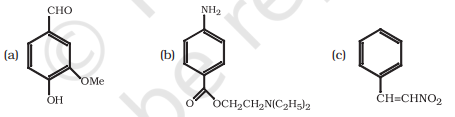
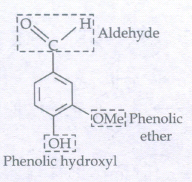
Identify the functional groups in the following compounds
17.
Write the names of isotopes of hydrogen. What is the mass ratio of these isotopes?
18.
What are the oxidation numbers of the underlined elements and how do you rationalise your results? CH3COOH
19.
What is an atom according to Dalton's atomic theory?
20.
Which of the following compounds will show cis-trans isomerism?
CH2= CBr2
21.
Write the expression for the equilibrium constant, KC for each of the following reactions:
(i) 2NOCl(g)↔2NO(g)+Cl2(g)
(ii) 2Cu(NO3)2(aq)↔2CuO(S)+4NO2(g)+O2(g)
(iii) CH3COOC2H5(aq)+H2O(l)↔CH3COOH(aq)+C2H5OH(aq)
(iv) Fe3+(aq)+3OH−(aq)↔Fe(OH)3(s)
(v) I2(s)+5F2↔2IF5
22.
Show that for an isothermal expansion of an ideal gas \(\triangle U=0\) .
23.
Use the periodic table to answer the following questions.
(a) Identify an element with five electrons in the outer subshell.
(b) Identify an element that would tend to lose two electrons.
(c) Identify an element that would tend to gain two electrons.
(d) Identify the group having metal, non-metal, liquid as well as gas at the room temperature
24.
Indicate the number of unpaired electrons in : (a) P, (b) Si, (c) Cr, (d) Fe and (e) Kr.
25.
The ionisation energy of H-atom (in the ground state) is xkJ. Find the energy required for an electron to jump from second to third energy level.
26.
Give equation for the following:
(i) Electrophilic Substitution
(ii) Nucleophilic Substitution
27.
What is meant by catenation? Why does 'C'show the property of catenation to maximum extent?
28.
(a) What do you mean by 'Surface Tension' of a liquid?
(b) Explain the factors which can affect the surface tension of a liquid
29.
Explain Lithium does not form alums
30.
An alkene ‘A’ contains three C – C, eight C – H σ bonds and one C – C π bond. ‘A’ on ozonolysis gives two moles of an aldehyde of molar mass 44 u. Write IUPAC name of ‘A’.
31.
Give condensed and bond line structural formulas and identify the functional group(s) present, if any, for :
(a) 2,2,4-Trimethylpentane
(b) 2-Hydroxy-1,2,3-propanetricarboxylic acid
(c) Hexanedial
32.
Calculate the number of moles in each of the following.
392 g of sulphuric acid
33.
Predict if the solutions of the following salts are neutral, acidic or basic
Nacl,KBr,NaCN, \({ NH }_{ 4 }{ ON }_{ 3 },Na{ NO }_{ 2 } \ And \ KF\)
34.
10 g of argon is compressed isothermally and reversibly at a temperature of 27oC from 10 L to 5 L. Calculate q, W, \(\Delta\)U and \(\Delta\)H for this process R = 2.0 cal K -1 mol-1, log2 = 0.30, atomic weight of Ar = 40.
35.
A catalyst will increase the rate of a chemical reaction by ______.
shifting the equilibrium to the right
shifting the equilibrium to the left
lowering the activation energy
increasing the activation energy
36.
For a cyclic process, the change in internal energy of the system is ______.
always +ve
equal to zero
always -ve
none of the above
37.
An aqueous solution of compound A gives ethane on electrolysis, the compound A is ______.
Ethyl acetate
Sodium acetate
Sodium propionate
Sodium ethoxide
38.
The hybridization state of a carbocation is ______.
Sp4
sp3
sp2
sp
39.
The orbital with n = 3 and 1 = 2 is _______.
3s
3p
3d
3j
40.
At constant temperature, the pressure of the gas is reduced to one-third, the volume
reduce to one-third
increases by three times
remaining the same
cannot be predicted
41.
Silicon carbide (SiC) is known as
quartz
tridynite
corundum
carborundum
42.
The oxidation number of the carboxylic carbon atom in CH3 COOH is ______.
+2
+4
+1
+3
43.
Which one is diamagnetic among NO+ , NO and NO-?
NO+
NO
NO-
None of these
44.
Hydrogen is obtained as a by-product in the
electrolysis of water
manufacture of caustic soda
Bosch process
Lane process
45.
Which one of the following alkaline earth metal carbonates is thermally most stable
MgCO3
CaCO3
SrCO3
BaCO3
46.
What is the electronic configuration of the elements of group 14?
ns2 np4
ns2 np6
ns2 np2
ns2
47.
How many grams are contained in 1 gram atom of Na?
13 g
1 g
23 g
\(\frac { 1 }{ 23 } \) g
1.
The aromatic compounds apparently contain alternate double and single bonds in a cyclic structure, and resemble benzene in chemical behaviour. They undergo substitution reactions rather addition reactions. This characteristic behaviour is called Aromatic character or Aromaticity.
Conditions for Aromaticity:
(i) An aromatic compound is cyclic and planar.
(ii) Each atom in an aromatic ring has a p-orbital. These p-orbitals must be parallel so that a continuous overlap is possible around a ring.
(iii) The cyclic \(\pi\)-molecular orbital formed by the overlap of p-orbitals must contain (4n + 2) \(\pi\) electrons, where (n = 0, 1, 2, 3, 4 etc.)
2.
The hydroxide formed in aqueous solution is Al(OH)3
3.
Sodium peroxide It is obtained by heating sodium metal (Which is obtained ny the electrolysis of molten NaCl), in excess of air. The initially formed sodium oxide reacts with more O2 to form Na2O2.
4Na + O2 \(\xrightarrow{\Delta}\) 2 Na2O2 2Na2O;
2Na2O + O2 + O2\(\xrightarrow{\Delta}\) 2 Na2O2 ;
4.
Kala chana , soya bean and sprouted lentils are the sources of iron potassium and proteins
5.
Yes, because these are unsaturated fats and hence,good for health. They do not form cholesterol if taken in small quantity.
6.
A heat capacity of water = heat capacity of calorimeter, the heat gained by water = heat lost by calorimeter
\(=125\times (296.5-286.4)\times 4.184 \ J=5282J=5.282kJ\)
7.
Use the following steps to solve out such problems.
Step I Write the balanced equation
\({ NH }_{ 2 }CN(s)+\frac { 3 }{ 2 } { O }_{ 2 }(g)\rightarrow { N }_{ 2 }(g)+{ CO }_{ 2 }(g)+{ H }_{ 2 }O(l)\)
Step II Calculate \({ \Delta n }_{ g }\)
Difference of moles of gaseous products and
reactants, \({ \Delta n }_{ g }={ n }_{ p }-{ n }_{ r }=2-\frac { 3 }{ 2 } =\frac { 1 }{ 2 } =0.5mol\)
Step III Calculate \(\Delta H\) by using the formula
\(\Delta H=\Delta U+{ \Delta n }_{ g }RT\)
\(\Delta H=-742.7 \ kj \ { mol }^{ -1 }\)
\( +(0.5mol\times 8.314\times { 10 }^{ -3 }kj \ { mol }^{ -1 }\times 298K)\)
During calculation always remember the units of different quantities, i.e.
\(\Delta H,\Delta U\) and R must be the same.
8.
According to Boyle's law, \({ p }_{ 1 }{ V }_{ 1 }={ p }_{ 2 }{ V }_{ 2 }\)
\(1bar\times 2.27L=0.2bar\times { V }_{ 2 }\)
\(or \ { V }_{ 2 }=\frac { 1bar\times 2.27L }{ 0.2bar }\)
\( =11.35L\)
Since, balloon burst at 0.2 bar pressure, the volume of balloon should be less than 11.35 L.
9.
10.
(i) Group 1 elements are most reactive.
(ii) Group 18 elements are least reactive because they have stable electronic configuration.
(iii) It may cause high blood pressure and any other harm to the body. It disturbs the person physically and mentally also.
(iv) They are cool, calm, happy and help other people. They are more healthy than aggressive people.
(v) aggressive people pick up fight. They do not accept their fault. Sometimes, it leads to physical injury which put them in trouble. We should not involve in such act.
11.
(i) Representation of electronic configuration is excluded by Hund's rule since electrons are not shown in separate orbitals of the same subshell with parallel spins.
(ii) Representation of electronic configuration is correct.
(iii) Representation of electronic configuration is excluded by the Aufbau principle because the 2s subshell fills before the 2p.
(iv) Representation of electronic configuration is excluded by the Pauli exclusion principle since the two electrons in the 2s-orbital cannot have the same spin.
12.
\(NaOH+{ HNO }_{ 3 }\longrightarrow { NaNO }_{ 3 }+{ H }_{ 2 }O\)
Applying molarity equation
M1V1(acid) = M2V2 (base); \({ M }_{ 1 }\times 30=0.5\times 40\)
\({ M }_{ 1 }\times 30=20; \ { M }_{ 1 }=\frac { 20 }{ 30 } \)
13.
Let s be the solubility of Ag2CrO4.

Let  be the solubility of AgBr.

Therefore, the ratio of the molarities of their saturated solution is 
14.
Pass them through dilute cold KMnO4 solution (purple) or Br2 in CCl4 solution (red). Propene will decolourise both the solutions but propane does not react.
15.
(i) In solid form they are (anions & cations) closely packed, that is why they are not able to move.
(ii) In water they aquire mobility and can conduct electricity.
(iii) By this property these compounds can be applied in electroplating of all types of cells.
16.
(a)
(b)
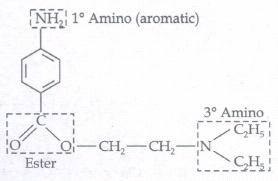
(c)
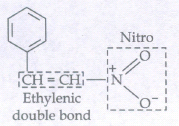
17.
Protium - \(^1_1H\)
Deuterium - \(^2_1H\) or D
Tritium - \(^3_1H\) or T
Mass ratio of Protium: Deuterium: Tritium
= 1: 2: 3
18.
By conventional method. CH3COOH = 2x + 4 - 4 = 0 or x = 0
By chemical bonding method, C2 is attached to three H-atoms (less electronegative than carbon) and one-COOH group (more electronegative than carbon).
\(H\overset { 2 }{ - } \overset { \overset { H }{ I } }{ \underset { \overset { I }{ H } }{ C } } -\overset { \overset { 0 }{ II } }{ C } -OH\)
therefore, O.N. of C2 = 3 (+1) + x + 1 (-1) = 0 or x = -2
C1 is, however, attached to one oxygen atom by a double bond, one .O.H (O.N. = -1) and one CH3 (O.N. = +1) group, therefore, O.N. of C1 = + 1 + x + 1
(-2) + 1 (-1) = 0 or x = +2
19.
According to Dalton's atomic theory, an atom is the ultimate particle of matter which cannot be further divided.
20.
For exhibiting cis-trans (or geometrical isomerism, a molecule must fulfil the following condition.
The groups attached to each double bonded carbon atom must be different.
21.
The expression for the equilibrium constant, KC for each of the following reactions are:
(a) \({ K }_{ c }=\frac { \left[ NO \right] ^{ 2 }\left[ { Cl }_{ 2 } \right] }{ \left[ NOCl \right] _{ 2 } } \)
(b) \({ K }_{ c }=\left[ { No }_{ 2 } \right] ^{ 4 }\left[ { O }_{ 2 } \right] \)
(because molar concentrations of pure solids are constant)
(c) \({ K }_{ c }=\frac { \left[ CH_{ 3 }COOH \right] \left[ { C }_{ 2 }{ H }_{ 2 }OH \right] }{ \left[ { CH }_{ 3 }COO{ C }_{ 2 }{ H }_{ 5 } \right] \left[ { H }_{ 2 }O(l) \right] } \)
(d) \({ K }_{ c }=\frac { 1 }{ \left[ { Fe }^{ 3+ } \right] .\left[ { OH }^{ 1 } \right] ^{ 3 } } \) because [Fe(OH)3 (s) = 1]
(e) \({ K }_{ c }=\frac { \left[ { IF }_{ 5 } \right] ^{ 2 } }{ \left[ { F }_{ 2 } \right] ^{ 5 } } \)(because [I2(s) = 1])
22.
For one mole of an ideal gas, \({ C }_{ V }=\left( \frac { \triangle U }{ \triangle T } \right) _{ V }\)
\(or \ \triangle U={ C }_{ V }\triangle T\)
For an isothermal process, T is constant so that \(\triangle T=0\)
\(\therefore \) \(\triangle U=0\)
23.
(a) The electronic configuration of an element having 5 electrons in its outermost subshell should be ns2np5. This is the electronic configuration of the halogen group. Thus, the element can be F, Cl, Br, I, or At.
(b) An element having two valence electrons will lose two electrons easily to attain the stable noble gas configuration. The general electronic configuration of such an element will be ns2. This is the electronic configuration of group 2 elements. The elements present in group 2 are Be, Mg, Ca, Sr, Ba.
(c) An element is likely to gain two electrons if it needs only two electrons to attain the stable noble gas configuration. Thus, the general electronic configuration of such an element should be ns2np4. This is the electronic configuration of the oxygen family.
(d) Group 17 has metalloid, non–metal, liquid as well as gas at room temperature. F and Cl are the gaseous states, Br is liquid state and I is solid state. Here, the F, Cl, Br and I are non-metals whereas, At is metalloid.
24.
(a) 15P = 1s2, 2s2, 2p6, 3s2, 3p3. 3 unpaired electrons.
(b) 14Si = 1s2, 2s2, 2p6, 3s2, 3p2. 2 unpaired electrons.
(c) 14Cr = 1s2, 2s2, 2p6, 3s2, 3p6, 3d5, 4s1. 6 unpaired electrons.
(d) 26Fe = 1s2, 2s2, 2p6, 3s2, 3p6, 3d6, 4s2. 4 unpaired electrons
(e) 36Kr = 1s2, 2s2, 2p6, 3s2, 3p6, 3d10, 4s2, 4p6. No unpaired electrons.
25.
Energy in second level, E2 =-\(\frac { x }{ 2^{ 2 } } \)=-\(\frac { x }{ 4 } \)
Energy in third energy level, E3= \(=-\frac { x }{ 3^{ 2 } } =-\frac { x }{ 9 } \)
Energy required for an electron to jump,
\(\left( E_{ 3 }-E_{ 2 } \right) =-\frac { x }{ 9 } +\frac { x }{ 4 } =\frac { 5x }{ 36 } \)
26.
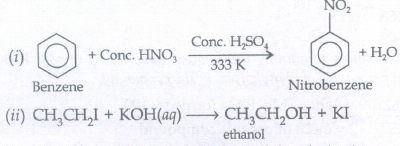
27.
It is the phenomenon of an atom to form a strong covalent bond with the atoms of itself. Carbon shares the property of catenation to maximum extent because it is small in size and can form P\(\pi\)-P\(\pi\) multiple bonds to itself.
28.
(a) Surface tension: It is defined as the force acting per unit length perpendicular to the line drawn on the surface. It's unit is Nm-1.
(b) Surface tension of a liquid depends upon following factors.
(i) Temperature: Surface tension decreases with rise in temperature. As the temperature of the liquid increases, the average kinetic energy of the molecules increases. Thus, there is a decrease in intermolecular force of attraction which decreases the surface tension.
(ii) Nature of the liquid: Greater the magnitude of intermolecular forces of attraction in the liquid, greater will be the value of surface tension.
29.
Due to small size, lithium does not form alums
30.
(i) An aldehyde with molar mass of 44 u is ethanal, CH3CH = O
(ii) Write two moles of ethanal side by side with their oxygen atoms pointing towards each other.
CH3CH = O O = CHCH3
Ethanal Ethanal
(ii) Remove the oxygen atoms and join them by a double bond, the structure of alkene 'A' is
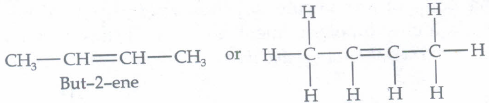
As required, but-2-ene has three C-C, eight C-H \(\sigma \)-bonds and one C-C \(\pi\)-bond.
31.
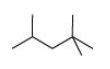
(a) 2, 2, 4-trimethylpentane
Condensed formula: (CH3)2CHCH2C (CH3)3
Bond line formula:
(b) 2-hydroxy-1, 2, 3-propanetricarboxylic acid
Condensed Formula: (COOH)CH2C(OH) (COOH)CH2(COOH)
Bond line formula:
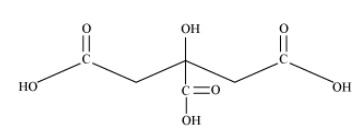
The functional groups present in the given compound are carboxylic acid (-COOH) and alcoholic (-OH) groups.
(c) Hexanedial Condensed Formula: (CHO) (CH2)4 (CHO)
Bond line Formula:

The functional group present in the given compound is aldehyde (-CHO).
32.
392 g of sulphuric acid
Molar mass of H2SO4 = 2 x 1 + 32 + 4 x 16 = 98 g
98 g of sulphuric acid = 1 mol
392 g of sulphuric acid = 1 mol x\(\frac { 392 \ g }{ (98 \ g) } \) = 4 mol
33.
| Salt | Acid | Base | Hdrolusis reaction | Nature of solution | |
| (i) | NaCl | HCl | NaOH | \({ H }_{ 2 }O\rightleftharpoons { H }^{ + }+{ OH }^{ - }No\quad Hydrolysis\) | neutral |
| (ii) | KBr | HBr | NAOH | No Hydrolusis | neutral |
| (ii) | NaCH | HCN | NaOH | \({ CN }^{ - }+{ H }_{ 2 }o\rightleftharpoons HCN+{ OH }^{ - }\) | Basic |
| (iv) | \(NH_{4}NO_{3}\) | \(HNO_{2}\) | \(NH_{4}OH\) | \({ NH }_{ 4 }^{ + }+{ H }_{ 2 }O\rightleftharpoons N{ H }_{ 4 }OH+{ H }^{ + }\) | Acidic |
| v | \(NaNO_{2}\) | \(HNO_{2}\) | NaOH | \({ NO }_{ 2 }^{ - }+{ H }_{ 2 }O\rightleftharpoons { HNO }_{ 2 }+{ OH }^{ - }\) | Basic |
| vi | KF | HF | KOH | \({ F }^{ - }+{ H }_{ 2 }O\rightleftharpoons { HNO }_{ 2 }+{ OH }^{ - }\) | Basic |
34.
q = 2.303 nRT log \(\frac { { V }_{ 2 } }{ V_{ 2 } } \) = 2.303\(\times \frac{10}{40}\times log\frac{5}{10}\)
=-103.635 cal
For isothermal expansion, \(\Delta\)U = 0 ...........(i)
W = \(\Delta\)U - q = 0 - (-103.635)
= +103.635 cal
Also, when temperature is constant,
p1V1 = p2V2 or pV = constant
\(\Delta\)H = \(\Delta\)E + \(\Delta\)(pV) = 0 + 0 = 0 ..........(ii)
35.
(c)
lowering the activation energy
36.
(b)
equal to zero
37.
(b)
Sodium acetate
38.
(c)
sp2
39.
(c)
3d
40.
(b)
increases by three times
41.
(d)
carborundum
42.
(d)
+3
43.
(a)
NO+
44.
(b)
manufacture of caustic soda
45.
(d)
BaCO3
46.
(c)
ns2 np2
47.
(c)
23 g

11th Standard CBSE Syllabus & Materials
11th Standard CBSE
CBSE 11th Business Studies Forms of Business Organisation Sample Question Papers Study Material - QB365 Set A
NEW11th Standard CBSE
CBSE 11th Business Studies Business, Trade and Commerce Sample Question Papers Study Material - QB365 Set A
NEW11th Standard CBSE
CBSE 11th Physics Waves Sample Question Papers Study Material - QB365 Set A
NEW11th Standard CBSE
CBSE 11th Physics Kinetic Theory Sample Question Papers Study Material - QB365 Set A



CBSE 11th Standard CBSE Subjects
CBSE Standards









