
 100% FREE ACCESS
11th Standard CBSE Syllabus & Materials
11th Standard CBSE
CBSE 11th Economics PART-A - Presentation of Data - New Sample Question Papers Study Material - QB365 Set A
NEW11th Standard CBSE
CBSE 11th Economics PART-A - Organisation of Data - New Sample Question Papers Study Material - QB365 Set A
NEW11th Standard CBSE
CBSE 11th Economics PART-A - Collection of Data - New Sample Question Papers Study Material - QB365 Set A
NEW11th Standard CBSE
CBSE 11th Economics PART-A - Introduction to Economics and Statistics - New Sample Question Papers Study Material - QB365 Set A
NEW11th Standard CBSE
CBSE 11th Business Studies International Trade Sample Question Papers Study Material - QB365 Set A
NEW11th Standard CBSE
CBSE 11th Business Studies Evolution and Fundamentals of Business Sample Question Papers Study Material - QB365 Set A

Published on: 13/08/2019
Redox Reactions
Download CBSE Class 11th Standard CBSE Chemistry question papers, sample papers, important questions, and previous year solved papers in PDF format. Get free study materials, NCERT solutions, and exam preparation resources for Class 11th Standard CBSE Chemistry
Questions + Answers key
Take MCQ Chemistry Test
1.
Identify the oxidant and reductant in the following redox reaction:
2K2MnO4 + Cl2 \(\rightarrow\) 2kcl + 2KMnO4
2.
Rahul was very angry because he got an oil spot on his favourite shirt. His mother want to make him happy but does not know what to do. Her neighbour Mrs. Sharma advised him to use bleach (bleaching powder, CaOCl2) to remove the oil spot.
(i) Do you suggest the same thing to remove oil spot ? Why or why not ? Justify your answer.
(ii) What is the oxidation number of both the Cl-atoms in the bleaching powder?
(iii) Which substance, is available in the market to remove such spots?
(iv) What values are associated with Mrs. Sharma?
3.
One mole of N2H4 loses 10 moles electrons to form a new compound Y. Assuming that all the nitrogen appears in the new compound, what is the oxidation number of N in Y ? There is no change in oxidation state of H.
4.
Justify that the reactions : 2Na(s)+H2(g)\(\rightarrow \)2NaH(s) is a redoxchange.
5.
How do you count for the following observations ?
(a) Though alkaline potassium permanganate and acidic potassium permanganate both are used as oxidants, yet in the manufacture of benzoic acid from toluene we use alcoholic potassium permanganate as an oxidant. Why ? Write a balanced redox equation for the reaction.
(b) When concentrated sulphuric acid is added to an inorganic mixture containing chloride, we get colourless pungent smelling gas HCl, but if the mixture contains bromide then we get red vapour of bromine. Why ?
6.
Justify that the following reaction are redox reaction
(a) \(CuO(s)+{ H }_{ 2 }(g)\rightarrow Cu(s)+{ H }_{ 2 }O(g)\)
(b) \({ F }e_{ 2 }O_{ 3 }(s)+3CO(g)\rightarrow 2Fe(s)+3{ CO }_{ 2 }(g)\)
(c) \(4BCl_{ 3 }(g)+3LiAl{ H }_{ 4 }(s)\longrightarrow 2{ B }_{ 2 }{ H }_{ 6 }(g)+3LiCl(s)+3AlC{ l }_{ 3 }(s)\)
(d) \(2k(s)+{ F }_{ 2 }(g)\longrightarrow 2K^{ + }{ F }^{ - }(s)\)
(e) \(4N{ H }_{ 3 }(g)+5{ O }_{ 2 }(g)\longrightarrow 4NO(g)+6H_{ 2 }O(g)\)
7.
Using the standard electrode potentials given in the predict if the reaction between the following is feasible - Ag+(aq) and Cu(s)
8.
What is a standard hydrogen electrode?
9.
Consider the elements:Cs,Ne,I and F.
(a) Identify the element that exhibits only positive oxidation state.
(b) Identify the element that exhibits both positive and negative oxidation states.
(c) Identify the element which exhibits neither the negative nor does the positive oxidation state.
10.
Does the oxidation number of an element in any molecule or any polyatomic ion represent the actual charge on it?
11.
In \({ MnO }_{ 4 }^{ 2- }\) undergoes disproportionation reaction in acidic medium but\({ MnO }_{ 4 }^{ - }\) does not. Give reason.
12.
Arrange the following metals in the order in which they displace each other from the solution of their salts. Al, Cu, Fe, Mg and Zn.
13.
Consider the reactions:
(a) H3PO2(aq) + 4 AgNO3(aq) + 2 H2O(l) → H3PO4(aq) + 4Ag(s) + 4HNO3(aq)
(b) H3PO2(aq) + 2CuSO4(aq) + 2 H2O(l) → H3PO4(aq) + 2Cu(s) + H2SO4(aq)
(c) C6H5CHO(l) + 2[Ag (NH3)2]+(aq) + 3OH–(aq) → C6H5COO–(aq) + 2Ag(s) + 4NH3 (aq) + 2 H2O(l)
(d) C6H5CHO(l) + 2Cu2+(aq) + 5OH–(aq) → No change observed.
What inference do you draw about the behaviour of Ag+ and Cu2+ from these reactions?
14.
How would you know whether a redox reaction is taking place in an acidic, alkaline or netural medium?
15.
Find the value of n in 4MnO4-+8H+ +ne- \(\rightarrow\) Mn2+ +4H2O
16.
In the ethylene molecule the two carbon atoms have the oxidation numbers.
-1, -1
-2, -2
-1, -2
+2,-2
17.
Which one among the following is not example of autoredox reaction?
\({ P }_{ 4 }+{ OH }^{ - }\longrightarrow { H }_{ 2 }{ PO }_{ 4 }^{ - }+{ PH }_{ 3 }\)
\({ H }_{ 2 }{ O }_{ 2 }\longrightarrow { H }_{ 2 }{ O+O }_{ 2 }\)
\({ S }_{ 2 }{ O }_{ 3 }^{ 2- }\longrightarrow S{ O }_{ 4 }^{ 2- }+S\)
\(AgCl+{ NH }_{ 3 }\longrightarrow [Ag({ NH }_{ 3 })_{ 2 }]Cl\)
18.
Which of the following are not redox reactions?
Mg + N2 \(\rightarrow\) Mg3N2
K4[Fe (CN)6] + H2S04 + H20 \(\rightarrow\) K2S04 + CO + FeS04 + (NH4)2S04
\({ S }_{ 2 }{ O }_{ 3 }^{ 2- }\longrightarrow S{ O }_{ 4 }^{ 2- }+S\)
\(AgCl+{ NH }_{ 3 }\longrightarrow [Ag\left( { NH }_{ 3 } \right) 2]Cl\)
19.
When methane is burnt in oxygen to produce CO2 and H20 the oxidation number of carbon changes by ______.
-8
Zero
+8
+4
20.
On the reaction 2Ag + 2H2SO4 \(\rightarrow\) Ag2So4 + 2H2O+SO2 sulphuric acid acts as ______.
an oxidizing agent
a reducing agent
a catalyst
an acid as well as an oxidant
1.
.png)
chlorine is an oxidant and K2MnO4 is reductant.
2.
(a) No, because used of a bleach can also destroy a cloth.
(b) Bleaching powder, CaOCl2 is actually Ca(OCl) Cl, in which the oxidation state of one chlorine (Cl) is -1 and that of other in parenthesis (Cl is +10.
⇒ -2 + x = -1 ⇒ (x =+ 1)
(c) You can use vanish to remove the spot.
(d) Values associated with Mrs. Sharma are helpful but unknowledgeable and not aware about side effects of bleach.
3.
Suppose the oxidation number of N in Y is x
(N-2)2\(\rightarrow\)(2N)x + 10e-
(as N2H4\(\rightarrow\)Y + 10e-)
Therefore, 2x - 10 = -4, which gives x = +3. Hence, oxidation number of H in Y = 3
4.
Since in the above reaction the compound formed is an ionic compound, which may also be represented as \(\mathrm{Na}^{+} \mathrm{H}^{-}\) (s), this
suggests that one half reaction in this process is :
\(2 \mathrm{Na}(\mathrm{s}) \rightarrow 2 \mathrm{Na}^{+}(\mathrm{g})+2 \mathrm{e}^{-}\)
and the other half reaction is:
\(\mathrm{H}_{2}(\mathrm{~g})+2 \mathrm{e}^{-} \rightarrow 2 \mathrm{H}^{-}(\mathrm{g})\)
This splitting of the reaction under examination into two half reactions automatically reveals that here sodium is oxidised and hydrogen is reduced, therefore, the complete reaction is a redox change.
5.
.png)
In the manufacture of benzoic acid from toluene, alcoholic potassium permanganate is used as an oxidant because of the following reasons.
(i) In a neutral medium, OH– ions are produced in the reaction itself. As a result, the cost of adding an acid or a base can be reduced.
(ii) KMnO4 and alcohol are homogeneous to each other since both are polar. Toluene and alcohol are also homogeneous to each other because both are organic compounds.
Reactions can proceed at a faster rate in a homogeneous medium than in a heterogeneous medium.
Hence, in alcohol, KMnO4 and toluene can react at a faster rate.
The balanced redox equation for the reaction in a neutral medium is give as below:

When conc. H2SO4 is added to an inorganic mixture containing bromide, initially HBr is produced.
HBr, being a strong reducing agent reduces H2SO4 to SO2 with the evolution of red vapour of bromine.
2NaBr+2H2SO4⟶2NaHSO4+2HBr2
HBr+H2SO4⟶Br2+SO2+2H2O (red vapour)
But, when conc. H2SO4 is added to an inorganic mixture containing chloride, a pungent smelling gas (HCl) is evolved. HCl, being a weak reducing agent, cannot reduce H2SO4 to SO2
2NaCl+2H2SO4⟶2NaHSO4+2HCI
6.
(a) \(CuO(s)+{ H }_{ 2 }(g)\rightarrow Cu(s)+{ H }_{ 2 }O(g)\)
Assign oxidation numbers of each atom above its symbol.
\(\overset { +2-2 }{ CuO } (s)+\overset { 0 }{ H_{ 2 } } (g)\rightarrow \overset { 0 }{ Cu } (s)+\overset { +1 }{ H_{ 2 } } \ \overset { -2 }{ 0 } \ (g)\)
Oxidation number of Cu in Cuo is +2.It decreases from +2 to zero in Cu.While oxidation number of hydrogen increases from 0(in H2) to +1 (in H2O)
This shows the CuO is reduced to Cu but H2 is oxidised to H2O.Hence,it is an example of redox reaction.
(b) \(\overset { +3 }{ { Fe }_{ 2 } } \ { 0 }_{ 3 }(s)+3\overset { +2-2 }{ CO } (g)\longrightarrow \overset { 0 }{ 2F } \ e(s)+\overset { +4-2 }{ CO_{ 2 } } (g)\)
Oxidation number of Fe decreases from +3(in Fe2O3) to zero (in Fe) and oxidation number of C increases from +2 (in CO) to +4
(in CO2 ). This shows that Fe2O3 is reduced to Fe and CO is oxidised to CO2. Hence, it is a redox reaction.
(c) \(\overset { +3-1 }{ 4BCl_{ 3 } } (g)+\overset { +1+3-1 }{ 3LiAl{ H }_{ 4 } } (s)\longrightarrow \overset { -3+1 }{ 2{ B }_{ 2 }{ H }_{ 6 } } (g)+\overset { +1-1 }{ 3LiCl } (s)+3\overset { +3-1 }{ AlC{ l }_{ 3 } } (s)\)
Oxidation number of B decreases from +3(in BCl3) to -3(in B2H6) and oxidation number of H increases from -1(in LiAlH4) to +1 (in B2H6 ). This shows that BCl3 is reduced to B2H4 and LiAlH4 is oxidised. Hence, it is redox reaction.
(d) \(\overset { 0 }{ 2k(s) } +\overset { 1 }{ { P }_{ 2 } } \longrightarrow 2\overset { +1-1 }{ K{ F } } (s)\)
Oxidation number of K increases from zero(in K) to +1 (in KF) and oxidation number of F reduces from zero(in F2) to -1(in KF).This shows that K is oxidised and F2 is reduced.Hence it is a redox reaction
(e) \(4\overset { -3-1 }{ N{ H }_{ 3 } } (g)+5\overset { 0 }{ { O }_{ 2 } } (g)\longrightarrow 4\overset { +2-1 }{ NO } (g)+6\overset { +1-2 }{ H_{ 2 }O } (g)\)
Oxidation number of N increases from -2(in NH3) to +2(in NO) and oxidation number of O decreases from zero (in O2) to-2
(in NO and H2O). This shows that NH3 is oxidised and O2 is reduced. Hence, it is a redox reaction.
7.
The possible reaction between Ag+(aq) and Cu(s) is
Cu(s) + 2Ag+(aq) \(\rightarrow\) Cu2+(aq) + 2Ag(s)
The above redox reaction can be split into the following two half reactions. Writing electrode potential for each half reaction from Table 8.1, we have
Oxidation Cu(s) \(\rightarrow\) Cu2+(aq) + 2e-; Eo= -0.34 V
Reduction: Ag+(aq) + e- \(\rightarrow\) Ag(s)] x 2; Eo= + 0.80 V
8.
Standard hydrogen electrode is known as reference electrode. Its electrode potential is taken as 0.000 volt.
9.
(a) Cs exhibits only positive oxidation state because it is the most electropositive element.
(b) I exhibits both positive and negative oxidation states.Iodine exhibits -1,0,+1,3,+5 and +7 oxidation states(+3,+5 and +7 oxidation states are exhibited by I due to the presence of vacant d-orbitals.)
(c) Ne is an inert gas, so it neither exhibits negative nor positive oxidation states.
10.
No, the oxidation number of an element in any species is an apparent charge on the atom which it appears to have acquired when all other atoms in the species are removed as ions.
11.
In \({ MnO }_{ 4 }^{ 2- }\)the oxidation number of Mn is +6. It can increase its oxidation number(to+7) or decrease its oxidation number (to+, +4,+3,+2,0)
Hence, it undergoes disproportionation reaction in acidic medium
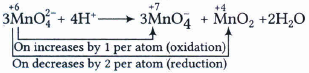
In \({ MnO }_{ 4 }^{ - }\) ,Mn is in its highest oxidation state,i.e +7 .It can only decrease its oxidation number.Hence,it cannot undergo disproportional reaction.
12.
EoAI3+ / AI = -.166V, EoCu2+ / Cu =+ 0.34 V
EFe2+ / Fe = - 0.44 V, EMg2+ / Mg = - 2.36 V
and EoZn2+ / Zn = - 0.76 V
A metal with more negative value of Eored is a stronger reducing agent than those which have less negative or positive value of Eored .Therefore, Mg can displace all the given metals from their aqueous salt solutions.AI can displace all metals from their aqueous salt solutions.Zinc can displace Fe and Cu from their aqueous salt solutions and Fe can displace only Cu from its aqueous salt solution. Hence, the orderin which they can display each other from the solution of their salts is as follows.
Mg, AI, Zn, Fe, Cu
13.
Ag+ and Cu2+ act as oxidising agents in reactions (a) and (b) respectively.
In reaction (c), Ag+ oxidises C6H5CHO to C6H5COO–, but in reaction (d), Cu2+ cannot oxidise C6H5CHO.
Hence, we can say that Ag+ is a stronger oxidising agent than Cu2+.
14.
If H+ or any acid appears on either side of the chemical equation, the reaction takes place in the acidic solution. If OH-, or any base, appears on either side of the chemical equation, the solution is basic. If neither H+, OH- nor any acid or base is present in the chemical equation, the solution is netrual.
15.
4MnO4-+8H+ +ne- → Mn2+ +4H2O
-1 + 8 + n = +2
-1 - 2+ 8 + n = 0
n = - 5 or 5e-
16.
(b)
-2, -2
17.
(d)
\(AgCl+{ NH }_{ 3 }\longrightarrow [Ag({ NH }_{ 3 })_{ 2 }]Cl\)
18.
(d)
\(AgCl+{ NH }_{ 3 }\longrightarrow [Ag\left( { NH }_{ 3 } \right) 2]Cl\)
19.
(d)
+4
20.
(d)
an acid as well as an oxidant

11th Standard CBSE Syllabus & Materials
11th Standard CBSE
CBSE 11th Business Studies Forms of Business Organisation Sample Question Papers Study Material - QB365 Set A
NEW11th Standard CBSE
CBSE 11th Business Studies Business, Trade and Commerce Sample Question Papers Study Material - QB365 Set A
NEW11th Standard CBSE
CBSE 11th Physics Waves Sample Question Papers Study Material - QB365 Set A
NEW11th Standard CBSE
CBSE 11th Physics Kinetic Theory Sample Question Papers Study Material - QB365 Set A



CBSE 11th Standard CBSE Subjects
CBSE Standards









