
 100% FREE ACCESS
11th Standard CBSE Syllabus & Materials
11th Standard CBSE
CBSE 11th Economics PART-A - Presentation of Data - New Sample Question Papers Study Material - QB365 Set A
NEW11th Standard CBSE
CBSE 11th Economics PART-A - Organisation of Data - New Sample Question Papers Study Material - QB365 Set A
NEW11th Standard CBSE
CBSE 11th Economics PART-A - Collection of Data - New Sample Question Papers Study Material - QB365 Set A
NEW11th Standard CBSE
CBSE 11th Economics PART-A - Introduction to Economics and Statistics - New Sample Question Papers Study Material - QB365 Set A
NEW11th Standard CBSE
CBSE 11th Business Studies International Trade Sample Question Papers Study Material - QB365 Set A
NEW11th Standard CBSE
CBSE 11th Business Studies Evolution and Fundamentals of Business Sample Question Papers Study Material - QB365 Set A

Published on: 25/09/2019
State of Matter
Download CBSE Class 11th Standard CBSE Chemistry question papers, sample papers, important questions, and previous year solved papers in PDF format. Get free study materials, NCERT solutions, and exam preparation resources for Class 11th Standard CBSE Chemistry
Questions + Answers key
Take MCQ Chemistry Test
1.
Tea or coffee is sipped from a saucer when it is quite hot.
2.
Explain
The level of mercury in a capillary tube is lower than the level outside when a capillary tube inserted in the mercury.
3.
Explain
The boiling point of a liquid rises on increasing pressure.
4.
Pay load is defined as the difference between the mass of the displaced air and the mass of the balloon. Calculate the pay load when a balloon of radius 10 m, mass 100 kg is filled with helium at 1.66 bar at 27oC (Density of air = 1.2 kg m-3 and R = 0.083 bar dm3 K-1 mol-1).
5.
State and explain Boyle's law. Represent the law graphically.
6.
A liquefied petroleum gas (LPG) cylinder weight 14.8 Kg when empty. When full it weighs 29.0 Kg and shows a pressure of 2.5 atm. In the course of use at 27\(^{o}\) C, the mass of the full cylinder is reduced to 23.2 Kg. Find out the volume of the gas in cubic meters used up at the normal usage conditions and final pressure inside the cylinder. Assume LPG to be n-butane with a normal boiling point of 0\(^{o}\) C.
7.
Nitrogen molecule(N2 )has radius of about 0.2 nm. Assuming that nitrogen molecule is spherical in shape, calculate volume of a single molecule of N2
8.
Calculate the total and average kinetic energy of 32 g methane molecules at 27oC(R = 8.314 JK-1 mol-1 )
9.
A gaseous mixture containing 50 g of nitrogen and 10 g of oxygen were enclosed in a vessel of 10 L capacity at 27oC.Calculate The partial pressure of each gas.
10.
Density of a gas is found to be 5.46 g/dm3 at 300 K and 2 bar pressure.What will be its density at STP?
1.
Evaporation causes cooling and the rate of evaporation increases with an increase in the surface area. Since, saucer has a large surface area, hence tea/ coffee taken in a saucer cools quickly.
2.
The cohesive forces in mercury are much stronger than the force of adhesion between glass and mercury. Therefore, mercury-glass contact angle is greater than 90o . As a result, the vertical component of the surface tension forces acts vertically downward, thereby lowering the level of mercury column in the capillary tube.
3.
A liquid boils when its vapour pressure becomes equal to the atmospheric pressure. An increase in pressure on liquid, therefore, causes a rise in the boiling temperature of the liquids.
4.
Radius of the balloon = 10 m
\(\therefore\)Volume of the balloon = \(\frac{4}{3}\pi\)r2 = \(\frac{4}{3}\times\frac{22}{7}\times\)(10m)3 = 4190.5 m3
Volume of He filled at 1.66 bar and 27°C = 4190.5 m3
Calculation of mass of He
PV = nRT = \(\frac { w }{ M } \)RT
or \(w\) = \(\frac{MPV}{RT}\) = \(\frac { (4\times { 10 }^{ -3 }kgmol^{ -1 })(1.66bar)(4190.5\times 103dm^{ 3 }) }{ (0.083bardm^{ 3 }K^{ -1 }mol^{ -1 })(300K) } \)
= 1117.5 kg
Total mass of the balloon along with He = 100 + 1117.5 = 1217.5 kg
Maximum mass of the air that can be displaced by balloon to go up = Volume x Density
= 4190.5 m3 x 1.2 kg m-3 = 5028.6 kg
\(\therefore\) Pay load = 5028.6 - 1217.5 kg = 3811.1 kg
5.
It states that, the pressure of a fixed mass of a gas is inversely proportional to its volume if temperature is kept constant.
P\(\alpha\)\(\frac{1}{V}\)
PV = constant (n and T are constant)
P1V1 = P2V2.
Graphical representation:
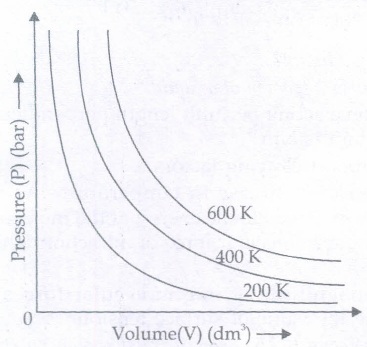
Fig. Graph of pressure, P vs. Volume,
V of a gas at different temperatures.
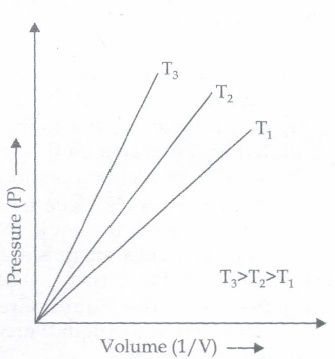
Fig. Graph of pressure of a gas, P VS. 1N
6.
Weight of LPG originally present = 29.0 - 14.8 = 14.2 Kg
Pressure = 2.5 atm
Weight of LPG present after use = 23.2 - 14.8
= 8.4 Kg
Since volume of the cylinder is constant, applying
pV = nRT \(\cfrac { { p }_{ 1 } }{ { p }_{ 2 } } =\cfrac { { n }_{ 1 } }{ { n }_{ 2 } } =\cfrac { { w }_{ 1 }/m }{ { w }_{ 2 }/m } =\cfrac { { w }_{ 1 } }{ { w }_{ 2 } } \)
\(\cfrac { 2.5 }{ { p }_{ 2 } } =\cfrac { 14.2 }{ 8.4 } \) or p2 = \(\cfrac { 2.5\times 8.4 }{ 14.2 } \) = 1.48 atm
Weight of used gas = 14.2 - 8.4 = 5.8 Kg
Moles of gas = \(\cfrac { 5.8\times { 10 }^{ 3 } }{ 58 } \)= 100mol
Normal Conditions p = 1 atm;
t = 273 + 27 = 300K
Volume of 100m L of LPG at 1 atm and 300 K
V = \(\cfrac { nRT }{ p } =\cfrac { 100\times 0.082\times 300 }{ 1 } \)
= 2460 L = 2.460 m3
7.
The volume of a sphere = \(\frac { 4 }{ 3 } \pi { r }^{ 2 }\) where r is radius of the sphere. For N2 molecule,
\(r=0.2nm=0.2\times { 10 }^{ -9 }m=2\times { 10 }^{ -8 }cm\)
Volume of a molecule of
\({ N }_{ 2 }=\frac { 4 }{ 3 } \times \frac { 22 }{ 7 } \times (2\times { 10 }^{ -8 })^{ 3 } \ cm^{ 3 }=3.35\times { 10 }^{ -23 }{ cm }^{ 2 }\)
8.
Total K.E = 74826 J Average K.E, K.E = 6.1 x 10⁻²¹ J mole-1 J
9.
pN2 = 8.71 bar; pO2 = 0.778
10.
Density at STP = 3 g/dm3

11th Standard CBSE Syllabus & Materials
11th Standard CBSE
CBSE 11th Business Studies Forms of Business Organisation Sample Question Papers Study Material - QB365 Set A
NEW11th Standard CBSE
CBSE 11th Business Studies Business, Trade and Commerce Sample Question Papers Study Material - QB365 Set A
NEW11th Standard CBSE
CBSE 11th Physics Waves Sample Question Papers Study Material - QB365 Set A
NEW11th Standard CBSE
CBSE 11th Physics Kinetic Theory Sample Question Papers Study Material - QB365 Set A



CBSE 11th Standard CBSE Subjects
CBSE Standards









