
 100% FREE ACCESS
11th Standard CBSE Syllabus & Materials
11th Standard CBSE
CBSE 11th Economics PART-A - Presentation of Data - New Sample Question Papers Study Material - QB365 Set A
NEW11th Standard CBSE
CBSE 11th Economics PART-A - Organisation of Data - New Sample Question Papers Study Material - QB365 Set A
NEW11th Standard CBSE
CBSE 11th Economics PART-A - Collection of Data - New Sample Question Papers Study Material - QB365 Set A
NEW11th Standard CBSE
CBSE 11th Economics PART-A - Introduction to Economics and Statistics - New Sample Question Papers Study Material - QB365 Set A
NEW11th Standard CBSE
CBSE 11th Business Studies International Trade Sample Question Papers Study Material - QB365 Set A
NEW11th Standard CBSE
CBSE 11th Business Studies Evolution and Fundamentals of Business Sample Question Papers Study Material - QB365 Set A

Published on: 05/10/2019
State of Matter
Download CBSE Class 11th Standard CBSE Chemistry question papers, sample papers, important questions, and previous year solved papers in PDF format. Get free study materials, NCERT solutions, and exam preparation resources for Class 11th Standard CBSE Chemistry
Questions + Answers key
Take MCQ Chemistry Test
1.
Isotherms of carbon dioxide at various temperatures are represented in the figure. Answer the following questions based on the figure.
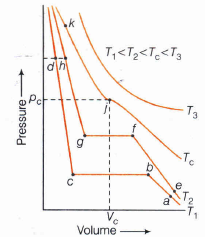
Will condensation take place when the temperature is T3?
2.
Isotherms of carbon dioxide at various temperatures are represented in the figure. Answer the following questions based on the figure.
In which state will CO2 exist between the points a and b at temperature T1?
3.
Rainy season brings lots of happiness as well as lots of diseases also.Malaria, dysentery, jaundice are common diseases that occurred in this season.Children usually get affected by these diseases.Renu's teacher advised the class to drink boiled water.She also explained to test jaundice by doing a simple test based on the property of surface tension.She told them to take the urine sample in a glass and sprinkle the sulphur powder over it.If it floats, the test is negative but if it sinks, it is positive.After reading the above paragraph, answer the following questions.
What values are expressed in the above paragraph.
4.
Rainy season brings lots of happiness as well as lots of diseases also.Malaria, dysentery, jaundice are common diseases that occurred in this season.Children usually get affected by these diseases.Renu's teacher advised the class to drink boiled water.She also explained to test jaundice by doing a simple test based on the property of surface tension.She told them to take the urine sample in a glass and sprinkle the sulphur powder over it.If it floats, the test is negative but if it sinks, it is positive.After reading the above paragraph, answer the following questions.
What is the reason that sulphur powder floats if the test is negative but it sinks if it is positive?
5.
An iron cylinder contains helium at a pressure of 250 KPa at 300 K. The cylinder can withstand a pressure of \(1\times { 10 }^{ 6 }Pa\) . The room in which cylinder is placed catches fire. Predict whether the cylinder will blow up before it melts or not (mp of the cylinder = 1800 K).
6.
On a ship sailing in Pacific ocean where temperature is \(23.4^{ \circ }C\) , a balloon is filled with 2L air. What will be the volume of the balloon when the ship reaches Indian ocean, where temperature is \(26.1^{ \circ }C\) ?
7.
A gaseous mixture containing 50 g of nitrogen and 10 g of oxygen were enclosed in a vessel of 10 L capacity at 27oC. Calculate The number of moles of each gas.
8.
Density of a gas is found to be 5.46 g/dm3 at 300 K and 2 bar pressure.What will be its density at STP?
9.
A large flask fitted with a stop-cock is evacuated and weighted; it mass is found to be 134.567g. It is then filled to a pressure of 735 mm at 31oC with a gas of unknown molecular mass and then reweighted; it mass is 137.456 g. The flask is then filled with water and weighed again; its mass is now 1067.9 g. Assuming that the gas is ideal, calculate the molar mass of the gas.
10.
Gases possess characteristic critical temperature which depends upon the magnitude of intermolecular forces between the gas particles. The critical temperature of ammonia and carbon dioxide are 405.5 K and 304.10 K respectively. Which of these gases will liquify first when you start cooling from 500 K to their critical temperature?
11.
Tea or coffee is sipped from a saucer when it is quite hot.
1.
No, because T3 is greater than Tc (critical temperature).
2.
CO2 will exist as gaseous state between 'a' and 'b'.
3.
During rainy season, we should drink boiled water as boiling kills the harmful bacteria present in water
4.
Normal urine has a surface tension of about 66 dynes/cm (water has 72 dynes/am) but if bile is present ( a test for jaundice), it drops its about 55 dyne/cm.i.e. surface tension is lowered and hence sulphur powered sinks (bile is a liquid produced by the liver which helps in the digestion of fats)
5.
According to Gay-Lussac's law, \(\frac { { p }_{ 1 } }{ { T }_{ 1 } } =\frac { { p }_{ 2 } }{ { T }_{ 2 } } \)
\(\frac { 250 }{ 300 } =\frac { { p }_{ 2 } }{ 1800 } or{ \ p }_{ 2 }=1500kPa\)
As the cylinder can withstand a pressure of \({ 10 }^{ 6 }\)
\(Pa=10^{ 3 }kPa\) = 1000kPa, hence, it will blow up.
6.
\(Given,\ { V }_{ 1 }=2L;{ V }_{ 2 }=?\)
\({ T }_{ 2 }=(26.1+273)K=299.1K\)
\( { T }_{ 1 }=(23.4+273)K=296.4K\)
\(According \ to \ Charles \ law,\)
\( \frac { { V }_{ 1 } }{ { T }_{ 1 } } =\frac { { V }_{ 2 } }{ { T }_{ 2 } } or{ V }_{ 2 }=\frac { { V }_{ 1 }{ T }_{ 2 } }{ T_{ 1 } } \)
\(on \ substituting \ the \ corresponding \ values,\ we \ get\)
\(\Rightarrow \ { V }_{ 2 }=\frac { 2L\times 299.1K }{ 296.4K } =2.018L\)
7.
nN2 = f 3.5; nO2 = 0.3125
8.
Density at STP = 3 g/dm3
9.
80.25 mol-1
10.
Ammonia will liquify girst as its critical temperature will be reached first. To liquify CO2 gas, more cooling is required.
11.
Evaporation causes cooling and the rate of evaporation increases with an increase in the surface area. Since, saucer has a large surface area, hence tea/ coffee taken in a saucer cools quickly.

11th Standard CBSE Syllabus & Materials
11th Standard CBSE
CBSE 11th Business Studies Forms of Business Organisation Sample Question Papers Study Material - QB365 Set A
NEW11th Standard CBSE
CBSE 11th Business Studies Business, Trade and Commerce Sample Question Papers Study Material - QB365 Set A
NEW11th Standard CBSE
CBSE 11th Physics Waves Sample Question Papers Study Material - QB365 Set A
NEW11th Standard CBSE
CBSE 11th Physics Kinetic Theory Sample Question Papers Study Material - QB365 Set A



CBSE 11th Standard CBSE Subjects
CBSE Standards









