
 100% FREE ACCESS
11th Standard CBSE Syllabus & Materials
11th Standard CBSE
CBSE 11th Economics PART-A - Presentation of Data - New Sample Question Papers Study Material - QB365 Set A
NEW11th Standard CBSE
CBSE 11th Economics PART-A - Organisation of Data - New Sample Question Papers Study Material - QB365 Set A
NEW11th Standard CBSE
CBSE 11th Economics PART-A - Collection of Data - New Sample Question Papers Study Material - QB365 Set A
NEW11th Standard CBSE
CBSE 11th Economics PART-A - Introduction to Economics and Statistics - New Sample Question Papers Study Material - QB365 Set A
NEW11th Standard CBSE
CBSE 11th Business Studies International Trade Sample Question Papers Study Material - QB365 Set A
NEW11th Standard CBSE
CBSE 11th Business Studies Evolution and Fundamentals of Business Sample Question Papers Study Material - QB365 Set A

Published on: 30/09/2019
Structure of Atom
Download CBSE Class 11th Standard CBSE Chemistry question papers, sample papers, important questions, and previous year solved papers in PDF format. Get free study materials, NCERT solutions, and exam preparation resources for Class 11th Standard CBSE Chemistry
Questions + Answers key
Take MCQ Chemistry Test
1.
State and explain the following:
(i) Aufbau principle
(ii) Pauli exclusion principle.
(iii) Hund's rule of maximum multiplicity.
2.
What were the weaknesses or limitations of Bohr's model of atoms? Briefly describe the quantum mechanical model of atom.
3.
Define atomic number, mass number and neutron. How are the three related to each other?
4.
(a) What is the limitations of Rutherford model of atoms?
(b) How has Bohr's theory helped in calculating the energy of hydrogen electron in different energy levels?
5.
A beam of helium of atoms move with a velocity of \(2.0\times { 10 }^{ 3 }{ ms }^{ -1 }\) Find the wavelength of the particle constituting the beam. (h = 6.626 \(\times \)10-34 Js).
6.
The threshold frequency ν0 for a metal is 7.0 ×10¹⁴ s–1. Calculate the kinetic energy of an electron emitted when radiation of frequency ν =1.0 ×10¹⁵ s–1 hits the metal.
7.
The wavelength range of the visible spectrum extends from violet (400 nm) to red (750 nm). Express these wavelengths in frequencies (Hz). (1nm = 10–9 m)
8.
Which state of the triple ionised beryllium \((Be^{ 3+ })\) has the same orbit radius at that of the ground state of hydrogen atom?
9.
A golf ball has a mass of 40g, and a speed of 45 m/s. If the speed can be measured within accuracy of 2%, calculate the uncertainty in the position.
10.
A molecule of O2 and that of SO2 travel with the same velocity.What is the ratio of their wavelengths?
11.
The number of electrons, protons and neutrons in a species are equal to 18, 16 and 16 respectively. Assign the proper symbol to the species.
1.
(i) Aufbau Principle: In the ground state of the atoms, the orbitals are filled in the order of their increasing energies. In other words, electrons first occupy the lowest-energy orbital available to them and enter into higher energy orbitals only after the lower energy orbitals are filled.
The order in which the energies of the orbitals increase and hence the order in which the orbitals are filled is as follows:
15, 25, 2p, 3s, 3p, 4s, 3d, 4p, 55, 4d, 5p, 6s, 4f, 5d, 6p, 75, Sf, 6d, 7p .......
(ii) Pauli Exclusion Principle: An orbital can have maximum of two electrons and
these must have opposite signs.
For example: Two electrons in an orbital can be represented by
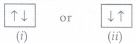
The two electrons have opposite spin, if one is revolving clockwise, the other is revolving anticlockwise or vice versa.
(iii) Hund's Rule of Maximum Multiplicity: Electron pairing in p, d and f orbitals cannot occur until each orbital of a given subshell contains one electron each or is single occupied.
For example: For the element nitrogen which contains 7 electrons, the following configuration can be written.
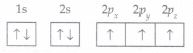
Total spin of unpaired electrons \(=\frac { 1 }{ 2 } +\frac { 1 }{ 2 } +\frac { 1 }{ 2 } =1\frac { 1 }{ 2 } \)
2.
Limitations of Bohr's model of an atom:
(i) It could not explain spectrum of multi-electron atoms.
(ii) It could not explain Zeeman and Stark effects.
(iii) It could not explain shape of molecules.
(iv) It was not in accordance with Heisenberg's uncertainty principle.
Quantum Mechanical Model: It was developed on the basis of Heisenberg's uncertainty principle and dual behaviour of matter. Main features of this model are given below :
(i) The energy of electrons in an atom is quantized i.e. can only have certain values.
(ii) The existence of quantized electronic energy levels is a direct result of the wave-like properties of electrons.
(iii) Both, the exact position and velocity of an electron in an atom cannot be determined simultaneously.
(iv) The orbitals are filled in increasing order of energy. All the information about the electron in an atom is stored in orbital wave function.\(\Psi \)
(v) From the value of\(\Psi \)2 at different points within atom, it is possible to predict the region around the nucleus where electron most probably will be found.
3.
Atomic Number (Z): The atomic number of an element is equal to the number of protons present inside the nucleus of its atoms. Since, an isolated atom has no net charge on it, in neutral atoms, the total number of electrons is equal to its atomic number.
Atomic number (Z) = Number of protons in the nucleus of an atom
= Number of electrons in the neutral atoms
Mass Number (A): The sum of the number of neutrons and protons in the nucleus of an atom is called its mass number. Mass number is denoted by A. Thus, for an atom, Mass number (A) = Number of protons (P) + Number of neutrons (n) A = P + n
Neutron: It is neutral particle. It is present in the nucleus of an atom. Expect hydrogen (which contains only one electron and one proton but no neutron), the atoms of all other elements including isotopes of hydrogen contain all the three fundamental particles called neutron, proton and electron.
The relation between mass number, Atomic no. and no. of neutrons is given by the equation:
A = Z+n I
Where A = Mass number
Z = Atomic number
n = Number of neutrons in the nucleus.
4.
(a) Limitations of Rutherford Model:
(i) When a body is moving in an orbit, it achieves acceleration (even if body is moving with constant speed in an orbit, it achieves acceleration due to change in direction). So an electron moving around nucleus in an orbit is under acceleration. However, according to radiation theory of Maxwell, the charged particles when accelerated must emit energy as electromagnetic radiations. This means that the revolving electron must also lose energy continuously in the form of electromagnetic radiation. The loss of energy in revolution of the electron around the nucleus must bring it closer to the nucleus and the electron must ultimately fall into the nucleus by the spiral path. This means that the atom must collapse. But we all know that atom is quite stable in nature.
(ii) Rutherford's model could not explain the existence of different spectral lines in the hydrogen spectrum.
(b) Based upon the postulates of Bohr's theory, it is possible to calculate the energy of the hydrogen electron and also one electron species. (He+, U2+ etc.) The mathematical expression for the energy in the nth orbit is
\(E_{ n }=-\frac { 2\pi ^{ 2 }m_{ e }e^{ 4 }Z^{ 2 } }{ n^{ 2 }h^{ 2 } } \)
By substituting the values of me (mass of electron), e (charge of electron) and h (Planck's constant), the value of energy comes out to be
\(E_{ n }=-\frac { 2.178\times 10^{ -18 }Z^{ 2 } }{ n^{ 2 } } \)J per atom.
\(=-\frac { 1312\times Z^{ 2 } }{ n^{ 2 } } \)KJ mol-1
For hydrogen electron,
Z = 1
\(E_{ n }=-\frac { 1312 }{ n^{ 2 } } \)KJ mol-1
The value for n = 1, gives the energy of the hydrogen electron in the ground state.
By assigning values, energy in different excited states can be calculated.
5.
Given, velocity of beam of helium atoms = 2.0\(\times \)103m sec-1
Mass of helium atom = \(\frac { 4 }{ 6.022\times { 10 }^{ 23 } } \)
= \(6.64\times { 10 }^{ -24 }g=6.64\times { 10 }^{ -27 }kg\)
According to de-Broglie equation, \(\lambda =\frac { h }{ mv } \)
\(=\frac { 6.626\times { 10 }^{ -34 }kg{ m }^{ 2 }{ s }^{ -1 } }{ (6.64\times { 10 }^{ -27 }kg)\times (2.0\times { 10 }^{ 3 }{ ms }^{ -1 }) } \)
\(= 4.99\times { 10 }^{ -11 }m=49.9pm \ [2]\)
6.
According to Einstein's equation \(KE=\frac { 1 }{ 2 } { m_{e}v }^{ 2 }=h(v-{ v }_{ o })\)
\(=\left( 6.626\times { 10 }^{ -34 }Js \right) (1.0\times { 10 }^{ 15 }{ s }^{ -1 }-7.0\times { 10 }^{ 14 }{ s }^{ -1 })\)
\( =\left( 6.626\times { 10 }^{ -34 }Js \right) (100\times { 10 }^{ 14 }{ s }^{ -1 }-7.0\times { 10 }^{ 14 }{ s }^{ -1 })\)
\(=\left( 6.626\times { 10 }^{ -34 }Js \right) \times (3.0\times { 10 }^{ 14 }{ s }^{ -1 })=1.988\times { 10 }^{ -19 }J\)
7.
Using equation c = ν λ, frequency of violet light
\(v=\frac { c }{ \lambda } =\frac { 3.00\times { 10 }^{ 8 } \ m{ s }^{ -1 } }{ 400\times { 10 }^{ -9 }m } \) = 7.50 × 10¹⁴ Hz
Frequency of red light
\(v=\frac { c }{ \lambda } =\frac { 3.00\times { 10 }^{ 8 } \ m{ s }^{ -1 } }{ 750\times { 10 }^{ -9 }m } =4.00\times { 10 }^{ 14 }Hz\)
The range of visible spectrum is from \(4.0\times { 10 }^{ 14 }Hz\) to \(7.5\times { 10 }^{ -9 }Hz\) in terms of frequency units.
8.
For H-atom, radius of ground state is
\(r_{ 1 }=\frac { { h }^{ 2 } }{ 4\pi ^{ 2 }me^{ 2 } } \ ...(i)\)
For hydrogen like atom.
\(r^{ ' }_{ n }=\frac { n^{ 2 }h^{ 2 } }{ 4\pi ^{ 2 }mZe^{ 2 } } \ ...(ii)\)
Dividing Eq.(ii) by Eq.(i)
\(\frac { r^{ ' }_{ n } }{ r_{ 1 } } =\frac { n^{ 2 } }{ Z } \)
For \(Be^{ 3+ }\) ion, Z = 4
\(\therefore \ \frac { r^{ ' }_{ n } }{ r_{ 1 } } =\frac { n^{ 2 } }{ 4 } \)
\(Now, \ r^{ ' }=r_{ 1 }\)
\( \therefore \ n^{ 2 }=4 \ or \ n=2\)
Thus, the second orbit of \(Be^{ 3+ }\) has the same radius as the Bohr's radius of hydrogen atom.
9.
The uncertainty in the speed is 2%, i.e.,
\(45 \frac { 2 }{ 100 } =0.9m{ s }^{ -1 }\)
Using the equation Heisenberg's principle,
\(\triangle x=\frac { h }{ 4\pi m.\triangle v } =\frac { 6.6\times{ 10 }^{ -34 } Js }{ 4\times3.14\times40g \times{ 10 }^{ -3 } \ kg \ g^{-1}\times 0.9 m s^{-1} }\)
= 1.46×10⁻³³ m
This is nearly ~ 1018 times smaller than the diameter of a typical atomic nucleus. As mentioned earlier for large particles, the uncertainty principle sets no meaningful limit to the precision of measurements.
10.
\(\lambda _{ O_{ 2 } }/\lambda _{ SO_{ 2 } }=2 \ (because \ \lambda =\frac { h }{ mv } ,i.e.\lambda \propto \frac { 1 }{ m } \) and mass of SO2 molecule viz.64 u is double than that of O2 molecule viz.32 u).
11.
The atomic number is equal to number of protons = 16. The element is sulphur (S).
Atomic mass number = number of protons + number of neutrons = 16 + 16 = 32
Species is not neutral as the number of protons is not equal to electrons. It is anion (negatively charged) with charge equal to excess electrons = 18 – 16 = 2. Symbol is \(_{ 16 }^{ 32 }{ { S }^{ 2- } }\)
Note : Before using the notation \({}^A_ Z X\), find out whether the species is a neutral atom, a cation or an anion. If it is a neutral atom, equation (2.3) is valid, i.e., number of protons = number of electrons = atomic number. If the species is an ion, determine whether the number of protons are larger (cation, positive ion) or smaller (anion, negative ion) than the number of electrons. Number of neutrons is always given by A–Z, whether the species is neutral or ion.

11th Standard CBSE Syllabus & Materials
11th Standard CBSE
CBSE 11th Business Studies Forms of Business Organisation Sample Question Papers Study Material - QB365 Set A
NEW11th Standard CBSE
CBSE 11th Business Studies Business, Trade and Commerce Sample Question Papers Study Material - QB365 Set A
NEW11th Standard CBSE
CBSE 11th Physics Waves Sample Question Papers Study Material - QB365 Set A
NEW11th Standard CBSE
CBSE 11th Physics Kinetic Theory Sample Question Papers Study Material - QB365 Set A



CBSE 11th Standard CBSE Subjects
CBSE Standards









