
 100% FREE ACCESS
11th Standard CBSE Syllabus & Materials
11th Standard CBSE
CBSE 11th Economics PART-A - Presentation of Data - New Sample Question Papers Study Material - QB365 Set A
NEW11th Standard CBSE
CBSE 11th Economics PART-A - Organisation of Data - New Sample Question Papers Study Material - QB365 Set A
NEW11th Standard CBSE
CBSE 11th Economics PART-A - Collection of Data - New Sample Question Papers Study Material - QB365 Set A
NEW11th Standard CBSE
CBSE 11th Economics PART-A - Introduction to Economics and Statistics - New Sample Question Papers Study Material - QB365 Set A
NEW11th Standard CBSE
CBSE 11th Business Studies International Trade Sample Question Papers Study Material - QB365 Set A
NEW11th Standard CBSE
CBSE 11th Business Studies Evolution and Fundamentals of Business Sample Question Papers Study Material - QB365 Set A

Published on: 25/09/2019
Thermodynamics
Download CBSE Class 11th Standard CBSE Chemistry question papers, sample papers, important questions, and previous year solved papers in PDF format. Get free study materials, NCERT solutions, and exam preparation resources for Class 11th Standard CBSE Chemistry
Questions + Answers key
Take MCQ Chemistry Test
1.
Graphically show the total work done in an expansion when the state of an ideal the state of an ideal gas is changed reversibly and isothermally from(pi,Vi) to (pf,Vf). With the help of a pV plot compare the work done in the above case with that carried out against a constant pressure pf .
2.
If the air supplied to the burner is insufficient, a portion of gas escapes without combustion. Assuming that 25% of the gas is wasted due to this inefficiency, how long will the cylinder last (Heat of combustion of butane = 2658 kJ/mol)?
3.
A cylinder of gas supplied by a company is assumed to contain 14kg of butane.If a normal family requires 20000kj of energy per day for cooking, how long will the cylinder last?
4.
A chemist while studying the properties of gaseous CCl2, a chlorofluorocarbon refrigerant, cooled a 1.25 g sample at a constant atmospheric pressure of 1.0 atm from 320 K to 293 K. During cooling, the sample volume decreased from 274 to 248 mL. Calculate \(\Delta\)H and \(\Delta\)U for the chlorofluorocarbon for this process. For CCl2F2, Cp = 80.7 J/(mol K).
5.
When 20.0 g of ammonium nitrate (NH4NO3) is dissolved in 125 g of water in a coffee cup calorimeter. (Treat heat capacity of water as the heat capacity of the calorimeter and its contents).
6.
An athlete is given 100g of glucose of energy equivalent to 1560 kJ. He utilises 50% of this gained energy in the event.In order to avoid storage of energy in the body, calculate the weight of water that would need to perspire.The enthalpy of vaporisation of water is 44 kJ mol-1.
7.
Standard heat of formation of hydrazine [N2H4(l)], hydrogen peroxide [H2O2(l)] and water [H2O(l)] are-50.4, -193.2 and -242.7kJ/mol respectively. Calculate the standard heat of reaction for the following reaction. \({ N }_{ 2 }{ H }_{ 4 }(l)+2{ H }_{ 2 }{ O }_{ 2 }(l)\rightarrow { N }_{ 2 }(g)+4{ H }_{ 2 }O(l)\)
8.
Two moles of a perfect gap undergo the following processes.
(i) a reversible isobaric expansion from (1.0 atm, 20.0 L) to (1.0 atm, 40.0 L)
(ii) a reversible isochoric change of state from (1.0 atm, 40.0 L) to (0.5 atm, 40.0 L)
(iii) a reversible isothermal compression from (0.5 atm, 40.0 L) to (1.0 atm, 20.0 L)
Answer the question related to the above processes.
What will be the value of \(\triangle U,\triangle H \ and \ \triangle S\) for the overall process?
1.
(i) Total work done in an expansion when the state of an ideal gas is changed reversibly and isothermally from (p i ,V i) to ( p f ,V f). Reversible work is represented by the combined areas ABC and BCViVf.
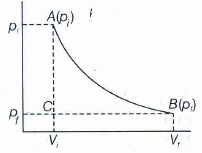
(ii) Work against constant pressure, pf is represented by the area BCViVf .Work(i) > Work (ii)
2.
25 percent of the gas is wasted due to inefficiency. This means that only 75% of butane gets combusted. Therefore, the energy produced by 75% combustion of butane = \(\frac { 641586\times 75 }{ 100 } \) = 481189.5 kJ
\(\therefore \) the number of days the cylinder will last.
3.
Molecular formula of butane = C4H10
Molecular mass of butane = 4 x 12 + 10 x 1 = 58
Heat of combustion of butane = 2658 kJ mol-1
1 mole or 58g of butane on complete combustion gives heat = 2658 kJ
\(\therefore \) 14 x 103 g of butane on complete combustion will give heat = \(\frac { 2658\times 14\times { 10 }^{ 3 } }{ 58 } \) = 641586
The family needs 20000 kJ of heat per day.
\(\therefore \) 20000 kJ of heat is used for cooking by a family in 1 day
\(\therefore \) 641586 kJ of heat will be used for cooking by a family in =\(\frac { 641586 }{ 20000 } \) = 32days
The cylinder will last for 32days
4.
\(\Delta\) H = qp and Cp is heat evolved or absorbed per mole for 1o fall or rise in temperature. Here, fall in temperature 320 - 293 = 27 K
Molar mass of CCl2F2 = 12 + 2 \(\times\) 35.5 + 2 \(\times\) 19
= 121 g mol-1
\(\therefore\) Heat evolved from 1.25 g of the sample on being cooled from 320 K to 293 K at constant pressu
=\(\frac{80.7}{121}\)\(\times\)1.25 \(\times\)27J = 22.51 J
Further, \(\Delta\)H = \(\Delta\)U + p\(\Delta\)V = -22.51 J
[\(\therefore\) p\(\Delta\)V = 1atm\(\times\) \(\frac{248-27487}{1000}\)L = -0.026L atm
= -0.026 \(\times\)101.325J = -2.63 J
-22.51 = \(\Delta\)U -2.63 J
or \(\Delta\)U = -22.51 +2.3 J = -19.88 J
5.
A heat capacity of water = heat capacity of calorimeter, the heat gained by water = heat lost by calorimeter
\(=125\times (296.5-286.4)\times 4.184 \ J=5282J=5.282kJ\)
6.
100g of glucose is equivalent to 1560 kJ of energy
Energy utilised in the event = \(\frac { 1560\times 50 }{ 100 } \) = 780
Energy left unutilised = 1560 - 780 = 780 kJ
Enthalpy of vaporisation of water = 44kJ/mol = \(\frac { 44 }{ 18 } \)kJ/g
Water needed to perspire =\(\frac { 44 }{ 18 } \) x 780 = 1906.66g
7.
\(\mathrm{N}_2 \mathrm{H}_4+2 \mathrm{H}_2 \mathrm{O}_2 \longrightarrow \mathrm{N}_2+4 \mathrm{H}_2 \mathrm{O}\)
\( \Delta H_\text {Reachion }=\Delta H f\left(\text { product) }-\Delta H_f\right. \text { (Reactant) } \)
\(=\Delta H_f N_2+4 \Delta H f H_2 O-\left(\Delta H_{N_2 h_9+}\right. \left.2 \Delta \mathrm{H}_4 \mathrm{H}_2 \mathrm{O}_2\right) \)
\(=0+4 x-242.7-(-50.9+2 x-193.2)\)
\(=-970.8+436.8 \)
\(\Delta H_R=-534 \mathrm{~kg} / \mathrm{mL}\)
= -534.0 kJmol-1
8.
In reversible isothermal compression volume and pressure both are change. Thus system is reached at state 'I' (Change takes place from 3 to 1). Hence, in this change work done W = - 2.303 nRT log10 V2/V1
\(\triangle U=0;\triangle H=0;\triangle S=0\)

11th Standard CBSE Syllabus & Materials
11th Standard CBSE
CBSE 11th Business Studies Forms of Business Organisation Sample Question Papers Study Material - QB365 Set A
NEW11th Standard CBSE
CBSE 11th Business Studies Business, Trade and Commerce Sample Question Papers Study Material - QB365 Set A
NEW11th Standard CBSE
CBSE 11th Physics Waves Sample Question Papers Study Material - QB365 Set A
NEW11th Standard CBSE
CBSE 11th Physics Kinetic Theory Sample Question Papers Study Material - QB365 Set A



CBSE 11th Standard CBSE Subjects
CBSE Standards









