
 100% FREE ACCESS
11th Standard CBSE Syllabus & Materials
11th Standard CBSE
CBSE 11th Economics PART-A - Presentation of Data - New Sample Question Papers Study Material - QB365 Set A
NEW11th Standard CBSE
CBSE 11th Economics PART-A - Organisation of Data - New Sample Question Papers Study Material - QB365 Set A
NEW11th Standard CBSE
CBSE 11th Economics PART-A - Collection of Data - New Sample Question Papers Study Material - QB365 Set A
NEW11th Standard CBSE
CBSE 11th Economics PART-A - Introduction to Economics and Statistics - New Sample Question Papers Study Material - QB365 Set A
NEW11th Standard CBSE
CBSE 11th Business Studies International Trade Sample Question Papers Study Material - QB365 Set A
NEW11th Standard CBSE
CBSE 11th Business Studies Evolution and Fundamentals of Business Sample Question Papers Study Material - QB365 Set A

Published on: 05/10/2019
Thermodynamics
Download CBSE Class 11th Standard CBSE Chemistry question papers, sample papers, important questions, and previous year solved papers in PDF format. Get free study materials, NCERT solutions, and exam preparation resources for Class 11th Standard CBSE Chemistry
Questions + Answers key
Take MCQ Chemistry Test
1.
(a) Why is the entropy of a substance taken as zero at OK?
(b) Calculate\(\triangle G\) and\(\triangle G^{ \ominus }\) for the reaction
\(A+B\rightleftharpoons C+D\)
at 27oC. Equilibrium constant (K) for this reaction = 10
2.
Define the following:
(i) First law of thermodynamics.
(ii) Standard enthalpy of formation
3.
Determine whether or not it is possible for sodium to reduce aluminium oxide to aluminium at 298 K.
\(\triangle _{ f }G^{ \ominus } \ { Al }_{ 2 }{ O }_{ 3 }(s)=-1582 \ KJ \ { mol }^{ -1 };\triangle _{ f }G^{ \ominus }Na_{ 2 }O(s)=-377 \ KJ \ { mol }^{ -1 }\)
4.
Calculate \({ \triangle }G^{ \ominus }\)for the reaction
4NH3(g) + 5O2(g)\(\longrightarrow \) 4NO(g) + 6H2O(l)
given that \({ \triangle }G^{ \ominus }\) for the formation of NH3 (g), NO(g) AND H2O (l) are - 16.8 KJ mol-1 +86.7 KJ mol-1 and -237.2KJ mol-1 respectively. predict feaibility of reaction under the conditions.
5.
Graphically show the total work done in an expansion when the state of an ideal the state of an ideal gas is changed reversibly and isothermally from(pi,Vi) to (pf,Vf). With the help of a pV plot compare the work done in the above case with that carried out against a constant pressure pf .
6.
Sodium carbonate, Na2 CO3 can be obtained by heating sodium hydrogen carbonate, NaHCO3 as 2 NaHCO3(s) \(\longrightarrow \) Na2CO3 (s) + CO2(g).The essential data are
NaHCO3(s) Na2CO3 (s) Na2(g) H2O(g)
| \(\triangle _{ f }{ H }^{ o }\)(KJ mol-1) | -947.7 | -1130.9 | -393.51 | -241.82 |
| \({ S }_{ m }^{ o }\)(J mol-1) | 102.1 | 136 | 188.83 | 213.74 |
Calculate the temperature above which NaHCO3 decomposes to give products at 1 bar.
7.
When 20.0 g of ammonium nitrate (NH4NO3) is dissolved in 125 g of water in a coffee cup calorimeter. (Treat heat capacity of water as the heat capacity of the calorimeter and its contents).
8.
Calculate \(\triangle _{ r }G^{ \ominus }\) for conversion of oxygen to ozone, 3/2 O2(g) \(\rightarrow \) O3(g) at 298 Kp. If Kp for this conversion is 2.47 x 10⁻²⁹.
1.
From third law of thermodynamics, it can be explained that entropy of a perfectly crystalline substance is zero at zero kelvin.
\(\triangle G=0\) (because the reaction is in equilibrium)
\(\triangle G^{ \ominus }\)= - 2.303 RT log K
= - 2.303 x 8.314 JK-l mol-1x 300 K log 102
= - 11.488 kJ mol-1
2.
(i) First law of thermodynamics: It states that energy can neither be created nor be destroyed. The energy of an isolated sytem is constant.
\(\triangle U=q+w\)
(ii) It is defined as the amount of heat evolved or absorbed when one mole of the compound is formed from its constituent elements in their standard states
3.
The reaction involved is
Al2O3(s) + 6Na(s)\(\longrightarrow \)2Al(S) + 3Na2O(s)
\(\triangle G^{ \ominus }=\sum { \triangle _{ f } } G^{ \ominus }(p)-\sum { \triangle _{ f } } G^{ \ominus }(r)\)
\(=[2\triangle _{ f }G^{ \ominus } \ AI(s)+3\triangle _{ f }G^{ \ominus }Na_{ 2 }O(s)]-[\triangle _{ f }G^{ \ominus }Al_{ 2 }O(s)+6\triangle _{ f }G^{ \ominus }Na(s)]\)
[2 x 0 + 3x (-377)] - [1582 + 6 x 0]
= 451 KJ mol-1
This means that sodium can not reduce aluminium oxide(Al2O3 ) to aluminium metal because \(\triangle G^{ \ominus }\) comes out to be positive.
4.
\(\sum { { \triangle } } _{ f }G^{ \ominus }_{ (products) }-\sum { { \triangle } } _{ f }G^{ \ominus }_{ (reactants) }\)
\(\{ 4 \ mol\times { 4 }_{ f }G^{ \ominus }NO(g)+6 \ mol\times { \triangle }_{ f }G^{ \ominus }{ H }_{ 2 }O(l)\} \)
\(-[4mol\times 86.7 \ KJ \ mol^{ -1 })+6\times (-237.2 \ KJ \ mol^{ -1 })]\)
\(-[4 \ mol\times (-16.8 \ KJ \ mol^{ -1 })+5\times zero]\)
\(=(364.8 \ KJ \ -1423.2 \ KJ)+67.2 \ KJ=-1009.2 \ KJ\)
since \({ \triangle }G^{ \ominus }\) is negative, the reaction is feasible in the forward direction.
5.
(i) Total work done in an expansion when the state of an ideal gas is changed reversibly and isothermally from (p i ,V i) to ( p f ,V f). Reversible work is represented by the combined areas ABC and BCViVf.
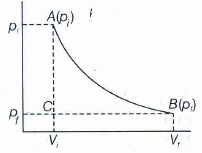
(ii) Work against constant pressure, pf is represented by the area BCViVf .Work(i) > Work (ii)
6.
2 NaHCO3(s) \(\longrightarrow \) Na2CO3 (s) + CO2(g) + H2O(g)
\({ \triangle }_{ r }{ H }^{ o }={ \triangle }_{ f }{ H }^{ o }({ Na }_{ 2 }{ CO }_{ 3 })+{ \triangle }_{ f }{ H }^{ o }({ CO }_{ 2 })+{ \triangle }_{ r }{ H }^{ o }({ H }_{ 2 }O)-2{ \triangle }_{ f }{ H }^{ o }({ S }_{ m }^{ o }(NaHCO_{ 3 })\)
\(=-1130+(-393.51)+(-241.82)-2X(-947.7)\)
\( =-1766.23+1895.4=129.17KJ{ mol }^{ -1 }\)
\( { \triangle }_{ r }{ S }^{ o }={ \triangle }_{ r }{ S }_{ m }^{ o }({ Na }_{ 2 }{ CO }_{ 3 })+{ S }_{ m }^{ o }({ CO }_{ 2 })+{ S }_{ m }^{ o }({ H }_{ 2 }O)-2{ S }_{ m }^{ o }(NaHCO_{ 3 })\)
\(=136.0+188.83+231.74-2\times102.1\)
\( =538.57-204.2=334.37J{ K }^{ -1 }{ mol }^{ -1 }\)
From second law of thermodynamics \({ \triangle }_{ r }{ S }^{ o }=\frac { { \triangle }_{ r }{ H }^{ o } }{ T } \)
\(\therefore T=\frac { { \triangle }_{ r }{ H }^{ o } }{ { \triangle }_{ r }{ S }^{ o } } =\frac { 129.17 }{ 334.37\times{ 10 }^{ -3 } } =386.3 \ K\)
Reaction will be spontaneous above 386.3 K.
7.
A heat capacity of water = heat capacity of calorimeter, the heat gained by water = heat lost by calorimeter
\(=125\times (296.5-286.4)\times 4.184 \ J=5282J=5.282kJ\)
8.
\(\text{ we know } \triangle _{ r }G^{ \ominus }=-2.303 \ RT \ \log { { K }_{ P } }\) \(and R=8.314 \ JK^{ -1 }mol^{ -1 }\)
\(\text{ therefore,}\triangle _{ r }G^{ \ominus }=-2.303(831JK^{ -1 }mol^{ -1 })\times (298K)(\log { 2.47\times { 10 }^{ -29 }) }\)
= 163000 J mol–1
= 163 kJ mol–1.

11th Standard CBSE Syllabus & Materials
11th Standard CBSE
CBSE 11th Business Studies Forms of Business Organisation Sample Question Papers Study Material - QB365 Set A
NEW11th Standard CBSE
CBSE 11th Business Studies Business, Trade and Commerce Sample Question Papers Study Material - QB365 Set A
NEW11th Standard CBSE
CBSE 11th Physics Waves Sample Question Papers Study Material - QB365 Set A
NEW11th Standard CBSE
CBSE 11th Physics Kinetic Theory Sample Question Papers Study Material - QB365 Set A



CBSE 11th Standard CBSE Subjects
CBSE Standards









