
 100% FREE ACCESS
11th Standard CBSE Syllabus & Materials
11th Standard CBSE
CBSE 11th Economics PART-A - Presentation of Data - New Sample Question Papers Study Material - QB365 Set A
NEW11th Standard CBSE
CBSE 11th Economics PART-A - Organisation of Data - New Sample Question Papers Study Material - QB365 Set A
NEW11th Standard CBSE
CBSE 11th Economics PART-A - Collection of Data - New Sample Question Papers Study Material - QB365 Set A
NEW11th Standard CBSE
CBSE 11th Economics PART-A - Introduction to Economics and Statistics - New Sample Question Papers Study Material - QB365 Set A
NEW11th Standard CBSE
CBSE 11th Business Studies International Trade Sample Question Papers Study Material - QB365 Set A
NEW11th Standard CBSE
CBSE 11th Business Studies Evolution and Fundamentals of Business Sample Question Papers Study Material - QB365 Set A

Published on: 03/09/2019
Classification of Elements and Periodicity in Properties
Download CBSE Class 11th Standard CBSE Chemistry question papers, sample papers, important questions, and previous year solved papers in PDF format. Get free study materials, NCERT solutions, and exam preparation resources for Class 11th Standard CBSE Chemistry
Questions + Answers key
Take MCQ Chemistry Test
1.
Electronegativity of F on Pauling scale is 4.0. What is the value on Mulliken's scale.
2.
Explain why chlorine can be converted into chloride ion more easily as compared to fluoride ion from fluorine.
3.
How many elements can be accommodated in the present set up of the long form of the periodic table? Explain.
4.
All transition elements are d-block elements, but all d-block elements are not transition elements. Explain.
5.
Four elements have the following first ionisation enthalpies ( in kJ mol-1); 869, 941, 1191 and 1142. The elements, in random order, are Se, Br, Te and I. Which element has an ionisation enthalphy of 869 kJ mol-1 and 1142 kJmol-1 respectively?
6.
A boy has reported the radii of Cu,Cu+ and Cu2+ as 0.096 nm,0.122 nm and 0.072 nm respectively.However, it has been noticed that he interchanged the values by mistake. Assign the correct values to different species.
7.
Why do elements in the same group have similar physical and chemical properties?
8.
Why were the names eka-aluminium and eka-silicon given to gallium and germanium by Mendeleev?
9.
The elements Z = 117 and 120 have not yet been discovered. In which family/group would you place these elements and also give the electronic configuration in each case.
10.
How does the metallic and non-metallic character vary on moving from left to right in a period?
11.
Arrange the following as stated. 'Decreasing order of electropositive character of Cu, Fe Mg'
12.
The amount of energy released when 1\(\times \)1010 atoms of chlorine in vapor state are converted to Cl- ions according to the equation, Cl ( g ) + e- \(\longrightarrow\) Cl- ( g ) is 57.86 \(\times\)10-10 J
Calculate the electron gain enthalpy of the chlorine atom in terms of kJ mol-1 and eV per atom.
1.
Value on Mulliken's scale = 2.8 x 4 = 11.2.
2.
Electron gain enthalpy of Cl is more negative than that of F.
3.
In the present set up of the long form of the periodic table, we have eighteen groups, seven periods (i.e. principal quantum number, n = 7) and four blocks (s, p, d and f-block elements).
Therefore, the maximum number of elements which can be accommodated in the present set up of the long form of the periodic table in accordance with Aufbau principle is
1s 2 , 2s 2 , 3s2 , 3p6 , 4s2, 3d10 , 4p6 , 5s2 , 4d10 , 5p6 , 6s2 ,4f14 , 5d10 , 6p6 , 7s2 , 5f14 , 6d10 , 7p6 = 118.
4.
Elements in which the last electron enters in the d-orbitals, are called d-block elements or transition elements. These elements have the general outer electronic configuration (n-1)d1-10 ns0-2 . Zn, Cd and H having the electronic configuration, (n-1)d10 ns2 do not show most of the properties of transition elements. The d-orbitals in these elements are completely filled in the ground state as well as in their common oxidation states. Therefore, they are not regarded as transition elements. Thus, on the basis of properties, all transition elements are d-block elements are not transition elements.
5.
Se and Te belong to 16 group and fourth and fifth period respectively whereas Br and I belong to 17 group and fourth and fifth period respectively. In a period ionisation energy increase but along a group, it decreases. Thus, the order of ionisation enthalpy is Te < I < Se < Br. i.e. Te has IE of 869 and Se has IE of 1142 kJ mol-1.
6.
Cu [ 0.122 nm ],Cu+ [0.096 nm],Cu2+ [0.072 nm].
∴ size ∝ \(\frac{1}{\text{positive charge}}\)
7.
Same group elements have similar valence shell electronic configuration. Therefore, have similar physical and chemical properties.
8.
These names were given to gallium and germanium by Mendeleev because he thought that these elements will have similar properties as that of aluminium and silicon, respectively.
9.
We see from Fig.,
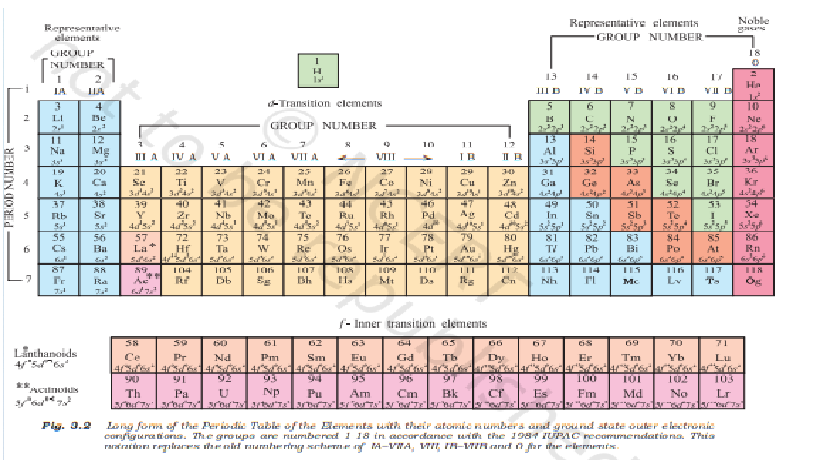
that element with Z = 117, would belong to the halogen family (Group 17) and the electronic configuration would be [Rn] 5f 146d107s27p5. The element with Z = 120, will be placed in Group 2 (alkaline earth metals), and will have the electronic configuration [Uuo]8s2.
10.
As we move from left to right in period, the number of valence electrons increases by one at each succeeding element but the number of shells remains same. Due to this, effective nuclear charge ivcreases.
More is the effective nuclear charge, more is the attraction between nuclei and electron.
Hence, the tendency of the element to lose electrons decreases, this results in decrease in metallic character.
Furthermore, the tendency of an element to gain electrons increases with increase in effective nuclear charge, so non-metallic character increases on moving from left to right in a period.
11.
Electropositive character means tendency to give an electron to form cation. It varies directly with atomic radii. Thus, the correct order is Mg > fe > Cu.
12.
The amount of energy released when 1 x 10¹⁰ atoms of chlorine in vapour state are converted to Cl- ions, according to the equation.
Cl ( G ) + e- \(\longrightarrow \) Cl- ( g ) is 57.86 \(\times \) 10-10 J
\(\therefore \) The electron gain enthalpy of ghlorine, i.e. the amount of energy releaed ehen 1 mole ( 6.023 \(\times \) 1023 ) atoms of chlorineare coverted into Cl- ions according to the above equation will be
= -\(\frac { 57.86\times { 10 }^{ -10 } }{ 1\times { 10 }^{ 10 } } \times 6.023\times { 10 }^{ 23 }\)
= -348.49 \(\times\) 103 J mol-1
= -348.49 kJ mol-
Now 1 eV/atom = 96.49 kj mol-1
\(\therefore\) Electron gain enthalpy of chlorine
= -\(\frac { 348.49 }{ 96.49 }\)
= - 3.61 eV/atom

11th Standard CBSE Syllabus & Materials
11th Standard CBSE
CBSE 11th Business Studies Forms of Business Organisation Sample Question Papers Study Material - QB365 Set A
NEW11th Standard CBSE
CBSE 11th Business Studies Business, Trade and Commerce Sample Question Papers Study Material - QB365 Set A
NEW11th Standard CBSE
CBSE 11th Physics Waves Sample Question Papers Study Material - QB365 Set A
NEW11th Standard CBSE
CBSE 11th Physics Kinetic Theory Sample Question Papers Study Material - QB365 Set A



CBSE 11th Standard CBSE Subjects
CBSE Standards









