
 100% FREE ACCESS
11th Standard CBSE Syllabus & Materials
11th Standard CBSE
CBSE 11th Economics PART-A - Presentation of Data - New Sample Question Papers Study Material - QB365 Set A
NEW11th Standard CBSE
CBSE 11th Economics PART-A - Organisation of Data - New Sample Question Papers Study Material - QB365 Set A
NEW11th Standard CBSE
CBSE 11th Economics PART-A - Collection of Data - New Sample Question Papers Study Material - QB365 Set A
NEW11th Standard CBSE
CBSE 11th Economics PART-A - Introduction to Economics and Statistics - New Sample Question Papers Study Material - QB365 Set A
NEW11th Standard CBSE
CBSE 11th Business Studies International Trade Sample Question Papers Study Material - QB365 Set A
NEW11th Standard CBSE
CBSE 11th Business Studies Evolution and Fundamentals of Business Sample Question Papers Study Material - QB365 Set A

Published on: 03/09/2019
Chemical Bonding and Molecular Structure
Download CBSE Class 11th Standard CBSE Chemistry question papers, sample papers, important questions, and previous year solved papers in PDF format. Get free study materials, NCERT solutions, and exam preparation resources for Class 11th Standard CBSE Chemistry
Questions + Answers key
Take MCQ Chemistry Test
1.
Give the correct decreasing order C-H bond,lengths in molecule \({ C }_{ 2 }H_{ 6 },{ C }_{ 2 }H_{ 4 }\) and \({ C }_{ 2 }H_{ 2 }\)
2.
Explain why HF is less viscous than H2O
3.
Why axial bonds of PCI5 are longer than equatorial bonds?
4.
Among the molecules, NO+, N2, SnCl 2, and \({ NO }_{ \overline { 2 } }\) identify the species which is isoelectronic with CO.
5.
What is meant by the term bond order? Calculate the bond order of : N2, O2, O2 +, \({ O }_{ 2 }^{ - }\)
6.
In the following pair of the compound, which one is more covalent and why?
(i) AgCl, AgI
(ii) BeCl2 , MgCl2
(iii) SnCl2 , SnCl4
(iv) CuO, CuS
7.
Explain the following on the basis of valence bond theory.
(a) BF3 is planer but NH3 is not.
(b) CCl4 and SiCl4 are tetrahedral.
(c) The HSH bond angle is H2S is closer to 900 than HOH bond angle in H2O.
8.
Calculate the formal charge on each atoms of Carbonate ion
1.

This is because hybrid orbitals of carbon involved in ocerlapping with 1s-orbital of hydrogen are Sp3,Sp2 and sp respectively and their sizes are in the order Sp3>Sp2>Sp
2.
There is greater intermolecular hydrogen bonding in H2 O than that in HF as each H2 O molecule forms four H-bonds with water molecules,, whereas HF forms only H-bonds with other HF molecules. Greater the intermolecular H-bonding, greater is the viscosity. Hence, HF is less viscous than H2 O
3.
This is due to greater repulsion on the axial bond pairs by the equatorial bond pairs of electrons.
4.
Isoelectronic species are those species have same number of electrons but different nuclear charge.
Electrons present in CO = 6 + 8 = 14
Then, In NO+ = 7 + 8 -1 = 14
In N2 = 7 + 7 = 14
In SnCl2 = (very high)50 + 17 \(\times \) 2 = 50 + 34 = 84
In \({ NO }_{ \overline { 2 } }\) = 7 + 16 + 1 = 24
5.
Bond order is defined as one half the difference between the number of electron present in the bonding and anti-bonding orbitals, i.e
Bond order (BO) \(=\frac { 1 }{ 2 } ({ N }_{ b }-{ N }_{ a })\)
A positive bond order means a stable molecule while a negative or zero bond order means an unstable molecule.
Stability of a molecule \(\propto \) bond order
Bond length \(\propto \) \(\frac { 1 }{ bond \ order } \)
Bond order values 1,2 or 3 corresponding to single, double or triple bonds respectively.
6.
(a) AgI is more covalent that AgCl. This is because I- ion is larger in size than Cl- ion and hence, is more polarised than Cl ion.-
(b) BeCl2 is more covalent than MgCl2 . This is because Be2+ ion is smaller in size than Mg2+ ion and hence has the greater polarising power.
(c) SnCl4 is more covalent than SnCl2 . This is because Sn4+ ion has greater charge and smaller size than Sn2+ ion and hence has greater polarising power.
(d) CuS is more covalent than CuO. This is because S2- ion has larger size than O2- ion and hence is more polarised than O2- ion.
7.
(i) In BF3, B-atom undergoes sp2 hybridisation. Hence, BF3 is triangular planar. In NH3, N-atom undergoes sp3 hybridisation. Hence, NH3 has pyramidal shape with one lone pair on N-atom.
(ii) Both C in CCl4 and Si and SiCl4 undergo sp3 hybridisation. Hence, they are tetrahedral.
(iii) This is because of lower electronegativity of S as compared to O.
8.
Lewis structure of CO32- ion is
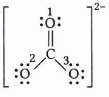
The formal charge on
(a) the carbon atom = V - L - \(\frac { 1 }{ 2 } \)S
= 4 - 0 - \(\frac { 1 }{ 2 } \)(8) = 0
(b) the oxygen atom marked as (1) = V - L - \(\frac { 1 }{ 2 } \)S
= 6 - 4 - \(\frac { 1 }{ 2 } \)(4) = 0
(c) the oxygen atoms marked as (2) and (3) = V - L - \(\frac { 1 }{ 2 } \)S
= 6 - 6 - \(\frac { 1 }{ 2 } \)(2) = -1

11th Standard CBSE Syllabus & Materials
11th Standard CBSE
CBSE 11th Business Studies Forms of Business Organisation Sample Question Papers Study Material - QB365 Set A
NEW11th Standard CBSE
CBSE 11th Business Studies Business, Trade and Commerce Sample Question Papers Study Material - QB365 Set A
NEW11th Standard CBSE
CBSE 11th Physics Waves Sample Question Papers Study Material - QB365 Set A
NEW11th Standard CBSE
CBSE 11th Physics Kinetic Theory Sample Question Papers Study Material - QB365 Set A



CBSE 11th Standard CBSE Subjects
CBSE Standards









