
 100% FREE ACCESS
11th Standard CBSE Syllabus & Materials
11th Standard CBSE
CBSE 11th Economics PART-A - Presentation of Data - New Sample Question Papers Study Material - QB365 Set A
NEW11th Standard CBSE
CBSE 11th Economics PART-A - Organisation of Data - New Sample Question Papers Study Material - QB365 Set A
NEW11th Standard CBSE
CBSE 11th Economics PART-A - Collection of Data - New Sample Question Papers Study Material - QB365 Set A
NEW11th Standard CBSE
CBSE 11th Economics PART-A - Introduction to Economics and Statistics - New Sample Question Papers Study Material - QB365 Set A
NEW11th Standard CBSE
CBSE 11th Business Studies International Trade Sample Question Papers Study Material - QB365 Set A
NEW11th Standard CBSE
CBSE 11th Business Studies Evolution and Fundamentals of Business Sample Question Papers Study Material - QB365 Set A

Published on: 28/07/2019
Chemical Bonding and Molecular Structure
Download CBSE Class 11th Standard CBSE Chemistry question papers, sample papers, important questions, and previous year solved papers in PDF format. Get free study materials, NCERT solutions, and exam preparation resources for Class 11th Standard CBSE Chemistry
Questions + Answers key
Take MCQ Chemistry Test
1.
Explain the diamagnetic behaviour of F2 molecule on the basis of molecular orbital theory
2.
Define antibonding molecular orbital.
3.
How is bond order related to bond length of a molecule?
4.
Why B2 is paramagnetic in nature while C2 is not?
5.
Arrange the following in order of decreasing bond angles.
(i) CH4, NH3, H2O, BF3, C2H2
(ii) \({ NH }_{ 3 },{ NH }_{ 2 }^{ - },{ NH }_{ 4 }^{ + }\)
6.
Arrange the following bonds in order of increasing ionic character giving reason. N-H, F-H, C-H and O-H
7.
Arrange the bonds in order of increasing ionic character in the molecules: LiF, K2O , N2, SO2 and ClF3 .
8.
Out of \(\sigma \) and \(\pi \)-bonds, which one is stronger and why?
9.
What is valence bond approach for the formation of covalent bond?
10.
Use molecular orbital theory to explain why the Be2 molecule does not exist.
11.
Can we have a diatomic molecule with its ground state molecular orbitals full with electrons? Give a reason for your answer.
12.
What type of atomic orbitals can overlap to form molecular orbitals?
13.
Apart from tetrahedral geometry, another possible geometry for CH4 is square planar with the four H atoms at the corners of the square and the C atom at its centre. Explain why CH4 is not square planar ?
14.
the percentage ionic character in certain bond A-B is 54.76% and the bond length A-B is given as 246 \(\mathring { A } \). What is the dipole moment of AB molecule?
15.
Explain why BeH2 molecule has a zero dipole moment although the Be–H bonds are polar.
16.
Explain the formation of H2 molecule on the basis of valence bond theory.
17.
Arrange the following sets of molecules in the decreasing order of bond angle.
(a) SF6, CCl4, H2O, NH3
(b) CH4, NH3, H2O, BF3
18.
sp3, sp2 and sp hybridized carbon atom, the p character is maximum in:______.
sp3
sp2
sp
all of the above have same p-character
19.
Which one is diamagnetic among NO+ , NO and NO-?
NO+
NO
NO-
None of these
20.
The molecule Ne2 does not exist because ______.
Nb > Na
Nb = Na
Nb < Na
None of these
21.
The species CO, CN- and N2 are ______.
isoelectronic
having coordinated bond
having polar bond
having low bond energies
22.
A co-ordinate bond is formed by ______.
sharing of electrons contributed by both the atoms
complete transfer of electrons
sharing of electrons contributed by one atom only
none of these
1.
The orbital electronic configuration of fluorine (Z = 9)
\(={ 1s }^{ 2 }{ 2s }^{ 2 }{ 2p }_{ x }^{ 2 }{ 2p }_{ y }^{ 2 }{ 2p }_{ z }^{ 1 }\)
M.O.E.C. of fluorine =[σ2s]2 [σ*2s]2 [σ2pz]2 [\(\pi\)2px]2 [\(\pi\)2py]2 [\(\pi\)*2px]2 [\(\pi\)*2py]2
Due to presence of all filled orbitals, F2 is diamagnetic
2.
The molecular orbital fonned by the subtractive effect of the electron waves of the combining atomic orbitals, is called antibonding molecular orbital.
3.
Bond length is inversely proportional to bond order.
4.
The molecular orbital electronic configuration of both B2 and C2 are
B2: [σ1s]2 [σ*1s]2 [σ2s]2 [σ*2s]2 [\(\pi\)2px]1[\(\pi\)*2py]1
C2: [σ1s]2 [σ*1s]2 [σ2s]2 [σ*2s]2 [\(\pi\)2px]2[\(\pi\)*2py]2
Since B2 has two unpaired electrons, B2 is paramagnetic. C2 has no unpaired electron. Thus, C2 is diamagnetic.
5.
(a) \({ C }_{ 2 }{ H }_{ 2 }\left( { 180 }^{ 0 } \right) >{ CH }_{ 4 }\left( { 109 }^{ 0 }{ 28 }^{ ' } \right) >{ BF }_{ 3 }\left( { 120 }^{ 0 } \right) >{ NH }_{ 3 }\left( { 107 }^{ 0 } \right) >{ H }_{ 2 }O>\left( { 104.5 }^{ 0 } \right) \)This is because all of them involve sp3 hybridisation. The number of lone pair of electrons present on N-atom are 0,1 and 2 respectively. Greater the number of lone pairs, greater is the repulsion and lesser is the bond angle.
(b) \({ NH }_{ 4 }^{ + }>{ NH }_{ 3 }>{ NH }_{ 3 }^{ - }\)
This is because all of them involve sp3 hybridisation. The number of lone pair of electrons present on N-atom are 0,1 and 2 respectively. Greater the number of lone pairs, greater is the repulsion and lesser is the bond angle.
6.
Greater is the electronegativity difference between the two bonded atoms, greater is the ionic character.
| N-H | F-H | C-H and | O-H | |
| Electronegativity difference |
(3.0-2.1) =0.9 |
(4.0-2.1) = 1.9 |
(2.5-2.1) = 0.4 |
(3.5-2.1) = 1.4 |
Therefore, increasing order of ionic character of the given bonds is as follows.
C-H.
7.
Ionic character \(\propto \) lattice energy
\(\propto \frac { 1 }{ size \ of \ ion } \propto charge \ on \ ion,\)
A non-polar molecule like N2 has almost negligible ionic character.
\(\therefore \)The order of ionic character is
\( ({ N }_{ 2 }<{ SO }_{ 2 }<{ CIF }_{ 3 }<{ K }_{ 2 }O\)
8.
σ bond is stronger. This is because σ-bond is formed by head-on overlapping of atomic orbitals and therefore, the overlapping is large. π -bond is formed by sideway overlapping which is small.
9.
A covalent bond is formed by the overlap of half-filled atomic orbitals.
10.
Electronic configuration of Be2 molecule (4 + 4 = 8)
σ1s2,σ1s2,σ1s2,σ1s2
Bond order=1/2[Nb−Na]=1/2(4−4)=0
Since, bond order in zero, so Be2 does not exist.
11.
No, because bond order becomes zero, e.g in case of He2, Be2, Ne2 etc. Note that in H2 ,σ1s molecular orbitals is full but σ1s is empty.
12.
Atomic orbitals with comparable energies and proper orientation overlap to form molecular orbitals
13.
Electronic configuration of carbon atom: C: σ1s2 2s2 2p2.
In the excited state, the orbital picture of carbon can be represented as:
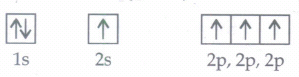
Hence, carbon atom undergoes sp3 hybridization in CH4 molecule and takes a tetrahedral shape.
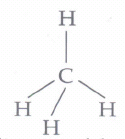
For a square planar shape, the hybridization of the central atom has to be dsp3. However, an atom of carbon does not have d-orbitals to undergo dsp3 hybridization. Hence, the structure of CH4 is tetrahedral.
14.
If the molecule where 100% ionic, then
\(\mu \) calculated for 100% ionic = \(q\times d\)
\(=1.602\times { 10 }^{ -19 } \ (C) \ 246\times { 10 }^{ -10 } \ (m) \ =3.94\times { 10 }^{ -27 } \ cm\)
% ionic character \(=\frac { { \mu }_{ observed } }{ { \mu }_{ calculated } } \times 100\)
\({ \mu }_{ observed }\)\(=\frac { { ionic \ character\times { \mu }_{ calculated } } }{ 100 } \)
\(=\frac { 54.76\times 3.94\times { 10 }^{ -27 } }{ 100 } \)
\(=2.15\times { 10 }^{ -27 } \ Cm=\frac { 2.15\times { 10 }^{ -27 } }{ 3.35\times { 10 }^{ -30 } } \ D=644.0D\)
15.
The Lewis structure for BeH2 is as follows:
H: Be: H
There is no lone pair at the central atom (Be) and there are two bond pairs. Hence, BeH2 is of the type AB2. It has a linear structure.
\(\nrightarrow \nleftarrow \)
H------Be-----H
Dipole moments of each H - Be bond are equal and are in opposite directions. Therefore, they nullify each other. Hence, BeH2 has a zero dipole moment.
16.
Let us consider the combination between atoms of hydrogen HA and HB and eA and eB be their respective electrons.
As they tend to come closer, two different forces operate between the nucleus and the electron of the other and vice versa. The nuclei of the atoms as well as their electrons repel each other. Energy is needed to overcome the force of repulsion. Although the number of new attractive and repulsive forces is the same, but the magnitude of the attractive forces is more. Thus, when two hydrogen atoms approach each other, the overall potential energy of the system decreases. Thus, a stable molecule of hydrogen is formed.
17.
(a) \(\underset { Tetrahedral }{ { CCl }_{ 4 }({ 109.5 }^{ 0 } } ),\underset { Pyramidal }{ { NH }_{ 3 }({ 107 }^{ 0 }) } ,\underset { Angular }{ { H }_{ 2 }O{ (104.5 }^{ 0 } } ),\underset { Octahedral }{ { SF }_{ 6 }{ (90 }^{ 0 }) } \)
(b) \(\underset { Planar }{ { BF }_{ 3 }({ 120 }^{ 0 } } ),\underset { Tetrahedral }{ { CH }_{ 4 }({ 109.5 }^{ 0 }) } ,\underset { Pyramidal }{ { NH }_{ 3 }{ (107 }^{ 0 } } ),\underset { Angular }{ { H }_{ 2 }{ O(104.5 }^{ 0 }) } \)
18.
(a)
sp3
19.
(a)
NO+
20.
(b)
Nb = Na
21.
(a)
isoelectronic
22.
(c)
sharing of electrons contributed by one atom only

11th Standard CBSE Syllabus & Materials
11th Standard CBSE
CBSE 11th Business Studies Forms of Business Organisation Sample Question Papers Study Material - QB365 Set A
NEW11th Standard CBSE
CBSE 11th Business Studies Business, Trade and Commerce Sample Question Papers Study Material - QB365 Set A
NEW11th Standard CBSE
CBSE 11th Physics Waves Sample Question Papers Study Material - QB365 Set A
NEW11th Standard CBSE
CBSE 11th Physics Kinetic Theory Sample Question Papers Study Material - QB365 Set A



CBSE 11th Standard CBSE Subjects
CBSE Standards









