
 100% FREE ACCESS
11th Standard CBSE Syllabus & Materials
11th Standard CBSE
CBSE 11th Economics PART-A - Presentation of Data - New Sample Question Papers Study Material - QB365 Set A
NEW11th Standard CBSE
CBSE 11th Economics PART-A - Organisation of Data - New Sample Question Papers Study Material - QB365 Set A
NEW11th Standard CBSE
CBSE 11th Economics PART-A - Collection of Data - New Sample Question Papers Study Material - QB365 Set A
NEW11th Standard CBSE
CBSE 11th Economics PART-A - Introduction to Economics and Statistics - New Sample Question Papers Study Material - QB365 Set A
NEW11th Standard CBSE
CBSE 11th Business Studies International Trade Sample Question Papers Study Material - QB365 Set A
NEW11th Standard CBSE
CBSE 11th Business Studies Evolution and Fundamentals of Business Sample Question Papers Study Material - QB365 Set A

Published on: 30/08/2019
Consumer Equilibrium
Download CBSE Class 11th Standard CBSE undefined question papers, sample papers, important questions, and previous year solved papers in PDF format. Get free study materials, NCERT solutions, and exam preparation resources for Class 11th Standard CBSE undefined
Questions + Answers key
Take MCQ Biology Test
1.
Suppose a consumer wants to consume two goods which are available only in integer units. The two goods are equally priced at Rs.10 and the consumer's income is Rs.40.
(i) Write down all the bundles that are available to the consumer.
(ii) Among the bundles that are available to the consumer's. Identify those which cost her exactly 40.
2.
A consumer wants to consume two goods. The prices of the two goods are Rs.4 and Rs. 5 respectively. The consumer's income is Rs.20.
(i) Write down the equation of the budget line.
(ii) How much quantity of good 1 can the consumer consume if she spends her entire income on that good?
(iii) How much of good 2 can she consume if she spends her entire income on that good?
(iv) What is the slope of the budget line?
3.
Why is budget line negatively sloped?
4.
Suppose your friend is indifferent to the bundles (5, 6) and (6, 6). Are the preferences of your friend monotonic?
5.
Suppose a consumer's preferences are monotonic. What can you say about her preference-ranking over the bundles (10, 10), (10, 9), (9, 9).
6.
A consumer wants to consume two goods. The prices of the two goods are Rs.4 and Rs. 5 respectively. The consumer's income is Rs.20.
(i) Write down the equation of the budget line.
(ii) How much quantity of good 1 can the consumer consume if she spends her entire income on that good?
(iii) How much of good 2 can she consume if she spends her entire income on that good?
(iv) What is the slope of the budget line?
What happens to the budget set if both the prices as well as the income double?
7.
A consumer wants to consume two goods. The prices of the two goods are Rs.4 and Rs. 5 respectively. The consumer's income is Rs.20.
(i) Write down the equation of the budget line.
(ii) How much quantity of good 1 can the consumer consume if she spends her entire income on that good?
(iii) How much of good 2 can she consume if she spends her entire income on that good?
(iv) What is the slope of the budget line?
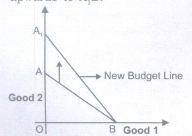
How does the budget line change if the price of good 2 decreases by a rupee but the price of good 1 and the consumer's income remain unchanged?
1.
Let Px = Py = Rs.10
Money Income = 40
(i) Bundles available to consumer are: (0,0), (0,1), (0,2), (0,3), (0,4), (1,0), (1,1), (1,2), (1,3), (2,0), (2,1), (2,2), (3,0), (3,1) and (4, 0).
(ii) (0,4), (1,3), (2,2), (3,1) and (4,0) cost exactly Rs.40. All the other bundles cost less than Rs.40.
2.
(i) Let the two quantities of goods be X and Y. We are given Px = Rs 4, Py = Rs.5, Consumer's income (M) = Rs.20.
Budget line equation is,
Px .X + Py .Y= M or = 4X + 5Y= 20
(ii) If quantity consumed of good Y = 0, Budget equation becomes,
Px.X + zero = M = 4.X = 20 = X = 20/4 = 5 units
(iii) If quantity consumed of good X = 0, Budget equation becomes,
Zero + Py .Y = M
or = 5Y = 20 = Y = 20/5 = 4 units.
(iv) Slope of budget line = Px/Py
=4/5 = 0.8
3.
()
Budget line is downward sloping because if a consumer wants to buy more of one commodity, he has to buy less of other goods, given money income.
4.
()
No, the preferences of my friend are not monotonic since bundle (6, 6) should be monotonically preferred to bundle (5, 6).
5.
()
If a consumer has monotonic preferences then,
(i) Bundle (10, 10) is monotonically preferred to bundle (10, 9) and bundle (9, 9).
(ii) Bundle (10, 9) is monotonically preferred to bundle (9, 9).
6.
()
There will be no change in the budget line. Let us understand this with the price of goods 1 rises from Rs.4 to Rs.8 and that of goods 2 rises from Rs.5 to Rs.10. Income also rises from Rs.20 to Rs.40. With double increase in prices and income, intercepts on both X-axis and Y-axis will remain unchanged at 5 units (goods 1) and 4 units (goods 2) respectively. Slope of budget line will also remain the same. Therefore, there will be no change in the budget set and the budget line.
7.
()
If price of good 2 (shown on y-axis) decreases, consumer can buy more pieces/quantity of good 2. The budget line AB will pivot at B and rotate upwards to A1B.

11th Standard CBSE Syllabus & Materials
11th Standard CBSE
CBSE 11th Business Studies Forms of Business Organisation Sample Question Papers Study Material - QB365 Set A
NEW11th Standard CBSE
CBSE 11th Business Studies Business, Trade and Commerce Sample Question Papers Study Material - QB365 Set A
NEW11th Standard CBSE
CBSE 11th Physics Waves Sample Question Papers Study Material - QB365 Set A
NEW11th Standard CBSE
CBSE 11th Physics Kinetic Theory Sample Question Papers Study Material - QB365 Set A



CBSE 11th Standard CBSE Subjects
CBSE Standards










