
 100% FREE ACCESS
11th Standard CBSE Syllabus & Materials
11th Standard CBSE
CBSE 11th Economics PART-A - Presentation of Data - New Sample Question Papers Study Material - QB365 Set A
NEW11th Standard CBSE
CBSE 11th Economics PART-A - Organisation of Data - New Sample Question Papers Study Material - QB365 Set A
NEW11th Standard CBSE
CBSE 11th Economics PART-A - Collection of Data - New Sample Question Papers Study Material - QB365 Set A
NEW11th Standard CBSE
CBSE 11th Economics PART-A - Introduction to Economics and Statistics - New Sample Question Papers Study Material - QB365 Set A
NEW11th Standard CBSE
CBSE 11th Business Studies International Trade Sample Question Papers Study Material - QB365 Set A
NEW11th Standard CBSE
CBSE 11th Business Studies Evolution and Fundamentals of Business Sample Question Papers Study Material - QB365 Set A

Published on: 27/09/2019
Cost
Download CBSE Class 11th Standard CBSE undefined question papers, sample papers, important questions, and previous year solved papers in PDF format. Get free study materials, NCERT solutions, and exam preparation resources for Class 11th Standard CBSE undefined
Questions + Answers key
Take MCQ Biology Test
1.
What is the behaviour of average fixed cost as output increases?
2.
How does AFC behave as output is increased?
3.
Given below is the cost schedule of a firm. Its average fixed cost is RS. 20 when it produces 3 units.
| Output(Units) | 1 | 2 | 3 |
|---|---|---|---|
| Average Variable cost(Rs.) | 30 | 28 | 32 |
4.
The fixed cost of a firm is Rs. 120. Its marginal cost at different levels of output is given below. Calculate the total cost and average variable cost at each output.
| Output | 1 | 2 | 3 | 4 |
| Marginal cost(Rs.) | 60 | 52 | 56 | 64 |
5.
AC schedule of a firm is given. Calculate the firm's MC for (i) 6 and (ii) 7 units.
| Quantity | 5 | 6 | 7 |
| AC | 40 | 41 | 42 |
6.
Can MC increase when AC falls?
7.
What is the behaviour of (a) Average Fixed Cost and (b) Average Variable Cost as more and more units of a good are produced?
8.
State the distinction between explicit cost and implicit cost. Give an example of each.
9.
An individual is both the owner and the manager of a shop taken on rent. Identify.implicit cost and explicit cost from this information. Explain.
10.
Explain the behaviour of aver age fixed cost using numerical example.
11.
What is meant by variable (prime) cost of a firm? Give examples.
12.
At which point does the SMC curve cut the SAC curve? Give reason in support of your answer.
13.
Why does SMC curve cut AVC curve at the minimum point of AVC curve?
14.
What are the average fixed cost, average variable cost and average cost of a firm? How are they related?
15.
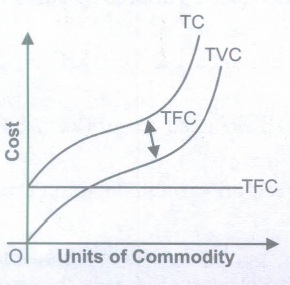
What are total fixed cost, total variable cost and total cost of a firm? How are they related?
1.
The shape of AFC is downward sloping Rectangular hyperbola. AFC falls as output increases because AFC=\(\frac{TFC}{Output}\) and TFC remains constant. So, as output increases, TFC remains constant, but AFC falls.
2.
The shape of AFC is downward sloping Rectangular hyperbola. AFC falls as output increases because AFC=\(\frac{TFC}{Output}\) and TFC remains constant. So, as output increases, TFC remains constant, but AFC falls.
3.
Calculate its marginal cost and average total cost at each given level of output.
| Output | AVC(Given) | TFC(Given) | TVC=AVC x Output | TC=TFC+TVC | AFC=\(\frac{TFC}{Output}\) | AC=\(\frac{TC}{Output}\) | MC=\(\frac{\Delta{TVC}}{\Delta{Output}}\) |
|---|---|---|---|---|---|---|---|
| 1 | 30 | 60 | 30 | 90 | 60 | 90 | 30 |
| 2 | 28 | 60 | 56 | 116 | 30 | 58 | 26 |
| 3 | 32 | 60 | 96 | 156 | 20 | 52 | 40 |
4.
| Output | MC(Given) | TFC(Given) | TVC=\(\sum\)MC | TC=TFC+TVC | AVC=\(\frac{TVC}{Output}\) |
|---|---|---|---|---|---|
| 1 | 60 | 120 | 60 | 180 | 60 |
| 2 | 52 | 120 | 112 | 232 | 56 |
| 3 | 56 | 120 | 168 | 288 | 56 |
| 4 | 64 | 120 | 232 | 352 | 58 |
5.
| Quantity | 5 | 6 | 7 |
|---|---|---|---|
| AC (Given) | 40 | 41 | 42 |
| TC = AC x Output | 200 | 246 | 294 |
| MC=\(\frac{\Delta{TC}}{\Delta{Output}}\) | - | 46 | 48 |
6.
Yes, it can happen when MC is below, than AC at the time of MC increases. The reason is that MC is confined to only one unit of the commodity produced whereas AC is related to all the units of commodity produced. As a result when MC increase, in case of MC, the whole increase is confined to the concerned one unit but in case of AC, this increase is shared by all the units of commodity produced. As the result of, rising MC is unable to bring about an increase in AC.
7.
(a) The average fixed cost falls as more and more units of goods are produced. It is so because average fixed cost is equal to
AFC = \(\frac{Total\ Fixed\ Cost (TFC)}{Output}\)
and total fixed cost remains constant with increase in level of output. So, with constant total fixed cost and increasing output, the average fixed cost falls.
(b) Average Variable Cost (AVC) is U-shaped with increase in output because of Law of Variable Proportion.
(i) As we know the shape ofAVCdepends upon the shape of Total Variable Cost (TVC). Initially, TVC increases at diminishing rate (because Total Product Increases at increasing Rate), that makes the AVC to fall.
(ii) Thereafter, TVC increases at increasing rate (because Total Product Increases at diminishing Rate), that makes the average variable cost to rise.
(iii) So, from inverse S-shape, TVC curve, we derive the U shape AVC curve.
8.
| Explicit Cost | Basis | Implicit Cost |
|---|---|---|
| It refers to the actual money expenditure of a firm on purchasing goods or hiring factor services and non-factor inputs (like raw material, electricity, fuel etc.) | Meaning | Implicit cost is the imputed or estimated value of inputs supplied by the owner of the firm himself. |
| It is explicitly shown in the firm's book of accounts and is thus, called accounting cost. | Account Book | It does not enter in the firm's book of accounts. |
| It is payment concept. | Concept | It is a receipt concept, i.e., the payments are received by producer for self-supplied services. |
| Wages, rent, interest, insurance, etc. | Examples | Wages of self-supplied labour, rent for self-owned premises, etc. |
9.
(i) For producing a commodity, a firm requires factor inputs (like services of land, labour, capital etc.) and non-factor inputs (like raw material, electricity, fuel etc.).
(ii) Actual money spent by a firm on buying and hiring of factor and nonfactor inputs is called explicit cost. As per question, rent paid for the shop is an explicit cost.
(iii) Implicit cost is the imputed or estimated value of inputs supplied by the owner of the firm himself. As, per question, imputed salary of the owner working as manager, imputed interest on self-supplied capital, etc. are implicit costs.
10.
(i) The per unit cost incurred on fixed factors of production is known as average fixed cost.
AFC = \(\frac{TFC}{Output}\)
(ii)
| Units of commodity | TFC | AFC |
|---|---|---|
| 0 | 60 | - |
| 1 | 60 | 60 |
| 2 | 60 | 30 |
| 3 | 60 | 20 |
| 4 | 60 | 15 |
| 5 | 60 | 12 |
AFC falls as output increases because
AFC = \(\frac{TFC}{Output}\)and TFC remains constant.
So, as output increases, TFC remains constant, AFC falls.
11.
(i) The cost incurred on variable factors of production is known as TVC.
(ii) TVC is very much related with the production and fluctuates with the fluctuation in production.
(iii) In case of zero level of production, TVC would also be zero.
(iv) For example, Wages of casual labour, payment for raw material, etc.
12.
(i) It happens because when SAC falls, SMC is less than SAC.
(ii) When SAC starts rising, SMC is more than SAC.
(iii) So, it is only when SAC is constant and at its minimum point, that SMC is equal to SAC. Therefore, SMC curve cuts SAC curve at its minimum point.
13.
(i) It happens because when AVC falls, SMC is less than AVC.
(ii) When AVC starts rising, SMC is more than AVC.
(iii) So, it is only when AVC is constant and at its minimum point, that SMC is equal to AVC. Therefore, SMC curve cuts AVC curve at its minimum point.
14.
AFC: The per unit cost incurred on fixed factors of production is known as average fixed cost.
AFC=\(\frac{TFC}{Q}\)
AFC always decreases as the firm increases the level of production.
AVC: It is variable cost per unit of output produced. It is obtained by dividing the total variable cost by the quantity of output.
AVC=\(\frac{TVC}{Q}\)
AVC initially decreases. But after reaching the stage of minimum cost it starts increasing. AVC is V-Shaped.
AC: It is cost per unit of output produced. It can be obtained by dividing the total cost by the quantity of output produced.
AC=\(\frac{TC}{Q}\)
Relationship between AFC, AVC and AC. There is a unique relationship among AC, AFC and AVC. AC is the sum of AFC and AVC, i.e., AC = AFC + AVC.
15.
(i) TC is divided into two parts TFC and TVC such that TC = TFC + TVC.
(ii) TFC is the overhead cost and it remains constant or fixed whatever be the level of output. TFC curve is a horizontal line parallel to the x-axis.
(iii) TVC is cost due to increased use of variable factors like raw material, labour, etc. TVC is inverse S-shaped starting from the origin due to law of variable proportion.
(iv) TC is aggregate of TFC and TVC. TC curve is inverse S-shaped starting from the level of fixed cost. The reason behind it shape is the law of variable proportion.

11th Standard CBSE Syllabus & Materials
11th Standard CBSE
CBSE 11th Business Studies Forms of Business Organisation Sample Question Papers Study Material - QB365 Set A
NEW11th Standard CBSE
CBSE 11th Business Studies Business, Trade and Commerce Sample Question Papers Study Material - QB365 Set A
NEW11th Standard CBSE
CBSE 11th Physics Waves Sample Question Papers Study Material - QB365 Set A
NEW11th Standard CBSE
CBSE 11th Physics Kinetic Theory Sample Question Papers Study Material - QB365 Set A



CBSE 11th Standard CBSE Subjects
CBSE Standards










