
 100% FREE ACCESS
11th Standard CBSE Syllabus & Materials
11th Standard CBSE
CBSE 11th Economics PART-A - Presentation of Data - New Sample Question Papers Study Material - QB365 Set A
NEW11th Standard CBSE
CBSE 11th Economics PART-A - Organisation of Data - New Sample Question Papers Study Material - QB365 Set A
NEW11th Standard CBSE
CBSE 11th Economics PART-A - Collection of Data - New Sample Question Papers Study Material - QB365 Set A
NEW11th Standard CBSE
CBSE 11th Economics PART-A - Introduction to Economics and Statistics - New Sample Question Papers Study Material - QB365 Set A
NEW11th Standard CBSE
CBSE 11th Business Studies International Trade Sample Question Papers Study Material - QB365 Set A
NEW11th Standard CBSE
CBSE 11th Business Studies Evolution and Fundamentals of Business Sample Question Papers Study Material - QB365 Set A

Published on: 03/09/2019
Demand
Download CBSE Class 11th Standard CBSE undefined question papers, sample papers, important questions, and previous year solved papers in PDF format. Get free study materials, NCERT solutions, and exam preparation resources for Class 11th Standard CBSE undefined
Questions + Answers key
Take MCQ Biology Test
1.
The price elasticity of demand is defined as the responsiveness of:
price to a change in quantity demanded.
quantity demanded to a change in price
price to a change in income.
quantity demanded to a change in income
2.
Which one of the following is not an assumption of the theory of demand based on analysis of indifference curve?
Given scale of preferences as between different combinations of two goods
Diminishing marginal rate of substitution
Constant marginal utility of money.
Consumers would always prefer more of a particular piece of goods to less of it, other things remaining the same.
3.
Give the meaning of inferior good and explain the same with the help of an example.
4.
What do you mean by an 'inferior good'? Give some examples.
5.
What do you mean by complements? Give examples of two goods which are complements of each other.
6.
What do you mean by substitutes? Give examples of two goods which are substitutes of each other.
7.
Suppose there are 20 consumers for a good and they have identical demand functions:
(p) = 10 - 3p for any price less than \(\frac { 10 }{ 3 } \) and d1(p) = 0 at any price greater than or equal to \(\frac { 10 }{ 3 } \) What is the 3 market demand function?
8.
Marginal utility of the first unit is equal to Total Utility
9.
What policy initiatives can the government undertake to increase the demand of milk in the country? Mention anyone.
1.
(b)
quantity demanded to a change in price
2.
(c)
Constant marginal utility of money.
3.
(i) A good is called 'inferior goods' when its demand falls with a rise in the income of a consumer and vice- versa.
(ii) For example, Jowar or Bajra for a poor person.
(iii) A good is inferior in a relative terms. It means, a good is inferior or normal is determined by the income level of a consumer.
(iv) When a consumer moves to higher income, he/she may consider some goods below their income status, and treats them as inferior.
4.
(i) A good is called 'inferior goods' when its demand falls with a rise in the income of a consumer and vice- versa.
(ii) For example, Jowar or Bajra for a poor person.
(iii) A good is inferior in a relative terms. It means, a good is inferior or normal is determined by the income level of a consumer.
(iv) When a consumer moves to higher income, he/she may consider some goods below their income status, and treats them as inferior.
5.
(i) Complementary goods are those which are useless in the absence of other goods and which are demanded jointly.
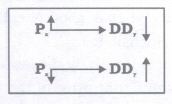
(ii) There would always exist an inverse relationship between price of complementary goods and demand for given commodity.
(iii) It means, with a rise in price of complementary goods, the demand for given commodity falls and vice-versa.
(iv) For example pen and refill, tea and sugar are complements to each other.
6.
(i) Substitute goods are those goods which can be used in place of another goods and give the same satisfaction to a consumer.
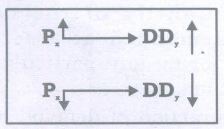
(ii) There would always exist a direct relationship between the price of substitute goods and demand for given commodity.
(iii) It means with an increase in price of substitute goods, the demand for given commodity also rises and vice-versa.
(iv) For example, Pepsi and Coke, tea and coffee are substitute to each other.
7.
It can be seen from the given demand functions, that 20 consumers do not want to demand the goods at any price greater than or equal to Rs.\(\frac { 10 }{ 3 } \). All of them demand only at a price of less than Rs.\(\frac { 10 }{ 3 } \).
For a single consumer d[P] = 10 - 3P For 20 consumers, d market[P] = [10 x 3P] x 20 = 20 - 60 P, for price \(\frac { 10 }{ 3 } \) and dmarket[P]= 0 ...., for price> = \(\frac { 10 }{ 3 } \).
8.
(a)
9.
()
Give subsidies to reduce price.
Undertake health campaigns to promote the positive effects of milk consumption.
Value: Analytic

11th Standard CBSE Syllabus & Materials
11th Standard CBSE
CBSE 11th Business Studies Forms of Business Organisation Sample Question Papers Study Material - QB365 Set A
NEW11th Standard CBSE
CBSE 11th Business Studies Business, Trade and Commerce Sample Question Papers Study Material - QB365 Set A
NEW11th Standard CBSE
CBSE 11th Physics Waves Sample Question Papers Study Material - QB365 Set A
NEW11th Standard CBSE
CBSE 11th Physics Kinetic Theory Sample Question Papers Study Material - QB365 Set A



CBSE 11th Standard CBSE Subjects
CBSE Standards










