
 100% FREE ACCESS
11th Standard CBSE Syllabus & Materials
11th Standard CBSE
CBSE 11th Economics PART-A - Presentation of Data - New Sample Question Papers Study Material - QB365 Set A
NEW11th Standard CBSE
CBSE 11th Economics PART-A - Organisation of Data - New Sample Question Papers Study Material - QB365 Set A
NEW11th Standard CBSE
CBSE 11th Economics PART-A - Collection of Data - New Sample Question Papers Study Material - QB365 Set A
NEW11th Standard CBSE
CBSE 11th Economics PART-A - Introduction to Economics and Statistics - New Sample Question Papers Study Material - QB365 Set A
NEW11th Standard CBSE
CBSE 11th Business Studies International Trade Sample Question Papers Study Material - QB365 Set A
NEW11th Standard CBSE
CBSE 11th Business Studies Evolution and Fundamentals of Business Sample Question Papers Study Material - QB365 Set A

Published on: 27/09/2019
Market Equilibrium with Simple Applications
Download CBSE Class 11th Standard CBSE undefined question papers, sample papers, important questions, and previous year solved papers in PDF format. Get free study materials, NCERT solutions, and exam preparation resources for Class 11th Standard CBSE undefined
Questions + Answers key
Take MCQ Biology Test
1.
Market for a good is in equilibrium. There is simultaneous "decrease" both in demand and supply but there is no change in market price. Explain with the help of a schedule how is it possible.
2.
What are the effects of 'price-floor' (minimum price ceiling) on the market of a good? Use diagram.
3.
Explain the effects of 'maximum price ceiling' on the market of a good. Use diagram.
4.
Explain the concept of 'buffer stock' as a tool of price floor
5.
Explain 'black marketing' as a direct consequence of price ceiling.
6.
Given below are four statements. Indicate for each whether it reflects an increase or decrease in demand; quantity demanded; supply; quantity supplied.
(i) Air Deccan reduces its average plane fare by 30% in order to attract more passengers.
(ii) The government grants export subsidy to producers of oranges in Nagpur to increase the sale of oranges abroad.
(iii) Wheat farmers decide to withhold wheat as the market price is low.
(iv) OPEC decides to increase the international oil price
7.
"An increase in the demand for notebooks raises the quantity of notebooks demanded, but not the quantity supplied." Is this statement true or false? Explain.
8.
Mrs Ramgopal says that economists say inconsistent things: as price falls, demand rises but as demand rises, prices rises. Defend or refute.
9.
Mention the various cases in which equilibrium price remains same.
10.
What would be an effect on equilibrium price and equilibrium quantity if demand and supply both fall at the same rate?
11.
Explain the effects of a 'price floor'.
12.
Explain the effects of a 'price ceiling'.
13.
Give reasons for the following statements:
(i) A decrease in supply will not result in a change in equilibrium quantity if the demand for a commodity is perfectly inelastic
(ii) An decrease in supply will not result in a change in equilibrium price if the demand for a commodity is perfectly elastic.
14.
Under what condition increase in demand would not make any effect on equilibrium quantity?
15.
Under what condition increase in demand would not make any effect on equilibrium price?
1.
When demand and supply both decrease at the same rate, equilibrium price remains constant and equilibrium quantity falls. It can be shown with the help of the following diagram.
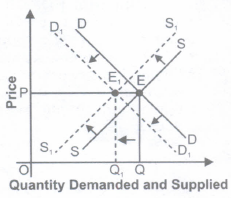
In the given diagram price is measured on vertical axis and quantity demanded and supplied is measured on horizontal axis. Initially, the equilibrium price is OP and equilibrium quantity is OQ.
But as given in the examination to problem, "demand and supply both Quantity Demanded and Supplied decrease at the same rate", then,
(i) Equilibrium price remains constant at OP and
(ii) Equilibrium quantity falls from OQ to OQ1
2.
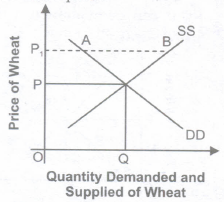
(i) When the government imposed lower limit on the price (minimum price) that may be charged for a good or service which is higher than equilibrium price is called price floor.
(ii) Price Floor is generally imposed on agricultural price support programmes and the minimum wage legislation.
(iii) Since this price is above equilibrium price, there is excess supply in the market. Since there is surplus, sellers can attempt to sell their product at a price below the floor price.
3.
(i) When the government imposed upper limit on the price (maximum price) of a good or service which is lower than equilibrium price is called price ceiling.
(ii) Price ceiling is generally imposed on necessary items like wheat, rice, kerosene etc.
(iii) It can be explained with the help of diagram below:
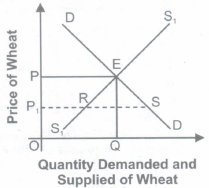
(a) In the given diagram, DD is the market demand curve and SS is the market supply curve of Wheat Suppose, equilibrium price OP is very high for many individuals and they are unable to afford at this price.
(b) As wheat is necessary product, government has to intervene and impose price ceiling of P1 which is below the equilibrium level.
(c) Since this price is below equilibrium price, there is excess demand in the market. With shortages, sellers tend to hoard the product. It could also lead to black marketing.
4.
(i) Government ensures price Floor/ minimum Support price with the tool called buffer stock.
(ii) If government feels market price is lower than what it ought to be, it would purchase the commodity at higher price from the farmers, producers so as to maintain stock.
(iii) Government maintain this buffer stock with itself and they real eased in case of shortage of the commodity in future
5.
(i) Black marketing may be termed as a direct consequence of price ceiling.
(ii) Black market is a market under which the commodity is bought and Sold at a price higher than the maximum fixed by the Government.
(iii) It arises due to presence of consumers who may be willing to pay higher price for the commodity than to go without it.
6.
(i) Increase in quantity demanded
(iii) Increase in supply.
(iii) Decrease in supply.
(iv) Decrease in quantity demanded.
7.
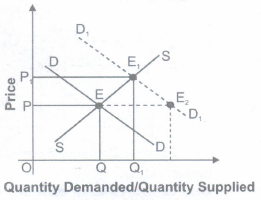
The statement that "an increase in the demand for notebooks raises the quantity of notebooks demanded, but not the quantity supplied,"in general, is false. As given figure shows, the increase in demand for notebooks results in an increased quantity supplied.
8.
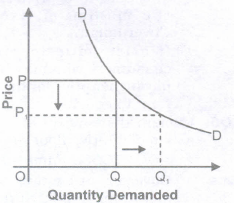
We defend the statement of Mrs. Ramgopal. As price falls, demand rises. According to Law of Demand, there is inverse relationship between demand and price. Lesser price leads to higher demand.
Demand = f (price)
When demand rises, prices also rises. Price is function of twin forces of demand and supply.
Price = f (demand, supply)
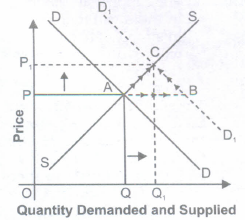
In the given figure, price is measured on vertical axis and quantity demanded and supplied is measured on horizontal axis. Initially, the equilibrium price is OP and equilibrium quantity is OQ.
But due increase in demand, the demand curve shifts rightward from DD to D1D1
With new demand curve D1D1 there is excess demand at initial price OP because at price OP, demand is PB and supply is PA, so there is excess demand ofABat price OP.
Due to this excess demand, competition among the consumer will raise the price. With the rise in price, there is upward movement along the demand curve (contraction in demand) from B to C and similarly, there is upward movement along the supply curve (expansion in supply) from A to C. So, finally equilibrium price rises from OP to OP1. So, demand rises, price rises.
9.
The equilibrium price remains same in the following cases:
(i) When increase in demand is equal to increase in supply.
(ii) When decrease in demand is equal to decrease in supply.
(iii) When demand increases and supply is perfectly elastic.
(iv) When demand decreases and supply is perfectly elastic.
(v) When supply increases and demand is perfectly elastic.
(vi) When supply decreases and demand is perfectly elastic.
10.
When demand and supply both decrease at the same rate, equilibrium price remains constant and equilibrium quantity falls. It can be shown with the help of the following diagram.
In the given diagram price is measured on vertical axis and quantity demanded and supplied is measured on horizontal axis. Initially, the equilibrium price is OP and equilibrium quantity is OQ.
But as given in the examination to problem, "demand and supply both Quantity Demanded and Supplied decrease at the same rate", then,
(i) Equilibrium price remains constant at OP and
(ii) Equilibrium quantity falls from OQ to OQ1
11.
(i) When the government imposed lower limit on the price (minimum price) that may be charged for a good or service which is higher than equilibrium price is called price floor.
(ii) Price Floor is generally imposed on agricultural price support programmes and the minimum wage legislation.
(iii) Since this price is above equilibrium price, there is excess supply in the market. Since there is surplus, sellers can attempt to sell their product at a price below the floor price.
12.
(i) When the government imposed upper limit on the price (maximum price) of a good or service which is lower than equilibrium price is called price ceiling.
(ii) Price ceiling is generally imposed on necessary items like wheat, rice, kerosene etc.
(iii) It can be explained with the help of diagram below:
(a) In the given diagram, DD is the market demand curve and SS is the market supply curve of Wheat Suppose, equilibrium price OP is very high for many individuals and they are unable to afford at this price.
(b) As wheat is necessary product, government has to intervene and impose price ceiling of P1 which is below the equilibrium level.
(c) Since this price is below equilibrium price, there is excess demand in the market. With shortages, sellers tend to hoard the product. It could also lead to black marketing.
13.
(i) If the demand for a commodity is perfectly inelastic, i.e., if the demand curve is a vertical straight line, a decrease in supply curve will result only in a change in the equilibrium price, but no change in the equilibrium quantity.
(ii) If the demand for a commodity is perfectly elastic, i.e., if the demand curve is a horizontal straight line, a decrease in supply curve will result only in change equilibrium quantity, but no change in equilibrium price.
14.
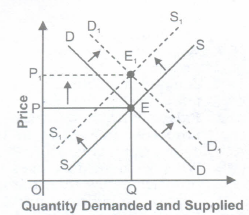
Case I: When supply decreases at the same rate as the demand increase
In the given diagram price is measured on vertical axis and quantity demanded and supplied is measured on horizontal axis. Initially, the equilibrium price is OP and equilibrium quantity is OQ. But when, "demand increases and supply decreases but at the same rate", then,
(i) Equilibrium price rises from OP to OP1; and
(ii) Equilibrium quantity remains constant at OQ.
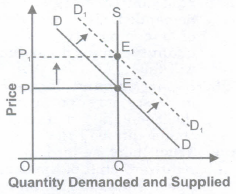
Case II: When supply becomes perfectly inelastic
In the given diagram price is measured on vertical axis and quantity demanded and supplied is measured on horizontal axis. Initially, the equilibrium price is OP and equilibrium quantity is OQ. But when "supply becomes perfectly inelastic and demand increase" then,
(i) Equilibrium price rises from OP to OP1; and
(ii) Equilibrium quantity remains constant at OQ.
15.
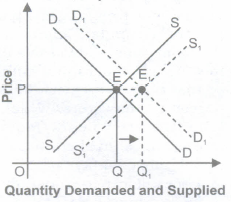
Case l: When supply also increase at the same rate as the demand increases
In the given diagram price is measured on vertical axis and quantity demanded and supplied is measured on horizontal axis. Initially, the equilibrium price is OP and equilibrium quantity is OQ. But when "demand and supply both increase at the same rate" then,
(i) Equilibrium price remains constant at OP; and
(ii) Equilibrium quantity rises from OQ to OQ1
Case II: When supply becomes perfectly elastic
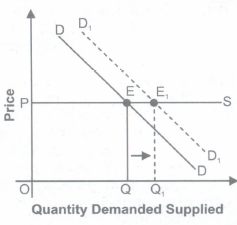
In the given diagram price is measured on vertical axis and quantity demanded and supplied is measured on horizontal axis. Initially, the equilibrium price is OP and equilibrium quantity is OQ. But when "supply becomes perfectly elastic and demand increases then,
(i) Equilibrium price remains constant at OP; and
(ii) Equilibrium quantity rises from OQ to OQ1

11th Standard CBSE Syllabus & Materials
11th Standard CBSE
CBSE 11th Business Studies Forms of Business Organisation Sample Question Papers Study Material - QB365 Set A
NEW11th Standard CBSE
CBSE 11th Business Studies Business, Trade and Commerce Sample Question Papers Study Material - QB365 Set A
NEW11th Standard CBSE
CBSE 11th Physics Waves Sample Question Papers Study Material - QB365 Set A
NEW11th Standard CBSE
CBSE 11th Physics Kinetic Theory Sample Question Papers Study Material - QB365 Set A



CBSE 11th Standard CBSE Subjects
CBSE Standards










