
 100% FREE ACCESS
11th Standard CBSE Syllabus & Materials
11th Standard CBSE
CBSE 11th Economics PART-A - Presentation of Data - New Sample Question Papers Study Material - QB365 Set A
NEW11th Standard CBSE
CBSE 11th Economics PART-A - Organisation of Data - New Sample Question Papers Study Material - QB365 Set A
NEW11th Standard CBSE
CBSE 11th Economics PART-A - Collection of Data - New Sample Question Papers Study Material - QB365 Set A
NEW11th Standard CBSE
CBSE 11th Economics PART-A - Introduction to Economics and Statistics - New Sample Question Papers Study Material - QB365 Set A
NEW11th Standard CBSE
CBSE 11th Business Studies International Trade Sample Question Papers Study Material - QB365 Set A
NEW11th Standard CBSE
CBSE 11th Business Studies Evolution and Fundamentals of Business Sample Question Papers Study Material - QB365 Set A

Published on: 27/09/2019
Non - Competitive Market
Download CBSE Class 11th Standard CBSE undefined question papers, sample papers, important questions, and previous year solved papers in PDF format. Get free study materials, NCERT solutions, and exam preparation resources for Class 11th Standard CBSE undefined
Questions + Answers key
Take MCQ Biology Test
1.
Suppose that the demand curve for the XYZ company slopes downward and to the right. Would you conclude that the firm is a price taker or a price maker? Give reasons.
2.
"A day without selling costs is nearly impossible". Comment.
3.
Selling cost is a nail in the coffin of consumer's sovereignty. How?
4.
How the efficiency may increase if two firms merge?
5.
Distinguish between cooperative and non-cooperative oligopoly.
6.
Explain the implication of the following: The feature of 'no close substitutes' under monopoly.
7.
Explain the 'free entry and exit of firms' feature of monopolistic competion.
8.
What is meant by price rigidity, under oligopoly.
9.
Explain the feature of 'interdependence of firms' in an oligopoly market.
10.
Explain the feature of few firms in an oligopoly market.
11.
What is meant by prices being rigid? How can oligopoly behaviour lead to such an outcome?
12.
List the three different ways in which oligopoly firms may behave.
13.
What is the value of MR when the demand curve is elastic?
14.
What is the reason for the long run equilibrium of a firm in monopolistic competition to be associated with zero profit?
15.
Explain why the demand curve facing a firm under monopolistic competition is negatively sloped?
1.
(i) Since the demand curve of XYZ Co. is downward sloping, it has to lower its price to sell additional units of output.
(ii) But in perfect competition the demand curve is parallel to x-axis as the firm can sell any amount of the output at the same price.
(iii) Hence, XYZCo. is not a price taker but a price maker.
2.
(i) The given statement is correct. It is the expenses which are incurred for promoting sales or inducing customers to buy a good of a particular brand.
(ii) This includes, the cost of advertisement through newspaper, television and radio and cost on each other sales promotional activities.
(iii) As selling costs by the firms in the form of various promotional tools have become a routine activity and the firm generally persuades or lures the customer to avail from one brand to another.
3.
(i) Selling cost is the expenses which are incurred for promoting sales or inducing customers to buy a good of a particular brand.
(ii) Theoretically, a consumer is the king because whatever he desires/ demands is produced/ supplied.
(iii) But in reality this is not so. Advertisement and salesmanship bias his mind in favour of certain commodities which otherwise may not be good.
4.
(i) Suppose that initially there are two firms in an industry and both are same but inefficient.
(ii) Their MC curves are at a high level and consequently they charge a higher price and produce less.
(iii) They realize, however, that if they merge with each other - and thereby become a monopoly they can reduce their cost.
(iv) For instance, one firm may have excellent technical manpower but may not have good marketing skills, whereas the other may not have good technical manpower but possesses superior marketing knowledge by merging the resulting monopoly firms MC curve will be at a lower level and thus it will be more efficient firm.
(v) This, by it self will induce the monopoly to charge a price which is less and produce a quantity which is greater than when both firms were competing with each other.
5.
| Collusive Oligopoly | Basis | Non-Collusive Oligopoly |
|---|---|---|
| When in an oligopoly market, the firms cooperate with each other in determining prices and output both. | Meaning | When in Oligopoly market, the firm's compete with each other. |
| Under Collusive Oligopoly, the firms would behave as a single monopoly (i.e., cartel) and aim at maximising their collective profit rather than their individual profits. | Profit | Under Non-Collusive Oligopoly each firm aims at maximising its own profits and decides how much quantity to produce assuming that the other firms would not change their quantity supplied. |
| All firms collude to form a cartel and fix output and price by themselves through output quotas and market price. | Aim | Each firm tries to increase its market share through competition. |
| Cooperative Oligopoly | Alternative Name | Non-Cooperative Oligopoly |
6.
No close substitute:
(i) A monopolist produces all the output in a particular market. So, there is no close substitute in monopoly.
(ii) The monopolist is a 'price-maker'. It does not mean that monopolist can fix both price and the quantity demanded. If he fixes a high price, less commodity will be demanded.
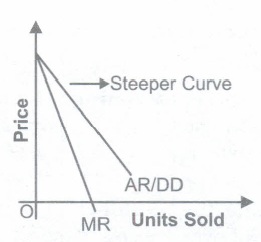
(iii) Implication: The result is an inelastic demand curve as shown in Figure. The demand curve is a constraint facing a monopoly firm. Demand curve is also the price line and the AR curve. Since Ar is downward sloping, MR lies below AR curve and is twice as steep as the AR curve.
7.
(i) New firms can enter the market, if found profitable. Similarly, inefficient firms already operating in the market are free to quit the market if they incur losses.
(ii) It is because of this feature that like perfect competition, monopolistic competition also gives rise to normal profit.
(iii) No firm receives abnormal profit in the long run as then new firms can emerge and old ones can expand output and adjust supply with changing demand.
8.
(i) Price rigidity refers to a situation in which whether there is change in demand and supply the price tends to stay fixed.
(ii) If a firm tries to reduce the price the rivals will also react by reducing their prices. Likewise,if it tries to raise the price, other firms will not do so. It will lead to loss of customers for the firm which intended to raise the price.
9.
(i) Interdependence means that actions of one firm affects the actions of other firms.
(ii) Since the number of sellers is small, each firm has to take into consideration the possible reaction of its competitors, when making decisions.
(iii) The business decision of a single seller will have a substantial impact on the product price, output and profits of the rival firms.
(iv) For example the "Na tiona1 Newspapers" market, when the "Economic Times" introduced invitation pricing policy-they offered the newspaper at a price of Rs. 1.50 on weekdays. The Hindustan Times was forced to reduce its prices from Rs.2.50 per copy to Rs.1.50 per copy on weekdays. When Hindustan Times was celebrating its 75 years of service, they offered the newspaper at Rs.1/-weekdays. The Times of India responded by matching the price cut.
10.
(i) The number of sellers in an oligopoly market is small-when there are two or more than two, but not many sellers.
(ii) What matters is that these few sellers account for most of the industry's sales.
(iii) These "few" sellers consciously dominate the industry and indulge in intense competition. Each firm is aware of that it possesses a large degree of monopoly power.
(iv) For example, the market for mobile service provider in India is an oligopolist structure as there are only few producers of mobile service provider. There exists severe competition among different firms and each firm tries to manipulate both prices and volume of production to outsmart each other.
11.
(i) Price rigidity refers to a situation in which whether there is change in demand and supply, the price tends to stay fixed.
(ii) In an oligopolistic market firms are in a position to influence the prices.
(iii) However, they stick to their prices in order to avoid a price war. If a firm tries to reduce the price the rivals will also react by reducing their prices. So, it will be of no benefit.
(iv) Likewise, if a firm tries to raise the price other firms will not do so. As a result, the firm which intended to raise the price will lose its customers. So, oligopoly behaviour leads to price rigidity in an oligopolistic market.
12.
Oligopoly firm may-
(i) cooperate with each other and formally have a contract or written document of their policies.
(ii) cooperate with each other but have tacit (informal) understanding.
(iii) not cooperate with each other.
13.
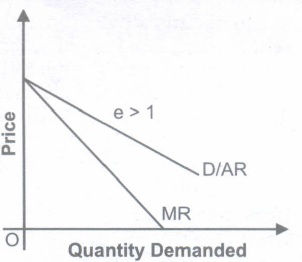
When demand curve is elastic (e > 1), MR is positive.
The relationship is given by,
MR=P\(\left( 1-\frac { 1 }{ e } \right) \)
Graphically, it is shown as is given here.
14.
(i) The reason why firm in monopolistic competition earns zero profit in the long run is free entry and exit of firm.
(ii) If firm earns super-normal profits in the short run then new entry will take place in the long run. If the firm is incurring losses in the short run, firm will leave in the long run.
(iii) The result is zero abnormal profits in the long run.
15.
(i) The demand curve of a firm under monopolistic competition is negatively sloped because of product differentiation.
(ii) The product of the sellers are differentiated but close substitutes of one another.
(iii) Each seller has some degree of monopoly power of 'Making' the price. But since there are many close substitutes available, the result is downward sloping and elastic demand curve.

11th Standard CBSE Syllabus & Materials
11th Standard CBSE
CBSE 11th Business Studies Forms of Business Organisation Sample Question Papers Study Material - QB365 Set A
NEW11th Standard CBSE
CBSE 11th Business Studies Business, Trade and Commerce Sample Question Papers Study Material - QB365 Set A
NEW11th Standard CBSE
CBSE 11th Physics Waves Sample Question Papers Study Material - QB365 Set A
NEW11th Standard CBSE
CBSE 11th Physics Kinetic Theory Sample Question Papers Study Material - QB365 Set A



CBSE 11th Standard CBSE Subjects
CBSE Standards










