
 100% FREE ACCESS
11th Standard CBSE Syllabus & Materials
11th Standard CBSE
CBSE 11th Economics PART-A - Presentation of Data - New Sample Question Papers Study Material - QB365 Set A
NEW11th Standard CBSE
CBSE 11th Economics PART-A - Organisation of Data - New Sample Question Papers Study Material - QB365 Set A
NEW11th Standard CBSE
CBSE 11th Economics PART-A - Collection of Data - New Sample Question Papers Study Material - QB365 Set A
NEW11th Standard CBSE
CBSE 11th Economics PART-A - Introduction to Economics and Statistics - New Sample Question Papers Study Material - QB365 Set A
NEW11th Standard CBSE
CBSE 11th Business Studies International Trade Sample Question Papers Study Material - QB365 Set A
NEW11th Standard CBSE
CBSE 11th Business Studies Evolution and Fundamentals of Business Sample Question Papers Study Material - QB365 Set A

Published on: 13/08/2019
Producer Equilibrium
Download CBSE Class 11th Standard CBSE undefined question papers, sample papers, important questions, and previous year solved papers in PDF format. Get free study materials, NCERT solutions, and exam preparation resources for Class 11th Standard CBSE undefined
Questions + Answers key
Take MCQ Biology Test
1.
Find maximum profit situation from the table:
| Output (in Units) | TR(Rs) | TC(Rs) |
|---|---|---|
| 1 | 50 | 60 |
| 2 | 60 | 65 |
| 3 | 68 | 68 |
| 4 | 70 | 60 |
| 5 | 75 | 75 |
| 6 | 80 | 95 |
Calculate:
(i) Output level showing loss.
(ii) Output level showing break-even point.
(iii) Output level showing maximum profit.
2.
Given below is the cost schedule of a product produced by a firm. The market price per unit of the product at all levels of output is Rs 12 .Using Marginal Cost and Marginal Revenue approach, find out the level of equilibrium output. Give reasons for your answer.
| Output (units) | 1 | 2 | 3 | 4 | 5 | 6 |
| Average cost (Rs) | 12 | 11 | 10 | 10 | 10.4 | 11 |
3.
Why is the equality between marginal cost and marginal revenue necessary for a firm to be in equilibrium? Is it sufficient to ensure equilibrium? Explain
4.
Explain the producer's equilibrium with MR/MC approach (when price falls with the rise in output).
5.
Explain why will a producer not be in equilibrium if the conditions of equilibrium are not met.
6.
Can there be a positive level of output that a profit-maximizing firm produces in a competitive market at which market price is not equal to marginal cost? Give an explanation.
7.
Explain the producer's equilibrium with MR/MC approach (when Price remains constant with the rise in output).
8.
"MC should be rising at the point of Producer's Equilibrium". Comment.
9.
What is the relation between Price and MC at equilibrium (when price falls with the rise in output)?
10.
Will a profit-maximizing firm in a competitive market ever produce a positive level of output in the range where the marginal cost is falling? Give an explanation.
11.
What is the general profit maximising condition for a producer (MRand MC approach)?
12.
Explain the producer's equilibrium.
13.
What are the two methods for determination of producer's equilibrium?
14.
What is meant by profit?
15.
What is the relation between price and marginal cost at equilibrium, when price remains constant with the rise in output.
Price = Marginal Cost
Price> Marginal Cost
Price < Marginal cost
None of these
16.
What is the relation between price and marginal cost at equilibrium, when price falls with the rise in output.
Price = Marginal Cost
Price> Marginal Cost
Price < Marginal cost
None of these
17.
If MC is more than MR at a particular level of output, how will the producer react to maximize the profits________________
Decrease Production
Increase Production
Increase Revenue
None of these
18.
A firm gets maximum profits only if difference between average revenue and average cost is the maximum
19.
If marginal revenue is equal to the total cost, producer is in equilibrium
20.
A producer is in equilibrium when total cost and total revenue are equal.
1.
| Output (in Units) | TR(Rs) | TC(Rs) | Profit (TR-TC) |
|---|---|---|---|
| 1 | 50 | 60 | -10=(50-60) |
| 2 | 60 | 65 | -5=(60-65) |
| 3 | 68 | 68 | 0=(68 - 68) |
| 4 | 70 | 60 | 10 = (70 - 60) |
| 5 | 75 | 75 | 0= (75 -75) |
| 6 | 80 | 95 | -15 =(80- 95) |
(i) At output level of 1 unit, 2 units and 6 units, producer is incurring loss.
(ii) At output levels of 3 units and 5 units, producer is earning zero profit (also called normal profit). These are break-even levels of output.
(iii) At output IeveIs 0f 4 units, producer is earning profit (also called supernormal profit).
2.
| Output (Q)(in units) | Price (P)(Rs) | AC(Rs) | Marginal Revenue(MR)(Rs) | TC(Rs) | MC(Rs) |
| 1 | 12 | 12 | 12 | 12 | - |
| 2 | 12 | 11 | 12 | 22 | 10 |
| 3 | 12 | 10 | 12 | 30 | 8 |
| 4 | 12 | 10 | 12 | 40 | 10 |
| 5 | 12 | 10.4 | 12 | 52 | 12 |
| 6 | 12 | 11 | 12 | 66 | 14 |
The producer will be at equilibrium at 5 units of output which satisfy both the conditions of producer's equilibrium.
(i) MC = MR
(ii) MC must be rising.
3.
When there is no fixed price and price falls with the rise in output, MR curve slope downwards. Producer aims to produce that level of output. at which MC is equal to MRand MC curve cuts the MR curve from below. Let us understand this with the help of following table:
| Units of Commodity | MR(Rs) | MC(Rs) |
| 1 | 10 | 9 |
| 2 | 9 | 7 |
| 3 | 8 | 6 |
| 4 | 7 | 7 |
| 5 | 6 | 8 |
| 6 | 5 | 9 |
According to Table, both the conditions of equilibrium are satisfied at 4 units of output. MC is equal to MR and MC is rising. MC is more than MR when output is produced after 4 units of output. So, Producer's Equilibrium will be achieved at 4 units of output. Letus understand the determination of equilibrium with the help of a diagram:
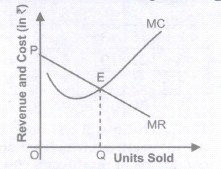
Producer's Equilibrium is determined at OQ level of output corresponding to point E as at this point, MC= MR and MC curve cuts MR curve from below.
In Figure, output is shown on the horizontal axis and revenue and costs on the vertical axis. Producer's equilibrium will be determined at OQ level of output corresponding to point E because at this, the following two conditions are met:
(i) MC = MR; and
(ii) MCcurve cuts the MR curve from below.
When MR > MC, then producer will continue to produce as long as MR becomes equal to MC. It is so because firm will find it profitable to raise the output level.
When MR< MC, then producer will cut down the production as long as MR becomes equal to MC. It is so because firm will find it unprofitable to produce an extra unit. So, it starts reducing the level of output till MR= MC.
So, the producer is at equilibrium at OQ units of output.
4.
When there is no fixed price and price falls with the rise in output, MR curve slope downwards. Producer aims to produce that level of output. at which MC is equal to MRand MC curve cuts the MR curve from below. Let us understand this with the help of following table:
| Units of Commodity | MR(Rs) | MC(Rs) |
| 1 | 10 | 9 |
| 2 | 9 | 7 |
| 3 | 8 | 6 |
| 4 | 7 | 7 |
| 5 | 6 | 8 |
| 6 | 5 | 9 |
According to Table, both the conditions of equilibrium are satisfied at 4 units of output. MC is equal to MR and MC is rising. MC is more than MR when output is produced after 4 units of output. So, Producer's Equilibrium will be achieved at 4 units of output. Letus understand the determination of equilibrium with the help of a diagram:
Producer's Equilibrium is determined at OQ level of output corresponding to point E as at this point, MC= MR and MC curve cuts MR curve from below.
In Figure, output is shown on the horizontal axis and revenue and costs on the vertical axis. Producer's equilibrium will be determined at OQ level of output corresponding to point E because at this, the following two conditions are met:
(i) MC = MR; and
(ii) MCcurve cuts the MR curve from below.
When MR > MC, then producer will continue to produce as long as MR becomes equal to MC. It is so because firm will find it profitable to raise the output level.
When MR< MC, then producer will cut down the production as long as MR becomes equal to MC. It is so because firm will find it unprofitable to produce an extra unit. So, it starts reducing the level of output till MR= MC.
So, the producer is at equilibrium at OQ units of output.
5.
The profit-maximizing level of output is always determined where,
(i) MR = MC
(ii) MC must be rising. In other words, where price is equal to MC.
If price is not equal to MC, profit-maximizing condition cannot hold. It can be explained with the help of the following two cases:
Case 1: Price Greater Than MC
(i) In the given figure at output level q2, the market price is greater than marginal cost.
(ii) To show that q2 is not a profit maximizing level of output, we have taken q3 output level, which is right of q2.
(iii) Suppose the firm increases its output level from q2 to q3. The increase in total revenue of the firm from this output is the market price multiplied by the change in quantity (\(\triangle\) TR= market price x \(\triangle\)Q), that is, the area of rectangle q2q3CB.
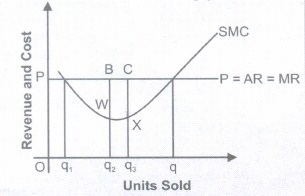
(iv) On the other hand, the increase in total cost with this increase in output is the area of the region q2q3XW.
(v) But, a comparison of the two area shows that the firm's profit is higher when output level is q2q3 rather than %. So, % is not a profit maximizing level of output.
Case 2: Price Less Than MC
(i) In the given figure at output level q2, the market price is less than marginal cost.
(ii) To show that %is not a profit maximizing level of output, we have taken q3 output level, which is left of q2.
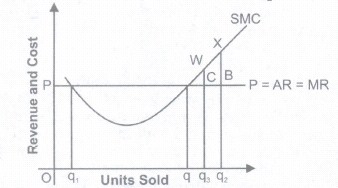
(iii) Suppose now, that the firm reduce its output level from q2 to q3. The decrease in total revenue of the firm from this output is the market price multiplied by the change in quantity (\(\triangle\)TR = market price x \(\triangle\)Q), that is, the area of rectangle q2q3CB.
(iv) On the other hand, the decrease in total cost with this decrease in output is the area of the region q2q3WX.
(v) But, a comparison of the two area shows, that by reducing the output from q2 to q3, the decrease in cost is more than the loss in revenue.
So, q2 is not a profit maximizing level of output.
6.
The profit-maximizing level of output is always determined where,
(i) MR = MC
(ii) MC must be rising. In other words, where price is equal to MC.
If price is not equal to MC, profit-maximizing condition cannot hold. It can be explained with the help of the following two cases:
Case 1: Price Greater Than MC
(i) In the given figure at output level q2, the market price is greater than marginal cost.
(ii) To show that q2 is not a profit maximizing level of output, we have taken q3 output level, which is right of q2.
(iii) Suppose the firm increases its output level from q2 to q3. The increase in total revenue of the firm from this output is the market price multiplied by the change in quantity (\(\triangle\) TR= market price x \(\triangle\)Q), that is, the area of rectangle q2q3CB.
(iv) On the other hand, the increase in total cost with this increase in output is the area of the region q2q3XW.
(v) But, a comparison of the two area shows that the firm's profit is higher when output level is q2q3 rather than %. So, % is not a profit maximizing level of output.
Case 2: Price Less Than MC
(i) In the given figure at output level q2, the market price is less than marginal cost.
(ii) To show that %is not a profit maximizing level of output, we have taken q3 output level, which is left of q2.
(iii) Suppose now, that the firm reduce its output level from q2 to q3. The decrease in total revenue of the firm from this output is the market price multiplied by the change in quantity (\(\triangle\)TR = market price x \(\triangle\)Q), that is, the area of rectangle q2q3CB.
(iv) On the other hand, the decrease in total cost with this decrease in output is the area of the region q2q3XW.
(v) But, a comparison of the two area shows, that by reducing the output from q2 to q3, the decrease in cost is more than the loss in revenue. So, q2 is not a profit maximizing level of output.
7.
The conditions must hold if a profit-maximizing firm produces positive output in a competitive market when price is constant under MR/MC approach is determined where,
(i) MR = MC (ii) MC must be rising
| Output (Units) | Marginal Revenue Rs | Marginal Cost Rs |
|---|---|---|
| 1 | 8 | 10 |
| 2 | 8 | 8 |
| 3 | 8 | 7 |
| 4 | 8 | 8 |
| 5 | 8 | 9 |
According to Table, both the conditions of equilibrium are satisfied at 4 units of output. MC is equal to MR and MC is rising. MC is more than MR when output is produced after 4 units of output. So, Producer's Equilibrium will be achieved at 4 units of output. However, MR is equal to MC at 2 units of output also. But, second condition is not fulfilled here.
Let us understand the determination of equilibrium with the help of a diagram:
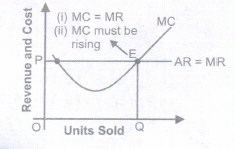
Producer's Equilibrium is determined at OQ level of output corresponding to point E as at this point, MC= MR and MC curve cuts MR curve from below.
In Figure, output is shown on the horizontal axis and revenue and costs on the vertical axis. Producer's equilibrium will be determined at OQ level of output corresponding to point E because at this, the following two conditions are met:
(i) MC = MR;
(ii) MC curve cuts the MR curve from below.
When MR > MC, then producer will continue to produce as long as MR becomes equal to MC. It is so because firm will find it profitable to raise the output level.
When MR< MC, then producer will cut down the production as long as MR becomes equal to MC. It is so because firm will find it unprofitable to produce an extra unit. So, it starts reducing the level of output till MR= MC.
8.
(i) The given statement is correct.
(ii) If MC is falling at the point of equilibrium, it means that it is possible to add to profits by producing more.
(iii) So, MC should be rising at the point of producer's equilibrium.
9.
(i) When more output can be sold only by reducing the prices, AR or Price > MR.
(ii) Equilibrium is achieved when MC = MR.
(iii) So, Price is more than MC at the equilibrium level.
10.
No, as sufficient condition of producer equilibrium is Marginal Cost must be rising when Marginal Cost = Marginal revenue. It can be explained with the help of following diagram:
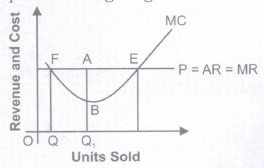
Point F is not a producer equilibrium because at this point, marginal cost = marginal revenue when marginal cost is falling. It is so because after point F, and output Q1. MR[AQ1]> MC [BQ1], then producer will continue to produce as long as MR becomes equal to MC as firm will find it profitable to raise the output level.
11.
()
(i) MC = MR; and
(ii) MC curve cuts the MR curve from below (i.e., MC is rising).
12.
()
A producer is said to be in equilibrium when he produces that level of output at which his profits are maximum. Producer's equilibrium is also known as profit maximisation situation.
13.
()
(i) TR - TC Approach
(ii) MR - MC Approach
14.
()
Profit refers to the excess of revenue over cost.
15.
(a)
Price = Marginal Cost
16.
(b)
Price> Marginal Cost
17.
(a)
Decrease Production
18.
(b)
19.
(b)
20.
(b)

11th Standard CBSE Syllabus & Materials
11th Standard CBSE
CBSE 11th Business Studies Forms of Business Organisation Sample Question Papers Study Material - QB365 Set A
NEW11th Standard CBSE
CBSE 11th Business Studies Business, Trade and Commerce Sample Question Papers Study Material - QB365 Set A
NEW11th Standard CBSE
CBSE 11th Physics Waves Sample Question Papers Study Material - QB365 Set A
NEW11th Standard CBSE
CBSE 11th Physics Kinetic Theory Sample Question Papers Study Material - QB365 Set A



CBSE 11th Standard CBSE Subjects
CBSE Standards










