
 100% FREE ACCESS
11th Standard CBSE Syllabus & Materials
11th Standard CBSE
CBSE 11th Economics PART-A - Presentation of Data - New Sample Question Papers Study Material - QB365 Set A
NEW11th Standard CBSE
CBSE 11th Economics PART-A - Organisation of Data - New Sample Question Papers Study Material - QB365 Set A
NEW11th Standard CBSE
CBSE 11th Economics PART-A - Collection of Data - New Sample Question Papers Study Material - QB365 Set A
NEW11th Standard CBSE
CBSE 11th Economics PART-A - Introduction to Economics and Statistics - New Sample Question Papers Study Material - QB365 Set A
NEW11th Standard CBSE
CBSE 11th Business Studies International Trade Sample Question Papers Study Material - QB365 Set A
NEW11th Standard CBSE
CBSE 11th Business Studies Evolution and Fundamentals of Business Sample Question Papers Study Material - QB365 Set A

Published on: 21/09/2019
Production
Download CBSE Class 11th Standard CBSE undefined question papers, sample papers, important questions, and previous year solved papers in PDF format. Get free study materials, NCERT solutions, and exam preparation resources for Class 11th Standard CBSE undefined
Questions + Answers key
Take MCQ Biology Test
1.
The data below shows the relationship between total output and the amount of labour hired at Papa's Pizza Shop-
| Number of Workers (per day) | Total Product (Pizzas per day) |
| 0 | 0 |
| 1 | 100 |
| 2 | 200 |
| 3 | 300 |
| 4 | 400 |
| 5 | 500 |
Does the production function in the above table exhibit diminishing marginal returns? Explain.
2.
Explain the differences between variable factors and fixed factors.
3.
What does the Law of variable proportions show? State the behaviour of Total product according to this Law.
4.
Complete the following table.
| Units of labour | TP | MPL | APL |
| 1 | 20 | - | - |
| 2 | - | 22 | - |
| 3 | - | - | 22 |
5.
What is the behaviour of TP, when
(i) MP rises
(ii) MP falls, but remains positive
(iii) MP is zero
(iv) MP becomes negative?
6.
Explain the relationship between Marginal product and Average Product.
7.
Differentiate between Short Period production and Long Period production function.
8.
Find out the maximum possible output for a firm with zero unit of Land 10 units of K when its production function is Q = SL + 2K
9.
The following table gives the marginal product schedule of labour. It is also given that total product of labour is zero at zero level of employment. Calculate the total and average product schedules of labour.
| L | MPL |
| 1 | 3 |
| 2 | 5 |
| 3 | 7 |
| 4 | 5 |
| 5 | 3 |
| 6 | 1 |
10.
The following table gives the total product schedule of labour. Find the corresponding average product and marginal product schedules of labour.
| L | TPL |
| 0 | 0 |
| 1 | 15 |
| 2 | 35 |
| 3 | 50 |
| 4 | 40 |
| 5 | 48 |
1.
No, the production function does not exhibit diminishing marginal returns. As the amount of labour hired increases, the marginal product of labour is constant. This violates the law of diminishing marginal returns.
2.
| Variable factors | Basis | Fixed factors |
|---|---|---|
| Variable factors refer to those factors, which can be changed in the short run. | Meaning | Fixed factors refer to those factors which cannot be changed in the short run. |
| They vary directly with the output. | Relation with output | They do not vary directly with the output. |
| Labour, raw material, etc | Example | Capital, land, plant, machinery, etc. |
3.
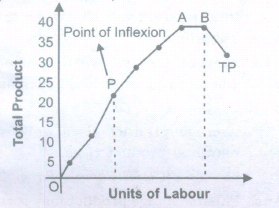
The law of variable proportion shows that as we increase the quantity of only one input, keeping other inputs fixed, the total product increases at an increasing rate in the beginning, then increases at diminishing rate and after a level of output ultimately falls. The behaviour of Total product according to this law is as under:
(I) TP increases continuously from points O to A.
(iI) It increases at an increasing rate (convex shape) from O to P and at a diminishing rate (concave shape) from P to A.
(iii) TP is maximum at A and remains so upto point B.
(iv) After Point B, Total Product falls.
4.
| Units of labour | TP | MPL=\(\frac { \Delta { TP }_{ L } }{ \Delta L } \) | APL=\(\frac { { TP }_{ L } }{ L } \) |
| 1 | 20 | 20 | 20 |
| 2 | 42 | 22 | 21 |
| 3 | 66 | 24 | 22 |
5.
The behaviour of TP in different cases will be:
(i) TP increases at increasing rate.
(ii) TP increases at diminishing rate.
(iii) TP is at its maximum and constant.
(iv) TP decreases.
6.
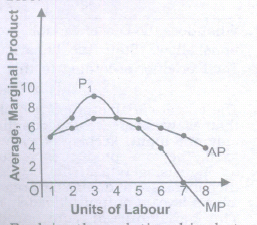
(i) Average Product increases as long as Marginal Product (MP)> Average Product (AP). Alternatively, when MP > AP, AP rises.
(ii) Average Product is maximum and constant when AverageProduct (AP) = Marginal Product (MP). Alternatively, when AP = MP, AP is maximum.
(iii) average product falls when Marginal Product < Average product.
(iv) Marginal Product can be zero and negative but Average product is never zero.
7.
| Short Period Production Function (SPPF) | Basis | Long Period Production Function (LPPF) |
|---|---|---|
| It is a production function in which factor ratio changes with the level of output. | Meaning | It is the production function in which factor ratio remains constant. |
| Output can only be increased by changing the quantity of variable factors. | Output | Output can be increased by making changes in the quantity of both the fixed as well as the variable factor inputs. |
| Scale of production does not change with the change in the level of output. | Scale of Production | Scale of production tends to change with the change in the level of output. |
.png) |
.png) |
|
| Note: Scale of production means changing both the factors simultaneously. During short period scale of production do not change because only variable factor changes and fixed factor remains constant. But in Long run all the factors change simultaneously. So, scale of production changes in long period. | ||
8.
Q = 5L + 2K (Given)
Q = 5 x 0 + 2 x 10
Q = 0 + 20 = 20 units.
So, the maximum possible output (Q) = 20 units
9.
| L | MPL (Given) | TPL = \(\sum \)MPL | APL = \(\frac { { TP }_{ L } }{ L } \) |
|---|---|---|---|
| 1 | 3 | 3 | 3 |
| 2 | 5 | 8 | 4 |
| 3 | 7 | 15 | 5 |
| 4 | 5 | 20 | 5 |
| 5 | 3 | 23 | 4.6 |
| 6 | 1 | 24 | 4 |
10.
| L | TPL (Given) | APL=\(\frac { { TP }_{ L } }{ L } \) | MPL=\(\frac { { \Delta P }_{ L } }{ \Delta L } \) |
|---|---|---|---|
| 0 | 0 | - | - |
| 1 | 15 | 15\(\left( =\frac { 15 }{ 1 } \right) \) | 15 |
| 2 | 35 | 17.5\(\left( =\frac { 35 }{ 2 } \right) \) | 20 |
| 3 | 50 | 16.7\(\left( =\frac { 50 }{ 3 } \right) \) | 15 |
| 4 | 40 | 10 \(\left( =\frac { 40 }{ 4 } \right) \) | -10 |
| 5 | 48 | 9.6\(\left( =\frac { 48 }{ 5 } \right) \) | 8 |

11th Standard CBSE Syllabus & Materials
11th Standard CBSE
CBSE 11th Business Studies Forms of Business Organisation Sample Question Papers Study Material - QB365 Set A
NEW11th Standard CBSE
CBSE 11th Business Studies Business, Trade and Commerce Sample Question Papers Study Material - QB365 Set A
NEW11th Standard CBSE
CBSE 11th Physics Waves Sample Question Papers Study Material - QB365 Set A
NEW11th Standard CBSE
CBSE 11th Physics Kinetic Theory Sample Question Papers Study Material - QB365 Set A



CBSE 11th Standard CBSE Subjects
CBSE Standards










