
 100% FREE ACCESS
11th Standard CBSE Syllabus & Materials
11th Standard CBSE
CBSE 11th Economics PART-A - Presentation of Data - New Sample Question Papers Study Material - QB365 Set A
NEW11th Standard CBSE
CBSE 11th Economics PART-A - Organisation of Data - New Sample Question Papers Study Material - QB365 Set A
NEW11th Standard CBSE
CBSE 11th Economics PART-A - Collection of Data - New Sample Question Papers Study Material - QB365 Set A
NEW11th Standard CBSE
CBSE 11th Economics PART-A - Introduction to Economics and Statistics - New Sample Question Papers Study Material - QB365 Set A
NEW11th Standard CBSE
CBSE 11th Business Studies International Trade Sample Question Papers Study Material - QB365 Set A
NEW11th Standard CBSE
CBSE 11th Business Studies Evolution and Fundamentals of Business Sample Question Papers Study Material - QB365 Set A

Published on: 05/08/2019
Revenue
Download CBSE Class 11th Standard CBSE undefined question papers, sample papers, important questions, and previous year solved papers in PDF format. Get free study materials, NCERT solutions, and exam preparation resources for Class 11th Standard CBSE undefined
Questions + Answers key
Take MCQ Biology Test
1.
When is price (AR) different from MR?
2.
What is the behaviour of Marginal Revenue in a market in which a firm can sell any quantity of the output it produces at a given price?
3.
What is the behaviour of average revenue in a market in which a firm can sell more only by lowering the price?
4.
When TR falls, what happens to MR?
5.
Give the meaning of revenue.
6.
How are the total revenue of a firm, market price, and the quantity sold by the firm related to each other?
7.
From the schedule provided below calculate the total revenue, demand curve and the price elasticity of demand:
| Quantity | 1 | 2 | 3 | 4 | 5 | 6 | 7 | 8 | 9 |
| Marginal Revenue | 10 | 6 | 2 | 2 | 2 | 0 | 0 | 0 | -5 |
8.
Average revenue curve is also known as:
Profit Curve
Demand Curve
Average Cost Curve
Indifference Curve
9.
How does TR change with output when MR is negative?
TR falls with the increase in output
TR rise with the increase in output
TR falls with the decrease in output
None of these.
10.
When price remains constant at all level of output, total revenue______.
increases at increasing rate
increases at diminishing rate
increases at constant rate
None of these.
11.
Marginal revenue can be defined as the change in total revenue resulting from__________.
purchase of an additional unit of a commodity
sale of an additional unit of a commodity
sale of subsequent units of a product
None of these.
12.
Marginal Revenue is equal to:
The change in price divided by the change in output.
The change in quantity divided by the change in price.
The change in P x Q due to a one unit change in output.
Price, but only if the firm is a price searcher.
13.
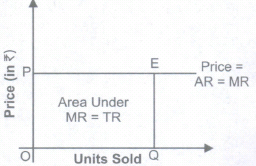
What is the relationship between TR and Price line when price is constant?
14.
Complete the following table.
| Output (units) | 1 | 2 | 3 | 4 |
| Price (Rs) | - | 9 | - | - |
| TR(Rs) | - | - | 24 | - |
| MR(Rs) | 10 | - | - | 4 |
15.
Complete the following table.
| Price(Rs) | 12 | 10 | 8 | 6 |
|---|---|---|---|---|
| Output (units) | 1 | 2 | 3 | 4 |
| TR(Rs) | - | - | - | - |
| MR(Rs) | - | - | - | - |
16.
Can Marginal revenue be zero.
17.
Can Average revenue be negative.
18.
Can Average revenue be zero.
19.
When marginal revenue falls to zero, average revenue becomes maximum.
20.
When total revenue is constant, average revenue will also be constant.
1.
()
Price (AR) is different from MR when more units of a commodity can be sold by reducing the price as in monopoly and monopolistic competition.
2.
()
Marginal revenue remains constant.
3.
()
Average revenue will fall.
4.
()
MR is negative.
5.
()
Revenue of a firm refers to receipts from the sale of output in a given period.
6.
()
Total Revenue = Market Price x Quantity sold
7.
| Q | MR | TR=ΣMR | Demand Curve or Price or \(AR=\frac{TR}{Q}\) | ED |
|---|---|---|---|---|
|
1 |
10 6 2 2 |
10 16 18 20 |
10 8 6 5 |
ED > 1 |
| 5 | 2 | 22 | 4.4 | |
| 6 7 8 |
0 0 0 |
22 22 22 |
3.6 3.2 2.75 |
ED =1 |
| 9 | -5 | 17 | 1.9 | ED < 1 |
Rule: When with the fall in price of goods, total revenue rises, ED > 1, if it remains same ED = 1 and if falls then ED < 1.
8.
(b)
Demand Curve
9.
(a)
TR falls with the increase in output
10.
(c)
increases at constant rate
11.
(b)
sale of an additional unit of a commodity
12.
(c)
The change in P x Q due to a one unit change in output.
13.
When price of a commodity is constant, Price = AR = MR at all levels of output. Therefore, price line is the same as MR curve. Also, TR = ΣMR. So, the area under MR curve or price line will be equal to TR. In Figure, TR at OQ level of output = OP x OQ = Area under price line.
14.
| Output (units) | Price | TR | MR |
|---|---|---|---|
| 1 | \(10[\frac{TR}{Q}]\) | 10[MR of unit 1] | 10 |
| 2 | 9 | 18[PxQ] | \(8[\frac{\triangle TR}{\triangle Q}]\) |
| 3 | \(8[\frac{TR}{Q}]\) | 24 | \(6[\frac{\triangle TR}{\triangle Q}]\) |
| 4 | \(7[\frac{TR}{Q}]\) | 28[24+4] | 4 |
15.
| Price (P)(Rs) | Output (Units) | TR(Rs)=PxQ | MR(Rs) TRn-TRn-1=MRn |
|---|---|---|---|
| 12 | 1 | 12 | 12 |
| 10 | 2 | 20 | 8 |
| 8 | 3 | 24 | 4 |
| 6 | 4 | 24 | 0 |
16.
(a)
17.
(b)
18.
(b)
19.
(b)
20.
(b)

11th Standard CBSE Syllabus & Materials
11th Standard CBSE
CBSE 11th Business Studies Forms of Business Organisation Sample Question Papers Study Material - QB365 Set A
NEW11th Standard CBSE
CBSE 11th Business Studies Business, Trade and Commerce Sample Question Papers Study Material - QB365 Set A
NEW11th Standard CBSE
CBSE 11th Physics Waves Sample Question Papers Study Material - QB365 Set A
NEW11th Standard CBSE
CBSE 11th Physics Kinetic Theory Sample Question Papers Study Material - QB365 Set A



CBSE 11th Standard CBSE Subjects
CBSE Standards










