
 100% FREE ACCESS
11th Standard CBSE Syllabus & Materials
11th Standard CBSE
CBSE 11th Economics PART-A - Presentation of Data - New Sample Question Papers Study Material - QB365 Set A
NEW11th Standard CBSE
CBSE 11th Economics PART-A - Organisation of Data - New Sample Question Papers Study Material - QB365 Set A
NEW11th Standard CBSE
CBSE 11th Economics PART-A - Collection of Data - New Sample Question Papers Study Material - QB365 Set A
NEW11th Standard CBSE
CBSE 11th Economics PART-A - Introduction to Economics and Statistics - New Sample Question Papers Study Material - QB365 Set A
NEW11th Standard CBSE
CBSE 11th Business Studies International Trade Sample Question Papers Study Material - QB365 Set A
NEW11th Standard CBSE
CBSE 11th Business Studies Evolution and Fundamentals of Business Sample Question Papers Study Material - QB365 Set A

Published on: 26/07/2019
Demand
Download CBSE Class 11th Standard CBSE undefined question papers, sample papers, important questions, and previous year solved papers in PDF format. Get free study materials, NCERT solutions, and exam preparation resources for Class 11th Standard CBSE undefined
Questions + Answers key
Take MCQ Biology Test
1.
Explain the causes behind law of demand.
2.
Give the meaning of inferior good and explain the same with the help of an example.
3.
What do you mean by an 'inferior good'? Give some examples.
4.
Does a rise in price of other goods have the same effect on demand for a commodity?
5.
What do you mean by complements? Give examples of two goods which are complements of each other.
6.
What do you mean by substitutes? Give examples of two goods which are substitutes of each other.
7.
How will an increase in the price of petrol affect the demand curve of a car?
8.
Due to rise in price of the commodity x, the demand of commodity y also rises. What type of commodity they are?
9.
Due to rise in price of commodity x the demand of commodity y falls. What type of commodity are they?
10.
Define market demand.
11.
What is meant by demand?
12.
The Law of Demand, assuming other things to remain constant, establishes the relationship between:
income of the consumer and the quantity of goods demanded by him.
price of goods and the quantity demanded.
price of goods and the demand for its substitute.
quantity demanded of goods and the relative prices of its complementary goods.
13.
Which of the following pairs of goods is an example of substitutes?
Tea and sugar
Tea and coffee.
Pen and ink.
Shirt and trousers
14.
All but one of the following are assumed to remain the same while drawing an individual's demand curve for a commodity. Which one is it?
The preference of the individual
His monetary income.
Price.
Price of related goods.
15.
Contraction of demand is the result of:
decrease in the number of consumers.
increase in the price of goods concerned
increase in the prices of other goods
decrease in the income of purchasers
16.
Demand for a commodity refers to:
desire for the commodity.
need for the commodity.
quantity demanded of that commodity
quantity of the commodity demanded at a certain price during any particular period of time.
17.
With a fall in income, demand for normal goods will rise.
18.
Change in quantity demanded means an increase and decrease in demand and Change in demand curve means expansion and contraction in demand.
19.
Law of demand explains quantitative relationship· between price and quantity demanded.
20.
Law of demand happens due to application of law of diminishing marginal productivity.
21.
Law of demand states that price and demand are positively related to each other.
22.
Explain the effect of the following on demand for a good:
(i) Fall in Income for Normal Goods.
(ii) Fall in Income for Inferior Goods.
23.
Explain with the help of diagrams, the effect of the following changes on the demand of a commodity:
(i) A rise in price of Substitute good.
(ii) A rise in price of Complementary good.
1.
The inverse relationship between price of the commodity and quantity demanded for that commodity is because of the following reasons:
(i) Income effect:
(a) Quantity demanded of a commodity changes due to change in purchasing power (real income), caused by change in price of a commodity is called Income Effect.
(b) Any change in the price of a commodity affects the purchasing power or real income of the consumers although his money income remains the same.
(c) Whenpriceofa commodity rise more has to be spent on purchase of the same quantity of that commodity. Thus, rise in price of commodity leads to fall in real income, which will thereby reduce quantity demanded is known as Income effect.
(ii) Substitution effect:
(a) It refers to substitution of one commodity in place of another commodity when it becomes relatively cheaper.
(b) A rise in price of the commodity let coke, also means that price of its substitute, let Pepsi, has fallen in relation to that of coke, even though the price of Pepsi remains unchanged. So, people will buy more of Pepsi and less of coke when price of coke rises.
(c) In other words, consumers will substitute Pepsi for coke. This is called Substitution effect.
Price effect = Income effect + Substitution effect
(iii) Law of Diminishing Marginal Utility:
(a) This law states that when a consumer consumes more and more units of a commodity, every additional unit of a commodity gives lesser and lesser satisfaction and marginal utility decreases.
(b) The consumer consumes a commodity till marginal utility (benefit)he gets equals to the price (cost)they pay, i.e., where benefit = cost.
(c) For example, a thirsty man gets the maximum satisfaction (utility)from the first glass of water. Lesser utility from the 2nd glass of water, still lesser from the 3rd glass of water and so on. Clearly, if a consumer wants to buy more units of the commodity,he would like to do so at a lower price. Since, the utility derived from additional unit is lower.
(iv) Additional consumer:
(a) When price of a commodity falls, two effects are quite possible:
1. New consumers, that is, consumers that were not able to afford a commodity previously, starts demanding it at a lower price.
2. Old consumers of the commodity starts demanding more of the same commodity by spending the same amount of money.
(b) As the result of old and new buyers push up the demand for a commodity when price falls.
2.
(i) A good is called 'inferior goods' when its demand falls with a rise in the income of a consumer and vice- versa.
(ii) For example, Jowar or Bajra for a poor person.
(iii) A good is inferior in a relative terms. It means, a good is inferior or normal is determined by the income level of a consumer.
(iv) When a consumer moves to higher income, he/she may consider some goods below their income status, and treats them as inferior.
3.
(i) A good is called 'inferior goods' when its demand falls with a rise in the income of a consumer and vice- versa.
(ii) For example, Jowar or Bajra for a poor person.
(iii) A good is inferior in a relative terms. It means, a good is inferior or normal is determined by the income level of a consumer.
(iv) When a consumer moves to higher income, he/she may consider some goods below their income status, and treats them as inferior.
4.
No, rise in prices of other goods does not have the same effect on demand for a commodity.
(i) In case of rise in price of substitute goods, demand for the given commodity rises.
(ii) In case of rise in price of complementary goods, demand for the given commodity falls.
5.
(i) Complementary goods are those which are useless in the absence of other goods and which are demanded jointly.
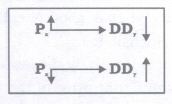
(ii) There would always exist an inverse relationship between price of complementary goods and demand for given commodity.
(iii) It means, with a rise in price of complementary goods, the demand for given commodity falls and vice-versa.
(iv) For example pen and refill, tea and sugar are complements to each other.
6.
(i) Substitute goods are those goods which can be used in place of another goods and give the same satisfaction to a consumer.
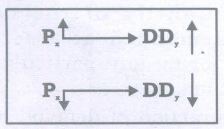
(ii) There would always exist a direct relationship between the price of substitute goods and demand for given commodity.
(iii) It means with an increase in price of substitute goods, the demand for given commodity also rises and vice-versa.
(iv) For example, Pepsi and Coke, tea and coffee are substitute to each other.
7.
()
The demand curve of a car will shift to the left.
8.
()
Substitute goods.
9.
()
Complementary goods.
10.
()
Market demand refers to the quantity of a commodity that all the consumers are willing and able to buy, at a particular price during a given period of time.
11.
()
Demand is a quantity of a commodity that a consumer wishes to purchase at a given level of price and during a specified period of time.
12.
(b)
price of goods and the quantity demanded.
13.
(b)
Tea and coffee.
14.
(c)
Price.
15.
(b)
increase in the price of goods concerned
16.
(d)
quantity of the commodity demanded at a certain price during any particular period of time.
17.
(b)
18.
(b)
19.
(b)
20.
(b)
21.
(b)
22.
(i) Fall in Income for Normal Goods:
1. In the above schedule, note that, as the income of a consumer falls from Rs.6000 to Rs.5000, the quantity demanded of normal goods decreases for any given price of normal goods. For example, the given income is Rs.6000 and at price of normal goods is Rs.150, the quantity demanded of normal goods is 25. Whereas the given income is Rs.5000, at the same price of normal goods (i.e. 150), the quantity demanded of normal goods is 20.
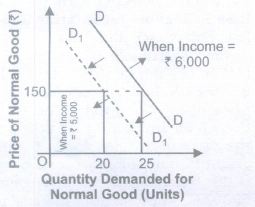
2. In the given diagram, the demand curve for normal goods, when income is Rs.5000 lies to the left of that when income is Rs.6000. Hence, an decrease in the income of a consumer shifts the demand curve for normal goods to the left.
(ii) Fall in Income for Inferior Goods:
3. In the above schedule, note that, as the income of a consumer decreases from Rs.6000 to Rs.5000, the quantity demanded of inferior goods increases for any given price of inferior goods. For example, the given income is Rs.6000 and at price of inferior goods is Rs.150, the quantity demanded of inferior goods is 18. Whereas the given income is Rs.5000, at the same price of inferior goods (i.e. 150), the quantity demanded of inferior goods is 20.
4. In the above diagram the demand curve for inferior goods when income is Rs.5000 lies to the right of that when income is Rs.6000. Hence, a decrease in the income of a consumer shifts the demand curve for inferior goods to the right.
23.
(i) A rise in price of Substitute good
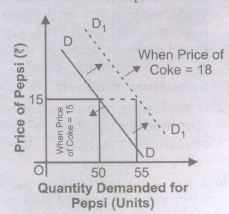
(a) Increase in Price of Substitute Goods An increase in price of substitute goods (Coke)leads to an increase in demand of a given commodity (Pepsi).The Demand curve of Pepsi would shift rightward It can be explained with the help of given diagram:
In the given diagram the demand curve for Pepsi when the price of Coke is 18 lies to the right of that when the price of Coke is Rs.15. Hence, an increase in the price of a substitute good shifts the demand curve for a product to the right.
(ii) Arise in price of Complimentary good
Increase in Price of Complimentary Good [Refill] leads to a decrease in demand of given commodity [Pen]. The Demand curve for Pen shifts leftwards. It can be explained with the help of given diagram:
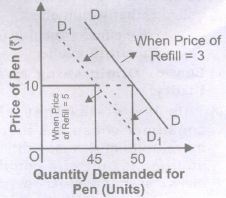
In the above diagram, the demand curve for Pen when Refill price is Rs.5 lies to the left of that when the Refill price is Rs.3

11th Standard CBSE Syllabus & Materials
11th Standard CBSE
CBSE 11th Business Studies Forms of Business Organisation Sample Question Papers Study Material - QB365 Set A
NEW11th Standard CBSE
CBSE 11th Business Studies Business, Trade and Commerce Sample Question Papers Study Material - QB365 Set A
NEW11th Standard CBSE
CBSE 11th Physics Waves Sample Question Papers Study Material - QB365 Set A
NEW11th Standard CBSE
CBSE 11th Physics Kinetic Theory Sample Question Papers Study Material - QB365 Set A



CBSE 11th Standard CBSE Subjects
CBSE Standards










