
 100% FREE ACCESS
11th Standard CBSE Syllabus & Materials
11th Standard CBSE
CBSE 11th Economics PART-A - Presentation of Data - New Sample Question Papers Study Material - QB365 Set A
NEW11th Standard CBSE
CBSE 11th Economics PART-A - Organisation of Data - New Sample Question Papers Study Material - QB365 Set A
NEW11th Standard CBSE
CBSE 11th Economics PART-A - Collection of Data - New Sample Question Papers Study Material - QB365 Set A
NEW11th Standard CBSE
CBSE 11th Economics PART-A - Introduction to Economics and Statistics - New Sample Question Papers Study Material - QB365 Set A
NEW11th Standard CBSE
CBSE 11th Business Studies International Trade Sample Question Papers Study Material - QB365 Set A
NEW11th Standard CBSE
CBSE 11th Business Studies Evolution and Fundamentals of Business Sample Question Papers Study Material - QB365 Set A

Published on: 04/09/2019
Production
Download CBSE Class 11th Standard CBSE undefined question papers, sample papers, important questions, and previous year solved papers in PDF format. Get free study materials, NCERT solutions, and exam preparation resources for Class 11th Standard CBSE undefined
Questions + Answers key
Take MCQ Biology Test
1.
Define the law of variable proportions.
2.
What is the law of variable proportions?
3.
What is the law of diminishing marginal product?
4.
What is the marginal product of an input?
5.
What is the average product of an input?
6.
What is the total product of an input?
7.
Let the production function of a firm be Q = 2L2K2 . Find out the maximum possible output that the firm can produce with 5 units of Land 2 units of K. What is the maximum possible output that the firm can produce with zero unit of Land 10 units of K?
8.
The following table gives the average product schedule of labour. Find the total product and marginal product schedules. It is given that the total product is zero at zero level of labour employment.
| L | APL |
| 1 | 2 |
| 2 | 3 |
| 3 | 4 |
| 4 | 4.25 |
| 5 | 4 |
| 6 | 3.5 |
9.
The following table gives the total product schedule of labour. Find the corresponding average product and marginal product schedules of labour.
| L | TPL |
| 0 | 0 |
| 1 | 15 |
| 2 | 35 |
| 3 | 50 |
| 4 | 40 |
| 5 | 48 |
10.
Explain the concepts of run and the long run.
11.
State the different phases of changes in Total Product and Marginal Product in the Law of Variable Proportions. Also show the same in a single diagram
12.
Explain the likely behaviour of Total Product and Marginal Product when for increasing production only one input is increased while all other inputs are kept constant.
1.
()
The law of variable proportion states that as we increase the quantity of only one input, keeping other inputs fixed, the total product increases at an increasing rate in the beginning, then increases at decreasing rate and after a level the output ultimately falls.
2.
()
The law of variable proportion states that as we increase the quantity of only one input, keeping other inputs fixed, the total product increases at an increasing rate in the beginning, then increases at decreasing rate and after a level the output ultimately falls.
3.
()
The Law of diminishing marginal product states that when we applied more and more units of variable factor to a given quantity of fixed factor, total product increases at a diminishing rate and marginal product falls.
4.
()
Marginal Product of an input is an addition to the total product when an additional unit of a variable factor is employed.
MP = \(\frac { Change\ in\ output }{ Change\ in\ input } ={\triangle q\over \triangle L}\)
5.
()
Average Product of an input is per unit product of variable factors. It is calculated by dividing the total Product by the units of variable factor.
Average product = \(\frac { Total\ product }{ Unit\ of\ variable\ Factor } \)
6.
()
.Total product of an input refers to total volume of goods and services produced by a firm with the given inputs during a specified period of time
7.
(i) Q = 2L2 K2(Given)
Q = 2 x 52 x 22
Q = 2 x 25 x 4 = 200 units.
So, the maximum possible output (Q) = 200 units.
(ii) Q = 2L2 K2(Given)
Q = 2 x 02 x 102
Q = 2 x 0 x 20 = 0
So, the maximum possible output (Q) = 0 units
8.
| L | APL | TPL = APL X L |
MPL = \(\frac { { \Delta P }_{ L } }{ \Delta L } \) |
| 1 | 2 | 2 | 2 |
| 2 | 3 | 6 | 4 |
| 3 | 4 | 12 | 6 |
| 4 | 4.25 | 17 | 5 |
| 5 | 4 | 20 | 3 |
| 6 | 3.5 | 21 | 1 |
9.
| L | TPL (Given) | APL=\(\frac { { TP }_{ L } }{ L } \) | MPL=\(\frac { { \Delta P }_{ L } }{ \Delta L } \) |
|---|---|---|---|
| 0 | 0 | - | - |
| 1 | 15 | 15\(\left( =\frac { 15 }{ 1 } \right) \) | 15 |
| 2 | 35 | 17.5\(\left( =\frac { 35 }{ 2 } \right) \) | 20 |
| 3 | 50 | 16.7\(\left( =\frac { 50 }{ 3 } \right) \) | 15 |
| 4 | 40 | 10 \(\left( =\frac { 40 }{ 4 } \right) \) | -10 |
| 5 | 48 | 9.6\(\left( =\frac { 48 }{ 5 } \right) \) | 8 |
10.
(i) Short run:
(a) A short run refers to the period of time in which a firm cannot change some of its factors like plant, machinery, building, etc. due to insufficiency of time but can change any variable factor like labour, raw material, etc.
(b) Thus, in short run, there will be some factors of production that are fixed at predetermined levels, e.g., a farmer may have fixed amount of land.
(ii) Long run:
(a) A long run is a time period during which a firm can change all its factors of production including machines, building, organization, etc.
(b) In other words, it is a period of time during which supplies can adjust itself to change in demand.
Note: (i) Mind, here the terms long run and short run are functional and do not refer to a calendar month or a year.
(ii) This distinction depends merely upon how quickly factor inputs can be change by producers in an industry.
11.
According to the Law of Variable Proportion when only one input is increased while all other inputs are kept constant, Marginal Product and Total Product behave in the following manner:
(i) When Marginal product rises (till Point PI), Total product increases at an increasing rate (convex shape) (till point P).
(ii) When Marginal product falls and remains positive (Till point B1), total product increases at a diminishing rate (concave shape) (till point A).
(iii) When Marginal Product is zero (at point B1), Total Product is at its maximum and constant (At point B).
(iv) When Marginal product becomes negative (after point B1), total product falls (after point B).
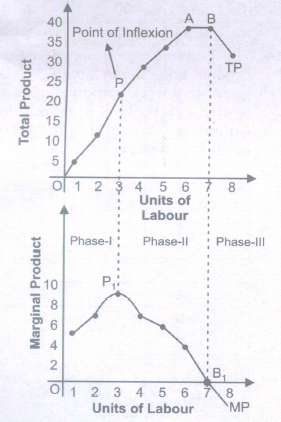
12.
According to the Law of Variable Proportion when only one input is increased while all other inputs are kept constant, Marginal Product and Total Product behave in the following manner:
(i) When Marginal product rises (till Point PI), Total product increases at an increasing rate (convex shape) (till point P).
(ii) When Marginal product falls and remains positive (Till point B1), total product increases at a diminishing rate (concave shape) (till point A).
(iii) When Marginal Product is zero (at point B1), Total Product is at its maximum and constant (At point B).
(iv) When Marginal product becomes negative (after point B1), total product falls (after point B).

11th Standard CBSE Syllabus & Materials
11th Standard CBSE
CBSE 11th Business Studies Forms of Business Organisation Sample Question Papers Study Material - QB365 Set A
NEW11th Standard CBSE
CBSE 11th Business Studies Business, Trade and Commerce Sample Question Papers Study Material - QB365 Set A
NEW11th Standard CBSE
CBSE 11th Physics Waves Sample Question Papers Study Material - QB365 Set A
NEW11th Standard CBSE
CBSE 11th Physics Kinetic Theory Sample Question Papers Study Material - QB365 Set A



CBSE 11th Standard CBSE Subjects
CBSE Standards










