
 100% FREE ACCESS
11th Standard CBSE Syllabus & Materials
11th Standard CBSE
CBSE 11th Economics PART-A - Presentation of Data - New Sample Question Papers Study Material - QB365 Set A
NEW11th Standard CBSE
CBSE 11th Economics PART-A - Organisation of Data - New Sample Question Papers Study Material - QB365 Set A
NEW11th Standard CBSE
CBSE 11th Economics PART-A - Collection of Data - New Sample Question Papers Study Material - QB365 Set A
NEW11th Standard CBSE
CBSE 11th Economics PART-A - Introduction to Economics and Statistics - New Sample Question Papers Study Material - QB365 Set A
NEW11th Standard CBSE
CBSE 11th Business Studies International Trade Sample Question Papers Study Material - QB365 Set A
NEW11th Standard CBSE
CBSE 11th Business Studies Evolution and Fundamentals of Business Sample Question Papers Study Material - QB365 Set A

Published on: 04/03/2020
11th Standard CBSE Mathematics Annual Exam Model Question 2020
Download CBSE Class 11th Standard CBSE Mathematics question papers, sample papers, important questions, and previous year solved papers in PDF format. Get free study materials, NCERT solutions, and exam preparation resources for Class 11th Standard CBSE Mathematics
Questions + Answers key
Take MCQ Mathematics Test
1.
Find the derivative of \(\frac { ax+b }{ cx+d } \) (it is to be understood that a, b, c, d, p, q, rand s are fixed non-zero constants and m and n are integers)
2.
A committe of two persons is selected from two men and two women.What is the probability that the committee will have two men?
3.
The following table shows the marks obtained by 100 candidates in an examination.Calculate the mean and standard deviation.
| Marks | 1-10 | 11-20 | 21-30 | 31-40 | 41-50 | 51-60 |
| Number of Candidates | 3 | 16 | 26 | 31 | 16 | 8 |
4.
Evaluate \(\lim_ { x\rightarrow 2 }{ lim } \left[ \frac { 1 }{ x-2 } -\frac { 2(2x-3) }{ { x }^{ 3 }-3{ x }^{ 2 }+2x } \right] \)
5.
Show that the points (-1,-6,10), (1,-3,4) (-5,-1,1) and (-7,-4,7) are the vertices of a rhombus.
6.
If a parabolic reflector is 20 cm in diameter and 5 cm deep. Find the focus.
7.
Transform the equation of the line 2x + 6y - 8 = 0 to normal form and also find the inclination of the perpendicular segment from the origin on the line with the axis and its length.
8.
If the nth term of a progression is a linear expression in n, then show that it is an AP.
9.
Find the value of \(\alpha \) for which the coefficients of the middle terms in the expansions of \({ \left( 1+\alpha x \right) }^{ 4 }\)and \({ \left( 1-\alpha x \right) }^{ 6 }\)are equal.
10.
How many 4-digit numbers can be formed by using the didits 1 to 9 , if repetition of digits is not allowed?
11.
Solve \(|\frac { 2 }{ x-4 } |<1.\)
12.
If z = x + iy, w = \(\frac { 1-iz }{ z-i } \) and \(|w|=1\) then show that z is purely real.
13.
If \(cos \left( \theta +\phi \right) = m\quad cos\quad \left( \theta -\phi \right) \)then find the value of \(\frac { 1-m }{ 1+m } cot\quad \phi .\)
14.
If f and g be two real function defined by \(f\left( x \right) =\sqrt { x+1 } \)and \(g\left( x \right) =\sqrt { 9-{ x }^{ 2 } } \) .Then, describe each of the following functions. \(\frac { f }{ g } \)
15.
Taking the set of a natural numbers as the universal set, write down the complements of the set.
{x : x \(\ge \) 7}
16.
Find the derivative of the following functions (it is to be understood that a, b, c, d, p, q, r and s are fixed non-zero constants and m and n are integers):
\(\frac { \cos x }{ 1+\sin x } \)
17.
How many words can be formed by using the letters of the word ORIENTAL so that A and E always occupy the odd places?
18.
Find the general solutions of the following equations \(tan \ x={-1\over \sqrt{3}}\)
19.
Solve the quadratic equation 5x2 - 6x + 2 = 0.
20.
Find the mean deviation about the mean for the following data
36,72,46,60,45,42,53,49,51,46
21.
Show that the following statement is true by the method of contrapositive
p: "If x is an integer and x2 is even, then x is also even"
22.
Find the coordinates of the focus, axis of the parabola, the equation of the directrix and the length of the latus rectum.
3x2=-15y
23.
Evaluate \(\lim_{x\rightarrow 0}\frac{sin5x}{2x}\)
24.
Are the following pairs of sets equal? Give reasons.
(i) A = {-4, 4} B = {x : x ∈ Nand x2 - 16 = 0}
(ii) A = {x : x is a letter in the word CHARM}
B = {x : x is a letter in the word MARCH}
25.
Solve -12x > 30 When
(i) x is a natural number
(ii) x is an integer
26.
A coin is tossed twice, what is the probability that at least one head occurs?
27.
Probability that a truck stopped at a roadblock will have faulty brakes or badly worn tires are 0.23 and 0.24, respectively. Also, the probability is 0.38 that a truck stopped at the roadblock will have faulty brakes and/or badly working tires. What is the probability that a truck stopped at this roadblock will have faulty breaks as well as badly worn tires?
28.
Find the mean deviation about the median for the data 34,66,30,38,44,50,40,60,42,51.
29.
Write down the contrapositive of the following statements.
If PT Usha stands first in 200 m race, then she will be awarded.
30.
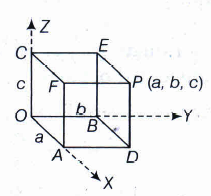
In the given figure, if the coordinates of point P are (a,b,c), then write the coordinates of A,D,B,C and E.
31.
If A,B,C are the feet of perpendiculars from a point P on the XY, YZ and ZX-planes respectively, then find the distance of A, B and C, where the point P is (-5,3,7)
32.
Find the equation of the circle, if the end points of whose diameter are the centres of the circles x2+ y2+ 6x - 14y - 1 = 0 and x2+ y2 - 4x+ 10y - 2 = 0
33.
Find the equation of the line midway between the parallel lines 9x + 6y - 7 = 0 and 3x + 2y + 6 = 0.
34.
By using slope method, find the value of x for which the points A(5,1), B(1,-1) and C(x,4) are collinear.
35.
Find an infinite GP whose first term is 1 and each term is the sum of all the terms which follow it.
36.
Find the sum of indicated number of terms in the following AP.
x + y, x - y, x-3y,...,22 terms
37.
Prove that there is no term involving y6 in the expansion of \(\left( 2y^{ 2 }-\frac { 3 }{ y } \right) ^{ 11 }\), where \(y\neq 0\).
38.
In the binomial expansion (x+y)n , the coefficients of 4th and 13th terms are equal. Find the value of n.
39.
In how many ways , can a the of 3 boys and 3 girls be selected from 5 boys and 4 girls ?
40.
Solve \(|x+3|\ge 10\).
41.
Simplify the following
in + in+1 +in+2 +in+3
42.
Prove that 22n -1 is divisible by 3, for all natural numbers n.
43.
Evaluate \(\underset { x\longrightarrow 0 }{ lim } \cfrac { { tan\quad x }^{ 0 } }{ { x }^{ 0 } } \)
44.
Find the quotient of the identify function by the modulus function.
45.
Let \(f\) and \(g\) be real functions defines by \(f(x)=\sqrt { x+2 } \) and \(g\) ,then\(g(x)=\sqrt { 4-{ x }^{ 2 } } \) find the following function: \(f-g\)
46.
Prove that \(\cos\theta\cos2\theta\cos2^{ 2 }\theta ...{ \cos2 }^{ n-1 }\theta =\frac { { \sin2 }^{ n }\theta }{ { 2 }^{ n }\sin\theta } for\ all\ n\in N.\)
47.
Prove the following by using the principle of mathematical induction for all n∊ N (2n+7) < (n+3)2
48.
Show that the statement
p:"If x is a real number such that :x3+ 4x = 0 then x is 0" is true by
(i) direct method
(ii) method of contradiction
(iii) method of contrapositive.
49.
Prove by the principle of mathematical induction that \({ 3 }^{ n }>{ 2 }^{ n }\) , for all \(n\in N\) .
50.
Write down the negation
x = 2 \(\Rightarrow \)x2 = 4
51.
If x and y are any two distinct integers, then prove by mathematical induction that \(\left( { x }^{ n }-{ y }^{ n } \right) \) is divisible by (x-y), for all \(n\in N\)
52.
Find the middle terms in the expansions of \(\left( 3-\frac { { x }^{ 3 } }{ 6 } \right) ^{ 7 }\)
53.
In how many ways can the letters of the word PERMUTATIONS be arranged if the
(i) words start with P and end with S
(ii) vowels are all together
(iii) there are always 4 letters between P and S?
54.
Find the coordinates of a point on y-axis which are at a distance of \(5\sqrt { 2 } \) from the point P(3, -2,5).
55.
Find the equation of the circle passing through the points (2,3) and (-1, 1) and whose centre is on the line x - 3y - 11 =0.
56.
Find the square root of -8i.
57.
Find the equation of the line that passes through the intersection of the lines 2x + 3y -1 = 0 and x + 5y + 4 = 0 and whose intercepts on the axes are same.
58.
The first term of a G.P. is 1. The sum of the third term and fifth term is 90. Find the common ratio of G.P.
59.
Find the values of other five trigonometric functions tan x =\(-\frac{5}{12}\) ,x lies in second quadrant.
60.
How many litres of water will have to be added to 1125 litres of the 45% solution of acid so that the resulting mixture will contain more than 25% but less than 30% acid content?
61.
A die is thrown, find the probability of following events:
(i) A prime number will appear.
(ii) A number greater than or equal to 3 will appear.
(iii) A number less than or equal to one will appear.
(iv) A number more than 6 will appear.
(v) A number less than 6 will appear.
62.
If A \(\subset\) B then prove that A x A = (A x B) \(\cap\) (B x A).
63.
Find the mean deviation about the median for the data :
36, 72, 46, 42, 60, 45, 53, 46, 51, 49
64.
If A = {3, 5, 7,9, 11}, B = {7, 9, 11, 13}, C = {11, 13, 15} and D = {15, 17};find:
(l) A \(\cap\) B
(ii) B \(\cap\) C
(iii) A \(\cap\) C \(\cap\) D
(iv) A \(\cap\) C
(v) B \(\cap\) D
(vi)A \(\cap\) (B\(\cup\) C)
(vii) A \(\cap\) D
(viil) A \(\cap\) (B \(\cup\) D)
(ix) (A \(\cap\)B) \(\cap\) (B \(\cup\) C)
(x) (A \(\cup\) D) \(\cap\) (B \(\cup\) C)
65.
Which one of the following is not a function
{(x, y) (:) x, y \(\in\) R, x2 = y}
{(x, y) (:) x, y \(\in\) R, y2 = x}
{(x, y) (:) x, y \(\in\) R, x = y3}
{(x, y) (:) x, y \(\in\) R, y = x3}
66.
For any two sets A and B, A \(\cup\) B = A iff _____.
A ⊂ B
B∈A
A=B
A\(\ne\)B
67.
The seen to infinity of the series \(1+2.\frac{1}{2}+3.\frac{1}{2^2}+4.\frac{1}{2^3}+...+\infty\) ______.
4
5
1
None
68.
In a ΔABC, if the sides are 7cm, 4\(\sqrt { 3 } \) cm and .\(\sqrt { 13 } \) cm, then the smallest angle is ______.
45o
60o
30o
90o
69.
\(\overset{lim}{x\rightarrow 1} \frac{sin\pi x}{x-1}\) is equal to _______.
-\(\pi\)
\(\pi\)
-\( \frac{1}{\pi}\)
\( \frac{1}{\pi}\)
70.
The locus of the points of trisection of the double ordinates of a parabola is a ______.
pair of lines
parabola
circles
none of these
71.
If in the expansion of (1 +x)n, the coefficients of fifth, sixth and seventh terms are inA.P. then n is equal to _____.
5,7
7,16
7,14
8,15
72.
In the three dimensional space the equation x2 - 7x + 12 = 0 represents ______.
pair of straight lines
curves
planes
none of these
73.
A line passes through the point (2, 2) and is perpendicular to the line 3x + y = 3. Its y intercept is ______.
1/3
5
3/4
4/3
74.
The mean deviation of the series a, a + d, a + 2d, .... a + nd from its mean is ______.
\({(n+1)d\over (n+2)}\)
\(nd\over 2n+1\)
\(n(n+1)d\over 2n+1\)
\((2n+1)d\over n\)
75.
Six boys and six girls sit in a row. The probability that all girls sit together is _______.
\(\frac { 1 }{ 132 } \)
\(\frac { 1 }{ 105 } \)
\(\frac { 1 }{ 142 } \)
\(\frac { 1 }{ 165 } \)
1.
Here f(x)=\(\frac { ax+b }{ cx+d } \)
\(\therefore f(x)=\frac { d }{ dx } \left[ \frac { ax+b }{ cx+d } \right] \)
\(=\frac { (cx+d)\frac { d }{ dx } (ax+b)-(ax+b)\frac { d }{ dx } (cx+d) }{ { (cx+d) }^{ 2 } } \)
\(=\frac { (cx+d)(a)-(ax+b)(c) }{ { (cx+d) }^{ 2 } } \)
\(=\frac { acx+ad-acx-bc }{ { (cx+d) }^{ 2 } } \)
\(=\frac { ad-bc }{ { (cx+d) }^{ 2 } } \)
2.
Number of favourable outcomes = \(^{ 2 }{ C }_{ 2 }\)
3.
Ans : 32,12.36
4.
Given limit \(=\lim_ { x\rightarrow 2 }{ lim } \left[ \frac { 1 }{ x-2 } -\frac { 2(2x-3) }{ { x }(x-1)(x-2) } \right] \)
\(=\lim { x\rightarrow 2 }{ lim } \left[ \frac { { x }^{ 2 }-5x+6 }{ { x }(x-1)(x-2) } \right] =\lim_ { x\rightarrow 2 }{ lim } \left[ \frac { (x-2)(x-3) }{ { x }(x-1)(x-2) } \right] \)
\(\frac { -1 }{ 2 } \)
5.
Show that AB=BC=CD=DA AND AC \(\neq \) BD
6.
Let POQ be the parabolic reflector which is 20 cm in diameter and 5 cm deep.
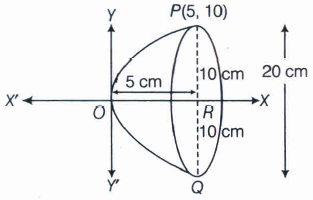
Then, PQ = 20 cm and OR = 5 cm, where R is the midpoint of PQ. We take OX as X-axis and OY as Y-axis. The equation of parabola may be taken as 4ax. Since, the point P(5, 10) lies on the parabola.
\({ 10 }^{ 2 }=4a(5)\Rightarrow a=5\)
Therefore, the coordinate of the focus are (a, o) i.e. (5, 0). Hence, the focus is the midpoint of the given diameter.
7.
\(\frac { x }{ \sqrt { 10 } } +\frac { 3y }{ \sqrt { 10 } } =\frac { 4 }{ \sqrt { 10 } } ,\quad \alpha =tan^{ -1 }(3)\quad and\quad p=\frac { 4 }{ \sqrt { 10 } } \)
8.
Let Tn - an + b, where a and b are constants.
Then, Tn-1 = a(n - 1) + b
\(\therefore \) Tn - Tn-1 = (an - b) - [a(n - 1) + b]
= an - an + b + a - b = a, which is constant.
9.
Middle term in \({ \left( 1+\alpha x \right) }^{ 4 }\) = \(\left( \frac { 4 }{ 2 } +1 \right) \)th = 3rd term
\(\therefore \) Coefficient of middle term = 4C2 (\(\alpha \))2
Middle term in \({ \left( 1-\alpha x \right) }^{ 6 }\)= \(\left( \frac { 6 }{ 2 } +1 \right) \)th = 4th term
\(\therefore \) Coefficient of middle term = (-1)3 6C3 (\(\alpha \))3
Now, 4C2 (\(\alpha \))2 = - 6C3 (\(\alpha \))3
\(\Rightarrow 6{ \alpha }^{ 2 }+20\alpha ^{ 3 }=0\Rightarrow 2{ \alpha }^{ 2 }\left( 3+10\alpha \right) =0\)
\( \Rightarrow \alpha =0,\frac { -3 }{ 10 } \)
10.
Here order matters for example 1234 and 1324 are two different numbers. Therefore, there will be as many 4 digit numbers as there are permutations of 9 different digits taken 4 at a time.
Therefore, the required 4 digit numbers \(={ }^{9} \mathrm{P}_{4}=\frac{9 !}{(9-4) !}=\frac{9 !}{5 !}=9 \times 8 \times 7 \times 6=3024\)
11.
\((-\infty ,-2)\cup (\frac { -1 }{ 2 } ,\infty )\)
12.
We have,
\(|w|=1\ \Rightarrow \frac { |1-iz| }{ |z-i| } =1\)
\(\Rightarrow |1-iz|=|z-i|\)
\(\Rightarrow |1+y-ix|=|x+i(y-1)|\)
13.
We have, \(cos \left( \theta +\phi \right) = m\quad cos\left( \theta -\phi \right) \)
\(\Rightarrow \frac { 1 }{ m } =\frac { cos\left( \theta -\phi \right) }{ cos\left( \theta +\phi \right) } \)
Now, \(\frac { 1-m }{ 1+m } =\frac { cos\quad \left( \theta -\phi \right) -cos\quad \left( \theta +\phi \right) }{ cos\quad \left( \theta -\phi \right) +cos\left( \theta +\phi \right) } =tan\quad \theta \quad tan\quad \phi \\ \\ \)
Ans. tan \(\theta \).
14.
Domain \((f)\cap \) Domain \((g)=\left[ -1,3 \right] \)
\(\left( \frac { f }{ g } \right) (x)=\sqrt { \frac { x+1 }{ 9-{ x }^{ 2 } } } \)
15.
{ x : x \(\in \) N and x < 7}
16.
Here f(x)=\(\frac { \cos x }{ 1+\sin x } \)
\(\therefore f'(x)=\frac { d }{ dx } \left[ \frac { cos\quad x }{ 1+sin\quad x } \right] \\ \)
=\(\frac { (1+sinx)\frac { d }{ dx } (cosx)-cosx.\frac { d }{ dx } (1+sin\quad x) }{ (1+sin\quad x)^{ 2 } } \)
=\(\frac { (1+sinx)\frac { d }{ dx } (-sin\quad x)-cos\quad x(cos\quad x)) }{ (1+sin\quad x)^{ 2 } } \)
=\(\frac { -sinx-sin^{ 2 }\quad x-cos\quad x\quad cos^{ 2 }\quad x }{ (1+sin\quad x)^{ 2 } } \)
=\(\frac { -sinx-(sin^{ 2 }\quad x+cos^{ 2 }\quad x }{ (1+sin\quad x)^{ 2 } } \)
=\(\frac { -sinx\quad x-1 }{ (1+sin\quad x)^{ 2 } } =\frac { -(1+sin\quad x) }{ (1+sin\quad x)^{ 2 } } \)
=\(\frac { -1 }{ 1+sin\quad x } \)
17.
8640
18.
X = n\(\pi\) -\({\pi\over 6},\)\(n \in z\)
19.
\(\frac{3}{5}\pm\frac{1}{5}i\)
20.
7.2
21.
The given compound statement is of the form "if p then q"
p: x \(\in \) Z and x2 is even.
q: x is an even integer.
We assume that q is false then x is not an even integer.
\(\Rightarrow \)x is an odd integer
\(\Rightarrow \)x2 is an odd integer.
\(\Rightarrow \)p is false
So when q is false, p is false.
Thus the given compound statement is true.
22.
The given equation of parabola is 3x2 =-15y ⇒ x2=-5y which is of the form x2 = -4ay.
∴ 4a=5 ⇒ a=\(\frac { 5 }{ 4 } \)
∴ Coordinates of focus are \(\left( 0,\frac { -5 }{ 4 } \right) \).
Axis of parabola is x = 0
y=Equation of the directrix is y=\(\frac { 5 }{ 4 } \) ⇒ 4y-5=0
Length of latus rectum =\(\frac { 4\times 5 }{ 4 } \)=5
23.
Here \(\lim_{x\rightarrow 0}\frac{sin5x}{2x}\)
=\(\lim_{x\rightarrow 0}(\frac{sin 5x}{5x}\times \frac{5x}{2x})=\frac{5}{2}\lim_{x\rightarrow 0}\frac{sin 5x}{5x}=\frac{5}{2} \times 1=\frac{5}{2}\)
24.
(i) No
(ii) Yes
25.
Here -12x > 30
Dividing both sides by -12, we have
\(\frac { -12x }{ -12 } <\frac { 30 }{ -12 } \) \(\Rightarrow \) \(x<\frac { -5 }{ 2 } \)
(i) When x is a natural number then values of x that make the statement true are none.
(il) When x is an integer then values of x, that make the statement true are ... -5, -4, -3. The solution set of inequality is {... ,-5, -4, -3}.
26.
S = {HH,HT,TH,TT}
n(s) = 4
n( at least one head occur)=3
Required probability = \(\frac { 3 }{ 4 } \)
27.
Let B be the event that a truck stopped at the roadblock will have faulty breaks and T be the event that it will have badly worn tires. Then, we have
P(B) = 0.23, P(T) = 0.24 and P(B∪T) = 0.38
Now,consider,P(B∪T) = P(B) + P(T) − P(B∩T)
⇒ 0.38 = 0.23 + 0.24 − P(B∩T)
⇒ P(B∩T)=0.23 + 0.24 − 0.38 = 0.09
Hence, the probability that a truck stopped at the roadblock will have faulty breaks as well as badly worn tires is 0.09.
28.
The given data can be arranged in ascending order as 30,34,38,40,42,44,50,51,60,66.
Here, total number of observations are 10 i.e. n = 10, which is even
\(\therefore \) Median
\(M=\frac { \left( \frac { n }{ 2 } \right) th\quad observation\quad +\left( \frac { n }{ 2 } +1 \right) th\quad observation\quad }{ 2 } \)
\(=\frac { \left( \frac { 10 }{ 2 } \right) th\quad observation\quad +\left( \frac { 10 }{ 2 } +1 \right) th\quad observation\quad }{ 2 } \)
\(=\frac { 5th\quad observation\quad +6th\quad observation\quad }{ 2 } \)
\(=\frac { 42+44 }{ 2 } =\frac { 86 }{ 2 } =43\)
Let us make the table for absolute deviation
| \({ x }_{ i }\) | \(\left| { x }_{ i }-M \right| \) |
| 30 | \(\left| 30-43 \right| =13\) |
| 34 | \(\left| 34-43 \right| =9\) |
| 38 | \(\left| 38-43 \right| =5\) |
| 40 | \(\left| 40-43 \right| =3\) |
| 42 | \(\left| 42-43 \right| =1\) |
| 44 | \(\left| 44-43 \right| =1\) |
| 50 | \(\left| 50-43 \right| =7\) |
| 51 | \(\left| 51-43 \right| =8\) |
| 60 | \(\left| 60-43 \right| =17\) |
| 66 | \(\left| 66-43 \right| =23\) |
| Total | \(\sum _{ i-1 }^{ 10 }{ \left| { x }_{ i }-M \right| } =87\) |
Now, mean deviation about the median.
\(MD=\frac { \sum _{ i-1 }^{ 10 }{ \left| { x }_{ i }-M \right| } }{ 10 } =\frac { 87 }{ 10 } =8.7\)
29.
If PT Usha is not awarded, then she does not stand first in 200 m race.
30.
Given, the coordinates of point P are (a,b,c).
Which shows that, OA = a, OB = b and OC = c.
Now, point A lies on X-axis, so its coordinates are (a,0,0). Point D lies in XY-plane, so its coordinates are (a,b,0). Point B lies on Y-axis, so its coordinates are (0,b,0).
Point C lies on Z - axis, so its coordinate are (0,0,c) and point E lies in YZ-plane, so its coordinate are (0,b,c).
Hence, the coordinates of required points are
A(a,0,0), D(a,b,0), B(0,b,0), C(0,0,c) and E(0,b,c).
31.
7 units, 5 units,3 units
32.
Given circles are
x2+ y2+ 6x - 14y - 1 = 0
and x2+ y2 - 4x+ 10y - 2 = 0
On comparing the above equation with x2+ y2+ 2gx + 2fy + c = 0 one-by-one,
we get the centres of given circles (-3,7) and (2, -5), respectively.
Since, the points (-3,7) and (2,-5) are end points of the diameter of the required circle.
Hence, the equation of circle is
( x + 3 ) ( x - 2 ) + ( y - 7 ) ( y + 5 ) = 0
x2+ y2+ x - 2y - 41 = 0
33.
Converting each of the given equations to the form y = mx + C, we get
\(9x+6y-7=0 \Rightarrow y=\frac { -3 }{ 2 } x+\frac { 7 }{ 6 } \) ........(i)
and \(3x+2y+6=0 \Rightarrow y=\frac { -3 }{ 2 } x-3\) ....(ii)
Clearly, the slope of each one of the given lines is \(\frac { -3 }{ 2 } \)
Let the given lines be y = mx + C1 and y = mx + C2.
Then, \(m=\frac { -3 }{ 2 } ,\quad { C }_{ 1 }=\frac { 7 }{ 6 } \quad and\quad { C }_{ 2 }=-3\)
Let L be the required line. Then L, is parallel to each one of lines (i) and (ii) and equidistant from each one of them.
\(\therefore \) Slope of L = \(\frac { -3 }{ 2 } \)
Let the equation of L be y = \(y=\frac { -3 }{ 2 } x+C\) ...(iii)
Then, distance between lines (i) and (iii) must be equal to the distance between lines (ii) and (iii).
\(\therefore \frac { \left| { C }_{ 1 }-C \right| }{ \sqrt { { 1+m }^{ 2 } } } =\frac { \left| { C }_{ 1 }-C \right| }{ \sqrt { 1+{ m }^{ 2 } } } \Rightarrow \left| { C }_{ 1 }-C \right| =\left| { C }_{ 2 }-C \right| \)
\( \Rightarrow \left| \frac { 7 }{ 6 } -C \right| =\left| -3-C \right| \Rightarrow \left| \frac { 7 }{ 6 } -C \right| \left| 3+C \right| \)
\(\Rightarrow \frac { 7 }{ 6 } -C=\pm \left( 3+C \right) \Rightarrow 2C=\frac { -11 }{ 6 } \Rightarrow C=\frac { -11 }{ 12 } \)
\(\therefore \) Equation of L y = \(y\frac { -3 }{ 2 } x-\frac { 11 }{ 12 } ,\) i.e. 18x + 12 y + 11 = 0
Hence, the line 18x + 12y + 11 = 0 is midway between the parallel lines 9x + 6y - 7 = 0 and 3x + 2y + 6 =0.
34.
Slope of AB = Slope of BC
Ans.x = 11
35.
Let a be the first term and \(r\left( |r|<1 \right) \), the common ratio of the GP.
\(\therefore \) The GP is a, ar, ar2, .....
According to the question, a = 1
and Tn = Tn+1 + Tn+2 + Tn+3 +.....
\(\Longrightarrow \) arn-1 = arn + arn+1 + arn+2 +......
\(\Longrightarrow \) \(\frac { a{ r }^{ n } }{ r } \) = arn [1 + r + r2 +....]
\(\Longrightarrow \) 1 = \(r\left( \frac { 1 }{ 1-r } \right) \) \(\Longrightarrow \) 1 - r = r
\(\Longrightarrow \) r = \(\frac { 1 }{ 2 } \)
\(\therefore \) 1, \(\frac { 1 }{ 2 } \) , \(\frac { 1 }{ 4 } \),....is the required GP.
36.
Given series is x + y, x - y, x-3y,...,22 terms.
Here, \(a=x+y\)
\(d={ a }_{ 2 }-{ a }_{ 1 }=(x-y)-(x+y)=-2y\)
\(and\quad n=22\)
\(\because \quad { S }_{ n }=\frac { n }{ 2 } [2a+(n-1)d]\)
\(\because \quad { S }_{ 22 }=\frac { 22 }{ 2 } [2\times (x+y)+(22-1)(-2y)]\)
\(=11[2x+2y+(21)(-2y)]\)
\(=11[2x+2y-42y]\)
\(=11[2x-40y]=22[x-20y]\)
37.
Let (r+1)th term involve y6.
Then,
\(T_{ r+1 }=(-1)^{ r }\quad ^{ 11 }C_{ r }\quad ({ 2y }^{ 2 })^{ 11-r }\quad \left( \frac { 3 }{ y } \right) ^{ r }\)
\(=(-1)^{ r }\quad ^{ 11 }C_{ r }\quad 2^{ 11-r }\quad (y^{ 2 })^{ 11-r }.\quad 3^{ r }.y^{ -6 }\)
\(=(-1)^{ r }\quad ^{ 11 }C_{ r }\quad 2^{ 11-r }\quad (3)^{ r }\times y^{ 22-3r }\)
Since, Tr+1 involve y6 , therefore 22-3r = 6
\(\Rightarrow 3r=16\Rightarrow r=\frac { 16 }{ 3 } ,\) which is not an integer.
Hence, there is no term containing y6.
Hence proved.
38.
Here, T4=T3+1=nC3 xn-3. y3
and T13=T12+1=nC12 xn-12. y12
nC3=nC12 \(\Rightarrow \)n=15
Ans: 15
39.
There are 5 boys and 4 girls. We have to select 3 boys out of 5 boys and 3 girls out of 4 gilrs
Clearly, 3 boys our of 5 boys can be selected in \(^{ 5 }{ C }{ _{ 3 } }\) ways, and 3 girls out of 4 gorls can be selected in \(^{ 4 }{ C }{ _{ 3 } }\) ways
Hence, by fundamental principle of multiplication, number of ways of selecting 3 boys and 3 girls
= \(^{ 5 }{ C }{ _{ 3 } } \times ^{ 4 }{ C }{ _{ 3 } }\)
=\(^{ 5 }{ C }{ _{ 2 } } \times ^{ 4 }{ C }{ _{ 1 } }\) [ \(\because \) \(^{ n }{ C }{ _{ r } }=^{ n }{ C }{ _{ n-r } }\) ]
=\( \frac { 5\times 4 }{ 2\times 1 } \times 4\) [ \(\because \) \( ^{ n }{ C }{ _{ 1 } }\) = n ]
=10\(\times\)4 = 40
40.
Use \(|x|\ge a\Longrightarrow x\ge a\) or \(x\le -a\)
(-\(\infty \), -13] \(\cup \) [7,\(\infty \))
41.
0
42.
Consider P(k):22k -1= \(3\lambda \) (say)
Now P(k+1):22k+1 -1 = 22k.22 -1
\((3\lambda +1)4-1=12\lambda +3\)
\(3(4\lambda +1)\), which is divisible by 3.
43.
\(\underset { x\longrightarrow 0 }{ lim } \frac { { tan\quad x }^{ 0 } }{ { x }^{ 0 } } =\underset { x\longrightarrow 0 }{ lim } \cfrac { tan\frac { \pi x }{ 180 } }{ \frac { \pi x }{ 180 } } =1\)
44.
Let f and g denote respectively the identity function and the modulus function. Then,
f: R \(\rightarrow\) R is defined as f(x) = x and
g: R \(\rightarrow\) R is defined as g(x)=\(\left| x \right| \)
Clearly, f and g have the same domain
Also, g(x)=0\(\Rightarrow \)\(\left| x \right| \) =0 \(\Rightarrow \) x=0
Therefore, the quotient of f by i.e. f/g is a function from R - {0} \(\rightarrow\) R and it is defined as
\(\left( \frac { f }{ g } \right) (x)=\frac { f(x) }{ g(x) } =\frac { x }{ \left| x \right| } =\begin{cases} \frac { x }{ x } =1,\quad x>0 \\ \frac { x }{ -x } =-1,\quad x<0\quad \end{cases}\)
45.
\(f(x)=\sqrt { x+2 } ,g(x)=\sqrt { 4-{ x }^{ 2 } } \)
\(f\)(x) is defined for \(x+2\ge 0\Rightarrow \ge -2\)
Domain(\(f\))=\([-2,\infty )\)
\(g(x)\)is defined for \(4-{ x }^{ 2 }\ge =0\Rightarrow { x }^{ 2 }-4\le 0\)
\(\Rightarrow (x-2)(x+2)\le 0\Rightarrow x\in \left[ -2,2 \right] ;Domain(g)=\left[ -2,2 \right] \)
Domain(\(f\)) \(\cap \) domain(\(g\)) = [-2,2]
\(\left( \sqrt { x+2 } \right) \left[ 1-\sqrt { 2-x } \right] \)
46.
Step I Let P(n) be the given statement.i.e., P(n) :\(cos\theta \ cos2\theta \ { cos2 }^{ 2 }\theta ...{ cos2 }^{ n-1 }\theta =\frac { { sin2 }^{ n }\theta }{ { 2 }^{ n }sin\theta } \)
Step II For n = 1, we have, LHS = \(cos\theta\) and \(RHS=\frac { sin2\theta }{ { 2 }sin\theta } =\frac { { 2 }sin\theta cos\theta }{ { 2 }sin\theta } =cos\theta \)
\(\therefore\) LHS = RHS P (1) is true.
Step III Let us assume that P(k) is true. i.e., P(k) : \(cos\theta \ cos2\theta \ { cos2 }^{ 2 }\theta ...{ cos2 }^{ k-1 }\theta =\frac { { sin2 }^{ k }\theta }{ { 2 }^{ k }sin\theta } \ ...(i)\)
Step IV Now, we shall prove the statement for n = k + 1
For this, we have to show that
\({ cos2 }^{ 2 }\theta ...{ cos2 }^{ (k+1)-1 }\theta \quad \frac { { sin2 }^{ k+1 }\theta }{ { 2 }^{ k+1 }sin\theta }\)
\(Then \ LHS=cos\theta \ cos2\theta \ { cos2 }^{ 2 }\theta ...{ cos2 }^{ k }\theta \)
\(=cos\theta \ cos2\theta \ { cos2 }^{ 2 }\theta ...{ cos2 }^{ k-1 }\theta \ { cos2 }^{ k }\theta\)
\(=\frac { { sin2 }^{ k }\theta }{ { 2 }^{ k }sin\theta } .{ cos2 }^{ k }\theta\)
\([Multiplying \ numerator \ and \ denominator \ by \ 2]\)
\(=\frac { { sin2.(2 }^{ k }\theta ) }{ { 2 }^{ k+1 }sin\theta } \ \ [\because 2sin\theta \ cos\theta =sin2\theta ]\)
\(=\frac { { sin2 }^{ k+1 }\theta }{ { 2 }^{ k+1 }sin\theta } =RHS\)
\(Thus, \ P(k+1) \ is \ true, \ whenever \ P(k) \ is \ true.\)
\(Hence, \ by \ principle \ of \ mathematical \ induction, \ P(n) \ is \ true \ for \ all \ n\in N\)
47.
Let P(n) = (2n + 7) < (n + 3)2
For n =1
P(1) = (2\(\times\)1+7)<(1+3)2
⇒ 9 < 16
∴ P(1) is true
Let P(n) be true for n = k
∴ P(k) = (2k+7)<(k+3)2 ...(i)
For n = k+1
P(k+1) =2(k+1)+7<(k+1+3)2
⇒ 2(k+1)+7<(k+4)2 From (i)
2k+7<(k+3)2
Adding 2 on both sides
2k+7+2<(k+3)2+2
⇒ 2(k+1)+7
⇒ 2(k+1)+7
⇒ 2(k+1)+7<(k+4)2
∴ P(k +1) is true
Thus P(k) is true
⇒ P(k + 1) is true
Hence by principle of mathematical induction, P(n) is true for all n∊N.
48.
The given compound statement is of the form "if p then q".
p: x \(\in \) R such that.x3 + 4x = 0
q: x= 0
(i) Direct method:
We assume that p is true then
x \(\in \) R such that x3 + 4x = 0
\(\Rightarrow \) x \(\in \) R such x (x2+ 4) = 0
\(\Rightarrow \) x \(\in \) R such that x = 0 or x2+ 4 = 0
\(\Rightarrow \)x = 0
\(\Rightarrow \)q is true
So when p is true, q is true.
Thus the given compound statement is true.
(ii) Method of contradiction:
We assume that p is true and q is false. then
x \(\in \) R such that x3+4x=0
\(\Rightarrow \) x \(\in \) R such that x(x2 + 4) = 0
\(\Rightarrow \) x \(\in \) R such that x=0 or x2 +4=0
\(\Rightarrow \) x = 0
which is a contradiction. So our assumption that x \(\neq \) 0 is false. Thus the given compound statement is true.
(iii) Method of contrapositive:
We assume that q is false, then
X \(\neq \) 0
\(\Rightarrow \) x \(\in \) R such that x3+ 4 x \(\neq \) 0
\(\Rightarrow \) p is false
So when q is false, p is false.
Thus the given compound statement is true.
49.
Step I Let P(n) be the given statement.
i.e.P(n):\({ 3 }^{ n }>{ 2 }^{ n }\)
Step II For =1,we have \({ 3 }^{ 1 }>{ 2 }^{ 1 }\)
\(\Rightarrow \) 3 > 2, Which is true.
Thus P(1) is true.
Step III Let us assume that P(k) is true.
i.e P(k):\({ 3 }^{ k }>{ 2 }^{ k }\)
Step IV Now, we shall prove the statement for n=k+1.For this,we have to show \({ 3 }^{ k+1 }>{ 2 }^{ k+1 }\)
from Eq.(i) we have \({ 3 }^{ k }>{ 2 }^{ k }\)
\({ 3 }^{ k }.3>{ 2 }^{ k }.3\) [multiplying both sides by 3]
\(\Rightarrow \) \({ 3 }^{ k+1 }>{ 2 }^{ k }.3\)
\({ 2 }^{ k }.3>{ 2 }^{ k }.3\) \(\Rightarrow \) \({ 3 }^{ k }.3>{ 2 }^{ k }.2\) = \({ 2 }^{ k+1 }\)
Thus ,P(K+1) is true whenever P(k) is true. Hence, by principle of mathematical induction,P(n) is true for all \(n\in N\)
50.
x = 2 and x2 \(\neq \) 4
51.
Let P(n) = (xn-yn) is divisible by (x - y) for all n ∊ N.
For n =1
P(1) = (x1-y1) is divisible by (x-y)
∴ P(1) is true
Let P(n) be true for n = k
∴ P(k)=(xk-yk) is divisible by (x-y)
⇒ (xk-yk) =m(x-y) for some m ∊ Z ..(i)
For n = k+1
∴ P(k+1)=xk+1-yk+1 is divisible by (x-y)
xk+1-yk+1 = xk+1-xky+xky-yk+1
= xk(x-y)+y(xk-yk)
= xk(x -y)+y.m(x-y)
= (x-y)[xk+my]
which is divisible by (x-y)
∴ P(k+1) is true
Thus P(k) is true ⇒ P(k + 1) is true
Hence by principle of mathematical induction, pen) is true for all n∊N.
52.
Here n = 7, which is odd.
So the middle terms are \(\left( \frac { 7+1 }{ 2 } \right) th,\left( \frac { 7+1 }{ 2 } +1 \right) th\) are 4th and 5th terms.
The general term in the expansion of\(\left( 3-\frac { { x }^{ 3 } }{ 6 } \right) ^{ 7 }\) is
\({ T }_{ r+1 }=^{ 7 }{ C }_{ r }{ (3) }^{ 7-r }{ \left( \frac { { -x }^{ 3 } }{ 6 } \right) }^{ r }....(i)\)
Putting r = 3 and 4 in (i)
\(\therefore \quad { T }_{ 4 }=^{ 7 }C_{ 3 }{ (3) }^{ 7-3 }{ \left( \frac { { -x }^{ 3 } }{ 6 } \right) }^{ 3 }\)
\(=^{ 7 }C_{ 3 }{ (3) }^{ 4 }.{ (-1) }^{ 3 }.\frac { { x }^{ 9 } }{ { (6) }^{ 3 } } \)
\(=35\times 81\times -\frac { { x }^{ 9 } }{ 216 } =-\frac { 105 }{ 8 } { x }^{ 9 }\)
Now \({ T }_{ 5 }=^{ 7 }C_{ 4 }{ (3) }^{ 7-4 }{ \left( \frac { { -x }^{ 3 } }{ 6 } \right) }^{ 3 }\)
\(=^{ 7 }C_{ 4 }{ (3) }^{ 3 }.(-1)^{ 4 }\frac { { x }^{ 12 } }{ { (6) }^{ 4 } } \)
\(=35\times 27\times \frac { { x }^{ 12 } }{ 1296 } =\frac { 35 }{ 48 } { x }^{ 12 }\)
53.
Total letters in the word PERMUTATIONS = 12.
Here T = 2.
(i) Now first letter is P and last letter is S, which are fixed.
So the remaining 10 letters are to be arranged between P and S
∴ Number of permutations = \(10!\over 2!\)
\(={10\times9\times8\times7\times6\times5\times4\times3\times2!\over 2!}\)
=1814400
(ii) There are 5 vowels in the word PERMUTATIONS. All vowels can be put together.
∴ Number of permutations of all vowels together = 5p5
\(={5!\over 0!}=5 \times 4 \times 3 \times 2 \times 1 = 120\)
Now consider the 5vowels together as one letter. Sothe number of letters in the word when all vowels are together = 8.
∴ Number of permutations \(={8!\over 2!}\)
\(={8\times7\times6\times5\times4\times3\times2!\over 2!}\)
=20160
Hence the total number of permutations
= 120 x 20160 = 2419200
(iii) Here P and S are on 1st and 6th places
P and S are on 2nd and 7th places
P and S are on 3rd and 8th places P and S are on 4th and 9th places
P and S are on 5th and 10th places P and S are on 6th and 11th places
P and S are on 7th and 12th places
Now we see that P and S can be put in 7 ways and also P and S can interchange their positions.
∴ Number of permutations = 2 x 7 = 14
Now the remaining 10 places can be filled with remaining 10 letters.
∴ Number of permutations = \(10!\over 2!\)
\(={10\times9\times8\times7\times6\times5\times4\times3\times2!\over 2!}\)
=1814400
Thus total number of permutations = 14 x 1814400= 25401600
54.
Let Q(O,y, 0) be any point on y-axis. Then
\(PQ=\sqrt { (0-3)2+(y+2)2+(0-5)2 } \)
\(=\sqrt { 9+y2+4+4y+25 } \)
\(=\sqrt { y2+4y+38 } \)
But \(\sqrt { y2+4y+38 } =5\sqrt { 2 } \)
y2 + 4y + 38 = 50 \(\Rightarrow \\ \) y2 + 4y - 12 = 0 \(\Rightarrow \\ \) (y - 2) (y + 6) = 0
\(\Rightarrow \\ \) y = 2, -6
Thus coordinates of point Q are (0, 2, 0) and (0, -6,0).
55.
The equation of the circle is
(x - h)2 + (y - k)2 = r2.....(i)
Since the circle passes through point (2, 3)
∴ (2 - h)2 + (3 - k)2 = r2
⇒ 4 + h2 - 4h + 9 + k2 - 6k = r2
⇒ h2 + k2 - 4h - 6k + 13 = r2 ...(ii)
Also the circle passes through point (-1, 1)
∴ (-1-h)2 + (1- k)2 = r2
⇒ 1 + h2 + 2h + 1 + k2 - 2k = r2
⇒ h2 + k2 + 2h - 2k + 2 = r2...(iii)
From (ii) and (iii), we have
h2 + k2 - 4h - 6k + 13 = h2 + k2 + 2h - 2k + 2
⇒ -6h-4k=-11
⇒ 6h + 4k = 11...(iv)
Since the centre (h, k) of the circle lies on the line x - 3y - 11 = 0
∴ h- 3k-11 = 0
⇒ h - 3k = 11...(v)
Solving (iv) and (v), we have
h=\(\frac { 7 }{ 2 } \) and k=\(\frac { -5 }{ 2 } \)
Putting these values of hand k in (ii), we have
\(\left( \frac { 7 }{ 2 } \right) ^{ 2 }+\left( \frac { -5 }{ 2 } \right) ^{ 2 }-\frac { 4\times 7 }{ 2 } -6\frac { -5 }{ 2 } \)=r2
⇒ \(\frac { 49 }{ 4 } +\frac { 25 }{ 4 } \)-14+15+13=r2
⇒ r2=\(\frac { 65 }{ 2 } \)
Thus equation of required circle is
\(\left( x-\frac { 7 }{ 2 } \right) ^{ 2 }+\left( y+\frac { 5 }{ 2 } \right) ^{ 2 }=\frac { 65 }{ 2 } \)
⇒ x2+\(\frac { 49 }{ 4 } \)-7x+y2+\(\frac { 25 }{ 4 } \)+5y=\(\frac { 65 }{ 2 } \)
⇒ 4x2 +49-28x+4y2 +25+20y= 130
⇒ 4x2 + 4y2 - 28x + 20y - 56 = 0
⇒ 4(x2 + y2 - 7x + 5y - 14) = 0
⇒ x2 + y2 - 7x + 5y - 14 =0.
56.
Let \(x+yi=\sqrt {-8i}\)
Squaring both sides, we get
x2-y2+2xyi=-8i
Comparing the real and imaginary parts
x2-y2=0......(i)
2xy=-8 \(\Rightarrow\) xy=-4
Now from the identity we have
(x2+y2)2=(x2-y2)2+4x2y2
=(0)2+4(-4)2
=64
\(\therefore\)x2+y2=8........(ii)[Neglecting (-) sign as x2+y2>0]
Solving (i) and (ii), we get
x2=4 and y2=4
\(\therefore\)x=士2 and y=士2
Since the sign of xy is (-)
\(\therefore\) if x=2,y=-2
and if x=-2,y=2
\(\therefore\sqrt {-8i}=\pm(2-2i).\)
57.
The equation of the given lines are
2x + 3y - 1 = 0 and x + 5y + 4 = 0
Equation ofany line passing through the point of intersection of the given lines is in the form
(2x + 3y - 1) + k (x + 5y + 4) = 0 ... (i)
\(\Rightarrow\) (2 + k) x + (3 + 5k) y - 1 + 4k = 0
\(\Rightarrow (\frac{2+k}{1-4k})x+(\frac{3+5k}{1-4k})y=1\)
\(\Rightarrow (\frac{x}{(\frac{1-4k}{2+k})})+\frac{y}{(\frac{1-4k}{3+5k})}=1\)
As the intercepts made by the line (i) on the axes are same
\(\therefore \frac{1-4k}{2+k}=\frac{1-4k}{3+5k}\)
\(\Rightarrow\) 3 + 5k = 2 + k
\(\Rightarrow\) 4k = -1
\(k=\frac{-1}{4}\)
Now putting the value of k in equation (i) we get
\((2x+3y-1)-\frac{1}{4}(x+5y+4)=0\)
\(\Rightarrow\) 8x + 12y - 4 - x - 5y - 4 = 0
\(\Rightarrow\) 7x + 7y - 8 = 0.
58.
Let 'r' be the common ratio for the given G.P.
Here, a = 1 and a3 + a5 = 90
\(\therefore\) ar2 + ar4 = 90 \(\Rightarrow\) a (r2 + r4) = 90
\(\therefore\) r2 + r4 = 90 \(\Rightarrow\) r4 +r2 -90 = 0
which is a quadratic equation in r2
\(\therefore\) r2 = \(\frac { -1\pm \sqrt { \left( 3 \right) ^{ 2 }-4\times (-90)\times 1 } }{ 2\times 1 } \)
\(\Rightarrow\) r2 = \(\frac { -1\pm \sqrt { 1+360 } }{ 2 } =\frac { -1\pm \sqrt { 361 } }{ 2 } \)
r2 = \(\frac { -1\pm 19 }{ 2 } \)
Either r2 = \(\frac { -1\pm 19 }{ 2 } \) i.e r2 = \(\frac { 18 }{ 2 } \)
\(\Rightarrow\) r2 = 9 r = \(\pm\) 3
or r2 = \(\frac { -1-19 }{ 2 } \) i.e r2 = \(\frac { -20 }{ 2 } \)
\(\Rightarrow\) r2 = -10, which is not possible
59.
Here tan x =\(-{5\over12}\)
cot x=\({1\over tan \ x}={-12\over 5}\)
Now sec2x = 1 + tan 2x
\(\Rightarrow sec^2 x=1+({-5\over 12})^2\)
\(\Rightarrow sec \ x={169\over 144}\)
\(\Rightarrow sec x=\pm{13\over 12}\)
But x lies in second quadrant.
\(\therefore \ sec \ x={-13\over 12}\)
\(cos \ x={1\over sec \ x}={-12\over 13}\)
Also sin2 x + cos2 x = 1
\(\Rightarrow sin^2 x+({-12\over 13})^2=1\)
\(\Rightarrow sin ^2=1-{144\over 169}\)
\(\Rightarrow sin ^2 \ x ={25\over 169}\)
\(\Rightarrow sin \ x=\pm{5\over13}\)
But x lies in second quadrant.
\(\therefore sin x={5\over13}\)
\(cosec \ x={1\over sin \ x}={13\over 5}\)
60.
Let x litres ofwater be added to 1125 litres of 45% acid solution.
Then total quantity of mixture = (1125 + x) litres
\(\frac { 45 }{ 100 } \times 1125+0\times \frac { x }{ 100 } >\frac { 25 }{ 100 } \times \left( 1125+x \right) \) and \(\frac { 45 }{ 100 } \times 1125+0\times \frac { x }{ 100 } <\frac { 30 }{ 100 } \times \left( 1125+x \right) \)
Combining the above inequations, we get
\(\frac { 25 }{ 100 } \times 100\le \frac { 2025\times 100 }{ 4(1125+x) } \le \frac { 30 }{ 100 } \times 100\)
\(\Rightarrow\) \(25\le \frac { 50625 }{ 1125+x } \le 30\)
\(\Rightarrow\) \(25\le \frac { 50625 }{ 1125+x } \) and \(\frac { 50625 }{ 1125+x } \le 30\)
\(\Rightarrow\) 28125 + 25x \(\le\) 50625 and 50625 \(\le\)33750 + 30x
\(\Rightarrow\) 25x \(\le\) 22500 and 30x \(\ge\) 1687.5
\(\Rightarrow\) x \(\le\) 900 and x \(\ge\) 562.5
\(\Rightarrow\) 562.5 \(\le\) x \(\le\) 900
61.
Here the sample space S = {I, 2, 3,4,5,6}
\(\therefore \) n(S) = 6
(i) Let A be the event of getting a prime number
A = {2, 3, 5} \(\Rightarrow \) n(A) = 3
\(Thus\ P(A)=\frac { n(A) }{ n(S) } =\frac { 3 }{ 6 } =\frac { 1 }{ 2 } \)
(ii) Let B be the event of getting a number greater than or equal to 3
B = {3, 4, 5, 6} \(\Rightarrow \) n(B) = 4
\(Thus\ P(B)=\frac { n(B) }{ n(S) } =\frac { 4 }{ 6 } =\frac { 2 }{ 3 } \)
Let C be the event of getting a number less than or equal to 1
C = {I} \(\Rightarrow \) n(C) = 1
\(Thus\ P(C)=\frac { n(C) }{ n(S) } =\frac { 1 }{ 6 } \)
(iv) Let D be the event of getting a number more than 6
\(D=\phi \Rightarrow n(D)=0\)
\(Thus\ P(D)=\frac { n(D) }{ n(S) } \frac { 0 }{ 6 } =0\)
Let E be the event of getting a number less than 6
E = {I, 2, 3, 4, 5} \(\Rightarrow \) n(E) = 5
\(Thus\ P(E)=\frac { n(E) }{ n(S) } \frac { 5 }{ 6 } \)
62.
Let (x, y) \(\in\) A x A
\(\Rightarrow x,y \in A\) \((\therefore A\subset B)\)
\(\Rightarrow x,y \in B\)
\(\therefore\) \(x,y \in A,y\in B\Rightarrow (x,y)\in A\times B\)
x \(\in\) B, Y\(\in\)A \(\Rightarrow\) (x, y) \(\in\) B x A
\(\Rightarrow\) (x, y)\(\in\) (A x B) \(\cap\) (B x A)
\(\therefore\) A x A\(\subset\)(A x B) \(\cap\) (B x A) ...(i)
Let (x, y)\(\in\)(A x B) \(\cap\)(B x A)
\(\Rightarrow\) (x, y)\(\in\) A x B and (x, y) \(\in\) B x A
\(\Rightarrow\) [x\(\in\) A and x\(\in\) B] and [x\(\in\) Band Y\(\in\)A]
\(\Rightarrow\) x, Y\(\in\)A \(\Rightarrow\) x, Y\(\in\)A x A
\(\therefore\)(A x B) \(\cap\) (B x A) \(\subset\)A x A ... (ii)
From (i) and (ii), we have
\(\therefore\) A x A = (A x B)\(\cap\) (B x A).
63.
Arrange the data in ascending order, we have
36,42,45,46,46,49,51,53,60,72
Here n = 10 (which is even)
So median is average of 5th and 6th observation
∴ Median=\(\frac{46+49}{2}=\frac{95}{2}=47.5\)
| xi | |xi-M| |
| 36 | 11.5 |
| 42 | 5.5 |
| 45 | 2.5 |
| 46 | 1.5 |
| 46 | 1.5 |
| 49 | 1.5 |
| 51 | 3.5 |
| 53 | 5.5 |
| 60 | 12.5 |
| 72 | 24.5 |
| Total | 70 |
M.D. about median=\(\frac { 1 }{ n } \sum _{ i=1 }^{ n }{ \left| { x }_{ i }-M \right| } \)
\(=\frac{1}{10}\times70=7\)
64.
Here A = {3, 5, 7, 9, 11}, B = {7, 9, 11, 13}, C = {11, 13, 15} and D = {15, 17}
(i) A \(\cap\) B = {3, 5, 7,9, 11} \(\cap\) {7, 9, 11, 13}
= {7, 9, 11}
(ii) B \(\cap\) C = {7, 9, 11, 13} \(\cap\) {11, 13, 15}
= {11, 13}
(iii) A\(\cap\)C\(\cap\)D = {3, 5, 7, 9, 11} \(\cap\) {11, 13, 15} \(\cap\){15,17}=ф
(iv) A\(\cap\) C = {3, 5, 7, 9, 11} \(\cap\) {11, 13, 15}
= {11}
(v) B \(\cap\) D = {7, 9, 11, 13} \(\cap\) {15, 17} = ф
(vi) A\(\cap\)(B \(\cup\)C) ={3, 5, 7, 9, 11} \(\cap\) ({7, 9,11, 13} \(\cup\) {11, 13, 15})
= {3, 5, 7, 9, 11} \(\cap\) {7, 9, 11, 13, 15}
= {7, 9, 11}
(vii) A \(\cap\) D
= {3, 5, 7, 9, 11}\(\cap\) {15, 17} = ф
(viii) A \(\cap\) (B \(\cup\)D)
= {3, 5, 7, 9, 11}\(\cap\) ({7,9,11,13}\(\cup\){15,17}
= {3, 5, 7, 9, 11} \(\cap\) {7, 9,11,13,15,17} = {7, 9, 11}
(ix) (A \(\cap\) B)\(\cap\) (B \(\cup\)C)
= ({3, 5, 7, 9, 11} \(\cap\) {7, 9,11,13}) \(\cap\) ({7, 9, 11, 13} \(\cup\) {11, 13, 15})
= {7, 9, 11} \(\cap\) {7, 9, 11, 13, 15}
= {7, 9, 11}
(x) (A \(\cup\)D) \(\cap\) (B \(\cup\)C)
= ({3, 5, 7, 9, 11}\(\cup\) {15, 17}) \(\cap\) ({7, 9, 11, 13}\(\cup\){11, 13, 15})
= {3, 5, 7, 9, 11, 15, 17}\(\cap\) {7, 9, 11, 13, 15}
= {7, 9, 11, 15}
65.
(b)
{(x, y) (:) x, y \(\in\) R, y2 = x}
66.
(b)
B∈A
67.
(d)
None
68.
(c)
30o
69.
(c)
-\( \frac{1}{\pi}\)
70.
(b)
parabola
71.
(b)
7,16
72.
(c)
planes
73.
(d)
4/3
74.
(b)
\(nd\over 2n+1\)
75.
(a)
\(\frac { 1 }{ 132 } \)

11th Standard CBSE Syllabus & Materials
11th Standard CBSE
CBSE 11th Business Studies Forms of Business Organisation Sample Question Papers Study Material - QB365 Set A
NEW11th Standard CBSE
CBSE 11th Business Studies Business, Trade and Commerce Sample Question Papers Study Material - QB365 Set A
NEW11th Standard CBSE
CBSE 11th Physics Waves Sample Question Papers Study Material - QB365 Set A
NEW11th Standard CBSE
CBSE 11th Physics Kinetic Theory Sample Question Papers Study Material - QB365 Set A



CBSE 11th Standard CBSE Subjects
CBSE Standards









