
 100% FREE ACCESS
11th Standard CBSE Syllabus & Materials
11th Standard CBSE
CBSE 11th Economics PART-A - Presentation of Data - New Sample Question Papers Study Material - QB365 Set A
NEW11th Standard CBSE
CBSE 11th Economics PART-A - Organisation of Data - New Sample Question Papers Study Material - QB365 Set A
NEW11th Standard CBSE
CBSE 11th Economics PART-A - Collection of Data - New Sample Question Papers Study Material - QB365 Set A
NEW11th Standard CBSE
CBSE 11th Economics PART-A - Introduction to Economics and Statistics - New Sample Question Papers Study Material - QB365 Set A
NEW11th Standard CBSE
CBSE 11th Business Studies International Trade Sample Question Papers Study Material - QB365 Set A
NEW11th Standard CBSE
CBSE 11th Business Studies Evolution and Fundamentals of Business Sample Question Papers Study Material - QB365 Set A

Published on: 01/01/2019
Class XI Full Portion
Download CBSE Class 11th Standard CBSE Mathematics question papers, sample papers, important questions, and previous year solved papers in PDF format. Get free study materials, NCERT solutions, and exam preparation resources for Class 11th Standard CBSE Mathematics
Questions + Answers key
Take MCQ Mathematics Test
1.
Solve \(3{ x }^{ 2 }-4x+\frac { 20 }{ 3 } =0\)
2.
Find the equation of the hyperbola satisfying the given condition.
Foci (± 4, 0), e =2
3.
A wheel makes 360 revolutions in one minute. Through how many radians does it turn in one second?
4.
A and B are mutually exclusive events of an experiment. If P(not A)=0.65, \(P(A\cup B)=0.65\) and P(B) = p, then find the value of p.
5.
For the function f,given by f(x)=x2- 6x + 8,prove that f'(5)-3f'(2)=f'(8)
6.
Evaluate \(\lim _{x \rightarrow \frac{1}{2}} \frac{4 x^{2}-1}{2 x-1}\)
7.
Find the equation of hyperbola, if length of transverse axis is 10 and conjugate axis is 8.
8.
In the arithmetic progressions 2, 5, 8,....upto 50 terms and 3, 5, 7, 9,.... upto 60 terms, find how many terms are identical.
9.
Compute \(\frac { 8! }{ 4! } \). is \(\frac { 8! }{ 4! } \) = 2!?
10.
State which of the following sets are finite and which are infinite?
D = {x : x \(\in\) Z and x > -10}
11.
Prove the following: tan x = \({4\tan x(1-\tan^2 \ x)\over 1-6\ \tan^2 \ x+\tan^4 \ x}\)
12.
Find the range of each of the following functions
(i) f(x) = 2 - 3x, x \(\in\) R, x > 0
(ii) f (x) = x2 + 2, x is a real number.
(iii) f (x) = x, x is a real number.
13.
Two students Anil and Ashima appeared in an examination.The probability that Anil will qualify the examination.The probability that Anil will qualify the examination is 0.05 and that Ashima will qualify the examination is 0.10.The probability that both will qualify the examination is 0.02.Find the probability that
atleast one of them will not qualify the examination
14.
The frequency distribution
| x | A | 2A | 3A | 4A | 5A | 6A |
| f | 2 | 1 | 1 | 1 | 1 | 1 |
Where, A is a positive integer, has a variance of 160. Determine the value of A.
15.
Show that the points P(0,7,10), Q(-1,6,6)and R(-4,9,6) form a right angled isosceles triangle.
16.
If a line passes through (2,2) and is perpendicular to the line 3x + y = 3, then find its y-intercept.
17.
Evaluate (1.025)-1/3 correct to three places of decimal.
18.
Solve the inequality \(|\frac { 2 }{ x-4 } |>1;x\neq 4.\)
19.
Solve \(\sqrt { 3 } cos\theta +sin\theta =\sqrt { 2 } \)
20.
Which of the following pairs of sets are disjoint
{a, e, i, o u} and { c, d, e, f }
21.
Write down the negation
x = 2 \(\Rightarrow \)x2 = 4
22.
If x and y are any two distinct integers, then prove by mathematical induction that \(\left( { x }^{ n }-{ y }^{ n } \right) \) is divisible by (x-y), for all \(n\in N\)
23.
Find the derivative of (x+a) (it is to be understood that a, b, c, d, p, q, rand s are fixed non-zero constants and m and n are integers)
24.
Find the sum to n terms of the series \(\frac{1}{1\times 2}+\frac{1}{2\times 3}+\frac{1}{3\times 4}+....\)
25.
Find what the following equation become when the origin is shifted to (1, 1). (i) x2+xy-3y2-y+2=0, (ii) xy-y2-x+y=0, (iii) xy-x-y+1=0
26.
Find the C.V of the following data:
| Size (in m) | 10-15 | 15-20 | 20-25 | 25-30 | 30-35 | 35-40 |
| No.of items | 2 | 8 | 20 | 35 | 20 | 15 |
27.
Solve the inequalities graphically 2x - y >1, 2y < -1
28.
If tan \(\theta={\alpha\over \alpha+1}\) and tan \(\phi ={1\over 2\alpha+1}\) , then (A+ B) is equal to ______.
0
\(\pi\over4\)
\(\pi\over6\)
\(\pi\over2\)
29.
For any two sets A and B, (A - B) \(\cup\) (B - A)=_____.
(A - B) \(\cup\) A
(B - A) \(\cup\) B
(A \(\cup\) B) - (A \(\cap\) B)
(A \(\cup\) B) \(\cap\) (A \(\cap\) B)
30.
The locus of the points of trisection of the double ordinates of a parabola is a ______.
pair of lines
parabola
circles
none of these
31.
If Sn denote the sum of n terms of an AP. whose first term is a and common difference is d given by is d given by d = Sn - kSn-1 + Sn-2 then K is equal to ______.
5
2
3
4
1.
Here \(3{ x }^{ 2 }-4x+\frac { 20 }{ 3 } =0\)
Comparing the given quadratic equation with ax2 + bx + C = 0, we have
a=3,b=-4 and c=\(\frac { 20 }{ 3 } \)
∴ \(x=\frac { -(-4)\pm \sqrt { (-4)^{ 2 }-4\times 3\times \frac { 20 }{ 3 } } }{ 2\times 3 } \)
= \(\frac { 4\pm \sqrt { 16-80 } }{ 6 } =\frac { 4\pm \sqrt { -64 } }{ 6 } \)
= \(\frac { 4\pm 8\sqrt { -1 } }{ 6 } =\frac { 4\pm 8i }{ 6 } =\frac { 2\pm 4i }{ 3 } \)
Thus x = \(\frac { 2+4i }{ 3 } \)and x=\(\frac { 2-4i }{ 3 } \)
2.
\(\frac { { x }^{ 2 } }{ 4 } -\frac { { y }^{ 2 } }{ 12 } \)=1
3.
Number of revolutions in one minute = 360 revolutions
Number of revolutions in 60 seconds = 360 revolutions
Number of revolutions in 1 second =\(360\over 60\)= 6 revoIutions
Angle made by wheel in 6 revolutions
= 360 x 6 = 2160°
Now 2160° =\((2160\times {\pi\over 180})^C=(12\pi)^C\)
4.
Use P(A∪B) = P(A) + P(B),for mutually exclusive events.
Ans.0.3
5.
Given,\(f(x)={ x }^{ 2 }-6x+8\)
On differentiating both sides w.r.t x we get
\(f^{ ' }(x)=2x-6\) ..(i)
Now, \(f^{ ' }(5)-3{ f }^{ ' }(2)=2\times 5-6-3(2\times 2-6)\) [From Eq.(i)]
\(=10-6-12+18=10\) ...(ii)
and\({ f }^{ ' }(8)=2\times 8-6\) [From Eq.(ii)]
=10 ..(iii)
From Eqs.(ii) and (iii),we get
\({ f }^{ ' }(5)-3{ f }^{ ' }(2)={ f }^{ ' }(8)\)
6.
On putting x =\( \frac{1} {2}\), we get the form\( \frac{0}{0}\)
So,let us first factorise it
Consider, \(\lim _{x \rightarrow \frac{1}{2}} \frac{4 x^{2}-1}{2 x-1}=\lim _{x \rightarrow \frac{1}{2}} \frac{(2 x+1)(2 x-1)}{(2 x-1)}\) [using factorisation method]
\(=\lim _{x \rightarrow \frac{1}{2}}(2 x+1) \)
\(=2\left(\frac{1}{2}\right)+1=2\)
7.
Transverse axis = 2a = 10 \(\Rightarrow \) a = 5
and conjugate axis = 2b = 8 \(\Rightarrow \) b = 4
Equation of hyperbola is
\(\frac { { x }^{ 2 } }{ { a }^{ 2 } } -\frac { { y }^{ 2 } }{ { b }^{ 2 } } =1\quad i.e\quad \frac { { x }^{ 2 } }{ 25 } -\frac { { y }^{ 2 } }{ 16 } \) = 1.
8.
Given, first AP is 2, 5, 8,.... upto 50 terms, we have a1 = 2, d1 = 5 - 2 = 3 and second AP is 3, 5, 7, 9.... upto 60 terms,.
Here a2 = 3, d2 = 5 - 3 = 2
Let the mth term of the first AP be equal to the nth term of the second AP.
Then, 2 + (m - 1)\(\times \) 3 = 3 + (n - 1) \(\times \) 2
\(\Longrightarrow \) 3m - 1 = 2n + 1
\(\Longrightarrow \) 3m = 2n + 2
\(\Longrightarrow \) \(\frac { m }{ 2 } \) = \(\frac { n+1 }{ 3 } \) = k (say)
\(\Longrightarrow \) m = 2k and n = 3k - 1
\(\Longrightarrow \) 2k\(\le \) 50 and 3k - 1 \(\le \) 60 [ \(\because \) m\(\le \) 50 and n\(\le \) 60]
\(\Longrightarrow \) k\(\le \) 25 and k \(\le \) 20 \(\frac { 1 }{ 3 } \)
\(\Longrightarrow \) k\(\le \) 20 [\(\because \) k is a natural number]
k=1, 2, 3, ...., 20
Corresponding to each value of k, we get a pair of identical terms. Hence, there are 20 identical terms in the two AP's.
9.
We have, \(\frac { 8! }{ 4! } \) =\(\frac { 8\times 7\times 6\times 5\times 4! }{ 4! } \) \([\because n!=n(n-1)(n-2)....3.2.1]\)
\(=8\times 7\times 6\times 5=1680\)
Also, \(2!=2\times 1=2\neq 1680\)
\(\therefore \) \(\frac { 8! }{ 4! } \neq 2!\)
10.
D = {-9, -8, -7,........}, so D is an infinite set.
11.
We have
\(L.H.S =tan \ 4x={2tan\ 2x\over 1-tan^2 \ 2x }\)
\([\because tan 2A={2tan A\over 1-tan^2A} ]\)
\(={2.{2tan \ x\over 1-tan ^2x}\over 1-({2tan \ x\over 1-tan^2 \ x})^2}\)
\(={{4 tan x\over 1-tan^2 x}\over {(1-tan^2 \ x)^2-4tan^2 \ x \over (1-tan^2 \ x)^2}}\)
\(={4tan \ x \over 1-tan^2 x} \times {(1-tan^2 x)^2\over 1+tan^4x-2tan ^2-4tan^2 x}={4tan \ x(1-tan^2 \ x)\over 1-6tan^2 \ x+tan ^4 \ x}\)
=R.H.S
12.
(i) Here f(x) = 2 - 3x
Since x \(\in\) R and x > 0
\(\therefore\) 3x> 0 \(\Rightarrow\)-3x<0 \(\Rightarrow\)2-3x<2
\(\therefore\) Range of function
= {a \(\in\) R: a < 2}
=(-\(\infty\),2)
(ii) Here (x) = x2 + 2
Since x \(\in\) R
\(\therefore\) x2 \(\ge\) 0 for all x \(\in\) R
\(\Rightarrow\) x2+2\(\ge\)2
\(\therefore\)Range of function
= {a\(\in\) R, a \(\ge\)2 \(\forall\) a \(\in\)R}
= [2,\(\infty\))
(iii) Here f(x) = x
Since X\(\in\) R
\(\therefore\) Range of function = R.
13.
0.98
14.
Let us make the following table from the given data.
| xi | fi | fixi | \(\left( { x }_{ i }-\bar { x } \right) ^{ 2 }=\left( { x }_{ i }-\frac { 22 }{ 7 } A \right) ^{ 2 }\) | \(\left( { x }_{ i }-\bar { x } \right) ^{ 2 }{ f }_{ i }\) |
| A 2A 3A 4A 5A 6A |
2 1 1 1 1 1 |
2A 2A 3A 4A 5A 6A |
(225/49)A2 (64/49)A2 (1/49)A2 (36/49)A2 (169/49)A2 (400/49)A2 |
(450/49)A2 (64/49)A2 (1/49)A2 (36/49)A2 (169/49)A2 (400/49)A2 |
| \(N=\Sigma { f }_{ i }=7\) | \(\Sigma { f }_{ i }{ x }_{ i }=22A\) | \(\Sigma { f }_{ i }({ x }_{ i }-\bar { x } )^{ 2 }=\frac { 1190 }{ 49 } { A }^{ 2 }\) |
Hence, \(N=\Sigma { f }_{ i }=7\) and \(\Sigma { f }_{ i }{ x }_{ i }=22A\)
\(\therefore \bar { x } =\frac { \sum _{ i=1 }^{ 6 }{ { f }_{ i }{ x }_{ i } } }{ N } =\frac { 22A }{ 7 } \)
Now, variance \(=\frac { 1 }{ N } \sum _{ i=1 }^{ 6 }{ { f }_{ i }({ x }_{ 1 }-\bar { x } )^{ 2 } } \)
\(\Rightarrow \ 160=\frac { 1 }{ 7 } \left( \frac { 1120 }{ 49 } \right) { A }^{ 2 }\)
[ \(\because \) variance = 60, given]
Ans. A=7
15.
\(PQ=QR\quad and\quad { PQ }^{ 2 }+{ QR }^{ 2 }={ PR }^{ 2 }\)
16.
Slope of the required perpendicular line=1/3
\(\therefore \) Equation of the required perpendicular line is
y-2=(1/3)(x-2)
For y-intercept put x=0 ,y = 4/3
17.
(1.025)-1/3 = (1+0.025)-1/3
\(=1-\left( \frac { 1 }{ 3 } \right) \left( 0.025 \right) +\frac { \left( \frac { 1 }{ 3 } \right) \left( \frac { 1 }{ 3 } +1 \right) }{ 2 } \left( 0.025 \right) ^{ 2 }\)
= 1 - 0.0083 + 0.000139 - ...
= 0.991
18.
(2,4) \(\cup \) (4, 6)
19.
\(\theta =2n\pi +\frac { 5\pi }{ 12 } or\quad 2n\pi -\frac { \pi }{ 12 } ,n\in Z\)
20.
The sets {a, e, i, o, u} and {c, d, e, f } have one element 'e' common.
21.
x = 2 and x2 \(\neq \) 4
22.
Let P(n) = (xn-yn) is divisible by (x - y) for all n ∊ N.
For n =1
P(1) = (x1-y1) is divisible by (x-y)
∴ P(1) is true
Let P(n) be true for n = k
∴ P(k)=(xk-yk) is divisible by (x-y)
⇒ (xk-yk) =m(x-y) for some m ∊ Z ..(i)
For n = k+1
∴ P(k+1)=xk+1-yk+1 is divisible by (x-y)
xk+1-yk+1 = xk+1-xky+xky-yk+1
= xk(x-y)+y(xk-yk)
= xk(x -y)+y.m(x-y)
= (x-y)[xk+my]
which is divisible by (x-y)
∴ P(k+1) is true
Thus P(k) is true ⇒ P(k + 1) is true
Hence by principle of mathematical induction, pen) is true for all n∊N.
23.
\(\text { Let } f(x)=x+a \text { . Accordingly, } f(x+h)=x+h+a\)
\(\text { By first principle, }\)
\(f^{\prime}(x) =\lim _{h \rightarrow 0} \frac{f(x+h)-f(x)}{h} \)
\(=\lim _{h \rightarrow 0} \frac{x+h+a-x-a}{h} \)
\(=\lim _{h \rightarrow 0}\left(\frac{h}{h}\right) \)
\(=\lim _{h \rightarrow 0}(1) \)
\(=1\)
24.
The given series is
\(\frac{1}{1\times 2}+\frac{1}{2\times 3}+\frac{1}{3\times 4}+....\)
Let 'an' be nth term of the given series and 'Sn' be the sum of nth terms of the given series.
\(\therefore a_n=\frac{1}{(n^{th}\quad term\quad of\quad 1,2,3...)(n^{th}\quad term\quad of 2,3,4...)}\)
= \(\frac{1}{[1+(n+1)\times 1][2+(n-1)\times 1]}\)
= \(\frac{1}{n(n+1)}=\frac{1}{n}+(\frac{-1}{n+1})\) [By partial fraction]
Putting n = 1, 2, 3, ....n, we have
\(a_1=\frac{1}{1}-\frac{1}{2};\)
\(a_2=\frac{1}{2}-\frac{1}{3};\)
\(a_3=\frac{1}{3}-\frac{1}{4}.....\)
\(a_n=\frac{1}{n}-\frac{1}{n+1}....\)
Adding vertically, we have:
Sn = a1 + a2 + a3 + .... + an
= \(\frac{1}{1}-\frac{1}{n+1}=\frac{n+1-1}{n+1}=\frac{n}{n+1}\)
\(\therefore\) Sn = \(\frac{n}{n+1}\)
25.
(i) Let (x', y') the coordinates of the given point (x, y0 in the new system of translation of axes.
\(\therefore\) x'=x-h \(\Rightarrow\) x=x'+h=x'+1 and y=y'+k=y'+1
Substituting these values of x and y in the given equation x2+xy-3y2-y+2 = 0, we get
(x'+1)2+(x'+1)(y'+1)-3(y'+1)2-(y'+1)+2=0
\(\Rightarrow\) x'2+1+2x'+x'y'+x'+y'+1-3y'2-3-6y'-y'-1+2=0
\(\Rightarrow\) x'2+x'y'-3y'2+3x'-6y' = 0
Hence the equation of the given pair of straight lines in a new system is
x2+xy-3y2+3x-6y=0
(ii) The orgin is shifted to a point (1, 1) and Let (x',y') be the new coordinates of the given point (x, y) in the line.
\(\therefore\) x = x' + h
\(\Rightarrow\) x = x' + 1 and y = y' + 1
Substituting these values of x and y in the given equation xy - y2 - x+y=0 we get,
(x'+1) (y'+1)-(y'+1)2-(x'+1)+(y'+1) = 0
\(\Rightarrow\) x'y' +x' +y' +1-y'2-1-2y'-x'-1+y'+1 = 0
\(\Rightarrow\) x'y'-y'2 = 0
Hence the equation of the given pair of straight lines in a new system is xy-y2 = 0
(iii) Here h = 1 and k = 1
Let (x', y' ) be the coordinates of the new point
\(\therefore\) x = x'+h, y=y' +k
\(\Rightarrow\) x = x'+1, \(\Rightarrow\) y = y' +1
Now substituting the values of x and y is given equation xy-x-y+1 = 0, we get
(x' +1) (y'+1) - (x'+1)-(y'+1)+1=0
\(\Rightarrow\) x'y' +x' +y' +1-x'-1-y'-1+1 =0
\(\Rightarrow\) x' y' = 0
Hence the equation of the given pair of straight lines in a new system of translation of axes is xy = 0.
26.
| Size | Mid Value xi | fi | \(u=\frac { x-27.5 }{ 5 } \) | fu | fu2 |
| 10-15 | 12.5 | 2 | -3 | -6 | 18 |
| 15-20 | 17.5 | 8 | -2 | -16 | 32 |
| 20-25 | 22.520 | -1 | -20 | 20 | 25-30 |
| 25-30 | 27.5 | 35 | 0 | 0 | 0 |
| 30-35 | 32.5 | 20 | 1 | 20 | 20 |
| 35-40 | 37.5 | 15 | 2 | 30 | 60 |
| 100 | 8 | 150 |
Mean \(\left( \bar { x } \right) =A+\frac { \sum { fu } }{ N } \times h=27.5+\frac { 8 }{ 100 } \times 5=27.5+0.4=27.9\)
Standard deviation \(\left( \sigma \right) \) \(=\frac { h }{ N } \sqrt { N\sum { { fu }^{ 2 }-{ (\sum { fu) } }^{ 2 } } } \)
\(\sigma =\frac { 5 }{ 100 } \sqrt { 100\times 150-{ (8) }^{ 2 } } =\frac { 1 }{ 20 } \sqrt { 15000-64 } =\frac { 1 }{ 24 } \times 122.21=6.11\)
\(\therefore \ C.V.=\frac { \sigma }{ x } \times 100=\frac { 6.11 }{ 27.9 } \times 100=21.89\)
27.
The given inequality is 2x - y > l.
Draw the graph of the line 2x - y = l.
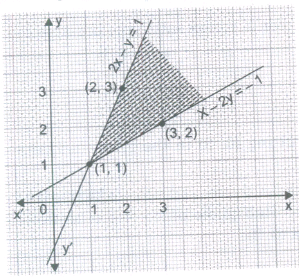
Table of value satisfying the equation 2x - y = 1
| x | 1 | 2 |
| y | 1 | 3 |
Putting (0, 0) in the given inequation, we have
2 x 0 - 0 > 1 \(\Rightarrow\) 0 > 1 , which is false
\(\therefore\) Half plane of 2x - y > 1 is away from origin
Also the given inequality is x - 2y < -l.
Draw the graph of the line x - 2y =-l.
Table of values satisfying the equation
x - 2y = -1
| x | 1 | 3 |
| y | 1 | 2 |
Putting (0, 0) in the given inequation, we have
0-2 x 0 < -1 \(\Rightarrow\) 0 < -1, which is false
\(\therefore\) Half plane of x - 2y < -1 is away from origin
28.
(b)
\(\pi\over4\)
29.
(c)
(A \(\cup\) B) - (A \(\cap\) B)
30.
(b)
parabola
31.
(b)
2

11th Standard CBSE Syllabus & Materials
11th Standard CBSE
CBSE 11th Business Studies Forms of Business Organisation Sample Question Papers Study Material - QB365 Set A
NEW11th Standard CBSE
CBSE 11th Business Studies Business, Trade and Commerce Sample Question Papers Study Material - QB365 Set A
NEW11th Standard CBSE
CBSE 11th Physics Waves Sample Question Papers Study Material - QB365 Set A
NEW11th Standard CBSE
CBSE 11th Physics Kinetic Theory Sample Question Papers Study Material - QB365 Set A



CBSE 11th Standard CBSE Subjects
CBSE Standards









