
 100% FREE ACCESS
11th Standard CBSE Syllabus & Materials
11th Standard CBSE
CBSE 11th Economics PART-A - Presentation of Data - New Sample Question Papers Study Material - QB365 Set A
NEW11th Standard CBSE
CBSE 11th Economics PART-A - Organisation of Data - New Sample Question Papers Study Material - QB365 Set A
NEW11th Standard CBSE
CBSE 11th Economics PART-A - Collection of Data - New Sample Question Papers Study Material - QB365 Set A
NEW11th Standard CBSE
CBSE 11th Economics PART-A - Introduction to Economics and Statistics - New Sample Question Papers Study Material - QB365 Set A
NEW11th Standard CBSE
CBSE 11th Business Studies International Trade Sample Question Papers Study Material - QB365 Set A
NEW11th Standard CBSE
CBSE 11th Business Studies Evolution and Fundamentals of Business Sample Question Papers Study Material - QB365 Set A

Published on: 01/01/2019
Class 11 Model Question
Download CBSE Class 11th Standard CBSE Mathematics question papers, sample papers, important questions, and previous year solved papers in PDF format. Get free study materials, NCERT solutions, and exam preparation resources for Class 11th Standard CBSE Mathematics
Questions + Answers key
Take MCQ Mathematics Test
1.
Find the derivative of \(\frac { 1 }{ { ax }^{ 2 }+bx+c } \) (it is to be understood that a, b, c, d, p, q, rand s are fixed non-zero constants and m and n are integers)
2.
Two dice are thrown simultaneously. Find the probability of getting an even number as the sum.
3.
Calculate the mean deviation from the median for the following data.
| Wages Per day | Number of workers |
| 20-30 | 3 |
| 30-40 | 8 |
| 40-50 | 12 |
| 50-60 | 9 |
| 60-70 | 8 |
4.
Find the coordinates of centroid of \(\Delta ABC\) , where vertices are A(x1, y1, z1), B(x2, y2, z2) and C(x3, y3, z3).
5.
If the sum of the distance of a moving point in a plane from the axes is 1, then find the locus of the point.
6.
If the integers r (>1), n (>2) and coefficients of (3r)th and (r + 2)nd terms in the expansion of (1 + x)2n are equal, then prove that n = 2r.
7.
Solve for \(x,\frac { 1 }{ |x|-3 } <0\)
8.
In a circle of diameter 44 cm, the length of chord is 22 cm. Find the length of minor arc of the chord.
9.
Find the general solution of the equation
sec22x=1-tan2x
10.
There are 200 individuals with a skin disorder, 120 has been exposed to chemical C1, 50 to chemical C2 and 30 to both the chemicals C 1 , C 2 . FInd the number of individuals exposed to chemical C1 but not chemical C2.
11.
Express the 0.3 as rational
12.
For some constants a and b, find the derivative of (ax2+b)2.
13.
Two die are rolled together what is the probability that the sum of numbers on the two faces is neither divisible by 4 nor by 5?
14.
Find the coordinates of the focus, axis of the parabola, the equation of the directrix and the length of the latus rectum.
x2=-18y
15.
Evaluate the following limits \({lim}_{x\rightarrow -1}\)\(\frac{x^{10}+x^{5}+1}{x-1}\)
16.
Write the following intervals of real numbers in the set·builder form:
(2,10)
17.
Find the coordinates of a point on the parabola y2=8x, whose focal distance is 4.
18.
A committee of 10 is to be formed form 8 gentleman and 9 ladies . In how many Wyas this can be done if atleat five ladies have to be included in a comittee? In how many of these committees
(i)the ladies are in majority?
(ii)the gentlement are in majority?
19.
Solve the equation \({ 25x }^{ 2 }-30x+11=0\) by using the general expression for the roots of a quadratic equation and show that the roots are complex conjugate.
20.
If A={1,4}, B= {2,3,6} and C= {2,3,7}, then verify that
\(A\times (B\cap C)=(A\times B)\cap (A\times C)\)
21.
Write the component statements of the following compound statement and check whether the compound statement is true or false
The sun is a star or Sun is plant
22.
Prove that (2n+7)<(n+3)2, for all natural numbers n.
23.
Solve the equation: cos \(\theta\) + cos 3\(\theta\) - 2 cos 2\(\theta\) = 0.
24.
Find the equations of the line through the intersection of lines 3x + 4y = 7 and x - y + 2 = 0 and whose slope is 5
25.
Solve the inequalities graphically - 5x +4y \(\le\) 20, x \(\ge\) 1, y \(\ge\) 2
26.
Find the mean deviation about the mean for the data
| Income per day | 0-100 | 100-200 | 200-300 | 300-400 | 400-500 | 500-600 | 600-700 | 700-800 |
| Number of persons | 4 | 8 | 9 | 10 | 7 | 5 | 4 | 3 |
27.
The ratio of the sum of m and n terms of an A.p. is m2:n2. Show that the ratio of mth and nth term is (2m - 1): (2n - 1).
28.
For any two sets A and B, (A - B) \(\cup\) (B - A)=_____.
(A - B) \(\cup\) A
(B - A) \(\cup\) B
(A \(\cup\) B) - (A \(\cap\) B)
(A \(\cup\) B) \(\cap\) (A \(\cap\) B)
29.
In a ΔABC, if the sides are 7cm, 4\(\sqrt { 3 } \) cm and .\(\sqrt { 13 } \) cm, then the smallest angle is ______.
45o
60o
30o
90o
30.
The latus rectum of the hyperbola \({ 16x }^{ 2 }-{ ay }^{ 2 }=144\quad is\) _______.
323
\(\frac { 15 }{ 4 } \)
\(\frac { 4 }{ 3 } \)
\(\frac { 3 }{ 4 } \)
31.
If the first term of an AP. is 5 and common difference is - 3 then sum of its 60 terms is equal to ______.
-1050
-5010
3010
None of these
1.
\(\text { Let } f(x)=\frac{1}{a x^{2}+b x+c}\)
\(\text { By quotient rule, }\)
\(f^{\prime}(x) =\frac{\left(a x^{2}+b x+c\right) \frac{d}{d x}(1)-\frac{d}{d x}\left(a x^{2}+b x+c\right)}{\left(a x^{2}+b x+c\right)^{2}} \)
\(=\frac{\left(a x^{2}+b x+c\right)(0)-(2 a x+b)}{\left(a x^{2}+b x+c\right)^{2}} \)
\(=\frac{-(2 a x+b)}{\left(a x^{2}+b x+c\right)^{2}}\)
2.
Total number of outcomes = 36 \(\Rightarrow \) n(s) = 36
Possible outcomes are (1,1)(1,3)(3,1),(2,2),(1,5),,(2,4),(4,2),(3,3),(3,5),(5,3),(4,4),(4,6),(2,6),(6,2),(6,4),(5,5),(6,6) n(E)=18
\(\frac { 1 }{ 2 } \)
3.
Let us make the following table from the given data.
| Wages per day(in Rs) | Mid value | fi | cf | \(|{ x }_{ i }-M|=|{ x }_{ i }-47.5|\) | \(f_{ i }|{ x }_{ i }-M|\) |
| 20-30 | 25 | 3 | 3 | 22.5 | 67.5 |
| 30-40 | 35 | 8 | 11 | 12.5 | 100.0 |
| 40-50 | 45 | 12 | 23 | 2.5 | 30.0 |
| 50-60 | 55 | 9 | 32 | 7.5 | 67.5 |
| 60-70 | 65 | 8 | 40 | 17.5 | 140.0 |
| Total | 40 | 405.0 |
Here, \(\frac { N }{ 2 } =\frac { 40 }{ 2 } =20\). The cumulative frequency just greater than 20 is 23, so the median class is 40-50.
So, we have l=40, f=12, cf=11, h=10 and N=40
Now, Median(M)=\(l+\frac { \frac { N }{ 2 } -cf }{ f } \times h=40+\frac { 20-11 }{ 12 } \times 10\)
\(=40+\frac { 90 }{ 12 } =40+7.5=47.5\)
and Mean deviation from the median = \(\frac { \sum { f_{ i }|{ x }_{ i }-M| } }{ N } \)
\(=\frac { 405 }{ 40 } =10.125\)
4.
Let D be the mid-point of BC and E be the centroid of \(\Delta ABC\), which divides AD in the ratio of 2:1
\(\left( \frac { { x }_{ 1 }+{ x }_{ 2 }+{ x }_{ 3 } }{ 3 } ,\frac { { y }_{ 1 }+{ y }_{ 2 }+{ y }_{ 3 } }{ 2 } \frac { { z }_{ 1 }+{ z }_{ 2 }+{ z }_{ 3 } }{ 2 } \right) \)
5.
\(\left| x \right| +\left| y \right| =1\),
\(\Rightarrow \pm x\pm y=1\) which forms a square
The locus of the point is a square.
6.
Here, r>1, n>2
\(\therefore \) T3r = 2nC3r-1 x3r-1; Tr+2 = 2nCr+1 xr+1
Then, 2nC3r-1= 2nCr+1
\(\Rightarrow \) 3r - 1 + r + 1 = 2n \(\Rightarrow \) n = 2r
7.
Let y = \(|x|\)
Ans. (-3, 3)
8.
Given, diameter = 44 cm
\(\therefore \) Radius, r = \(\frac { 44 }{ 2 } \) = 22 cm
Let chord AB = 22 cm
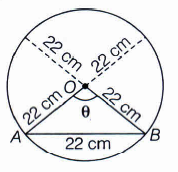
Since OA = OB = AB = 22 cm
\(\therefore \) \(\Delta \)OAB is equilateral
\(\Rightarrow \theta =\angle AOB=60^{ 0 }\)
Now, we convert 60o into radian measure.
\(\therefore 60^{ 0 }=\left( 60\times \frac { \pi }{ 180 } \right) rad\)
\(\left[ \because radian\quad measure=\frac { \pi }{ 180 } \times degree\quad measure \right] \)
\(\Rightarrow 60^{ 0 }=\frac { \pi }{ 3 } radian\)
\(\therefore Length\quad of\quad minor\quad arc\quad AB=r\theta \left[ \because \theta =\frac { arc\quad length(l) }{ radius\quad (r) } \therefore arc\quad length=r\theta \right] \)
\(=22\times \frac { \pi }{ 3 } =\frac { 22 }{ 3 } \times \frac { 22 }{ 7 } \quad \quad \left[ \because \pi =\frac { 22 }{ 7 } \right] \)
\(=\frac { 484 }{ 21 } cm\)
9.
1+tan22x=1-tan2x=>tan22x+tan2x=0
\(\Rightarrow\)tan2x=0 or tan2x=-1
\(\Rightarrow\)2x=\(n\pi \) or 2x=\(n\pi +\frac { \pi }{ 4 } \)
Ans
\(x = \frac { n\pi }{ 2 } \quad or\quad\frac { n\pi }{ 2 } +\frac { 3\pi }{ 8 } ,n\in Z\)
10.
Required number of individuals=\(n({ C }_{ 1 }\cap { C }_{ 2 }^{ ' })\)
=\(n({ C }_{ 1 }) -n({ C }_{ 1 }\cap { C }_{ 2 })\) = 120-30= 90
11.
We know that 0.3 = 0.3333 ...
\(\Rightarrow\) 0.3 + 0.03 + 0.003 +.......\(\infty\)
Clearly, it is Geometric series
Here a = 0.3 and r = \(\frac { 1 }{ 10 } \)
\(\therefore\) S\(\infty\) = \(\frac { a }{ 1-r } =\frac { 03 }{ 1-\frac { 1 }{ 10 } } \)
\(\therefore\) 0.3 = \(\frac { 1 }{ 3 } \)(in rational form)
12.
Here \(f^{'}(x)=(ax^{2}+b)^{2}=a^{2}x^{4}+b^{2}+2abx^{2}\)
∴ \(f^{'}(x)=\frac{d}{dx}[a^{2}x^{4}+b^{2}+2abx^{2}]\)
=\(a^{2}\frac{d}{dx}(x^{4})+\frac{d}{dx}(b^{2})+2ab \frac{d}{dx}(x^{2})\)
=\(a^{2} \times 4 x^{3}+0+2ab\times 2x\)
=4\(a^{2}x^{3}+4abx\)
=4ax(ax2 + b).
13.
\(\frac { 5 }{ 9 } \)
14.
\(\left( 0,\frac { -9 }{ 2 } \right) \); x=0; 2y-9=0; 18
15.
Here \(\overset{lim}{x\rightarrow -1}\)\(\frac{x^{10}+x^{5}+1}{x-1}\)
putting x = -1
\(=\frac{(-1)^{10}+(-1)^{5}+1}{-1-1}=\frac{1-1+1}{-2}=\frac{0+1}{2}=\frac{-1}{2}\)
16.
{x:x∈R,2<x<10}
17.
Given equation of parabola is y2=8x,
Here, a = 2
\(\therefore\) Focus=(2, 0)
Now, focal distance = 4
We know that focal distance is a distance of any point P(x, y) on the parabola from the focus F.
\(\therefore\) PF= Focal distance
\(\Rightarrow\) PF= \(\sqrt { { \left( x-a \right) }^{ 2 }+{ y }^{ 2 } } \) [by distance formula]
\(\Rightarrow\) 4=\(\sqrt { { \left( x-2 \right) }^{ 2 }+{ 8x } } \) [\(\because\) y2=8x]
\(\Rightarrow\) 16=x2-4x+4+8x [on squaring both sides]
\(\Rightarrow\) 16=(x+2)2
\(\Rightarrow\) x+2=4 [taking positive square root on both sides]
\(\Rightarrow\) x = 2
Now, y2 = 8\(\times\)2\(\Rightarrow\)y2 = 16\(\Rightarrow\) y =\(\pm\)4
Hence coordinates of a point are (2, 4) and (2, -4)
Note: The distance of a point P on the parabola from the focus is called focal distance of the point
18.
There are 9 ladies and 8 gentelmen. We have to form a commitee of 1 , consiting of atleat 5 ladoies
this can be formed by selecting
(a)5 ladies and 5 gentelmen
(b)6 ladies and 4 gentelmen
(c)7 ladies and 3 gentelmen
(d)8 ladies and 2 gentelmen
(e)9 ladies and 1 gentelmen
Noe , the number of ways of forming a committee
=9C5 X 8C5 + 9C6 X 8C4 + 9C7X 8C3 + 9C8 X 8C2+ 9C9 X 8C1
=9C4 X 8C3 + 9C3 X 8C4 + 9C2 X 8C3 + 9C1 X 8C2 + 9C0 X8C1 [nCr=nCn-r]
=\(\frac { 9\times 8\times 7\times 6 }{ 4\times 3\times 2\times 1 } \times \frac { 8\times 7\times 6 }{ 3\times 2\times 1 } +\frac { 9\times 8\times 7 }{ 3\times 2\times 1 } \times \frac { 8\times 7\times 6\times 5 }{ 4\times 3\times 2\times 1 } +\frac { 9\times 8 }{ 2\times 1 } \times \frac { 8\times 7\times 6 }{ 3\times 2\times 1 } +\)
\(9\times \frac { 8\times 7 }{ 2\times 1 } \)
=126 X 56 + 84 X 70 + 36 X 56 + 9 X 28 + 8
=7056+5880+2016+252+8=15212
(i) Clearly, ladies are in majority in (b),(c),(d) and (e) case as discussed above.
nUmber of committees in which ladies are in majority = 15212-9C5 x 8C5
(ii) Clearly, gentlemen are not in majority in the cases discussed above.
Thus, there is no committee in which gentlemen are in majority.Hence, number of such committee = 0.
19.
\(Given,\ { 25x }^{ 2 }-30x+11=0\)
On comparing Eq.(i) with ax2+bx+c=0, we get
\(a=25,\quad b=-30\quad and\quad c=11\)
\( \because x=\frac { -b\pm \sqrt { { b }^{ 2 }-4ac } }{ 2a } \)
\(\therefore x=\frac { 30\pm \sqrt { { (-30) }^{ 2 }-4\times 25\times 11 } }{ 2\times 25 } \)
\(\Rightarrow x=\frac { 30\pm \sqrt { 900-1100 } }{ 50 } \)
\( \Rightarrow x=\frac { 30\pm \sqrt { -200 } }{ 50 } \)
\( \Rightarrow x=\frac { 30\pm 10i\sqrt { 2 } }{ 50 } \quad [\because \sqrt { -1 } =i]\)
\( \Rightarrow x=\frac { 3 }{ 5 } \pm \frac { \sqrt { 2 } }{ 5 } i\)
\(\text{Hence, the roots are}\frac { 3 }{ 5 } +\frac { \sqrt { 2 } }{ 5 } i\ and\ \frac { 3 }{ 5 } -\frac { \sqrt { 2 } }{ 5 } i\)
\(Now,\ let\ \alpha =\frac { 3 }{ 5 } +\frac { \sqrt { 2 } }{ 5 } i \ and\ \beta =\frac { 3 }{ 5 } -\frac { \sqrt { 2 } }{ 5 } i\)
\(\because \ \alpha =\bar { \beta } and\ \beta =\bar { \alpha } \)
So,we can say that,the roots are complex conjugate of each other.
20.
We have,A={1,4}, B={2,3,6} and C={2,3,7}
To find \(A\times (B\cap C)\)
\(B\cap C\) = {2,3}
\(\therefore\) \(A\times (B\cap C)\)={1,4}\(\times \){2,3}
= {(1,2),(1,3),(4,2),(4,3}....(iii)
To find \((A\times B)\cap (A\times C)\)
\(A\times B\) ={(1,2),(1,3),(1,6),(4,2),(4,3),(4,6)}
\(A\times C\)= {(1,2),(1,3),(1,7),(4,2),(4,3),(4,7)}
\(\therefore \) \((A\times B)\cap (A\times C)\)= {(1,2),(1,3),(4,2),(4,3)}......(iv)
From Eqs.(iii) and (iv), we get
\(A\times (B\cap C)=(A\times B)\cap (A\times C)\)
21.
Compound statement is true and its component statements are
p: The Sun is a star
q: The Sun is a plant
22.
Consider P(k): (2k+7)<(k+3)2
\(\Rightarrow \) (2k+7)+2 < (k+3)2 +2
\(\Rightarrow \) 2(k+1)+7 < (k+4)2 [(k+3)3+2<(k+4)2]
23.
(2n + 1)\({\pi\over 4},2m\pi;m,n \in Z\)
24.
The given equations are 3x + 4y - 7 = 0 and x - y + 2 = 0
Equation of any line passing through the intersection of the given lines is in the form
(3x + 4y - 7) + k (x - y + 2) = 0 ... (i)
⇒ 3x + 4y - 7 + kx - ky + 2k = 0
⇒ (3 + k) x + (4 - k) y - 7 + 2k = 0
Slope= \(-(3+k)\over 4-k\)
∴ \(-{(3+k)\over 4-k}=5\)
⇒ 20 - 5k = -3 - k
⇒ 4k = 23
∴ \(k={23\over 4}\)
Substituting the value of k is equation (i)
\((3x + 4y - 7) +{23\over 4}(x - y + 2) = 0\)
⇒ 12x + 16y - 28 + 23x - 23y + 46 = 0
⇒ 35x - 7y + 18 = 0
25.
The given inequality 5x +4y \(\le\) 20
draw the graph of the line 5x + 4y = 20
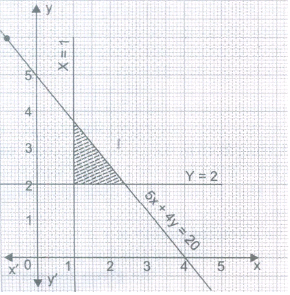
table of values satisfying the equation 5x +4y = 20
| x | 4 | 0 |
| y | 0 | 5 |
Putting (0,0) in the given inequation, we have 5 x 0 +4 x 0 \(\le\) 20 \(\Rightarrow\) 0 \(\le\) 20, which is true
\(\therefore\) Half plane of 5x +4y \(\le\) 20 is towards origin
Also the given inequality ix x \(\ge\) 1
Draw the graph of the line x = 1
Putting (0,0) in the given inequation, we have 0 \(\ge\) 1 which is false
\(\therefore\) Half plane of x \(\ge\) 1 is away from origin
the given inequality is y \(\ge\) 2
Draw the graph of the line y = 2
Putting (0,0) in the given inequation, we have 0 \(\ge\)2, which is false
\(\therefore\) half plane y \(\ge\) 2 is away from origin
26.
| Income per day | Mid values xi | fi | fixi | |xi-358| | fi|xi-358| |
| 0-100 | 50 | 4 | 200 | 308 | 1232 |
| 100-200 | 150 | 8 | 1200 | 208 | 1664 |
| 200-300 | 250 | 9 | 2250 | 108 | 972 |
| 300-400 | 350 | 10 | 3500 | 8 | 80 |
| 400-500 | 450 | 7 | 3150 | 92 | 644 |
| 500-600 | 550 | 5 | 2750 | 192 | 960 |
| 600-700 | 650 | 4 | 2600 | 292 | 1168 |
| 700-800 | 750 | 3 | 250 | 392 | 1176 |
| 50 | 17900 | 7896 |
Mean\(\overline { x } =\frac { 1 }{ N } \sum { { f }_{ i }{ x }_{ i } } =\frac { 1 }{ 50 } \times 17900=358\)
Mean deviation about mean\(=\frac { 1 }{ N } \sum _{ i=1 }^{ n }{ { f }_{ i }\left| { x }_{ i }-\overline { x } \right| } \)
\(=\frac{1}{50}\times7896 = 157.92\)
27.
Let 'a' be the first term and 'd' be the common difference of given A.P.
\(\because \quad { S }_{ m }=\frac { m }{ 2 } [2a+(m-1)d]\)
and \({ S }_{ n }=\frac { n }{ 2 } [2a+(n-1)d]\)
\(\therefore \quad \frac { { S }_{ m } }{ { S }_{ n } } =\frac { \frac { m }{ 2 } [2a+(m-1)d] }{ \frac { n }{ 2 } [2a+(n-1)d] } \)
But \(\frac { { S }_{ m } }{ { S }_{ n } } =\frac { { m }_{ 2 } }{ { n }_{ 2 } } \) [Given]
\(\Rightarrow \frac { \frac { m }{ 2 } [2a+(m-1)d] }{ \frac { n }{ 2 } [2a+(n-1)d] } =\frac { { m }^{ 2 } }{ { n }^{ 2 } } \)
\(\Rightarrow \frac { 2a+(n-1)d }{ 2a+(n-1)d] } =\frac { { m }^{ 2 } }{ { n }^{ 2 } } \times \frac { n }{ 2 } \times \frac { 2 }{ m } =\frac { m }{ n } \)
\(\Rightarrow\) 2an + n(m-1)d = 2am + m(n-1)d
\(\Rightarrow\) 2an-2am= (mn-m)d-(mn-n)d
\(\Rightarrow\) 2a[n-m]=[mn-m-mn+n]d
\(\Rightarrow\) 2a[n-m]=[n-m]d
\(\Rightarrow d=\frac { 2a[n-m] }{ [n-m] } =2a\)
Now, \(\frac { { a }_{ m } }{ { a }_{ n } } =\frac { a+(m-1)d }{ a+(n-1)d } =\frac { a+(m-1)\times 2a }{ a+(n-1)\times 2a } \)
\(=\frac { a[1+2m-2] }{ a[1+2n-2] } =\frac { 2m-1 }{ 2n-1 } \)
Thus, the ratio of 'mth' and 'nth' term is (2m+1): (2m-1).
28.
(c)
(A \(\cup\) B) - (A \(\cap\) B)
29.
(c)
30o
30.
(a)
323
31.
(b)
-5010

11th Standard CBSE Syllabus & Materials
11th Standard CBSE
CBSE 11th Business Studies Forms of Business Organisation Sample Question Papers Study Material - QB365 Set A
NEW11th Standard CBSE
CBSE 11th Business Studies Business, Trade and Commerce Sample Question Papers Study Material - QB365 Set A
NEW11th Standard CBSE
CBSE 11th Physics Waves Sample Question Papers Study Material - QB365 Set A
NEW11th Standard CBSE
CBSE 11th Physics Kinetic Theory Sample Question Papers Study Material - QB365 Set A



CBSE 11th Standard CBSE Subjects
CBSE Standards









