
 100% FREE ACCESS
11th Standard CBSE Syllabus & Materials
11th Standard CBSE
CBSE 11th Economics PART-A - Presentation of Data - New Sample Question Papers Study Material - QB365 Set A
NEW11th Standard CBSE
CBSE 11th Economics PART-A - Organisation of Data - New Sample Question Papers Study Material - QB365 Set A
NEW11th Standard CBSE
CBSE 11th Economics PART-A - Collection of Data - New Sample Question Papers Study Material - QB365 Set A
NEW11th Standard CBSE
CBSE 11th Economics PART-A - Introduction to Economics and Statistics - New Sample Question Papers Study Material - QB365 Set A
NEW11th Standard CBSE
CBSE 11th Business Studies International Trade Sample Question Papers Study Material - QB365 Set A
NEW11th Standard CBSE
CBSE 11th Business Studies Evolution and Fundamentals of Business Sample Question Papers Study Material - QB365 Set A

Published on: 01/01/2019
Grade 11 Revision Test Question
Download CBSE Class 11th Standard CBSE Mathematics question papers, sample papers, important questions, and previous year solved papers in PDF format. Get free study materials, NCERT solutions, and exam preparation resources for Class 11th Standard CBSE Mathematics
Questions + Answers key
Take MCQ Mathematics Test
1.
Find the derivative of \(\frac{x^{n}-a^{n}}{x-a}\) for some constant a.
2.
Find equation of the circle with centre (5,-2) and radius 3.
3.
A and B are mutually exclusive events of an experiment. If P(not A)=0.65, \(P(A\cup B)=0.65\) and P(B) = p, then find the value of p.
4.
Evaluate the following limit \(\lim_ { x\rightarrow \pi /2 }{ lim } \frac { { cos }^{ 2 }x }{ 1-sin x } \)
5.
Find the equation of an ellipse, if it satisfies the condition b = 3, c = 4, centre at the origin, foci on the X-axis.
6.
How many terms of GP\(3,\frac { 3 }{ 2 } ,\frac { 3 }{ 4 } \),...are needed to give the sum \(\frac { 3069 }{ 512 } \)?
7.
In how many different ways, the letters of the word 'ALGEBRA' can be arranged in a row, if the two A's are together?
8.
If \(cos\theta =\frac { cos\alpha -cos\beta }{ 1-cos\alpha cos\beta } ,\) then prove that \(tan\frac { \theta }{ 2 } =\pm tan\frac { \alpha }{ 2 } cot\frac { \beta }{ 2 } .\)
9.
Let R be a relation of N defined by R={(a,b):a,b\(\epsilon \)N and a=b2} Are the following true?
(a,a)\(\epsilon \)R for all a\(\epsilon \)N
10.
State which of the following sets are finite and which are infinite?
B = {x : x \(\in\) Z and x2 is even}
11.
Prove that : sin 3x+sin 2x-sin x= 4sinxcos\({x\over2}cos{3x\over2}\)
12.
From a well-shuffled deck of 52 cards is drawn at random. Find the probability of getting a face card.
13.
The scores of a batsman in 10 innings are 48, 80, 58, 44, 52, 65, 73, 56, 64, 54. Find the mean deviation from the median.
14.
Show that the points P(0,7,10), Q(-1,6,6)and R(-4,9,6) form a right angled isosceles triangle.
15.
If a line passes through (2,2) and is perpendicular to the line 3x + y = 3, then find its y-intercept.
16.
Find the coefficient of a4 in the product (1+2a)4 (2-a)5 using binomial theorem
17.
Solve graphically \(x-y\le 2;x+2y\le 8;x,y\ge 0\)
18.
If z1 = 3+2i and z2 = 2-4i, then verify that \({ \left| { z }_{ 1 }+{ z }_{ 2 } \right| }^{ 2 }+ { \left| { z }_{ 1 }-{ z }_{ 2 } \right| }^{ 2 }=2({ \left| { z }_{ 1 } \right| }^{ 2 }+{ \left| { z }_{ 2 } \right| }^{ 2 })\)
19.
In a \(\Delta\)ABC prove that,
\(\cfrac { co{ s }^{ 2 }(\cfrac { B-C }{ 2 } ) }{ (b+c{ ) }^{ 2 } } +\cfrac { si{ n }^{ 2 }(\cfrac { B-C }{ 2 } ) }{ (b-c{ ) }^{ 2 } } ={ a }^{ -2 }\)
20.
If X = {a,b,c,d} and Y = {f,b,d,g}, then find
\(X\cap Y\)
21.
By giving a counter example, shows that the following statement is not true.
p: If all the angles of a triangle are equal, than the triangle is an obtuse angled triangle.
22.
If x and y are any two distinct integers, then prove by mathematical induction that \(\left( { x }^{ n }-{ y }^{ n } \right) \) is divisible by (x-y), for all \(n\in N\)
23.
Evaluate: \(\overset{Lt}{x\rightarrow e}\frac{log x-1}{x-e}\)
24.
Find the sum to n terms of the series: 12 -22 +32 - 42 + 52 - 62 - 72 -82
25.
Find the area of the triangle formed by the lines y - x = 0, x + y = 0 and x - k = 0.
26.
Solve the inequalities graphically x+y \(\ge\) 4, 2x - y > 0
27.
Find the mean deviation about the median for the data
13,17,16,14,11,13,10,16,11,18,12,17
28.
If tan\(\theta\) + cot \(\theta\) = 5 then tan3 \(\theta\) + cot3 \(\theta\) is equal to ______.
135
140
110
90
29.
For any two sets A and B, (A - B) \(\cup\) (B - A)=_____.
(A - B) \(\cup\) A
(B - A) \(\cup\) B
(A \(\cup\) B) - (A \(\cap\) B)
(A \(\cup\) B) \(\cap\) (A \(\cap\) B)
30.
In the parabola y2 = 4ax,the length of the chord passing through the vertex and inclined to the axis at π/4 is ________.
\(4\sqrt { 2 } a\)
\(3\sqrt { 2 } a\)
\(2\sqrt { 2 } a\)
\(\sqrt { 2 } a\)
31.
If first and last terms ofanAP. are 3 and 18 and the sum of its terms is 84, then number of terms will be ______.
5
6
7
8
1.
Here f(x)=\(\frac{x^{n}-a^{n}}{x-a}\)
∴ \(f^{'}(x)=\frac{d}{dx}[\frac{x^{n}-a^{n}}{x-a}]\)
=\(\frac{(x-a)\frac{d}{dx}(x^{n}-a^{n})-(x^{n}-a^n)\frac{d}{dx}(x-a)}{(x-a)^{2}}\)
=\(\frac{(x-a)\times nx^{n-1}-(x^{n}-a^{n}\times 1)}{(x-a)^{2}}\)
=\(\frac{nx^{n}-anx^{n-1-(x^{n}+a^{n})}}{(x-a)^{2}}\)
2.
Here, h=5, k=-2 and r=3
(x - h)2 + (y - k)2 = r2
∴ (x - 5)2 + (y + 2)2 = (3)2
⇒ x2 + 25 - 10x + y2 + 4 + 4y = 9
⇒ x2 + y2 - 10x + 4y + 29 - 9 = 0
⇒ x2 + y2 -10x + 4y + 20 =0
which is required equation of circle.
3.
Use P(A∪B) = P(A) + P(B),for mutually exclusive events.
Ans.0.3
4.
Given limit = \(\lim_ { x\rightarrow \pi /2 }{ lim } \frac { 1-{ sin }^{ 2 }x }{ 1-sinx } =\lim_ { x\rightarrow \pi /2 }{ lim } 1+sin \ x\)
Ans. 2
5.
Given, foci lies on X-axis, So, the equation of ellipse will be of the form
\(\frac { { x }^{ 2 } }{ { a }^{ 2 } } +\frac { { y }^{ 2 } }{ { b }^{ 2 } } =1,\quad a>b\)
Also, given that, b = 3 and c = 4
\(\therefore{ c }^{ 2 }={ a }^{ 2 }-{ 3 }^{ 2 }\Rightarrow { \left( 4 \right) }^{ 2 }={ a }^{ 2 }-9 \Rightarrow 16={ a }^{ 2 }-9\)
\(\Rightarrow { a }^{ 2 }=16+9 \Rightarrow { a }^{ 2 }=25\)
On putting the values of \({ a }^{ 2 }=25\) and \({ b }^{ 2 }=9\) in Eq. (i) we get
\(\frac { { x }^{ 2 } }{ 25 } +\frac { { y }^{ 2 } }{ 9 } =1\)
6.
Given,GP is \(3,\frac { 3 }{ 2 } ,\frac { 3 }{ 4 } \),...
Here, a=3,\(r=\frac { 3 }{ 2 } \div 3=\frac { 1 }{ 2 } \)
Let n be the number of terms needed
Thus Sn=\(\frac { 3069 }{ 512 } \)\(\Rightarrow \frac { a(1-{ r }^{ n }) }{ 1-r } =\frac { 3069 }{ 512 }\quad [\because r<1]\)
\(\Rightarrow \frac { 3\left\{ 1-\frac { 1 }{ { 2 }^{ n } } \right\} }{ 1-\frac { 1 }{ 2 } } =\frac { 3069 }{ 512 } \)
\( \Rightarrow 6\left( 1-\frac { 1 }{ { 2 }^{ n } } \right) =\frac { 3069 }{ 512 } \Rightarrow 1-\frac { 1 }{ { 2 }^{ n } } =\frac { 3069 }{ 3072 }\)
\(\Rightarrow \frac { 1 }{ { 2 }^{ n } } =1-\frac { 3069 }{ 3072 } =\frac { 3072-3069 }{ 3072 } \\ \)
\(\Rightarrow \frac { 1 }{ { 2 }^{ n } } =\frac { 3 }{ 3072 } =\frac { 1 }{ 1024 } \Rightarrow 2^{ v }=1024\Rightarrow { 2 }^{ n }={ 2 }^{ 10 }\)
On comparing the powers from both sides, we get
n=10
hence,10 terms are needed to give the sum\(\frac { 3069 }{ 512 } \).
7.
There are 7 letters in the word ALGEBRA. In these letters, 'A' occurs twice and rest all are different.
(i) Since two A's are always together, so let us consider two 'A' s as one letter.
\({ AA }\) , L, G, E, B, R Now, we have 6 letters, which can be arranged in 6P6 = 6! ways
Hence, required number of ways = 6! = 720
[\(\because \) two A's can be arranged among themselves in one way only]
8.
\(Given,\quad cos\theta =\frac { cos\alpha -cos\beta }{ 1-cos\alpha cos\beta } \)
\(\Rightarrow \frac { 1-tan^{ 2 }\frac { \theta }{ 2 } }{ 1+tan^{ 2 }\frac { \theta }{ 2 } } =\frac { cos\alpha -cos\beta }{ 1-cos\alpha cos\beta } \quad \left[ \because cosx=\frac { 1-tan^{ 2 }\frac { x }{ 2 } }{ 1+tan^{ 2 }\frac { x }{ 2 } } \right] \)
\(\Rightarrow \frac { 1-tan^{ 2 }\frac { \theta }{ 2 } +1+tan^{ 2 }\frac { \theta }{ 2 } }{ 1-tan^{ 2 }\frac { \theta }{ 2 } -1-tan^{ 2 }\frac { \theta }{ 2 } }\)
\( =\frac { cos\alpha -cos\beta +1-cos\alpha cos\beta }{ cos\alpha -cos\beta -1+cos\alpha cos\beta } \)
\([applying\quad componendo\quad and\quad dividendo]\)
\(\Rightarrow -\frac { 2 }{ 2tan^{ 2 }\frac { \theta }{ 2 } } =\frac { (cos\alpha +1)(1-cos\beta ) }{ (cos\alpha -1)(cos\beta +1) } \)
\(\Rightarrow \frac { 1 }{ 2tan^{ 2 }\frac { \theta }{ 2 } } =\frac { (1+cos\alpha )(1-cos\beta ) }{ (1-cos\alpha )(1+cos\beta ) } \)
\(\Rightarrow \frac { 1 }{ tan^{ 2 }\frac { \theta }{ 2 } } =\frac { \left( 1+2cos^{ 2 }\frac { \alpha }{ 2 } -1 \right) \left( 1-1+2sin^{ 2 }\frac { \beta }{ 2 } \right) }{ \left( 1-1+2sin^{ 2 }\frac { \alpha }{ 2 } \right) \left( 1+2cos^{ 2 }\frac { \beta }{ 2 } -1 \right) } \)
\(\Rightarrow \frac { 1 }{ tan^{ 2 }\frac { \theta }{ 2 } } =\frac { 4cos^{ 2 }\frac { \alpha }{ 2 } sin^{ 2 }\frac { \beta }{ 2 } }{ 4sin^{ 2 }\frac { \alpha }{ 2 } cos^{ 2 }\frac { \beta }{ 2 } } \Rightarrow tan^{ 2 }\frac { \theta }{ 2 } =\frac { sin^{ 2 }\frac { \alpha }{ 2 } cos^{ 2 }\frac { \beta }{ 2 } }{ cos^{ 2 }\frac { \alpha }{ 2 } sin^{ 2 }\frac { \beta }{ 2 } } \)
\(\Rightarrow tan^{ 2 }\frac { \theta }{ 2 } =tan^{ 2 }\frac { \alpha }{ 2 } cot^{ 2 }\frac { \beta }{ 2 } \)
\(\therefore \quad tan\frac { \theta }{ 2 } =\pm tan\frac { \alpha }{ 2 } cot\frac { \beta }{ 2 } \)
Hence proved.
9.
If \((a,a)\in R\) , then \(a={ a }^{ 2 }\). It is true for \(a=1\epsilon N\) only \(\therefore (1,1)\in R\) but \((2,2),(3,3),(4,4)\).....does not belongs to R.So, is not true
10.
B = {....., -6, -4, -2, 0, 2, 4, 6,......}, so B is an infinite set.
11.
We have
L.H.S. = sin 3x + sin 2x - sin x.
= (sin 3x - sin x) + sin 2x
\(=[2cos({3x+x\over2}) sin({3x+x\over2})]+2sin x cos x\)
\([\because \ sin C- sin D=2cos {C+D\over2}.sin{C-D\over2}]\)
= 2 cos 2x sin x + 2 sin x cos x
= 2 sin x [cos 2x + cos x]
= 2 sin x\([2cos({2cos ({2x+x\over2})}cos({2x+x\over2})]\)
\(=2sin x[2cos({3x\over2})cos({x\over2})]\)
= 4 sin x cos \({x\over2}\) cos \({3x\over2}\) =R.H.S
12.
Required probability = \(\frac { 12 }{ 52 } \)
\(\frac { 3 }{ 13 } \)
13.
Arranging the data in ascending order, we have 44, 48, 52, 54, 56, 58, 64, 65, 73, 80
Here, n=10. So, median is the mean of 5th and 6th terms.
\(\therefore \) Median (M) = \(\left( \frac { 56+58 }{ 2 } \right) =57\)
We make the table from the given data.
| \(Scores(x_{ i })\) |
Deviation from median |
\(|{ x }_{ i }-M|\) |
| 44 | 44-57=-13 | 13 |
| 48 | 48-57=-9 | 9 |
| 52 | 52-57=-5 | 5 |
| 54 | 54-57=-3 | 3 |
| 56 | 56-57=-1 | 1 |
| 58 | 58-57=1 | 1 |
| 64 | 64-57=7 | 7 |
| 65 | 65-57=8 | 8 |
| 73 | 73-57=16 | 16 |
| 80 | 80-57=23 | 23 |
| Total | 86 |
\(\therefore \) Mean deviation = \(\frac { \sum { |{ x }_{ i }-M| } }{ n } =\frac { 86 }{ 10 } =8.6\)
Hence, the mean deviation from the median is 8.6.
14.
\(PQ=QR\quad and\quad { PQ }^{ 2 }+{ QR }^{ 2 }={ PR }^{ 2 }\)
15.
Slope of the required perpendicular line=1/3
\(\therefore \) Equation of the required perpendicular line is
y-2=(1/3)(x-2)
For y-intercept put x=0 ,y = 4/3
16.
We first expand each of the factors of the given product using Binomial
Theorem. We have
(1+2a)4 \(\left[ { ^{ 4 }C }_{ 0 }+{ ^{ 4 }C }_{ 1 }(2a)+{ ^{ 4 }C }_{ 2 }(2a)^{ 2 }+{ ^{ 4 }C }_{ 3 }(2a)^{ 3 }+{ ^{ 4 }C }_{ 4 }(2a)^{ 4 } \right] \)
= 1 + 4 (2a) + 6(4a2) + 4 (8a3) + 16a4.
= 1 + 8a + 24a2 + 32a3 + 16a4
and (2-a)5 \(\left[ { ^{ 5 }C }_{ 0 }({ 2 }^{ 5 })-{ ^{ 5 }C }_{ 1 }(2)^{ 4 }a+{ ^{ 5 }C }_{ 2 }(2)^{ 3 }(a)^{ 2 }-{ ^{ 5 }C }_{ 3 }(2)^{ 2 }(a)^{ 3 }+{ ^{ 5 }C }_{ 4 }(2)(a)^{ 4 }-{ ^{ 5 }C }_{ 5 }(a)^{ 5 } \right] \)
= 32 – 80a + 80a2 – 40a3 + 10a4 – a5
Thus (1 + 2a)4 (2 – a)5
\(\left[ 1+8a+{ 24 }a^{ 2 }+{ 32a }^{ 3 }+{ 16a }^{ 4 } \right] \times \left[ 32-80a+{ 80a }^{ 2 }-{ 40a }^{ 3 }+{ 10a }^{ 4 }-{ a }^{ 5 } \right] \)The complete multiplication of the two brackets need not be carried out. We write only
those terms which involve a4. This can be done if we note that ar. a4 – r = a4. The terms containing a4 are
1 (10a4) + (8a) (–40a3) + (24a2) (80a2) + (32a3) (– 80a) + (16a4) (32) = – 438a4
Thus, the coefficient of a4 in the given product is – 438.
17.
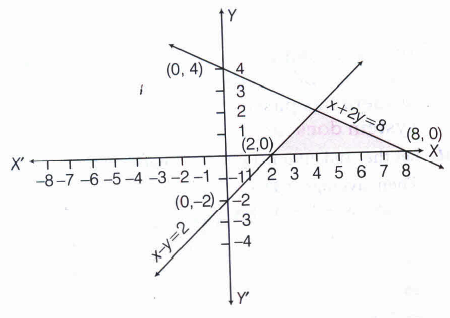
18.
We have, z1 = 3+2i and z2 = 2-4i
Now, LHS= \({ \left| { z }_{ 1 }+{ z }_{ 2 } \right| }^{ 2 }+ { \left| { z }_{ 1 }-{ z }_{ 2 } \right| }^{ 2 }\)
On substituting the value of z1 and z2, we get
LHS = \({ \left| { z }_{ 1 }+{ z }_{ 2 } \right| }^{ 2 }+ { \left| { z }_{ 1 }-{ z }_{ 2 } \right| }^{ 2 }=2({ \left| { z }_{ 1 } \right| }^{ 2 }+{ \left| { z }_{ 2 } \right| }^{ 2 })\)
\(={ \left| 3+2i+2-4i \right| }^{ 2 }+\left| 3+2i+2-4i \right| \)
\( ={ \left| 5-2i \right| }^{ 2 }+{ \left| 1+6i \right| }^{ 2 }={ (5) }^{ 2 }+{ (-2) }^{ 2 }+{ (1) }^{ 2 }+{ (6) }^{ 2 }\)
\( [if\quad z=a+ib,\quad then\quad { \left| z \right| }^{ 2 }={ a }^{ 2 }+{ b }^{ 2 }]\)
\(=25+4+1+36\)
\(\because \quad LHS=66\quad ......(i)\)
\(and\ RHS=2({ \left| { z }_{ 1 } \right| }^{ 2 }+{ \left| { z }_{ 2 } \right| }^{ 2 } =2({ \left| 3+2i \right| }^{ 2 }+{ \left| 2-4i \right| }^{ 2 })\)
\(=2[{ (3) }^{ 2 }+{ (2) }^{ 2 }+{ (2) }^{ 2 }+{ (-4) }^{ 2 }]\)
\(=2(9+4+4+16) =2\times 33\)
\(\because \quad RHS=66\quad ....(ii)\)
From Eq (i) and (ii), we get LHS = RHS.
Hence proved.
19.
\(LHS=\frac { co{ s }^{ 2 }(\frac { B-C }{ 2 } ) }{ (b+c{ ) }^{ 2 } } +\frac { si{ n }^{ 2 }(\frac { B-C }{ 2 } ) }{ (b-c{ ) }^{ 2 } }\)
\(=\frac { co{ s }^{ 2 }(\frac { B-C }{ 2 } ) }{ (ksinB+ksinC{ ) }^{ 2 } } +\frac { si{ n }^{ 2 }(\frac { B-C }{ 2 } ) }{ (ksinB-KsinC{ ) }^{ 2 } } \)
\(=\frac { co{ s }^{ 2 }(\frac { B-C }{ 2 } ) }{ { k }^{ 2 }(sinB+sinC{ ) }^{ 2 } } +\frac { si{ n }^{ 2 }(\frac { B-C }{ 2 } ) }{ { K }^{ 2 }(sinB-sinC{ ) }^{ 2 } } \)
\(=\frac { 1 }{ { K }^{ 2 } } \left[ \frac { co{ s }^{ 2 }(\frac { B-C }{ 2 } ) }{ 4si{ n }^{ 2 }\left( \frac { B+C }{ 2 } \right) co{ s }^{ 2 }\left( \frac { B-C }{ 2 } \right) } +\frac { si{ n }^{ 2 }\left( \frac { B-C }{ 2 } \right) }{ 4co{ s }^{ 2 }(\frac { B+C }{ 2 } )si{ n }^{ 2 }\left( \frac { B-C }{ 2 } \right) } \right] \)
\(=\frac { 1 }{ { k }^{ 2 } } \left[ \frac { 1 }{ 4si{ n }^{ 2 }\left( \frac { B+C }{ 2 } \right) } +\frac { 1 }{ 4co{ s }^{ 2 }\left( \frac { B+C }{ 2 } \right) } \right] \)
\( =\frac { 1 }{ { k }^{ 2 } } \left[ \frac { co{ s }^{ 2 }(\frac { B+C }{ 2 } +si{ n }^{ 2 }\left( \frac { B+C }{ 2 } \right) }{ \{ 2si{ n }\left( \frac { B+C }{ 2 } \right) cos\left( \frac { B+C }{ 2 } \right) { \} }^{ 2 } } \right] =\frac { 1 }{ { k }^{ 2 }si{ n }^{ 2 }(B+C) } \)
\(=\frac { 1 }{ { k }^{ 2 }si{ n }^{ 2 }A } ={ a }^{ -2 }=RHS\)
20.
\(X\cap Y=\{ b,d\} \)
-S.png)
21.
p: All the angles of a triangle are equal.
q: the triangles is an obtuse angled triangled.
We have to show that if p then \(\sim \) q. Take each angle equal to \({ 60 }^{ \circ }\), it means they are acute angle.
Hence, we conclude that the given statement is false.
22.
Let P(n) = (xn-yn) is divisible by (x - y) for all n ∊ N.
For n =1
P(1) = (x1-y1) is divisible by (x-y)
∴ P(1) is true
Let P(n) be true for n = k
∴ P(k)=(xk-yk) is divisible by (x-y)
⇒ (xk-yk) =m(x-y) for some m ∊ Z ..(i)
For n = k+1
∴ P(k+1)=xk+1-yk+1 is divisible by (x-y)
xk+1-yk+1 = xk+1-xky+xky-yk+1
= xk(x-y)+y(xk-yk)
= xk(x -y)+y.m(x-y)
= (x-y)[xk+my]
which is divisible by (x-y)
∴ P(k+1) is true
Thus P(k) is true ⇒ P(k + 1) is true
Hence by principle of mathematical induction, pen) is true for all n∊N.
23.
Put x=e+h
then \(x\rightarrow e \Rightarrow h\rightarrow 0\)
ஃ \(\overset{Lt}{h\rightarrow 0}\frac{log x-1}{x-e}=\overset{Lt}{h\rightarrow 0}\frac{log(e+h)-log e}{e+h-e}\) [∵ log e=1]
=\(\overset{Lt}{h\rightarrow 0} \frac{log[\frac{e+h}{e}]}{h} \Rightarrow \overset{Lt}{h\rightarrow 0}\frac{log[1+\frac{h}{e}]}{\frac{h}{e}\times e}\)
∴ \(\frac{h}{e}\rightarrow 0 \Rightarrow \frac{1}{e}.\frac{1}{1} \Rightarrow \frac{1}{e} \)
∴ \(\overset{Lt}{x\rightarrow e}\frac{log x-1}{x-e}=\frac{1}{e}\).
24.
When n is even
12 -22 +32 - 42 + 52 - 62 - 72 -82 + ....+(n -1)2 - n2
= (12 - 22) + (32- 42) + (52 - 62) + (72 - 82) + ...+ [(n - 1)2 - n2]
= (1 + 2) (1 -2) + (3 -4)(3 +4) + (5 - 6) (5 +6)+...+ (n - 1 - n) (n - 1 + n)
= -[1 + 2 + 3 + 4 + 5 + 6 + ...+ (n - 1) + n]
= \(\frac { n(n+1) }{ 2 } \)
When n is odd:
(12 - 22) + (32 - 42) + (52 - 62) + ... [(n - 2)2 - (n- 1)2] + n2
= (1 + 2) (1 - 2) + (3 + 4) (3 - 4) + (5 + 6)
(5 - 6) + ...+ (n - 2 - n + 1) (n - 2 + n - 1) + n2
= - [1 + 2 + 3 + 4 + 5 + 6 + ...+ (n - 2) + (n -1)] + n2
= \(\frac { \left( n-1 \right) \left( n-1+1 \right) }{ 2 } +{ n }^{ 2 }\)
= \(\frac { n(n-1) }{ 2 } +{ n }^{ 2 }\)
= \(\frac { -{ n }^{ 2 }+n+{ 2n }^{ 2 } }{ 2 } =\frac { { n }^{ 2 }+n }{ 2 } =\frac { n(n+1) }{ 2 } \)
25.
The equation of lines are
y - x = 0.....(i)
x + y = 0....(ii)
x - k = 0....(iii)
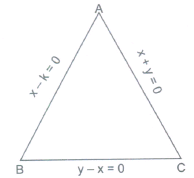
By solving (i) and (ii), we get the coordinates of point C.
\(\therefore\) Coordinate of Care (0, 0).
By solving (ii) and (iii), we get the coordinates of point A.
\(\therefore\) Coordinate of A are (k, - k).
By solving (i) and (iii), we get the coordinates of point B.
\(\therefore\) Coordinates of B are (k, k).
\(\therefore\) Area of \(\Delta ABC=\frac { 1 }{ 2 } \left| \begin{matrix} k & -k & 1 \\ k & k & 1 \\ 0 & 0 & 1 \end{matrix} \right| \)
= \(\frac{1}{2}\)[(k2 + k2) + (0 - 0) + (0 - 0)]
= \(\frac{1}{2}\times\) 2k2 = k2 sq.units.
26.
The given inequality ix x + y \(\ge\) 4
Draw the gtaph of the line x + y = 4

Total of value satisfying the equation x +y = 4
| x | 3 | 2 |
| y | 1 | 2 |
Putting (0, 0) in the given inequation, we have 0 + 0 \(\ge\) 4 \(\Rightarrow\) 0 \(\ge\) 4 which is false
\(\therefore\) Half plane of x + y \(\ge\) 4 is away from origin
Also the given inequality is 2x - y > o.
Draw the graph of the line 2x - y = o.
Table of values satisfying the equation
2x -y =0
| x | 1 | 2 |
| y | 2 | 4 |
Putting (3, 0) in the given inequation, we have
2 x 3 - 0 > 0 => 6 > 0, which is true.
\(\therefore\) Half plane of 2x - y > 0 containing (3,0)
27.
Arrange the data in ascending order, we have
10,11,12,13,13,14,16,16,17,17,18
Here n = 12 (which is even)
So median is average of 6th and 7th observations
∴ Median =\(\frac { 13+14 }{ 2 } =\frac { 27 }{ 2 } =13.5\)
| xi | |xi-M| |
| 10 | 3.5 |
| 11 | 2.5 |
| 11 | 2.5 |
| 12 | 1.5 |
| 13 | 0.5 |
|
13 |
0.5 |
| 14 | 0.5 |
| 16 | 2.5 |
| 16 | 2.5 |
| 17 | 3.5 |
| 17 | 3.5 |
| 18 | 4.5 |
| Total | 28 |
M.D. about median =\(\frac { 1 }{ n } \sum _{ i=1 }^{ n }{ \left| { x }_{ i }-M \right| } \)
\(=\frac{1}{12}\times28=2.33\)
28.
(c)
110
29.
(c)
(A \(\cup\) B) - (A \(\cap\) B)
30.
(a)
\(4\sqrt { 2 } a\)
31.
(d)
8

11th Standard CBSE Syllabus & Materials
11th Standard CBSE
CBSE 11th Business Studies Forms of Business Organisation Sample Question Papers Study Material - QB365 Set A
NEW11th Standard CBSE
CBSE 11th Business Studies Business, Trade and Commerce Sample Question Papers Study Material - QB365 Set A
NEW11th Standard CBSE
CBSE 11th Physics Waves Sample Question Papers Study Material - QB365 Set A
NEW11th Standard CBSE
CBSE 11th Physics Kinetic Theory Sample Question Papers Study Material - QB365 Set A



CBSE 11th Standard CBSE Subjects
CBSE Standards









