
 100% FREE ACCESS
11th Standard CBSE Syllabus & Materials
11th Standard CBSE
CBSE 11th Economics PART-A - Presentation of Data - New Sample Question Papers Study Material - QB365 Set A
NEW11th Standard CBSE
CBSE 11th Economics PART-A - Organisation of Data - New Sample Question Papers Study Material - QB365 Set A
NEW11th Standard CBSE
CBSE 11th Economics PART-A - Collection of Data - New Sample Question Papers Study Material - QB365 Set A
NEW11th Standard CBSE
CBSE 11th Economics PART-A - Introduction to Economics and Statistics - New Sample Question Papers Study Material - QB365 Set A
NEW11th Standard CBSE
CBSE 11th Business Studies International Trade Sample Question Papers Study Material - QB365 Set A
NEW11th Standard CBSE
CBSE 11th Business Studies Evolution and Fundamentals of Business Sample Question Papers Study Material - QB365 Set A

Published on: 11/10/2019
Introduction to Three Dimensional Geometry
Download CBSE Class 11th Standard CBSE Mathematics question papers, sample papers, important questions, and previous year solved papers in PDF format. Get free study materials, NCERT solutions, and exam preparation resources for Class 11th Standard CBSE Mathematics
Questions + Answers key
Take MCQ Mathematics Test
1.
If A and B be the points (3, 4, 5) and (–1, 3, –7), respectively, find the equation of the set of points P such that PA2+PB2=K2 where k is a constant.
2.
Find the coordinates of a point on y-axis which are at a distance of \(5\sqrt { 2 } \) from the point P(3, -2,5).
3.
If the origin is the centroid of the triangle PQR with vertices P (2a, 2, 6), Q (– 4, 3b, –10) and R(8, 14, 2c), then find the values of a, b and c.
4.
A point R with x-coordinate 4 lies on the line segment joining the points P(2,-3, 4) and Q(8, 0,10). Find the coordinates of the point R.
Suppose R divides PQ in the ratio k : 1. The coordinates of the point R all given by \(\left( \frac { 8k+2 }{ k+1 } ,\frac { -3 }{ k+1 } ,\frac { 10k+4 }{ k+1 } \right) \).
5.
Find the lengths of the medians of the triangle with vertices A (0, 0, 6), B (0,4, 0) and (6, 0, 0).
6.
Show that the coordinates of the centroid of a triangle with vertices A(x1,x 2,x3)., b(y1,y 2,y 3), c(z1,z2,z 3) are \(\left[ \frac { x1+x2+x3 }{ 3 } ,\frac { y1+y2+y3 }{ 3 } ,\frac { z1+z2+z3 }{ 3 } \right] \)
7.
Three vertices of a parallelogram ABCD are A(3, – 1, 2), B (1, 2, – 4) and C (– 1, 1, 2). Find the coordinates of the fourth vertex.
8.
Given that P(5, 4, -2), Q (7, 6, -4) and R (11, 10, -8) are collinear points. Find the ratio in which Q divides PR.
9.
Find the locus of the point which is equidistant from A(3, 4, 0) and B(5, 2, -3).
10.
Find a point in XY plane which is equidistant from three points (2, 0, 3), (0, 3, 2) and (0, 0, 1).
1.
Let P(x, y, z) be any point Then
\(PA=\sqrt { (x-3)^{ 2 }+(y-4)^{ 2 }+(z-5)^{ 2 } } \)
\(=\sqrt { x^{ 2 }+9-6x+y^{ 2 }+16-8y+z^{ 2 }+25-10z } \)
\(PA=\sqrt { (x+1)^{ 2 }+(y-3)^{ 2 }+(z+7)^{ 2 } } \)
\(\sqrt { x^{ 2 }+1+2x+y^{ 2 }+9-6y+z^{ 2 }+49-14z }\)
Now PA2 + PB2 = K2
2.
Let Q(O,y, 0) be any point on y-axis. Then
\(PQ=\sqrt { (0-3)2+(y+2)2+(0-5)2 } \)
\(=\sqrt { 9+y2+4+4y+25 } \)
\(=\sqrt { y2+4y+38 } \)
But \(\sqrt { y2+4y+38 } =5\sqrt { 2 } \)
y2 + 4y + 38 = 50 \(\Rightarrow \\ \) y2 + 4y - 12 = 0 \(\Rightarrow \\ \) (y - 2) (y + 6) = 0
\(\Rightarrow \\ \) y = 2, -6
Thus coordinates of point Q are (0, 2, 0) and (0, -6,0).
3.
Here P(2a, 2, 6), Q(-4, 3b, -10) and R(8, 14, 2c) are vertices of triangle PQR.
\(\therefore \)Coordinates of centroid of PQR is
\(\left( \frac { 2a-4+8 }{ 3 } ,\frac { 2+3b+14 }{ 3 } ,\frac { 6-10+2c }{ 3 } \right) \)
\(=\left( \frac { 2a+4 }{ 3 } ,\frac { 6-10+2c }{ 3 } ,\frac { 2c-4 }{ 3 } \right) \)
But is it given that coordinates of centroid is (0,0,0)
\(\therefore \frac { 2a+4 }{ 3 } =0\Rightarrow 2a+4=0\Rightarrow a+-2\)
\( \frac { 3b+16 }{ 3 } =0\Rightarrow 3b+16=0\)
\(\Rightarrow b=\frac { -16 }{ 3 } \)
\(\frac { 2c-4 }{ 3 } =0\Rightarrow 2c-4=0\Rightarrow c=2.\)
4.
Let R(4, y, z) be any point which divides the join P(2, - 3, 4) and Q(8, 0, 10) in the ratio k: 1 internally.
\(\therefore \) coordinates of R is \(\left( \frac { 8k+2 }{ k+1 } ,\frac { -3 }{ k+1 } ,\frac { 10k+4 }{ k+1 } \right) \)
But x coordinates of R is 4
\(\therefore \frac { 8k+2 }{ k+1 } =4\Rightarrow 8k+2=4k+5\)
\(\Rightarrow k\frac { 1 }{ 2 } \)
\(\therefore y=\frac { -3 }{ \frac { 1 }{ 2 } +1 } =\frac { -3 }{ \frac { 3 }{ 2 } } =-2\)
\(z=\frac { \frac { 10\times 1 }{ 2 } +4 }{ \frac { 1 }{ 2 } +1 } =\frac { 9 }{ \frac { 3 }{ 2 } } =6\)
Thus coordinates ofR is (4, -2,6).
5.
Here A(0,0, 6), B(0,4, 0) and C(6, 0, 0) are vertices of \(\triangle \)ABC
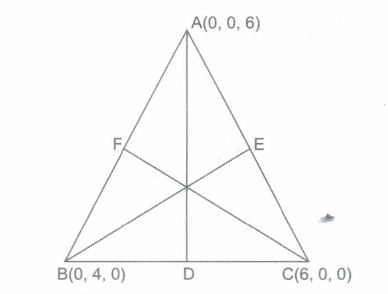
Now D is mid point of BC
\(\therefore \) Coordinates of D is \(\left( \frac { 0+6 }{ 2 } ,\frac { 4+0 }{ 2 } ,\frac { 0+0 }{ 2 } \right) \)= (3,2,0)
\(\therefore \quad AD=\sqrt { (0-3)^{ 2 }+(0-2)^{ 2 }+(6-0)^{ 2 } } \)
=\(\sqrt { 9+4+36 } =\sqrt { 7 } \) units.
Also E is mid point of AC
\(\therefore \) Coordinates of E is \(\left( \frac { 0+6 }{ 2 } ,\frac { 0+0 }{ 2 } ,\frac { 6+0 }{ 2 } \right) \)= (3,0,3)
\(\therefore \quad BE=\sqrt { (0-3)^{ 2 }+(4-0)^{ 2 }+(0-3)^{ 3 } } \)
\(=\sqrt { 9+16+9 } =\sqrt { 34 } \)units.
Also F is mid point of AB
\(\therefore \) Coordiates of F is \(\left( \frac { 0+0 }{ 2 } ,\frac { 0+4 }{ 2 } ,\frac { 6+0 }{ 2 } \right) \)=(0,2,3)
\(\therefore \) CF=\(\sqrt { (6-0)^{ 2 }+(0-2)^{ 2 }+(0-3)^{ 2 } } \)
\(=\sqrt { 36+4+9 } =7\)units.
6.
Here A (x1, y1, z1) B (x2, y2, z2)and C (x3, y3, z3 )be three vertices of \(\triangle \)ABC, then coordinates of point D are
\(\left[ \frac { x1+x2+x3 }{ 2 } ,\frac { y1+y2+y3 }{ 2 } ,\frac { z1+z2+z3 }{ 2 } \right] \)
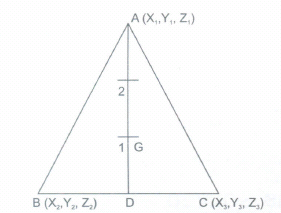
Let Gbe the centroid of ABC. Then Gdivides AD in the ratio 2 : 1. So the coordinates of G are
\(\left[ \frac { x1+2\left( \frac { x2+x3 }{ 2 } \right) }{ 1+2 } ,\frac { y1+2\left( \frac { y2+y3 }{ 2 } \right) }{ 1+2 } ,\frac { z1+2\left( \frac { z2+z3 }{ 2 } \right) }{ 1+2 } \right] \)
\(\Rightarrow \left( \frac { x1+x2+x3 }{ 3 } ,\frac { y1+y2+y3 }{ 3 } ,\frac { z1+z2+z3 }{ 3 } \right) \)
7.
Let D(x, y, z) be the fourth vertex of parallelogram ABCD.
We know that diagonals of a parallelogram bisect each other. So the mid points ofAC and BD coincide.
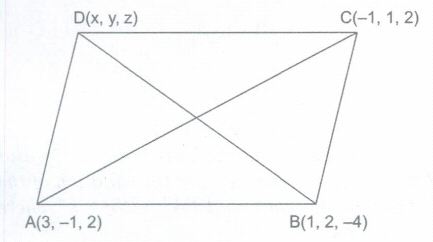
\(\therefore \) Coordinates of mid point of AC \(\left( \frac { 3-1 }{ 2 } ,\frac { -1+1 }{ 2 } ,\frac { 2+2 }{ 2 } \right) \)=(1,0,2)
Also coordiantes of mid point of BD \(\left( \frac { x+1 }{ 2 } ,\frac { y+2 }{ 2 } ,\frac { z-4 }{ 2 } \right) \)
\(\therefore \quad \frac { x+1 }{ 2 } =1\Rightarrow x+1=2\Rightarrow x=1\)
\(\frac { y+2 }{ 2 } =0\Rightarrow y+2=0\Rightarrow y=-2\)
\(\frac { z-4 }{ 2 } =2\Rightarrow z-4=4\Rightarrow z=8\)
Thus the coordinates of point Dare (1, -2,8).
8.
Let Q divides PR in the ratio k : l. Thus co-ordinates of Q are
\(\left[ \frac { 11k+5 }{ k+1 } ,\frac { 10k+4 }{ k+1 } ,\frac { -8k-2 }{ k+1 } \right] \)
It is given that coordinates of Q are (7, 6, - 4).
\(\therefore \frac { 11k+5 }{ k+1 } =7,\frac { 10k+4 }{ k+1 } =6,\frac { -8k-2 }{ k+1 } =-4\)
Now solving these, we get k=\(\frac { 1 }{ 2 } \) .
Thus Q divides PR in the ratio \(\frac { 1 }{ 2 } \) : 1 or 1 : 2.
9.
Let P(x, y, z) be any point which is equidistant from A(3, 4, 0) and B(5, 2, -3).
Now PA = PB => PA2 = PB2
\(\therefore \)(x - 3)2 + (y - 4)2 + (z - 0)2
= (x - 5)2 + (y - 2)2 + (z + 3)2
=> x2+ 9 - 6x + y2 + 16 - 8y + Z2
= x2 + 25 -10x + y2 + 4 - 4y + Z2+ 9 + 6z
=> 4x - 4y - 6z - 13 = O.
10.
Let A(2, 0, 3), B(O, 3, 2) and C(O, 0,1) be given points.
Let P(x, y, 0) be any point in XY plane such that PA = PB = PC.
Now PA = PB => PA2 = PB2
\(\therefore \) (x - 2)2 + (y - 0)2 + (- 3)2
= (x - 0)2 + (y - 3)2 + (- 2)2
=> x2+4-4x+y2+9
=x2+y2+9-6y+4
=> 4x - 6y = 0 => 2x - 3y = 0 ....(i)
Also PB = PC => PB2 = PC2
(x - 0)2 + (y - 3)2 + (0 - 2)2 = (x - 0)2 + (y - 3)2 + (0 - 2)2
\(\therefore \)(x - 0)2 + (y - 3)2 + (0 - 2)2 = (x - 0)2 + (y - 3)2 + (0 - 1)2
=> x2+ y2 + 9 - 6y + 4
=x2+y2+1
=> 6y = 12 => y = 2
Putting value of y in (i), we have
2x-3x2=0 => x=3
Thus co-ordinates ofrequired point are (3, 2, 0).

11th Standard CBSE Syllabus & Materials
11th Standard CBSE
CBSE 11th Business Studies Forms of Business Organisation Sample Question Papers Study Material - QB365 Set A
NEW11th Standard CBSE
CBSE 11th Business Studies Business, Trade and Commerce Sample Question Papers Study Material - QB365 Set A
NEW11th Standard CBSE
CBSE 11th Physics Waves Sample Question Papers Study Material - QB365 Set A
NEW11th Standard CBSE
CBSE 11th Physics Kinetic Theory Sample Question Papers Study Material - QB365 Set A



CBSE 11th Standard CBSE Subjects
CBSE Standards









