
 100% FREE ACCESS
11th Standard CBSE Syllabus & Materials
11th Standard CBSE
CBSE 11th Economics PART-A - Presentation of Data - New Sample Question Papers Study Material - QB365 Set A
NEW11th Standard CBSE
CBSE 11th Economics PART-A - Organisation of Data - New Sample Question Papers Study Material - QB365 Set A
NEW11th Standard CBSE
CBSE 11th Economics PART-A - Collection of Data - New Sample Question Papers Study Material - QB365 Set A
NEW11th Standard CBSE
CBSE 11th Economics PART-A - Introduction to Economics and Statistics - New Sample Question Papers Study Material - QB365 Set A
NEW11th Standard CBSE
CBSE 11th Business Studies International Trade Sample Question Papers Study Material - QB365 Set A
NEW11th Standard CBSE
CBSE 11th Business Studies Evolution and Fundamentals of Business Sample Question Papers Study Material - QB365 Set A

Published on: 28/09/2019
Linear Inequalities
Download CBSE Class 11th Standard CBSE Mathematics question papers, sample papers, important questions, and previous year solved papers in PDF format. Get free study materials, NCERT solutions, and exam preparation resources for Class 11th Standard CBSE Mathematics
Questions + Answers key
Take MCQ Mathematics Test
1.
Find the pairs of consecutive even positive integers which are larger than 5and are such that their sum is less than 20
2.
Solve the inequation \(\frac { 2x+4 }{ x-3 } \le 4\)
3.
Solve the inequation \(\frac { x+3 }{ x-2 } \ge 4\)
4.
Solve the following inequations: \(\frac { 2x-3 }{ 4 } +19\ge 13+\frac { 4x }{ 3 } \)
5.
Solve 5x - 3 < 3x + 1 when
(i) x is an integer,
(ii) x is a real number
6.
Solve the Linear inequations (i) 2x - 4 \(\le\) 0, (ii) -5x + 15 < 0
7.
Solve the inequalities Graphically x > -3
8.
Solve the inequalities : \(\frac { 3(x-2) }{ 5 } \le \frac { 5(2-x) }{ 3 } \)
9.
Solve 5x - 3 < 7 when
(i) x is an integer,
(ii) x is a real number
10.
Check whether the half plane x + 2y \(\ge \) 4 contains origin.
11.
Solve \(|3x-2|\le \frac { 1 }{ 2 } \)
12.
Solve the inqualities - 3 \(\le \) 4 - \(\frac { 7x }{ 2 } \) \(\le \) 18.
13.
Solve the linear inequality 3x - 5 < x + 7, when x is a whole number
14.
Solve the inequalities 6 \(\le \) - 3(2x - 4) < 12.
15.
Solve the linear inequality 3x - 5 < x + 7, when x is a natural number
1.
Let the consecutive even positive integers be x and x + 2
\(\therefore\) x > 5 . and x + 2 > 5
\(\Rightarrow\) x > 5 and x > 3
\(\Rightarrow\) x > 5 ....(i)
Also x + (x + 2) < 20
\(\Rightarrow\) 2x < 20 - 2 => 2x < 18
\(\Rightarrow\) x < 9 .....(ii)
From (i) and (ii), we have
5
But x is even positive integer
\(\therefore\) x = 6and8
Thus two pairs of even positive integers are 6, 8 and 8, 10
2.
Here \(\frac { 2x+4 }{ x-3 } \le 4\), \(x\neq 3\)
\(\Rightarrow\) \(\frac { 2x+4 }{ x-3 } -4\) \(\le\) 0 \(\Rightarrow\) \(\frac { 2x+4-4x+12 }{ x-3 } \le 0\)
\(\Rightarrow\) \(\frac { -2x+16 }{ x-3 } \le 0\) \(\Rightarrow\) -2x + 16\(\le\) 0
\(\Rightarrow\) -2x \(\le\) - 16
Dividing both sides by - 2
\(\therefore\) \(\frac { -2x }{ -2 } \le \frac { -16 }{ -2 } \) \(\Rightarrow\) x \(\ge\) 8
Thus the Solution et of given in equation is [8, \(\infty\))
3.
Here \(\frac { x+3 }{ x-2 } \ge 4\), \(x\neq 2\)
\(\Rightarrow\) \(\frac { x+3 }{ x-2 } -4\) \(\ge\) \(\Rightarrow\) \(\frac { x+3-4x+8 }{ x-2 } \ge 0\)
\(\Rightarrow\) \(\frac { -3x+11 }{ x-2 } \ge 0\) \(\Rightarrow\) -3x +11 \(\ge\)0
\(\Rightarrow\) -3x\(\ge\)-11
Dividing both sides by -3
\(\therefore\) \(\frac { -3x }{ -3 } \le \frac { -11 }{ -3 } \) \(\Rightarrow\) \(x\le \frac { 11 }{ 3 } \)
Thus the solution set of given inequation is \(\left( -\infty ,\frac { 11 }{ 3 } \right) \) - {2}
4.
Here \(\frac { 2x-3 }{ 4 } +19\ge 13+\frac { 4x }{ 3 } \)
\(\frac { 2x-3 }{ 4 } -\frac { 4x }{ 3 } \) \(\ge\) 13 -19
\(\frac { 6x-9-16x }{ 12 } \) \(\ge\) -6 \(\Rightarrow\) \(\frac { -10x-9 }{ 12 } \) \(\ge\) -6
Multiplying both sides by 12
\(\therefore\) -10x - 9 \(\ge\) -6 x 12
\(\Rightarrow\) -10x -9 \(\ge\) -72
\(\Rightarrow\) -10x \(\ge\) -72 + 9
\(\Rightarrow\) -10x \(\ge\) -63
Dividing both sides by - 1 0
\(\therefore\) \(\frac { -10x }{ 10 } \le \frac { -63 }{ -10 } \)
\(\therefore\) \(x\le \frac { 63 }{ 10 } \)
Thus the solution set of given in equation is \(\left( -\infty ,\frac { 63 }{ 10 } \right) \)
5.
We have, 5x –3 < 3x + 1
or 5x –3 + 3 < 3x +1 +3 (Rule 1)
or 5x < 3x +4
or 5x – 3x < 3x + 4 – 3x (Rule 1)
or 2x < 4 or x < 2 (Rule 2)
(i) When x is an integer, the solutions of the given inequality are ..., – 4, – 3, – 2, – 1, 0, 1
(ii) When x is a real number, the solutions of the inequality are given by x < 2, i.e., all real numbers x which are less than 2. Therefore, the solution set of the inequality is x ∈ (– ∞, 2).
We have considered solutions of inequalities in the set of natural numbers, set of integers and in the set of real numbers. Henceforth, unless stated otherwise, we shall solve the inequalities in this Chapter in the set of real numbers.
6.
(i) Here 2x - 4 \(\le\) 0
\(\Rightarrow\) 2x \(\le\)4
Dividing both sides by 2
\(\therefore\) \(\frac { 2x }{ 2 } \le \frac { 4 }{ 2 } \) \(\Rightarrow\) x \(\le\) 2
Thus solution set of the given inequation is (-\(\infty\),2]
(ii) Here - 5x +15<0
\(\Rightarrow\) -5x<-15
Dividing both sides by -5
\(\therefore\) \(\frac { -5x }{ -5 } >\frac { -15 }{ 5 } \) \(\Rightarrow\) x > 3
Thus solution set of the given inequation is (3, \(\infty\))
7.
The given inequality is x > -3
Draw the graph of the line x = -3.
Putting (0, 0) in the given in equation, we have
0 > -3 which is true
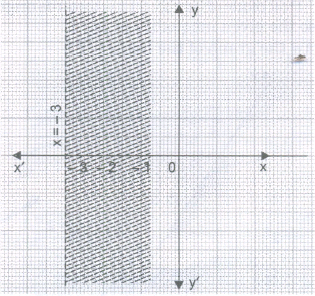
\(\therefore\) Half plane of x > -3 is towards origin
8.
Here \(\frac { 3(x-2) }{ 5 } \le \frac { 5(2-x) }{ 3 } \)
\(\Rightarrow \) \(\frac { 3x-6 }{ 5 } \le \frac { 10-5x }{ 3 } \) \(\Rightarrow\) \(\frac { 3x }{ 5 } -\frac { 6 }{ 5 } \le \frac { 10 }{ 3 } -\frac { -5x }{ 3 } \)
\(\Rightarrow \) \(\frac { 3x }{ 5 } +\frac { 5x }{ 3 } \le \frac { 10 }{ 3 } +\frac { 6 }{ 5 } \) \(\Rightarrow\) \(\frac { 9x+25 }{ 15 } \le \frac { 50+18 }{ 15 } \)
\(\Rightarrow \) \(\frac { 34x }{ 15 } \le \frac { 68 }{ 15 } \)
Multiplying both sides by 15, we have 34x\(\le\) 68
Dividing both sides by 34, we have x \(\le\) 2
Thus the solution set is (-\(\infty\), 2]
9.
Here 5x - 3 < 7
5x < 7 + 3 \(\Rightarrow\) 5x < 10
Dividing both sides by 5, we have x < 2
(i) When x is an integer then values of x that make the statement true are ..., -3, -2, -1, 0, 1
The solution set of inequality is {..., -3, -2, -1,0, I}.
(ii) When x is a real number. The solution set of inequality is x \(\epsilon \) (-\(\infty\),2)
10.
We have, x + 2y \(\ge \) 4
On putting x = 0 and y = 0, we get
0 + 2(0) \(\ge \) 4 \(\Rightarrow \) 0 \(\ge \) 4
This is a false statement. Therefore, the given half plane does not contain the origin.
11.
Given, \(|3x-2|\le \frac { 1 }{ 2 } \)
\(\therefore \) \(\Rightarrow\) \(\frac { -1 }{ 2 } \le \left( 3x-2 \right) \le \frac { 1 }{ 2 } \quad \left[ \therefore |x|\le a\Longrightarrow -a\le x\le a \right]\)
\(\Longrightarrow\) \(-\frac { 1 }{ 2 } +2\le 3x-2+2\le \frac { 1 }{ 2 } +2\) [adding 2 on each term]
\(\Longrightarrow\) \(\frac { 3 }{ 2 } \le 3x\le \frac { 5 }{ 2 } \)
\(\Longrightarrow\) \(\frac { 3 }{ 2 } \times \frac { 1 }{ 3 } \le \frac { 3x }{ 3 } \le \frac { 5 }{ 2 } \times \frac { 1 }{ 3 } \) [dividing each term by 3]
\(\Longrightarrow\) \(\frac { 1 }{ 2 } \le x\le \frac { 5 }{ 6 } \) i.e. \(x\in \left[ \frac { 1 }{ 2 } ,\frac { 5 }{ 6 } \right] \)
Hence, the required solution set is \(\left[ \frac { 1 }{ 2 } ,\frac { 5 }{ 6 } \right] \)
12.
We have, - 3 \(\le \) 4 - \(\frac { 7x }{ 2 } \) \(\le \) 18.
On subtracting 4 from each term, we get
- 3 - 4 \(\le \) 4 - \(\frac { 7x }{ 2 } \) - 4 \(\le \) 18 - 4 \(\Longrightarrow \) - 7 \(\le \) - \(\frac { 7x }{ 2 } \) \(\le \) 14
On multiplting each term by (\(\frac { -2 }{ 7 } \)), we get
- 7 (\(\frac { -2 }{ 7 } \)) \(\ge \) \(\frac { -7 }{ 2 } \) x \(\times \) (\(\frac { -2 }{ 7 } \)) \(\ge \) 14 \(\times \) (\(\frac { -2 }{ 7 } \))
[while multiplying each term by the same negative number, then the sign of inequalities will get change]
\(\Longrightarrow \) 2 \(\ge \) x \(\ge \) - 4 or - 4 \(\le \) x \(\le \) 2 or x \(\in \) [- 4, 2]
Hence, solution set of given system of inequations is [- 4, 2].
13.
We have, 3x - 5 < x + 7
\(\Rightarrow \) 3x -5 + 5 < x + 7 + 5 [adding 5 on both sides]
\(\Rightarrow \) 3x < x + 12
\(\Rightarrow \) 3x -x < x + 12 - x [Subtracting x from both sides]
\(\Rightarrow \) 2x < 12
\(\Rightarrow \) \(\frac { 2x }{ 2 } \) < \(\frac { 12 }{ 2 } \)
\(\Rightarrow \) x < 6
Now if x is a whole number, then the solution set {0, 1, 2, 3, 4, 5}
14.
We have, 6 \(\le \) - 3(2x - 4) < 12 or 6 \(\le \) - 6x + 12 < 12
On subtracting 12 from each term, we get
6 - 12 \(\le \) - 6x + 12 - 12 < 12 - 12
\(\Longrightarrow \) - 6 \(\le \) -6x < 0
On dividing each term by - 6, we get \(\frac { -6 }{ -6 } \) \(\ge \) \(\frac { -6x }{ -6 } >\frac { 0 }{ -6 } \)
[ while dividing each term by the same negative number, then sign of inequalities will get change]
\(\Longrightarrow \) 1 \(\ge \) x > 0
Which can be written as 0 < x \(\le \) 1.
Hence, solution set of given system of inequalities is (0, 1].
15.
We have,3x - 5 < x + 7
\(\Rightarrow \) 3x -5 + 5 < x + 7 + 5 [adding 5 on both sides]
\(\Rightarrow \) 3x < x + 12
\(\Rightarrow \) 3x -x < x + 12 - x [Subtracting x from both sides]
\(\Rightarrow \) 2x < 12
\(\Rightarrow \) \(\frac { 2x }{ 2 } \) < \(\frac { 12 }{ 2 } \)
\(\Rightarrow \) x < 6
Now if x is natural number, then the solution set is {1, 2, 3, 4, 5}

11th Standard CBSE Syllabus & Materials
11th Standard CBSE
CBSE 11th Business Studies Forms of Business Organisation Sample Question Papers Study Material - QB365 Set A
NEW11th Standard CBSE
CBSE 11th Business Studies Business, Trade and Commerce Sample Question Papers Study Material - QB365 Set A
NEW11th Standard CBSE
CBSE 11th Physics Waves Sample Question Papers Study Material - QB365 Set A
NEW11th Standard CBSE
CBSE 11th Physics Kinetic Theory Sample Question Papers Study Material - QB365 Set A



CBSE 11th Standard CBSE Subjects
CBSE Standards









