
 100% FREE ACCESS
11th Standard CBSE Syllabus & Materials
11th Standard CBSE
CBSE 11th Economics PART-A - Presentation of Data - New Sample Question Papers Study Material - QB365 Set A
NEW11th Standard CBSE
CBSE 11th Economics PART-A - Organisation of Data - New Sample Question Papers Study Material - QB365 Set A
NEW11th Standard CBSE
CBSE 11th Economics PART-A - Collection of Data - New Sample Question Papers Study Material - QB365 Set A
NEW11th Standard CBSE
CBSE 11th Economics PART-A - Introduction to Economics and Statistics - New Sample Question Papers Study Material - QB365 Set A
NEW11th Standard CBSE
CBSE 11th Business Studies International Trade Sample Question Papers Study Material - QB365 Set A
NEW11th Standard CBSE
CBSE 11th Business Studies Evolution and Fundamentals of Business Sample Question Papers Study Material - QB365 Set A

Published on: 01/01/2019
11th Class Full Test
Download CBSE Class 11th Standard CBSE Mathematics question papers, sample papers, important questions, and previous year solved papers in PDF format. Get free study materials, NCERT solutions, and exam preparation resources for Class 11th Standard CBSE Mathematics
Questions + Answers key
Take MCQ Mathematics Test
1.
Three coins are tossed once.Find the probability of getting 2 heads
2.
Find the standard deviation for the following data.
| xi | 3 | 8 | 13 | 18 | 23 |
| fi | 7 | 10 | 15 | 10 | 6 |
3.
Using the section formula, show that the points, (2, -3, 4), (-1, 2, 1) and (0, \(\frac{1}{3}\), 2) are collinear.
4.
Which of the lines 2x - y + 3 = 0 and ax - 4y - 7 = 0, is farther from the origin?
5.
Using binomial theorem, evaluate each of the following
\(\left( 12 \right) ^{ 5 }+\left( 8 \right) ^{ 5 }\)
6.
Solve for \(x,\frac { 4 }{ x+1 } \le 3\le \frac { 6 }{ x+1' } x>0\)
7.
If tan θ + sin θ = m and tan θ − sin θ = n,show that m2 − n2 = 4 \(\sqrt{mn} \)
8.
If X = {a,b,c,d} and Y = {f,b,d,g}, then find
Y - X
9.
If nPr=nPr+1 and nCr = nCr-1, find the values of n and r.
10.
Solve the quadratic equation \(\sqrt 5 x^2+x+\sqrt 5=0\).
11.
Find the co-ordinates of foci and the vertices, the eccentricity and the length of the latus rectum of the hyperbolas.
12.
Evaluate \(\lim_{x\rightarrow 1}[\frac{1}{x^{2}+x-2}-\frac{x}{x^{3}-1}]\)
13.
Which of the following are sets? Justify your answer.
The collection of all even integers.
14.
One mapping is selected at ramdom from all the mappings of the set set B = {1,2,3,.......6} into itself.Find the probability that the mapping selected is one-to-one .
15.
Find the derivative of the following functions, \(\frac { secx+tanx }{ secx-tanx } \) First, consider the given function as f(x). Then, use quotient rule to find the required derivative.
16.
Find the equation of parabola when the vertex is at (0, 0) and focus is at (0, -4).
As vertex and focus lies on Y- axis, so use the equation of parabola in the form of x2 =-4axy.
17.
A man accepts a position with an initial salary of Rs.5200 per month. It is understood that he will receive an automatic increase of Rs.320 in the very next month and each month thereafter.
Find his salary for the tenth month.
18.
Find the degree measure corresponding to following radians.
6 rad
19.
Verify by method of contradiction p:\(\sqrt { 11 } \) is irrational.
20.
Prove by the principle of mathematical induction that, for all \(n\in N\),4nwhen divided by 3, the remainder is always 1.
21.
Show that \(\frac { 1\times { 2 }^{ 2 }+2\times { 3 }^{ 2 }+...+n\times (n+1)^{ 2 } }{ { 1 }^{ 2 }\times 2+{ 2 }^{ 2 }3+...+{ n }^{ 2 }\times (n+1) } =\frac { 3n+5 }{ 3n+1 } \).
22.
Find the derivative of (x+a) (it is to be understood that a, b, c, d, p, q, rand s are fixed non-zero constants and m and n are integers)
23.
Find the equations of the medians of a triangle formed by the lines x + y - 6 = 0, x - 3y - 2 = 0 and 5x - 3y + 2 = 0.
24.
The mean and variance of eight observations are 9 and 9.25 respectively. If six of the observations are 6, 7, 10, 12, 12 and 13, find the remaining two observations.
25.
A train is travelling at the rate of 66 km/hr on a circular track of 1500 m radius. Find the angle in degrees through which it turns in 20 seconds.
26.
Let A = {1, 2, 3, 4},B = {1, 5, 9, 11, 15, 16} and f = {(1,5), (2, 9), (3, 1), (4, 5), (2, 11)}. Are the following true?
(i) f is a relation from A to B
(ii) f is a function from A to B
Justify your answer in each case
27.
Solve the inequalities graphically 2x - y >1, 2y < -1
28.
If 4 sin2\(\theta=1\) then the values of \(\theta\) are ______.
\(2n\pi\pm{\pi\over3},n\in Z\)
\(n\pi\pm{\pi\over3},n\in Z\)
\(n\pi\pm{\pi\over6},n\in Z\)
\(2n\pi\pm{\pi\over6},n\in Z\)
29.
Let U be the universal set containing 700 elements. If A and B are sub-sets of U such that n(A) = 200, n(B) = 300 and n(A \(\cap\) B) = 100, then n(A' \(\cap\) B') =___.
400
500
300
800
30.
The eccentricity of the hyperbola whose latus rectum is half of its transverse axis is _______.
\(\frac { 1 }{ 2 } \)
\(\sqrt { \frac { 1 }{ 3 } } \)
\(\sqrt { \frac { 2 }{ 3 } } \)
\(\sqrt { \frac { 3 }{ 2 } } \)
31.
The three geometric means between the numbers 1 and 81 are ______.
3, 6 and 18
3, 9 and 27
3, 6 and 27
None of these
1.
\(\frac { 3 }{ 8 } \)
2.
Let us make the table from the given data.
| xi | fi | fixi | \({ x }_{ i }^{ 2 }\) | \({ f }_{ i }{ x }_{ i }^{ 2 }\) |
| 3 8 13 18 23 |
7 10 15 10 6 |
21 80 195 180 138 |
9 64 169 324 529 |
63 640 2535 3240 3174 |
| Total | \(\sum { { f }_{ i }=48 } \) | \(\sum { { f }_{ i }{ x }_{ i }=614 } \) |
\(\sum { { f }_{ i }{ x }_{ i }^{ 2 }=9652 } \) |
\(\therefore Standard\ deviation,\sigma =\frac { 1 }{ N } \sqrt { N\sum { { f }_{ i }{ x }_{ i }^{ 2 } } -(\sum { { f }_{ i }{ x }_{ i }^{ 2 })^{ 2 } } } \)
Ans. 6.12
3.
Let C (0, \(\frac{1}{3}\), 2) divides the joint of A (2, -3) and B(-1, 2,1) in the ratio k:1
Then coordinates of C are
\(\left( \frac { -k+2 }{ k+1 } ,\frac { 2k-3 }{ k+1 } ,\frac { k+4 }{ k+1 } \right) \) [using internal ratio formula]
But coordinates of C are (0, \(\frac{1}{3}\), 2)
On comparing Eqs.(i) and (ii) we get
\(\frac { -k+2 }{ k+1 } =0\Rightarrow -k+2=0\Rightarrow 2\)
\( \frac { 2k-3 }{ k+1 } =\frac { 1 }{ 3 } \Rightarrow 6k-9=k+1\Rightarrow 5k=10\Rightarrow k=2\)
\(and \quad \frac { k+4 }{ k+1 } =2\Rightarrow k+4=2k+2\Rightarrow k=2\)
From each of these equations, we get k=2 Since, from each equation, we get the same value of k. Therefore, the given points are collinear nad C divides AB internally in the ratio 2:1.
4.
\({ P }_{ 1 }=\frac { \left| 0+0+3 \right| }{ \sqrt { { \left( -2 \right) }^{ 2 }+{ \left( 1 \right) }^{ 2 } } } =\frac { 3 }{ \sqrt { 5 } } \)
\({ P }_{ 2 }=\frac { \left| 0+0-7 \right| }{ \sqrt { { \left( 1 \right) }^{ 2 }+{ \left( -4 \right) }^{ 2 } } } =\frac { 7 }{ \sqrt { 17 } } \)
Again, \({ P }_{ 1 }=\frac { 3 }{ \sqrt { 5 } } \times \frac { \sqrt { 17 } }{ \sqrt { 17 } } =\sqrt { \frac { 153 }{ 85 } } \)
and \({ P }_{ 2 }=\frac { 7 }{ \sqrt { 17 } } \times \frac { \sqrt { 5 } }{ \sqrt { 5 } } =\sqrt { \frac { 245 }{ 85 } } \)
\(\therefore \sqrt { \frac { 245 }{ 85 } } >\sqrt { \frac { 153 }{ 85 } } \Rightarrow { P }_{ 2 }>{ P }_{ 1 }\)
Ans. x - 4y - 7 = 0 is farther.
5.
\(\left( 12 \right) ^{ 5 }+\left( 8 \right) ^{ 5 }=\left( 10+2 \right) ^{ 5 }+\left( 10-2 \right) ^{ 5 }\\ \left( 10+2 \right) ^{ 5 }=^{ 5 }{ C }_{ 0 }\times { 10 }^{ 5 }+^{ 5 }{ C }_{ 1 }\times { 10 }^{ 4 }\times 2+^{ 5 }{ C }_{ 2 }\times { 10 }^{ 3 }\times { 2 }^{ 2 }+.........(i)\\ \left( 10-2 \right) ^{ 5 }=^{ 10 }{ C }_{ 5 }\times 5-^{ 5 }{ C }_{ 1 }\times { 10 }^{ 4 }\times 2+^{ 5 }{ C }_{ 2 }\times { 10 }^{ 3 }\times { 2 }^{ 2 }+.........(ii)\\ Now\quad adding\quad equ(i)\quad and\quad (ii)\\ \left( 12 \right) ^{ 5 }+\left( 8 \right) ^{ 5 }=2\left[ ^{ 5 }{ C }_{ 0 }10^{ 5 }+^{ 5 }{ C }_{ 2 }\left( 10 \right) ^{ 3 }\left( 2 \right) ^{ 2 }+^{ 5 }{ C }_{ 4 }\left( 10 \right) ^{ 1 }\left( 2 \right) ^{ 4 } \right] \\ =281600\)
6.
We have, \(\frac { 4 }{ x+1 } \le 3\le \frac { 6 }{ x+1 } \)
\(\Longrightarrow \)\(4\le 3\left( x+1 \right) \le 6\quad \left[ \because x+1\neq 0\Longrightarrow x\neq -1 \right] \)
\(\Longrightarrow \)\(\frac { 4 }{ 3 } \le x+1\le 2\)
\(\Longrightarrow \)\(\frac { 4 }{ 3 } -1\le x\le 2-1\Longrightarrow \frac { 1 }{ 3 } \le x\le 1\)
Ans. \(\left[ \frac { 1 }{ 3 } ,1 \right] \)
7.
\(LHS={ m }^{ 2 }-{ n }^{ 2 }\)
LHS=RHS
\(=(tan\theta +sin\theta )^{ 2 }-({ tan\theta }-sin\theta )^{ 2 }\)
\(=(tan\theta +sin\theta +tan\theta -sin\theta )(tan\theta +sin\theta -tan\theta +sin\theta )\quad [\because { a }^{ 2 }-{ b }^{ 2 }=\left( a+b \right) \left( a-b \right) ]\)
\(=\left( 2tan\theta \right) \left( 2sin\theta \right)\)
\(\Rightarrow { m }^{ 2 }-{ n }^{ 2 }=4tan\theta sin\theta\)
\(RHS=4\sqrt { mn } \)
\(=4\sqrt { \left( tan\theta +sin\theta \right) (tan\theta -sin\theta ) }\)
\(=4\sqrt { { tan }^{ 2 }\theta -{ sin }^{ 2 }\theta } \quad [\because (a+b)(a-b)=({ a }^{ 2 }-{ b }^{ 2 })]\)
\(=4\sqrt { { sin }^{ 2 }\theta \left( \frac { 1 }{ { cos }^{ 2 }\theta } -1 \right) } \)
\(=4\sqrt { { sin }^{ 2 }\theta ({ sec }^{ 2 }\theta -1) } =4\sqrt { { sin }^{ 2 }\theta { tan }^{ 2 }\theta } \)
\(\Rightarrow 4\sqrt { mn } =4sin\theta tan\theta\)
\(\\ From\quad Eqs.(i)\quad and\quad (ii)\)
LHS=RHS
Hence proved.
8.
\(Y-X=\{ f,g\} \)
-S.png)
9.
Here nPr = nPr+1
\(\Rightarrow \frac { n! }{ (n-r)! } =\frac { n! }{ (n-r-1)! } \)
\(\Rightarrow \frac { 1 }{ (n-r)(n-r-1)! } =\frac { 1 }{ (n-r-1)! } \)
\(\Rightarrow \frac { 1 }{ n-r } =1 \Rightarrow n-r=1\) ....(i)
Also nCr = nCr-1
\(\Rightarrow \frac { n! }{ (n-r)!r! } =\frac { n! }{ (n-r+1)!(r-1)! } \)
\(\Rightarrow \frac { 1 }{ (n-r)!(r-1)! } =\frac { 1 }{ (n-1+1)(n-r)!(r-1)! } \)
\(\Rightarrow \frac { 1 }{ r } =\frac { 1 }{ n-r+1 } \)
\(\Rightarrow \) n-r+1=r \(\Rightarrow \) n - 2r = -1 ....(ii)
From (i) and (ii), we have
n = 3 and r = 2.
10.
\(\frac{-1\pm\sqrt {19i}}{2\sqrt 5}\)
11.
The equation of given hyperbola is 3x2 - 6y2=-18
i.e \(\frac { 3{ x }^{ 2 } }{ -18 } -\frac { 6{ y }^{ 2 } }{ -18 } =1\)
⇒ \(\frac { { y }^{ 2 } }{ 3 } -\frac { { x }^{ 2 } }{ 6 } =1\) which is of the form \(\frac { { y }^{ 2 } }{ { a }^{ 2 } } -\frac { { x }^{ 2 } }{ { b }^{ 2 } } \)=1
The foci and vertices of the hyperbola lie on y-axis
a2 = 3 ⇒ a =\(\sqrt { 3 } \) and b2 = 6 ⇒ b = \(\sqrt6\)
Now c2 = a2 + b2 = 3 + 6 = 9 ⇒ c = 3
.. Coordinates of foci are (0, ± c) i.e. (0, ± 3)
Coordinates of vertices are (0, ± a) i.e. (0, ± \(\sqrt3\))
Eccentricity (e) = \(\frac { c }{ a } =\frac { 3 }{ \sqrt { 3 } } =\sqrt { 3 } \)
Length of latus rectum =\(\frac { 2{ b }^{ 2 } }{ a } =\frac { 2\times 6 }{ \sqrt { 3 } } =4\sqrt { 3 } \).
12.
\(\frac{-1}{9}\)
13.
The collection of all even integers is {..., -4, -2, 0, 2, 4, } which is well defined and hence it forms a set.
14.
\(\frac { 6! }{ { 6 }^{ 6 } } \)
15.
Let \(y=\frac { secx+tanx }{ secx-tanx } =\frac { \frac { 1 }{ cosx } +\frac { sinx }{ cosx } }{ \frac { 1 }{ cosx } -\frac { sinx }{ cosx } } \Rightarrow y=\frac { 1+sinx }{ 1-sinx }\)
On differentiating both sides w.r.t. x,we get
\(\frac { dy }{ dx } =\frac { d }{ dx } \left( \frac { secx+tanx }{ secx-tanx } \right) =\frac { d }{ dx } \left( \frac { 1+sinx }{ 1-sinx } \right)\)
\(=\frac { \left( 1-sinx \right) \frac { d }{ dx } \left( 1+sinx \right) -\left( 1+sinx \right) \frac { d }{ dx } \left( 1-sinx \right) }{ ({ 1-sinx) }^{ 2 } } \)
\(=\frac { \left( 1-sinx \right) \left( 0+cosx \right) -\left( 1+sinx \right) \frac { d }{ dx } \left( 1-sinx \right) }{ (1-sinx)^{ 2 } } \) [using quotient rule of derivative]
\(=\frac { \left( 1-sinx \right) \left( 0+cosx \right) -\left( 1+sinx \right) \left( 0-cosx \right) }{ ({ 1-sinx })^{ 2 } } \)
\(=\frac { 2cosx }{ (1-sinx)^{ 2 } } \)
16.
Here the vertex is at (0, 0) and focus is at (0, -4) which lies on Y-axis. So, Y-axis is the axis of the parabola.
\(\therefore\) Equation of parabola is of the form
x2 = -4ay \(\Rightarrow\) x2 = -4(4)y [\(\because\) a = 4]
\(\therefore\) x2 = -16y
17.
Here, the man gets a fixed increment of Rs.320 each month.
Therefore, this forms an AP whose first term = 5200 and common difference (d) = 320
Salary for tenth month i.e. for n=10,
\({ a }_{ 10 }=a+(n-1)d\)
\(\Rightarrow { a }_{ 10 }=5200+(10-1)\times 320\)
\(\Rightarrow { a }_{ 10 }=5200+9\times 320\)
\(\Rightarrow { a }_{ 10 }=5200+2880\)
\(\therefore { a }_{ 10 }=8080\)
18.
We know that, degree measure \(=\frac { 180 }{ \pi } \times \) Radian measure
\(\therefore \) Required degree measure \(=\left( \frac { 180 }{ \frac { 22 }{ 7 } } \times 6 \right) \quad \left[ \therefore \pi =\frac { 22 }{ 7 } \right] \)
\(=\left( \frac { 1080\times 7 }{ 22 } \right) ^{ o }=\left( 343\frac { 7 }{ 11 } \right) ^{ 0 }\)
\(={ 343 }^{ o }+\frac { 7 }{ 11 } \times 60min\) \(\left[ \because { 1 }^{ o }=60' \right] \)
\(={ 343 }^{ o }+38\frac { 2 }{ 11 } min={ 343 }^{ o }+38'+\frac { 2 }{ 11 } min\)
\(={ 343 }^{ o }+38'+\frac { 2 }{ 11 } \times 60''\)
\(={ 343 }^{ o }+38'+10.9''={ 343 }^{ o }38'11''(approx.)\)
Hence, the degree measure of 6 rad is
\({ 343 }^{ o }38'11''(approx.).\)
19.
Let given statement be false.i.e \(\sqrt { 11 } \) is rational.
It means \(\sqrt { 11 } \)=\(\frac { p }{ q } \), where p and q are coprime and q \(\neq \) 0
\(\Rightarrow \) \(11=\frac { { p }^{ 2 } }{ { q }^{ 2 } } \Rightarrow { p }^{ 2 }=11{ q }^{ 2 }\)
It means 11 divides p.
Thus, there exists an integer r such that
p = 11r \(\Rightarrow \)p2 = 121r2
It means 11 divides q.
It means 11 is a common factor of p and q which contradicts our assumption that p and q have no common factor.
20.
Consider \(P(k) : { 4 }^{ k }=3\lambda +1\)
Now,
P(k+1) :\({ 4 }^{ k+1 }={ 4 }^{ k }.4=(3\lambda +1)4\)
\(=12\lambda +4=3(4\lambda +1)+1\)
21.
\(\frac { 1\times { 2 }^{ 2 }+2\times { 3 }^{ 2 }+...+n\times (n+1)^{ 2 } }{ { 1 }^{ 2 }\times 2+{ 2 }^{ 2 }3+...+{ n }^{ 2 }\times (n+1) } \)
=\(\frac { \Sigma n(n+1)^{ 2 } }{ \Sigma n^{ 2 }(n+1) } =\frac { \Sigma n({ n }^{ 2 }+2n+1) }{ \Sigma ({ n }^{ 3 }+n^{ 2 }) } \)
=\(\frac { \Sigma ({ n }^{ 3 }+2{ n }^{ 2 }+n) }{ \Sigma ({ n }^{ 3 }+{ n }^{ 2 }) } =\frac { \Sigma { n }^{ 3 }+2\Sigma { n }^{ 2 }+\Sigma n }{ \Sigma { n }^{ 3 }+\Sigma { n }^{ 2 } } \)
=\(\frac { \frac { { n }^{ 2 }(n+1)^{ 2 } }{ 4 } +\frac { 2n(n+1)(2n+1) }{ 6 } +\frac { n(n+1) }{ 2 } }{ \frac { { n }^{ 2 }(n+1)^{ 2 } }{ 4 } +\frac { n(n+1)(2n+1) }{ 6 } } \)
=\(\frac { \frac { n(n+1) }{ 2 } \left[ \frac { n(n+1) }{ 2 } +\frac { 2(2n+1) }{ 3 } +1 \right] }{ \frac { n(n+1) }{ 2 } \left[ \frac { n(n+1) }{ 2 } +\frac { 2n+1 }{ 3 } \right] } \)
=\(\frac { 3n^{ 2 }+11n+10 }{ 3{ n }^{ 2 }+7n+2 } =\frac { 3{ n }^{ 2 }+6n+5n+10 }{ 3{ n }^{ 2 }+6n+n+2 } \)
=\(\frac { 3n(n+2)+5(n+2) }{ 3n(n+2)+1(n+2) } \)
=\(\frac { (n+2)(3n+5) }{ (n+2)(3n+1) } =\frac { 3n+5 }{ 3n+1 } \).
22.
\(\text { Let } f(x)=x+a \text { . Accordingly, } f(x+h)=x+h+a\)
\(\text { By first principle, }\)
\(f^{\prime}(x) =\lim _{h \rightarrow 0} \frac{f(x+h)-f(x)}{h} \)
\(=\lim _{h \rightarrow 0} \frac{x+h+a-x-a}{h} \)
\(=\lim _{h \rightarrow 0}\left(\frac{h}{h}\right) \)
\(=\lim _{h \rightarrow 0}(1) \)
\(=1\)
23.
The equations of lines AB, BC and AC are
x + y - 6 = 0 ...(i)
x - 3y - 2 = 0 ...(ii)
5x- 3y + 2 = 0 ...(iii)
On solving the equation (i) and (ii), we have coordinates of point B (5,1).
On solving the equation (ii) and (iii), we have coordinates of point C (-1, -1).
On solving the equation (iii) and (i), we have coordinates of point A (2, 4).
Let D, E, F are mid points of BC, AC and AB respectively.
Coordinates of D are \(\left({5-1\over 2},{1-1\over 2}\right)\ i.e.(2,0)\)
Coordinates of E are \(\left({2-1\over 2},{4-1\over 2}\right)\ i.e.\left({1\over 2},{3\over 2}\right)\)
Coordinates of D are \(\left({2+5\over 2},{4+1\over 2}\right)\ i.e.\left({7\over 2},{5\over 2}\right)\)
Equation of median AD is
\(y-4={(0-4)\over (2-2)}(y-2)\)
⇒ x - 2 = 0
Equation of median BE is
\(y-1={\left({3\over2}-1\right)\over \left({1\over2}-5\right)}(x-5)\)
\(⇒\ y-1={{1\over 2}\over -{9\over 2}}(x-5)\)
⇒ 9y - 9 = -x + 5
⇒ x + 9y - 14 = 0
Equation of CF is
\(y+1={\left({5\over 2}+1\right)\over \left({7\over 2}+5\right)}(x+1)\)
\(⇒\ y+1={{7\over 2}\over {9\over 2}}(x+1)\)
\(⇒\ y+1={7\over 9}(x+1)\)
⇒ 9y + 9 = 7x + 7 ⇒ 7x - 9y - 2 = 0
Thus equations of medians are x - 2 = 0, x + 9y - 14 = 0 and 7x - 9y - 2 = O.
24.
Let two remaining observations be x and y. Then
\(\frac { 6+7+10+12+12+13+x+y }{ 8 } =9\)
\(\therefore\) 60 + x + y = 72 \(\Rightarrow\) x + y = 12 ......(i)
Also \(\frac { 1 }{ 8 } ({ 6 }^{ 2 }+{ 7 }^{ 2 }+{ 10 }^{ 2 }+{ 12 }^{ 2 }+{ 12 }^{ 2 }+{ 13 }^{ 2 }+{ x }^{ 2 }+{ y }^{ 2 })-{ (9) }^{ 2 }=9.25\)
\(\Rightarrow \frac { 1 }{ 8 } (36+49+100+144+144+169+{ x }^{ 2 }+{ y }^{ 2 })-81=9.25\)
\(\Rightarrow\) 642 + x2 + y2 = 722
\(\Rightarrow\) x2 + y2 = 80 ......(ii)
Now (x+y)2 + (x-y)2 = 2(x2+y2)
\(\Rightarrow\) (12)2 + (x - y)2 = 2 x 80
\(\Rightarrow\) (x - y)2 = 160 - 144
\(\Rightarrow\) (x - y)2 = 16 \(\Rightarrow\) x - y = \(\pm \) 4
When x - y = 4
Solving x + y = 12 and x - y = 4 we get x = 8 and y = 4
When x - y = -4
Solving x + y = 12 and x - y = -4 we get x = 4 and y = 8.
25.
14 degree
26.
(i) Here A = {1, 2, 3, 4} and B = {1, 5, 9, 11,15,16}.
\(\therefore\) A x B = {(1, 1), (1, 5), (1, 9), (1, 11),
(1,15), (1,16), (2,1), (2, 5),
(2, 9), (2, 11) (2, 15), (2, 16),
(3,1),(3,5),(3,9),(3,11),
(3,15), (3,16), (4,1),(4,5),
(4,9), (4,11), (4,15),(4,16)}
f = {1, 5), (2, 9), (3, 1), (4, 5), (2, 11)}
Now (1, 5), (2, 9), (3, 1), (4, 5), (2, 11) \(\in\) A x B
\(\therefore\) f is a relation from A to B.
(ii)Here f(2) = 9 and f(2) = 11
\(\therefore\) f is not a function from A to B.
27.
The given inequality is 2x - y > l.
Draw the graph of the line 2x - y = l.
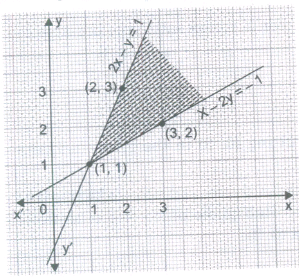
Table of value satisfying the equation 2x - y = 1
| x | 1 | 2 |
| y | 1 | 3 |
Putting (0, 0) in the given inequation, we have
2 x 0 - 0 > 1 \(\Rightarrow\) 0 > 1 , which is false
\(\therefore\) Half plane of 2x - y > 1 is away from origin
Also the given inequality is x - 2y < -l.
Draw the graph of the line x - 2y =-l.
Table of values satisfying the equation
x - 2y = -1
| x | 1 | 3 |
| y | 1 | 2 |
Putting (0, 0) in the given inequation, we have
0-2 x 0 < -1 \(\Rightarrow\) 0 < -1, which is false
\(\therefore\) Half plane of x - 2y < -1 is away from origin
28.
(c)
\(n\pi\pm{\pi\over6},n\in Z\)
29.
(c)
300
30.
(d)
\(\sqrt { \frac { 3 }{ 2 } } \)
31.
(b)
3, 9 and 27

11th Standard CBSE Syllabus & Materials
11th Standard CBSE
CBSE 11th Business Studies Forms of Business Organisation Sample Question Papers Study Material - QB365 Set A
NEW11th Standard CBSE
CBSE 11th Business Studies Business, Trade and Commerce Sample Question Papers Study Material - QB365 Set A
NEW11th Standard CBSE
CBSE 11th Physics Waves Sample Question Papers Study Material - QB365 Set A
NEW11th Standard CBSE
CBSE 11th Physics Kinetic Theory Sample Question Papers Study Material - QB365 Set A



CBSE 11th Standard CBSE Subjects
CBSE Standards









