
 100% FREE ACCESS
11th Standard CBSE Syllabus & Materials
11th Standard CBSE
CBSE 11th Economics PART-A - Presentation of Data - New Sample Question Papers Study Material - QB365 Set A
NEW11th Standard CBSE
CBSE 11th Economics PART-A - Organisation of Data - New Sample Question Papers Study Material - QB365 Set A
NEW11th Standard CBSE
CBSE 11th Economics PART-A - Collection of Data - New Sample Question Papers Study Material - QB365 Set A
NEW11th Standard CBSE
CBSE 11th Economics PART-A - Introduction to Economics and Statistics - New Sample Question Papers Study Material - QB365 Set A
NEW11th Standard CBSE
CBSE 11th Business Studies International Trade Sample Question Papers Study Material - QB365 Set A
NEW11th Standard CBSE
CBSE 11th Business Studies Evolution and Fundamentals of Business Sample Question Papers Study Material - QB365 Set A

Published on: 04/03/2020
11th Standard CBSE Mathematics Public Exam Important Question 2019-2020
Download CBSE Class 11th Standard CBSE Mathematics question papers, sample papers, important questions, and previous year solved papers in PDF format. Get free study materials, NCERT solutions, and exam preparation resources for Class 11th Standard CBSE Mathematics
Questions + Answers key
Take MCQ Mathematics Test
1.
Prove that \(\left( { 9 }^{ \frac { 1 }{ 3 } }\times { 9 }^{ \frac { 1 }{ 9 } }\times { 9 }^{ \frac { 1 }{ 27 } }\times ...\infty \right) =3\)
2.
Find r if 54Pr+3 : 54Pr+3 = 30800 : 1
3.
If (2,6, -4) and (4, -2,3) are two vertices of a triangle whose centroid is (7, -2,5). Find the coordinates of the third vertex.
4.
Three numbers are in AP. and their sum is 15. If 1, 3, 9 be added to them respectively, they form a G.P. Find the numbers.
5.
Find the equation of the ellipse that satisfies the given conditions:
Foci (0, ±3), a = 5
6.
Find the equation of the line which is parallel to 2x - 3y + 1 = 0 and passes through the point (6, 2).
7.
Express the complex number in the form a+ib: (1-i)4
8.
Find the derivative of \(\frac{2x+3}{3x+2}\) from first principle.
9.
Find the mean deviation about the mean for the following data
| Marks obtained | 10-20 | 20-30 | 30-40 | 40-50 | 50--60 | 60-70 | 70-80 |
| Number of Students | 2 | 3 | 8 | 14 | 8 | 3 | 2 |
10.
Solve the inequalities graphically 2x - 3y > 6
11.
Solve the inequalities 3(1- x)< 2 (x +4)
12.
Write all the proper subsets of the set A = {1, 2, 3}.
13.
A card is drawn from a deck of 52 cards. Find the probability of getting a king or a heart or a red card.
14.
A die is rolled. If the outcome is an odd number, then what is the probability that it is a prime number?
15.
Two plants A and B of a factory show following results about the number of workers and the wages paid to them.
| A | B | |
| Number of workers | 4000 | 4500 |
| Average monthly wages | 3000 | 3000 |
| Variance of distribution | 16 | 25 |
Which plant, A or B shows greater variability in individual wages?
16.
Find the component statement of the following compound statements and check whether they are true or false.
Number 3 is prime or it is odd.
17.
Write the negation of the following statements and check whether the resulting statements are true.
(i) The sum of 2 and 3 is 4.
(ii) \(\sqrt { 3 } \) is rational
(iii) New Delhi is a city.
(iv) Every natural number is greater than 0
18.
If \(f(x)=\left\{\begin{array}{l} x+2, x \leq-1 \\ c x^{2}, x>-1 \end{array}\right.\) then find c when \(\lim _{ x\rightarrow -1 }{ f(x) } \) exists.
19.
Three students are standing in a park with signboards "SAVE ENVIRONMENT". "DONT'T LITTER", "KEEP YOUR PLACE CLEAN". Their positions are marked by the points A(0, 7, 10), B(-1, 6, 6) and C(-4, 9, 6). The three students are holding GREEN coloured ribbon together. Does the ribbons form sides of a right angled triangle? Do you feel the need to promote? What message is given from this question to the society?
20.
Find the centre and radius of each of the following circles.
\((x-\frac { 1 }{ 2 } { ) }^{ 2 }+(y+\frac { 1 }{ 3 } { ) }^{ 2 }=\frac { 1 }{ 4 } \)
21.
Find the equation of line passing through the points(-1,1) and (2,-4)
22.
Using binomial theorem, expand the following expressions.
\(\left( 2x-3y \right) ^{ 4 }\)
23.
Evaluate\(\left( { x }^{ 2 }-\sqrt { 1-{ x }^{ 2 } } \right) ^{ 4 }+\left( { x }^{ 2 }+\sqrt { 1-{ x }^{ 2 } } \right) ^{ 4 }\)
24.
Evaluate \(^{13}{C}{_{6}}\)+ \(^{13}{C}{_{5}}\)
25.
Express the following in the form of a + ib, where a, b \(\in \) R
\(({ i }^{ 29 }+\frac { 1 }{ { i }^{ 29 } } )\)
26.
Prove that the sum of first n even numbers is n(n+1).
27.
If a \(\tan \alpha =\frac { 1 }{ \sqrt { x\left( { x }^{ 2 }+x+1 \right) } } \tan\beta =\frac { \sqrt { x } }{ \sqrt { { x }^{ 2 }+x+1 } } and \tan\gamma =\sqrt { { x }^{ -3 }+{ x }^{ -2 }+{ x }^{ -1 } } ,\) then prove that α + β = γ
28.
Find the radian measures corresponding to following degree measures.
5o37' 30''
29.
If \(y=f(x)=\frac { 1-x }{ 1+x } ,\) then show that x = f(y).
30.
Which of the following are functions, if X = {a,b,c,d} and Y = {1, 2, 3, 4, 5}?
f1 = {(a,1),(b,1),(c,3),(d,4)}
31.
Find the symmetric difference of sets A={1,3,5,6,7} and B ={3,7,8,9}
32.
A card is selected from a pack of 52 cards .How many points are there in the sample space.
33.
Find the mean and standard deviation of the following frequency distribution
| xi | 6 | 10 | 14 | 18 | 24 | 28 | 30 |
| fi | 2 | 4 | 7 | 12 | 8 | 4 | 3 |
34.
Evaluate log(x+k)
35.
Three points A(1,2,3), B(0,4,1) and C(-1,-1,-3) are the vertices of \(\Delta ABC\). Find the point in which the bisector of \(\angle BAC\) meets BC.
36.
Draw the shape of ellipse \(\frac { { x }^{ 2 } }{ 49 } +\frac { { y }^{ 2 } }{ 16 } =1\) and find the eccentricity.
37.
Transform the equation of the line 2x + 6y - 8 = 0 to intercept form and also find the intercepts on the coordinate axes
38.
If the first and the nth term of a G.P. are a and b, respectively, and if P is the product of n terms, prove that p2 = (ab)n.
39.
Prove that 11n-10n, when divided by 100, always leave a remainder 1 where n\(\in\)+N
40.
How many 3 digit numbers can be formed usingthe digits 0, 2, 3, 6, 8, when the digits may be repeated any number of times ?
41.
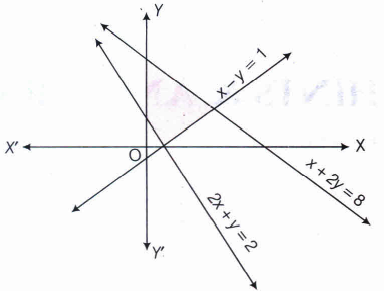
Find the linear inequalities for which the shaded region in given figure is a solution set.
42.
Find real values of x and y for which the complex numbers - 3 + ix2 y and x2 + y + 4i are conjugate of each other.
43.
Prove that \(sin4A=4sinAcos^{ 3 }A-4cosAsin^{ 3 }A.\)
44.
If f(x) = x2, find \(\frac { f(1.1)-f(1) }{ 1.1-1 } \)
45.
If X={1,2,3} and n represents any member of X, write the following sets containing all numbers represented by n-1
46.
Show that the following statement is true. p:For any real numbers x,y if x = y, then 2x + a = 2y + a when a \(\in\) Z.
47.
Prove that 2n<(n+2)! for all natural numbers n.
48.
Prove by the principle of mathematical induction that \(1\times 1!+2\times 2!+3\times 3!+....+n\times n!=(n+1)!-1\)for all natural numbers n.
49.
Prove the following by using the principle of mathematical induction for all n∊ N (2n+7) < (n+3)2
50.
Give three examples of sentences which are not statements. Give reasons for the answers.
51.
Find the middle terms in the expansions of \(\left( 3-\frac { { x }^{ 3 } }{ 6 } \right) ^{ 7 }\)
52.
Solve the equation: cos \(\theta\) + cos 3\(\theta\) - 2 cos 2\(\theta\) = 0.
53.
Find a point in XY plane which is equidistant from three points (2, 0, 3), (0, 3, 2) and (0, 0, 1).
54.
Find the equation of the hyperbola satisfying the given conditions.
Foci (0, ± \(\sqrt10\) ),passing through (2, 3)
55.
If a+i=\(\frac { ({ x }^{ 2 }+i)^{ 2 } }{ { 2x }^{ 2 }+1 } \) ,prove that a2+b2 =\(\frac { ({ x }^{ 2 }+i)^{ 2 } }{ ({ 2x }^{ 2 }+1)^{ 2 } } \)
56.
Find if \(^{ 5 }P_{ r }=^{ 6 }P_{ r-1 }\)
57.
The hypotenuse of a right angled triangle has its ends at the points (1, 3) and (– 4, 1). Find an equation of the legs (perpendicular sides) of the triangle which are parallel to the axes.
58.
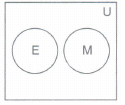
Draw the Venn diagrams to illustrate the following relationship among sets, E, M and U, where E is the set of students studying English in a school, M is the set of students studying Mathematics in the same school, U is the set of all students in that school.
There is no student who studies both Mathematics and English.
59.
Solve the inequalities graphically 4x+3y\(\le\)60, y\(\ge\)2x, x\(\ge\)3, x,y\(\ge\)0
60.
Suppose \( f(x)=\left\{\begin{array}{ll} a+b x, & x<1 \\ 4, & x=1 \text { and if } \lim _{x \rightarrow 1} f(x)=f(1) \\ h-a x & x>1 \end{array}\right.\)what are possible values of a and b?
61.
Let A = {1, 2, 3, 4} and B = {5, 6, 7}. If R = {(a, b) ; a \(\in\) A, b \(\in\) B} and a - b is even} then find R.
62.
Refer to question 6 above, state true or false (give reason for your answer)
(i) A and B are mutually exclusive
(ii) A and B are mutually exclusive and exhaustive
(iii) A = B'
(iv) A and C are mutually exclusive
(v) A and B' are mutually exclusive
(vi) A', B', C are mutually exclusive and exhaustive.
63.
The ratio of the sum of m and n terms of an A.p. is m2:n2. Show that the ratio of mth and nth term is (2m - 1): (2n - 1).
64.
Find the mean deviation about the median for the data
13,17,16,14,11,13,10,16,11,18,12,17
65.
If the set A has m elements, B has n elements then the number of elements in A x B is ______.
m + n
m + n + 1
mn
n2
66.
The solution of the equation cos2 \(\theta\) -+sin\(\theta\)+ 1=0lies in the interval ______.
\(({\pi\over 4},{3\pi\over4})\)
\((-{\pi\over 4},{3\pi\over4})\)
\(({3\pi\over 4},{5\pi\over4})\)
\(({5\pi\over 4},{7\pi\over4})\)
67.
If \(A\cap B=B\) then _____.
B⊂A
A=ф
A⊂B
B=ф
68.
\(\overset{lim}{x\rightarrow 0} \frac{x}{tan x}\) is _______.
0
1
2
3
69.
The eccentricity of the hyperbola whose latus rectum is half of its transverse axis is _______.
\(\frac { 1 }{ 2 } \)
\(\sqrt { \frac { 1 }{ 3 } } \)
\(\sqrt { \frac { 2 }{ 3 } } \)
\(\sqrt { \frac { 3 }{ 2 } } \)
70.
The middle term in the expansion of \(\left( \frac { { 2x }^{ 2 } }{ 3 } +\frac { 3 }{ { 2x }^{ 2 } } \right) ^{ 10 }\)is _____.
240
280
262
252
71.
The ratio in which the line joining (4, -3, 2) and (6, -5, -1) is divided by YZ-plane is _______.
2 : 3
2 : -3
-2 : 3
none of these
72.
The area of a triangle whose vertices are (3, -2), (5, 6) and (-2, -5) is ______.
15 sq. units
16 sq. units
17 sq. units
18 sq. units
73.
If the first term of an AP. is 5 and common difference is - 3 then sum of its 60 terms is equal to ______.
-1050
-5010
3010
None of these
74.
Six boys and six girls sit in a row. The probability that all girls sit together is _______.
\(\frac { 1 }{ 132 } \)
\(\frac { 1 }{ 105 } \)
\(\frac { 1 }{ 142 } \)
\(\frac { 1 }{ 165 } \)
1.
L.H.S The given expression can be writen as \(\frac { 1 }{ { 9 }^{ 3 } } +\frac { 1 }{ 9 } +\frac { 1 }{ 27 } +..\infty \)
Let us find the sum \(\frac { 1 }{ 3 } +\frac { 1 }{ 9 } +\frac { 1 }{ 27 } +.....\infty \)
Here \(a=\frac { 1 }{ 3 } \), \(r=\frac { 1 }{ 3 } \)
\(\therefore\) \({ s }_{ \infty }=\frac { a }{ 1-r } =\frac { \frac { 1 }{ 3 } }{ 1-\frac { 1 }{ 3 } } \Rightarrow \frac { 1 }{ 2 } \)
\(\therefore\) \(\frac { 1 }{ { 9 }^{ 3 } } +\frac { 1 }{ 9 } +\frac { 1 }{ 27 } +..\infty \) = \(\frac { 1 }{ { 9 }^{ 2 } } \) = 3
Hence Proved
2.
41
3.
(-15, -10, 16)
4.
15, 5, - 5 or 3, 5, 7
5.
\(\frac { { x }^{ 2 } }{ 25 } +\frac { { y }^{ 2 } }{ 34 } \)=1
6.
2x - 3y - 6 = 0.
7.
(1-i)4 =[(1-i)2]2 = (1+i2-2i)2
= (1-1-2i)2 = (-2i)2
= 4i2=4\(\times\)-1 =-4
8.
Here f(x)=\(\frac{2x+3}{3x+2}\)
Then \(f(x+h)=\frac{2(x+h)+3}{3(x+h)+2}=\frac{2x+2h+3}{3x+3h+2}\)
We know that \(f^{'}(x)=\lim_{h\rightarrow0} \frac{f(x+h)-(x)}{h}\)
\(f^{'}(x)=\lim_{h\rightarrow0} \frac{\frac{2x+2h+3}{3x+3h+2}-\frac{2x+3}{3x+2}}{h}\)
=\(\lim_{h\rightarrow0} \frac{(2x+2h+3)(3x+2)-(2x+3)(3x+3h+2)}{h(3x+3h+2)(3x+2)}\)
=\(\lim_{h\rightarrow 0} \frac{(2x+3)(3x+2)+2h(3x+2)-(2x+3)(3x+2)-3h(2x+3)}{h(3x+3h+2)(3x+2)}\)
=\(\lim_{h\rightarrow0}\frac{h[6x+4-6x-9]}{h(3x+3h+2)(3x+2)}=\frac{-5}{(3x+2)^{2}}\)
9.
10
10.
The given inequality is 2x - 3y > 6.
Draw the graph of line 2x - 3y = 6.
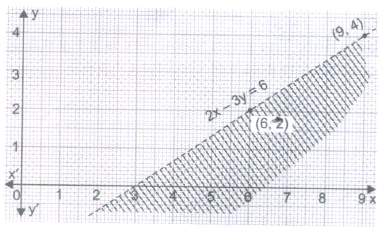
table of values satisfying the equation 2x - 3y = 6
| x | 6 | 9 |
| y | 2 | 4 |
Putting (0,0)in the given inequation, we have
2 x 0 - 3 x 0 > 6 \(\Rightarrow\) 0 > 6, which is false
\(\therefore\) Half plane of 2x - 3y > 6 is away from origin
11.
Here 3(1-x)< 2 (x+4)
\(\Rightarrow\) 3 - 3x < 2x + 8 \(\Rightarrow\) -3x - 2x < 8 - 3
\(\Rightarrow\) -5x < 5
Dividing both sides by - 5, we have x > -1
the solution set is (-1,\(\infty\))
The representation of the solution set on the number line is

12.
{1}, {2}, {3}, {1, 2}, {2, 3}, {1, 3}
13.
Let S be the sample space. Then, n(s) = 52
Let A, B and C be the event of getting a king, a heart and a red card, respectively.
Then,
\(n(A)=4,n(B)=13,n(C)=26\)
\(\therefore \ P(A)=\frac { n(A) }{ n(S) } =\frac { 4 }{ 52 } =\frac { 1 }{ 13 } \)
\(P(B)=\frac { n(B) }{ n(S) } =\frac { 13 }{ 52 } =\frac { 1 }{ 4 } \)
\(P(C)=\frac { n(C) }{ n(S) } =\frac { 26 }{ 52 } =\frac { 1 }{ 2 } \)
Clearly, \((A\cap B)\) is the event of getting a king among hearts.
\((B\cap C)\) is the event of getting a heart among red cards.
\((A\cap C)\) is the event of getting the king among red cards.
\((A\cap B\cap C)\) is the event of getting a king among heart and the red cards.
\(\Rightarrow n(A\cap B)=1,n(B\cap C)=13,n(A\cap C)=2\ and\ n(A\cap B\cap C)=1\)
\( \therefore \ P(A\cap B)=\frac { n(A\cap B) }{ n(S) } =\frac { 1 }{ 52 } ,\)
\(P(B\cap C)=\frac { n(B\cap C) }{ n(S) } =\frac { 13 }{ 52 } =\frac { 1 }{ 4 }\)
\(P(A\cap C)=\frac { n(A\cap C) }{ n(S) } =\frac { 2 }{ 52 } =\frac { 1 }{ 26 } \)
\(and\ P(A\cap B\cap C)=\frac { n(A\cap B\cap C) }{ n(S) } =\frac { 1 }{ 52 } \)
\(Now,\ P(getting\ a\ king\ or\ heart\ or\ red\ card)\)
\( =P(AorBorC)=P(A\cup B\cup C)\)}
\(=P(A)+P(B)+P(C)-P(A\cap B)-P(A\cap C)-P(B\cap C)+P(A\cap B\cap C)\)
\(=\frac { 1 }{ 13 } +\frac { 1 }{ 4 } +\frac { 1 }{ 2 } -\frac { 1 }{ 52 } -\frac { 1 }{ 26 } -\frac { 1 }{ 4 } +\frac { 1 }{ 52 } =\frac { 28 }{ 52 } =\frac { 7 }{ 13 } \)
14.
On rolling a die, we get outcomes as odd number.So,sample space, S = (1,3,5} \(\Rightarrow \) n(S) = 3
Let E be the event of getting a prime number then,
E={3,5} \(\Rightarrow \) n(E) = 2
Required probability = \(\frac { n(E) }{ n(S) } =\frac { 2 }{ 3 } \)
15.
Here, we observe that average monthly wages in both the plants is same i.e 3000. Therefore, the plant with greater variance will have more variability. Hence, the plant B has greater variability in individual wages.
16.
The component statements are
p :Number 3 is prime
q :Number 3 is odd
Both p and q are true. So \(p\vee q\) is true.
17.
(i) The negation of the given statements is It is false that sum of 2 and 3 is 4
or
The sum of 2 and 3 is not equal to 4
This statements is true because 2+3= 5 \(\neq \) 4
(ii) The negation of the given statements is
It is false that \(\sqrt { 3 } \) is rational
or
\(\sqrt { 3 } \) is not rational
This statements is true because \(\sqrt { 3 } \) is rational
(iii) The negation of the given statements is It is false thet New Delhi is a city
or
New Delhi is not a city
This statements is false.
(iv) The negation of the given staement is
It is false that every natural number is greater than 0.
This is a false statement.
18.
\(LHL=\lim _{ X\rightarrow { -1 }^{ - } }{ (x+2)= } \lim _{ h\rightarrow 0 }{ (-1-h+2)=1 } \)
\(RHL=\lim _{ x\rightarrow { 1 }^{ + } }{ f(x) } =\lim _{ x\rightarrow { -1 }^{ + } }{ { cx }^{ 2 } } =\lim _{ h\rightarrow 0 }{ c{ (-1+h })^{ 2 } } \)
Ans. c = 1
19.
Yes, ;et A(0, 7, 10), B(-1, 6, 6) and C(-4, 9, 6) be the vertices of a triangle. Then,
Side \(AB=\sqrt { { \left( 0+1 \right) }^{ 2 }+{ \left( 7-6 \right) }^{ 2 }+{ \left( 10-6 \right) }^{ 2 } }\)
\( [\therefore \quad distance\quad =\sqrt { { \left( { x }_{ 1 }-{ x }_{ 2 } \right) }^{ 2 }+{ \left( { y }_{ 1 }-{ y }_{ 2 } \right) }^{ 2 }+{ \left( { z }_{ 1 }-{ z }_{ 2 } \right) }^{ 2 } } ]\)
\(\Rightarrow AB=\sqrt { { 1 }^{ 2 }+{ 1 }^{ 2 }+{ 4 }^{ 2 } } =\sqrt { 1+1+16 } =\sqrt { 18 } =\sqrt [ 3 ]{ 2 } units\)
\(Side\quad BC=\sqrt { { \left( -1+4 \right) }^{ 2 }+{ \left( 6-9 \right) }^{ 2 }+{ \left( 6-6 \right) }^{ 2 } } =\sqrt { { 3 }^{ 2 }+{ 3 }^{ 2 }+0 } \)
\(\Rightarrow BC=\sqrt { 9+9+0 } =\sqrt { 18 } =\sqrt [ 3 ]{ 2 } units\)
\(and\quad side\quad CA=\sqrt { { \left( -4-0 \right) }^{ 2 }+{ \left( 9-7 \right) }^{ 2 }+{ \left( 6-10 \right) }^{ 2 } } \)
\(=\sqrt { { 4 }^{ 2 }+{ 2 }^{ 2 }+{ 4 }^{ 2 } } \)
\( \Rightarrow CA=\sqrt { 16+4+16 } =\sqrt { 36 } =6\quad units\)
\(Now, { AB }^{ 2 }+{ BC }^{ 2 }={ \left( \sqrt [ 3 ]{ 2 } \right) }^{ 2 }+{ \left( \sqrt [ 3 ]{ 2 } \right) }^{ 2 }{ =6 }^{ 2 }={ CA }^{ 2 }\)
Hence, \(\Delta ABC\) is right angled triangle at B.
Yes, this question gives us message to protect our environment and help us to follow these in our daily lives to make ourselvegs healthy.
20.
On comparing the given equation with (x - h)2 + (y - k)2 = r2 , we get
\(h=\frac { 1 }{ 2 } ,k=-\frac { 1 }{ 3 } \)
\(and\quad r=\frac { 1 }{ 2 } \)
\((\frac { 1 }{ 2 } ,-\frac { 1 }{ 3 } )\quad and\quad \frac { 1 }{ 2 } \)
21.
Let the given points are \(A({ x }_{ 1 },{ y }_{ 1 })\equiv A(-1,1)\) and,\(B({ x }_{ 2 },{ y }_{ 2 })\equiv B(2,-4)\) then equation of line AB is
\(y-1=\frac { -4-1 }{ 2+1 } (x+1)\)
\( \left[ \because y-{ y }_{ 1 }=\frac { { y }_{ 2 }-{ y }_{ 1 } }{ { x }_{ 2 }-{ x }_{ 1 } } (x-{ x }_{ 1 }) \right]\)
\( \Rightarrow y-1=\frac { -5 }{ 3 } (x+1) \Rightarrow 3y-3=-5x-5\)
\(\Rightarrow 5x+3y+2=0\)
22.
Here, a = 2x, b = 3y and n = 5
Given, \(\left( 2x-3y \right) ^{ 4 }\)
\(=^{ 4 }{ C }_{ o }\left( 2x \right) ^{ 4 }-^{ 4 }{ C }_{ 1 }\left( 2x \right) ^{ 3 }\times \left( 3y \right) ^{ 1 }+^{ 4 }{ C }_{ 2 }\left( 2x \right) ^{ 2 }\times \left( 3y \right) ^{ 2 }-^{ 4 }{ C }_{ 3 }\left( 2x \right) ^{ 1 }\times \left( 3y \right) ^{ 3 }+^{ 4 }{ C }_{ 4 }\left( 2x \right) ^{ o }\left( 3y \right) ^{ 4 }\)
Ans. \(16{ x }^{ 4 }-96{ x }^{ 3 }y+216{ x }^{ 2 }{ y }^{ 2 }-216{ xy }^{ 3 }+81{ y }^{ 4 }\)
23.
Let E = \(\left( { x }^{ 2 }-\sqrt { 1-{ x }^{ 2 } } \right) ^{ 4 }+\left( { x }^{ 2 }+\sqrt { 1-{ x }^{ 2 } } \right) ^{ 4 }\)
Put \(\sqrt { 1-{ x }^{ 2 } } =y,\quad \) , we get
\(E=\left( { x }^{ 2 }-y \right) ^{ 4 }+\left( { x }^{ 2 }+y \right) ^{ 4 }\)
\(=2[^{ 4 }{ C }_{ o }\left( { x }^{ 2 } \right) ^{ 4 }{ y }^{ o }+^{ 4 }{ C }_{ 2 }\left( { x }^{ 2 } \right) ^{ 2 }{ y }^{ 2 }+^{ 4 }{ C }_{ 4 }\left( { x }^{ 2 } \right) ^{ o }{ y }^{ 4 }]\)
\(\left[ if\quad n\quad is \quad even,then(x-a)^{ n }+(x+a)^{ n }=2\left\{ ^{ n }{ C }_{ o }{ x }^{ n }{ a }^{ o }+^{ n }{ C }_{ 2 }{ x }^{ n-2 }{ a }^{ 2 }+^{ n }{ C }_{ 4 }{ x }^{ n-4 }{ a }^{ 4 }+... \right\} \right] \)
\(=2[1\times { x }^{ 8 }\times 1+6\times { x }^{ 4 }{ y }^{ 2 }+1\times 1\times { y }^{ 4 }]\)
\(=2[{ x }^{ 8 }+6{ x }^{ 4 }(1-{ x }^{ 2 })+(1-{ x }^{ 2 })^{ 2 }]\quad [put\quad y=\sqrt { 1-{ x }^{ 2 } } \)
\(=2({ x }^{ 8 }+6{ x }^{ 4 }-6{ x }^{ 6 }+1+{ x }^{ 4 }-2{ x }^{ 2 })\)
\(=2{ x }^{ 8 }-12{ x }^{ 6 }+14{ x }^{ 4 }-4{ x }^{ 2 }+2\)
24.
We have,
\(^{13}{C}{_{6}}\)+ \(^{13}{C}{_{5}}\) = \(^{14}{C}{_{6}} \) \([ \because ^{n}{C}{_{r}} + ^{n}{C}{_{r-1}} = ^{n+1}{C}{_{r}}]\)
=\(\frac {14!}{6!(14-6)} \) \(\left[ \because \ \ ^{ n }{ C }{ _{ r } }= \frac { n! }{ r!(n-r)! } \right] \)
=\(\frac{14!}{6 \times 8}\) = \(\frac {14 \times 13 \times 12 \times 11 \times 10 \times 9 \times 8!}{6 \times 5 \times 4 \times 3 \times 2 \times 1 \times 8!} \)
=7\(\times\)13\(\times\)11\(\times\)3 = 3003
25.
\({ i }^{ 29 }+\frac { 1 }{ { i }^{ 29 } } =\frac { { i }^{ 29 }.{ i }^{ 29 }+1 }{ { i }^{ 29 } } =\frac { { (i }^{ 2 })^{ 29 }+1 }{ { i }^{ 29 } } \)
\(=\frac { { (-1) }^{ 29 }+1 }{ { i }^{ 29 } } =\frac { -1+1 }{ { i }^{ 29 } } =0=0+0i\)
26.
Consider P(k):2+4+6+8+.....+2k = k(k+1)
Now, P(k+1):2+4+6+.....2(k)+2(k+1)
=k(k+1)+2(k+1)=k2 + 3k+2
=(k+1)(k+1)
27.
\(We\quad known\quad that,\quad tan(\alpha +\beta )=\frac { tan\alpha +tan\beta }{ 1-tan\alpha \quad tan\beta }\)
\( \Rightarrow tan(\alpha +\beta )=\frac { \frac { 1 }{ \sqrt { x\left( { x }^{ 2 }+x+1 \right) } } +\frac { \sqrt { x } }{ \sqrt { { x }^{ 2 }+x+1 } } }{ 1-\frac { \sqrt { x } }{ \sqrt { x\left( { x }^{ 2 }+x+1 \right) } \sqrt { { x }^{ 2 }+x+1 } } } \)
\(\Rightarrow tan(\alpha +\beta )=\frac { \frac { 1+x }{ \sqrt { x\left( { x }^{ 2 }+x+1 \right) } } }{ 1-\frac { 1 }{ { x }^{ 2 }+x+1 } }\)
\(\Rightarrow tan(\alpha +\beta )=\frac { 1+x }{ \sqrt { x\left( { x }^{ 2 }+x+1 \right) } } \times \frac { { x }^{ 2 }+x+1 }{ { x }^{ 2 }+x+1-1 } \)
\(\Rightarrow tan(\alpha +\beta )=\frac { \left( 1+x \right) \left( { x }^{ 2 }+x+1 \right) }{ x\left( x+1 \right) \sqrt { x\left( { x }^{ 2 }+x+1 \right) } } \)
\(\Rightarrow tan(\alpha +\beta )=\frac { \sqrt { x\left( { x }^{ 2 }+x+1 \right) } }{ { x }^{ 2 } }\)
\(=\frac { \sqrt { \left( { x }^{ 3 }+{ x }^{ 2 }+x \right) } }{ { x }^{ 4 } } =\sqrt { { x }^{ -1 }+{ x }^{ -2 }+{ x }^{ -3 } }\)
\(\Rightarrow tan(\alpha +\beta )=\quad tan\gamma \therefore \quad \alpha +\beta =\gamma \)
28.
\((30)''=\left( \frac { 1 }{ 2 } \right) ^{ ' }\Rightarrow 37'30''=\left( 37\frac { 1 }{ 2 } \right) ^{ ' }=\left( \frac { 75 }{ 2 } \times \frac { 1 }{ 60 } \right) ^{ o }=\left( \frac { 5 }{ 8 } \right) ^{ o }\)
\({ 5 }^{ 0 }37'30''={ 5 }^{ 0 }+\frac { { 5 }^{ o } }{ 8 } =\frac { 45 }{ 8 } \times \frac { \pi }{ 180 } \)
Ans. \(\frac { \pi }{ 32 } rad\)
29.
We have, \(y=f(x)=\frac { 1-x }{ 1+x } \)
Then, \(f(y)=\frac { 1-y }{ 1+y } =\frac { 1-\left( \frac { 1-x }{ 1+x } \right) }{ 1+\left( \frac { 1-x }{ 1+x } \right) } \) [from Eq. (i)]
\(\frac { \frac { 1+x-(1-x) }{ 1+x } }{ \frac { 1+x+1-x }{ 1+x } } =\frac { 2x }{ 2 } \)
\(\Rightarrow \) f(y) = x
\(\therefore \) x = f(y), when \(y=f(x)=\frac { 1-x }{ 1+x } \)
30.
f1 is a function.
31.
Given sets are A = {1,3,5,6,7} and B={3,7,8,9}.
Now, A-B={1,3,5,6,7} - {3,7,8,9} ={1,5,6}
[set of those elements of A, which are not present in B]
and, B-A={3,7,8,9} - {1,3,5,6,7} ={8,9}
[set of those elements of B, which are not present in A]
\(\because \) Required symmetric difference,
\(A\triangle B=(A-B)\cup (B-A)\quad =\{ 1,5,6\} U\{ 8,9\} =\{ 1,5,6,8,9\} \)
32.
52
33.
Let us make the following table from the given data.
| xi | fi | fixi | \(\left( { x }_{ i }-\bar { x } \right) =\left( { x }_{ i }-19 \right) \) | \(\left( { x }_{ i }-\bar { x } \right) ^{ 2 }\) | \({ f }_{ i }({ x }_{ i }-\bar { x } )^{ 2 }\) |
| 6 10 14 18 24 28 30 |
2 4 7 12 8 4 3 |
12 40 98 216 192 112 90 |
-13 -9 -5 -1 5 9 11 |
169 81 25 1 25 81 121 |
338 324 175 12 200 324 363 |
| \(\sum { { f }_{ i } } =40\) | \(\sum { { f }_{ i }{ x }_{ i }=760 } \) | \(\sum { { f }_{ i }({ x }_{ i }-\bar { x } )^{ 2 }=1736 } \) |
\(\therefore \ (\bar { x } )=\frac { \sum { { f }_{ i }{ x }_{ i } } }{ N } =\frac { 760 }{ 40 } =19\)
\(and\ standard\ deviation=\sqrt { \frac { 1 }{ N } [\sum { { f }_{ i }({ x }_{ i }-\bar { x } )^{ 2 }] } } \)
\(=\sqrt { \frac { 1736 }{ 40 } } =\sqrt { 434 } =6.59\)
Ans.19,6.59
34.
\(f\prime (x)=\lim_ { h\rightarrow 0 }{ lim } \frac { log(x+k+h)-(logx+k) }{ h } \)
\(=\lim_ { h\longrightarrow 0 }{ lim } \frac { log\left[ 1+\frac { h }{ x+k } \right] }{ \frac { h }{ (x+k) } (x+k) } \)
\(=\frac { 1 }{ x+k }\)
35.
\(\left( \frac { -3 }{ 10 } ,\frac { 5 }{ 2 } ,\frac { -1 }{ 5 } \right) \)
36.
Given equation of ellipse is \(\frac { { x }^{ 2 } }{ 49 } +\frac { { y }^{ 2 } }{ 16 } =1.\)
\(\text{On comparing with} \frac { { x }^{ 2 } }{ { a }^{ 2 } } +\frac { { y }^{ 2 } }{ { b }^{ 2 } } =1\text{,we get }a=7,b=4\)
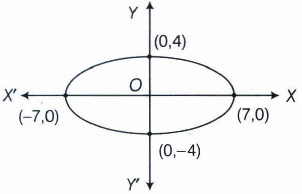
Here, a>b, so major axis is along X-axis.
\(Eccentricity,e=\frac { c }{ a } =\frac { \sqrt { 33 } }{ 7 } \)
37.
\(\frac { x }{ 4 } +\frac { y }{ 4 } =1,\quad a=4\quad and\quad b=\frac { 4 }{ 3 } \)
38.
Let the GP be A,AR,AR2,AR3....
Given , first term ,
A = a ....(i)
and nth term , ARn-1 = b ....(ii)
Now , p = Product of n terms
p = A\(\times\)AR1\(\times\)AR2\(\times\)AR3\(\times\).....\(\times\)n terms
p = A1+1+1+1+.....+n terms R1+2+3+....(n-1)
p = AnR \(\frac{n(n-1)}{2}\)
p2 = An An Rn(n-1) = An (ARn-1)n
p2 = anbn [using Eqs.(i) and (ii)]
39.
11n - 10n = (1+10)n - 10n
= 1 + 10n + nC2(10)2 + nC3(10)3 + -10n
= 1 + 100 {nC2 + nC3 10+...+ nCn10n-2}
= 100 x an integer + 1
\(\Rightarrow \) 11n - 10n leaves remainder 1 when divided by 100.
40.
0 do not comes in hundred's place, so only 4 numbers are posiible in hundred's place. Since, the digits are repeated, so remaining two digits, 5 numbers are possible in each place.
\(\therefore \) Total number of ways = 4 x 5 x 5 = 100
41.
Consider the equation of the line x+2y=8. We opbserve that the shaded region and the origin lie on the same side of the line.So, the corresponding inequality is \(x+2y<8.\)
Now, consider the equation of the line x-y=1.
We observe that the shaded region and orgin both lie on the same side. So, corresponding inequality is \(x-y<1.\)
Consider the equation of the line 2x+y=2.We observe that the shaded region and origin lie on opposite side of and is on the right side of Y-axis.So, \(x\ge 0\ and\ y\ge 0.\)
Thus, the linear inequalities corresponding to the given solution ser are
\(x+2y<8,2x+y>2\)
\(x-y>1\)
\(x\ge 0,y\ge 0\)
42.
Since, -3 + ix2y and x2 + y + 4i are conjugate of each other \(-3+i{ x }^{ 2 }y=\overline { { x }^{ 2 }+y+4i } x = {-b \pm \sqrt{b^2-4ac} \over 2a}\).
After this, equate real and imaginary parts, to get the values of x and y. (x = 1, y = -4) or (x = -1, y = -4)
43.
\(RHS=4sinAcosA(cos^{ 2 }A-sin^{ 2 }A)\)
\(= 2sin2A(cos2A)=sin4A\)
44.
Given, f(x)=x2
\(\therefore \frac{\mathrm{f}(1.1)-\mathrm{f}(1)}{(1.1-1)}=\frac{(1.1)^2-(1)^2}{(1.1-1)}=\frac{1.21-1}{0.1}=\frac{0.21}{0.1}=2.1\)
45.
{0,1,2}
46.
Direct Method For any real number x,y, it is given
x = y \(\Rightarrow \) 2x = 2y
\(\Rightarrow \) 2x + a = 2y + a for some a \(\in\) Z.
Contrapositive Method The contrapositive statement of 'p' is 'For any real numbers x,y, if 2x+a\(\neq \)2y+a, where a\(\epsilon \)Z.then x\(\neq \)yn .
47.
2k<(k+2)!\(\Rightarrow \)2k+2(k+2)!+2]
\(\Rightarrow \) (k+1)2 < 2k + 2k [(2k+1)<2k for k\(\le \)3]
\(\Rightarrow \) (k+1)2 < 2k+1
48.
Step I: Let P(n) be the given statement
i.e. P(n): \(1\times 1!+2\times 2!+3\times 3!+....+n\times n!=(n+1)!-1\)
Step II : For n=1, we have
LHS=\(1\times 1!\)=1
and RHS=(1+1)!-1=2!-1=2-1=LHS
\(\because \) LHS=RHS
\(\therefore \) P(1) is true
Step III Let us assume that P(n) is true for n=k
Then, we have
P(k): \(1\times 1!+2\times 2!+3\times 3!+....+k\times k!+(k+1)!-1\quad \quad ....(i)\)
Step IV Now, we shall prove the statement for n=k+1. For this we have to show that
\(1\times 1!+2\times 2!+3\times 3!+....+k\times k!+(k+1)\times (k+1)!=(k+1+1)!-1\)
Then, LHS \(=1\times 1!+2\times 2!+3\times 3!+....+k\times k!+(k+1)\times (k+1)!\)
=(k+1)!-1+(k+1)!\(\times \)(k+1) [from Eq.(1)]
=(k+1+1)(k+1)!-1=(k+2)(k+1)!-1
=(k+2)!-1 [\(\because \)n(n-1)!=n]
Thus, P(k+1) is true, whenever P(k) is true. Hence, by the principle of mathematical induction, P(n) is true for all natural numbers n.
49.
Let P(n) = (2n + 7) < (n + 3)2
For n =1
P(1) = (2\(\times\)1+7)<(1+3)2
⇒ 9 < 16
∴ P(1) is true
Let P(n) be true for n = k
∴ P(k) = (2k+7)<(k+3)2 ...(i)
For n = k+1
P(k+1) =2(k+1)+7<(k+1+3)2
⇒ 2(k+1)+7<(k+4)2 From (i)
2k+7<(k+3)2
Adding 2 on both sides
2k+7+2<(k+3)2+2
⇒ 2(k+1)+7
⇒ 2(k+1)+7
⇒ 2(k+1)+7<(k+4)2
∴ P(k +1) is true
Thus P(k) is true
⇒ P(k + 1) is true
Hence by principle of mathematical induction, P(n) is true for all n∊N.
50.
The three examples of sentences, which are not statements, are as follows.
(i) He is a doctor.
It is not evident from the sentence as to whom ‘he’ is referred to. Therefore, it is not a statement.
(ii) Geometry is difficult.
This is not a statement because for some people, geometry can be easy and for some others, it can be difficult.
(iii) Where is she going?
This is a question, which also contains ‘she’, and it is not evident as to who ‘she’ is. Hence, it is not a statement.
51.
Here n = 7, which is odd.
So the middle terms are \(\left( \frac { 7+1 }{ 2 } \right) th,\left( \frac { 7+1 }{ 2 } +1 \right) th\) are 4th and 5th terms.
The general term in the expansion of\(\left( 3-\frac { { x }^{ 3 } }{ 6 } \right) ^{ 7 }\) is
\({ T }_{ r+1 }=^{ 7 }{ C }_{ r }{ (3) }^{ 7-r }{ \left( \frac { { -x }^{ 3 } }{ 6 } \right) }^{ r }....(i)\)
Putting r = 3 and 4 in (i)
\(\therefore \quad { T }_{ 4 }=^{ 7 }C_{ 3 }{ (3) }^{ 7-3 }{ \left( \frac { { -x }^{ 3 } }{ 6 } \right) }^{ 3 }\)
\(=^{ 7 }C_{ 3 }{ (3) }^{ 4 }.{ (-1) }^{ 3 }.\frac { { x }^{ 9 } }{ { (6) }^{ 3 } } \)
\(=35\times 81\times -\frac { { x }^{ 9 } }{ 216 } =-\frac { 105 }{ 8 } { x }^{ 9 }\)
Now \({ T }_{ 5 }=^{ 7 }C_{ 4 }{ (3) }^{ 7-4 }{ \left( \frac { { -x }^{ 3 } }{ 6 } \right) }^{ 3 }\)
\(=^{ 7 }C_{ 4 }{ (3) }^{ 3 }.(-1)^{ 4 }\frac { { x }^{ 12 } }{ { (6) }^{ 4 } } \)
\(=35\times 27\times \frac { { x }^{ 12 } }{ 1296 } =\frac { 35 }{ 48 } { x }^{ 12 }\)
52.
(2n + 1)\({\pi\over 4},2m\pi;m,n \in Z\)
53.
Let A(2, 0, 3), B(O, 3, 2) and C(O, 0,1) be given points.
Let P(x, y, 0) be any point in XY plane such that PA = PB = PC.
Now PA = PB => PA2 = PB2
\(\therefore \) (x - 2)2 + (y - 0)2 + (- 3)2
= (x - 0)2 + (y - 3)2 + (- 2)2
=> x2+4-4x+y2+9
=x2+y2+9-6y+4
=> 4x - 6y = 0 => 2x - 3y = 0 ....(i)
Also PB = PC => PB2 = PC2
(x - 0)2 + (y - 3)2 + (0 - 2)2 = (x - 0)2 + (y - 3)2 + (0 - 2)2
\(\therefore \)(x - 0)2 + (y - 3)2 + (0 - 2)2 = (x - 0)2 + (y - 3)2 + (0 - 1)2
=> x2+ y2 + 9 - 6y + 4
=x2+y2+1
=> 6y = 12 => y = 2
Putting value of y in (i), we have
2x-3x2=0 => x=3
Thus co-ordinates ofrequired point are (3, 2, 0).
54.
Here foci are (0, ±\(\sqrt10\)) which lie on y-axis.
So the equation of hyperbola in standard form is \(\frac { { y }^{ 2 } }{ { a }^{ 2 } } -\frac { { x }^{ 2 } }{ { b }^{ 2 } } \)=1
∴ foci (0, ± c) is (0, ± \(\sqrt10\)) a = \(\sqrt10\)
We know that c2 = a2 + b2
∴ (\(\sqrt10\))2 = a2 + b2 ⇒ b2 = 10 - a2
Since the hyperbola passes through (2, 3)
∴ \(\frac { 9 }{ a^{ 2 } } -\frac { 4 }{ { b }^{ 2 } } \)=1
⇒ \(\frac { 9 }{ a^{ 2 } } -\frac { 4 }{ 10-{ a }^{ 2 } } \)=1
⇒ \(\frac { 9(10-{ a }^{ 2 })-4{ a }^{ 2 }={ a }^{ 2 }(10-{ a }^{ 2 }) }{ { a }^{ 2 }(10-{ a }^{ 2 }) } \)
⇒ a4 - 23a2 + 90 = 0
⇒ a4 - 18a2 - 5a2 + 90 = 0
⇒ (a2 - 18) (a2 - 5) = 0
⇒ a2 = 18 or a2 = 5
When a2= 18 then b2= 10-18=-8 (which is not possible)
When a2 = 5 then b2 = 10 - 5 = 5
Thus required equation of hyperbola is
\(\frac { { y }^{ 2 } }{ 5 } -\frac { { x }^{ 2 } }{ 5 } \)=1
55.
Here a+ib =\(\frac { ({ x }^{ 2 }+i)^{ 2 } }{ { 2x }^{ 2 }+1 } =\frac { { x }^{ 2 }+i+2ix }{ { 2x }^{ 2 }+1 } \)
= \(\frac { { x }^{ 2 }-1 }{ 2{ x }^{ 2 }+1 } +i\frac { 2x }{ { 2x }^{ 2 }+1 } \)
Comparing both sides, we have
a= \(\frac { { x }^{ 2 }-1 }{ 2{ x }^{ 2 }+1 } \)and b= \(\frac { 2x }{ { 2x }^{ 2 }+1 } \)
∴ a2+b2= \(\left( \frac { { x }^{ 2 }-1 }{ 2{ x }^{ 2 }+1 } \right) ^{ 2 }+\left( \frac { 2x }{ { 2x }^{ 2 }+1 } \right) ^{ 2 }\)
= \(\frac { { (x }^{ 2 }-1)^{ 2 } }{ (2{ x }^{ 2 }+1)^{ 2 } } +\frac { (2x)^{ 2 } }{ ({ 2x }^{ 2 }+1)^{ 2 } } \)
= \(\frac { { (x }^{ 2 }-1)^{ 2 }+(2x)^{ 2 } }{ (2{ x }^{ 2 }+1)^{ 2 } } \)
= \(\frac { { x }^{ 4 }+1-{ 2x }^{ 2 }+{ 4x }^{ 2 } }{ ({ 2x }^{ 2 }+1)^{ 2 } } \)
= \(\frac { { x }^{ 4 }+1+{ 2x }^{ 2 } }{ ({ 2x }^{ 2 }+1)^{ 2 } } =\frac { ({ x }^{ 2 }+1)^{ 2 } }{ ({ 2x }^{ 2 }+1)^{ 2 } } \)
56.
\(\therefore \frac { 5! }{ (5-r)! } =\frac { 6! }{ (7-r)! }\)
\( \Rightarrow \frac { 5! }{ (5-r)! } =\frac { 6\times 5! }{ (7-r)(6-r)(5-r)! }\)
\( \Rightarrow 1=\frac { 6 }{ (7-r)(6-r) } \)
\(\Rightarrow { r }^{ 2 }-13r+42=6\)
\(\Rightarrow { r }^{ 2 }-13r+36=0\)
\( \Rightarrow { r }^{ 2 }-{ 9r }-4r+36=0\)
\(\Rightarrow r(r-9)-4(r-9)=0\)
\(\Rightarrow (r-9)(r-4)=0\)
\( \Rightarrow r=9\quad or\quad r=4\)
\(Now\quad r=9\quad is\quad not\quad possible\quad because\quad r>n\)
\(Thus\quad r=4\)
57.
\(\text { | et } A B C \text { be the riaht analed trianale where } \angle \mathrm{C}=90^{0}\)
\(\text { There are infinitely many such lines. }\)
\(\text { Let } m \text { be the slope of } A C \text { . }\)
\(\text { Slope of } B C=-\frac{1}{m}\)
\(\text { Equation of } A C: \quad y-3=m(x-1)\)
\(\Rightarrow x-1=\frac{1}{m}(y-3)\)
\(\text { Equation of BC: } \quad y-1=-\frac{1}{m}(x+4)\)
\(\Rightarrow x+4=-m(y-1)\)
\(\text { For a given value of } m \text { , we can get theseequations }\)
\(\text { For } m=0, \quad y-3=0 ; x+4=0\)
\(\text { For } m \rightarrow \infty, \quad x-1=0 : y-1=0\)
58.
59.
The given inequality is 4x +3y\(\le\)60
Draw the graph of the line 4x +3y = 60
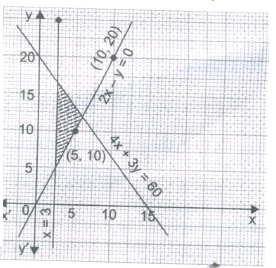
table of values satisfying the equation 4x +3y=60
| x | 15 | 0 |
| y | 0 | 20 |
Putting (0, 0) in the given inequation, we have 4 x 0 + 3 x 0 \(\le\)60 \(\Rightarrow\)0 \(\le\)60, which is true.
. . Half plane of 4x +3y \(\le\) 60 is towards origin.
Also the given inequality is 2x-y\(\le\)0
Draw the graph of the line 2x - y = O.
Table of values satisfying the equation 2x-y=0
| x | 5 | 10 |
| y | 10 | 20 |
Putting (10,0) in the given inequation, we have 2 x 10-0\(\le\) 0 \(\Rightarrow\) 20\(\le\)0, which is false.
\(\therefore\) Half plane of 2x -y \(\le\)0 does not contain (10,0).
The given inequality is x \(\ge\)3.
Draw the graph of the line x = 3.
Putting (0,0) in the given inequation, we have o \(\ge\)3, which is false.
\(\therefore\) Half plane of x \(\ge\)3 is away from origin
60.
\(\text { The given function is }\)
\(f(x)=\left\{\begin{array}{ll} a+b x, & x<1 \\ 4, & x=1 \\ b-a x & x>1 \end{array}\right.\)
\(\lim _{x \rightarrow 1^{-}} f(x)=\lim _{x \rightarrow 1}(a+b x)=a+b \)
\(\lim _{x \rightarrow 1^{+}} f(x)=\lim _{x \rightarrow 1}(b-a x)=b-a \)
\(f(1)=4\)
\(\text { It is given that } \lim _{x \rightarrow 1} f(x)=f(1) \text { . }\)
\(\therefore \lim _{x \rightarrow 1^{-}} f(x)=\lim _{x \rightarrow 1^{+}} f(x)=\lim _{x \rightarrow 1} f(x)=f(1) \)
\(\Rightarrow a+b=4 \text { and } b-a=4\)
\(\text { On solving these two equations, we obtain } a=0 \text { and } b=4 \text { . }\)
\(\text { Thus, the respective possible values of } a \text { and } b \text { are } 0 \text { and } 4\)
61.
Here A = {1, 2, 3, 4} and B = {5, 6, 7}, a \(\in\) A, b \(\in\) B.
\(\therefore\) a - b = 1 - 5, 1 - 6, 1 - 7, 2 - 5, 2 - 6, 2 - 7, 3 - 5, 3 - 6, 3 - 7, 4 - 5, 4-6,4-7
= -4, -5, -6, -3, -4, -5, -2, -3, -4, -1, -2,-3
R = {(1, 5), (1, 7), (2, 6), (3,5), (3, 7), (4,6)}.
62.
Taking A, B, C events from question 6 above we have
\(i)\ A\cap B=\phi \)
Thus A and B are mutually exclusive and exhaustive events.
∴ True.
\( ii)\ A\cap B\ =\phi \ and\ A\cap B=S\)
Thus A and B are mutually exclusive and exhaustive events.
∴ True.
(iii) B′={(2,1),(2,2),(2,3),(2,4),(2,5),(2,6),(4,1),(4,2),(4,3),(4,4),(4,5),(4,6),(6,1),(6,2),(6,3),(6,4),(6,5),(6,6)}=A.
∴ True.
(iv) A∩C = {(2,1)(2,2)(2,3)(4,1)}=ϕ
Thus A and C are not mutually exclusive events.
∴ False
(v) A∩B′ = A ≠ ϕ
Thus A and B are not mutually exclusive events.
(vi) Since A′ = B and B′ = A, A∩B = ϕ
B∩C = {(1,1),(1,2),(1,3),(1,4),(3,1),(3,2)} ≠ ϕ
A∩C = {(2,1)(2,2)(2,3)(4,1)} = ϕ
Thus A′, B′ and C are not mutually exclusive.
∴ False.
63.
Let 'a' be the first term and 'd' be the common difference of given A.P.
\(\because \quad { S }_{ m }=\frac { m }{ 2 } [2a+(m-1)d]\)
and \({ S }_{ n }=\frac { n }{ 2 } [2a+(n-1)d]\)
\(\therefore \quad \frac { { S }_{ m } }{ { S }_{ n } } =\frac { \frac { m }{ 2 } [2a+(m-1)d] }{ \frac { n }{ 2 } [2a+(n-1)d] } \)
But \(\frac { { S }_{ m } }{ { S }_{ n } } =\frac { { m }_{ 2 } }{ { n }_{ 2 } } \) [Given]
\(\Rightarrow \frac { \frac { m }{ 2 } [2a+(m-1)d] }{ \frac { n }{ 2 } [2a+(n-1)d] } =\frac { { m }^{ 2 } }{ { n }^{ 2 } } \)
\(\Rightarrow \frac { 2a+(n-1)d }{ 2a+(n-1)d] } =\frac { { m }^{ 2 } }{ { n }^{ 2 } } \times \frac { n }{ 2 } \times \frac { 2 }{ m } =\frac { m }{ n } \)
\(\Rightarrow\) 2an + n(m-1)d = 2am + m(n-1)d
\(\Rightarrow\) 2an-2am= (mn-m)d-(mn-n)d
\(\Rightarrow\) 2a[n-m]=[mn-m-mn+n]d
\(\Rightarrow\) 2a[n-m]=[n-m]d
\(\Rightarrow d=\frac { 2a[n-m] }{ [n-m] } =2a\)
Now, \(\frac { { a }_{ m } }{ { a }_{ n } } =\frac { a+(m-1)d }{ a+(n-1)d } =\frac { a+(m-1)\times 2a }{ a+(n-1)\times 2a } \)
\(=\frac { a[1+2m-2] }{ a[1+2n-2] } =\frac { 2m-1 }{ 2n-1 } \)
Thus, the ratio of 'mth' and 'nth' term is (2m+1): (2m-1).
64.
Arrange the data in ascending order, we have
10,11,12,13,13,14,16,16,17,17,18
Here n = 12 (which is even)
So median is average of 6th and 7th observations
∴ Median =\(\frac { 13+14 }{ 2 } =\frac { 27 }{ 2 } =13.5\)
| xi | |xi-M| |
| 10 | 3.5 |
| 11 | 2.5 |
| 11 | 2.5 |
| 12 | 1.5 |
| 13 | 0.5 |
|
13 |
0.5 |
| 14 | 0.5 |
| 16 | 2.5 |
| 16 | 2.5 |
| 17 | 3.5 |
| 17 | 3.5 |
| 18 | 4.5 |
| Total | 28 |
M.D. about median =\(\frac { 1 }{ n } \sum _{ i=1 }^{ n }{ \left| { x }_{ i }-M \right| } \)
\(=\frac{1}{12}\times28=2.33\)
65.
(c)
mn
66.
(d)
\(({5\pi\over 4},{7\pi\over4})\)
67.
(a)
B⊂A
68.
(b)
1
69.
(d)
\(\sqrt { \frac { 3 }{ 2 } } \)
70.
(d)
252
71.
(c)
-2 : 3
72.
(c)
17 sq. units
73.
(b)
-5010
74.
(a)
\(\frac { 1 }{ 132 } \)

11th Standard CBSE Syllabus & Materials
11th Standard CBSE
CBSE 11th Business Studies Forms of Business Organisation Sample Question Papers Study Material - QB365 Set A
NEW11th Standard CBSE
CBSE 11th Business Studies Business, Trade and Commerce Sample Question Papers Study Material - QB365 Set A
NEW11th Standard CBSE
CBSE 11th Physics Waves Sample Question Papers Study Material - QB365 Set A
NEW11th Standard CBSE
CBSE 11th Physics Kinetic Theory Sample Question Papers Study Material - QB365 Set A



CBSE 11th Standard CBSE Subjects
CBSE Standards









