
 100% FREE ACCESS
11th Standard CBSE Syllabus & Materials
11th Standard CBSE
CBSE 11th Economics PART-A - Presentation of Data - New Sample Question Papers Study Material - QB365 Set A
NEW11th Standard CBSE
CBSE 11th Economics PART-A - Organisation of Data - New Sample Question Papers Study Material - QB365 Set A
NEW11th Standard CBSE
CBSE 11th Economics PART-A - Collection of Data - New Sample Question Papers Study Material - QB365 Set A
NEW11th Standard CBSE
CBSE 11th Economics PART-A - Introduction to Economics and Statistics - New Sample Question Papers Study Material - QB365 Set A
NEW11th Standard CBSE
CBSE 11th Business Studies International Trade Sample Question Papers Study Material - QB365 Set A
NEW11th Standard CBSE
CBSE 11th Business Studies Evolution and Fundamentals of Business Sample Question Papers Study Material - QB365 Set A

Published on: 04/03/2020
11th Standard CBSE Mathematics Public Exam Model Question 2020
Download CBSE Class 11th Standard CBSE Chemistry question papers, sample papers, important questions, and previous year solved papers in PDF format. Get free study materials, NCERT solutions, and exam preparation resources for Class 11th Standard CBSE Chemistry
Questions + Answers key
Take MCQ Chemistry Test
1.
Discuss the preparation of alkanes by Wurtz reaction. What is the limitation of the reaction?
2.
(a) What is Lassaigne's extract? Will NaCN give a positive Lassaigne's test for nitrogen?
(b) Which colour will appear in the Lassaigne's test if the compound contains both nitrogen and sulphur.
(c) Why is Lassaigne's extract prepared in distilled water? Can we detect oxygen in a compound by Lassaigne's test?
3.
Using the standard electrode potentials given in the Table , predict if the reaction between the following is feasible:
(a) Fe3+ (aq) and I-(aq)
(b) Ag+(aq) and Cu(s)
(c) Fe3+(aq)and Cu(s)
(d) Ag(s) and Fe3+(aq)
(e) Br2 (aq) and Fe2+(aq)
4.
Can we use concentrated sulphuric acid and pure zinc in the preparation of dihydrogen?
Write the chemical reactions to show the amphoteric nature of water. Why is hydrogen peroxide stored in wax-lined plastic coloured bottles?
5.
Discuss the various reactions that occur in the Solvay process.
6.
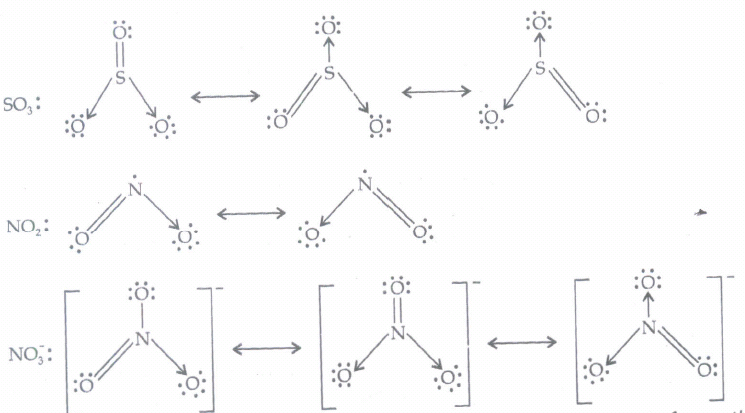
Write the resonance structures for SO3, NO2 and NO-3
7.
Write suitable chemical equations to show their nature.
8.
Diamond is covalent, yet it has high melting point, why?
9.
In India, there is the shortage of drinking water. Thus, projects like rainwater harvesting are used by Green Park Association to increase the amount of underground water. Rainwater is the almost pure form of water after the heavy shower as it is, in fact, the distilled water. The first shower contains dissolved gases from the atmosphere. Being a good solvent, when it flows on the surface of the earth, it dissolves many salts in the form of hydrogen carbonate, chloride and sulphate in water which make it hard Write the disadvantage of hard water?
10.
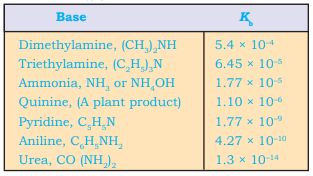
What is the pH of 0.001M aniline solution? The ionization constant of aniline can be taken from Table . Calculate the degree of ionization of aniline in the solution. Also calculate the ionization constant of the conjugate acid of aniline.
11.
A mixture of 1.57 mol of N2, 1.92 mol of H2 and 8.13 mol of NH3 is introduced into a 20 L reaction vessel at 500 K. At this temperature, the equilibrium constant, Kc for the reaction, \({ N }_{ 2 }\left( g \right) +3{ H }_{ 2 }\left( g \right) \rightleftharpoons 2{ NH }_{ 3 }\left( g \right) \) is \(1.7\times { 10 }^{ 2 }\) . Is the reaction mixture at equilibrium? If not, what is the direction of the net reaction?
12.
Mr.sharma, who was a teacher,explained the second law of thermodynamics by giving example of car in which heat energy produced by the combusion of a fuel is not completely converted into mechanical work.He also explained the working of refrigerator on the basis of this law.
(i) State the second law of thermodynamics
(ii) why the energy produced by the combustion of a fuel in the car engine is not completely converted into mechanical work?
(iii) could you explain the working of refrigerator on the basis of second law of thermodynamics?
(iv) What values are associated with Mr.Sharma?
13.
An athlete is given 100g of glucose of energy equivalent to 1560 kJ. He utilises 50% of this gained energy in the event.In order to avoid storage of energy in the body, calculate the weight of water that would need to perspire.The enthalpy of vaporisation of water is 44 kJ mol-1.
14.
Nitrogen molecule(N2 )has radius of about 0.2 nm. Assuming that nitrogen molecule is spherical in shape, calculate the percentage of empty space in one mole of N2 gas at STP.
15.
A density of a gas is found to be 6.46 g dm-3 at 25o C and 5 bar pressure. What will be its density at STP?
16.
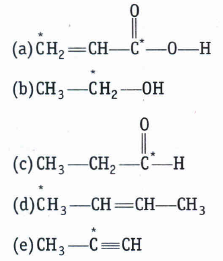
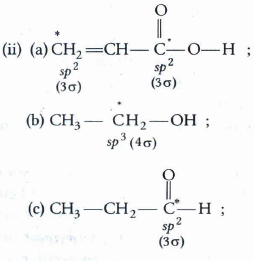
What is the type of hybridisation of carbon atoms marked with star?
17.
The amount of energy released when one million of atoms of iodine in vapour state are converted to I- ions is \(4.9\times { 10 }^{ -13 }J \) according to the reaction:
\(I(g)+{ e }^{ - }\rightarrow { I }^{ - }(9g)\)
Express the electron gain enthalpy of iodine in terms of KJmol-1 and eV per atom.
18.
If the position of the electron is measured within an accuracy of + 0.002 nm, calculate the uncertainty in the momentum of the electron. Suppose the momentum of the electron is h/4πm × 0.05 nm, is there any problem in defining this value.
19.
The density of the water at room temperature is 0.1 g / mL. How many molecules are there in a drop of water if its volume is 0.05 mL?
20.
When is a cation highly polarising? Which alkali metal cation has the highest polarising power?
21.
Identify the compounds A, X and Z in the following reactions,
\(A+2HCI+5{ H }_{ 2 }O\rightarrow 2NaCl+X\)
\(X \ \xrightarrow [ \Delta ]{ 370K } HBO_{ 2 }\xrightarrow [ \Delta ]{ >370K } Z\)
22.
Nitric oxide reacts with Br2 and gives nitrosyl bromide as per reaction given below:
\(2NO\left( g \right) +Br\left( g \right) \leftrightharpoons 2NOBr\left( g \right) \)
When 0.087 mol of NO and 0.0437 mol of Br2 are mixed in a closed container at constant temperature, 0.0518 mol of NOBr is obtained at equilibrium. Calculate equilibrium amount of NO and Br2 .
23.
1 mole of an ideal gas undergoes reversible isothermal expansion from an initial volume of \({ V }_{ 1 }\) to a final volume of \(10{ V }_{ 1 }\) and does 10kJ of work. The initial pressure was \(1\times 10^{ 7 }Pa.\)
(i) Calculate \({ V }_{ 1 }\)
(ii) If there were 2 moles of gas, what must its temperature have been?
24.
A discharge tube of 2 L capacity containing hydrogen gas was evacuated till the pressure inside is 1 x 10⁻⁵ Pa pressure. If the tube is maintained at a temperature of 27oC, calculate the number of hydrogen molecules still present in the tube.
25.
How would you justify the presence of 18 elements in the 5th period of the Periodic Table?
26.
Which of the following are isoelectronic species i.e., those having the same number of electrons?
Na+,K+,Mg2+,Ca2+,S2-,Ar
27.
Write the structure of the alkene which on reductive ozonolysis gives butanone and ethanol.
28.
Determine the empirical formula of an oxide of iron, which has 69.9% iron and 30.1% dioxygen by mass.
29.
Which of the following compounds will show cis-trans isomerism?
CH2= CBr2
30.
For testing halogens in an organic compound with AgNO3 solution sodium extract (Lassaigne's test) is acidified with dilute HNO3. What will happen if a student acidifies the extract with dilute H2SO4 in place of diluate HNO3?
31.
Calculate the pH of a solution formed by mixing equal volumes of two solutions A and B of a respectively.
32.
Calculate the enthaly of formation of methane from the following data.
C(s)+O2(g)\(\rightarrow \)CO2(g);\(\Delta \)rHo = -393.5 KJ
2H2(g)+O2(g)\(\rightarrow \)2H2O(l;)\(\Delta \)rHo = -571.8KJ
CH4(g)+2O2(g)\(\rightarrow \)CO2(g) + 2H2O(l);
\(\Delta \)rHo = -890.3 KJ
33.
Compressibility factor, Z of a gas is given as \(Z=\frac { pV }{ nRT } \) What is the value of Z an ideal gas?
34.
A catalyst will increase the rate of a chemical reaction by ______.
shifting the equilibrium to the right
shifting the equilibrium to the left
lowering the activation energy
increasing the activation energy
35.
The process depicted by the equation.
H2O (s) \(\rightarrow\) H2O (l)
\(\Delta\)H = +1.43 kcal represents
fusion
melting
evaporation
boiling
36.
Which of the following is correct regarding the stability of carbocation?
3°>2°>1°
1°<2°<3°
2°>1°>3°
2°>3°>1°
37.
The reaction

carbocation formation
free-radical mechanism
carbanion formation
none of these
38.
de Broglie equation is _______.
\(\lambda =\frac { h }{ mv } \)
\(\lambda =\frac { hv }{ m } \)
\(\lambda =\frac { mv }{ h } \)
\(\lambda =hmv\)
39.
When heated to 800oC, NaNO3 gives
Na+N2+O2
NaNO2+O2
Na2O+O2+N2
NaN3+O2
40.
Which of the following is the correct mathematical relation for Charles law at constant pressure?
V\(\alpha\)T
V\(\alpha\)t
V\(\alpha\)\(\frac{1}{2}\)
all of above
41.
Which of the following molecules have zero dipole moment?
CS2
CO2
CCl2
CH2Cl2
42.
In the ethylene molecule the two carbon atoms have the oxidation numbers.
-1, -1
-2, -2
-1, -2
+2,-2
43.
The pollutant released in Bhopal gas tragedy was
Ammonia
Mustard gas
Nitrous oxide
Methyl isocyanate
44.
The axial overlap between the two orbitals leads to the formation of a: ______.
sigma bond
pi bond
multiple bond
none of these
45.
On treatment of hard water with zeolite, sodium ions get exchanged with
Ca2+ ions
Mg2+ ions
H+ ions
OH-
46.
The highest ionization energy is exhibited by _____.
halogens
alkaline earth metals
transition metals
noble gases
47.
One mole of CO2 contains _______.
6.02 x 10²³atoms of C
3 g of CO2
6.02 x 10²³atoms of O
18.1 x 10²³ molecules of CO2
1.
Wurtz synthesis: Higher alkanes are prepared by heating an alkyl halide (RX) with sodium metal in dry ether solution.
R - X + 2Na + XR \(\overset { ether }{ \longrightarrow } \) R - R + 2NaX
CH3Br + 2Na + BrCH3\(\longrightarrow \) CH3-CH3 + 2NaBr
Limitations: Use of two different alkyl halides in Wurtz reaction always leads to a mixture of alkanes. The separation of these alkanes is difficult because there is only a little difference in their boiling points. Thus only symmetrical alkanes can be prepared by this method.
2.
(a) When organic compound is fused with sodium metal and then extracted by water, it is called Lassaigne's extract. Yes.
(b) Blood red colour.
(c) Lassaigne's extract is prepared in distilled water since tap water contains Cl- ions. No, oxygen cannot be detected by Lassaigne's test.
3.
(a) It may be noted that for oxidation reactions, i.e., Eq. (i), the sign of the llectrode potential as given in Table B.l is reversed. To get the equation for the overall reaction, the number of electrons lost in Eq. (i) and gained in Eq. (ii) must be cancelled. To do so, Eq. (ii) is multiplied by 2 and added to Eq. (i). Further, it may be noted that whenever any half reaction equation is multiplied by any integer, its electrode potential is not multiplied by that integer. Thus
Overall reaction: 2Fe3+(aq) + 2I-(aq) \(\rightarrow\) 2Fe2+(aq) + 12(s);EO= + 0.23 V
Since the EMF for the above reaction is positive, therefore, the above reaction is feasible.
(b) The possible reaction between Ag+(aq) and Cu(s) is
Cu(s) + 2Ag+(aq) \(\rightarrow\) Cu2+(aq) + 2Ag(s)
The above redox reaction can be split into the following two half reactions. Writing electrode potential for each half reaction from Table , we have
Oxidation Cu(s) \(\rightarrow\) Cu2+(aq) + 2e-; Eo= -0.34 V
Reduction: Ag+(aq) + e- \(\rightarrow\) Ag(s)] x 2; Eo= + 0.80 V
(c) Overall reaction: Cu(s) + 2Ag+(aq) \(\rightarrow\) Cu2+(aq) + 2Ag(s); po = +0.46 V
Since the EMF of the above reaction comes out to be positive, therefore, the above reaction is feasible.
(c) Suppose the reaction between Fe3+(aq) and Cu(s) occurs according to the following equation.
Cu(s) + 2Fe3+(aq) \(\rightarrow\) 3Cu2+(aq) + 2Fe2+(aq)
The above reaction can be split into the following two half reactions. Writing electrode potential for each half reaction from Table , we have,
Oxidation: Cu(s) \(\rightarrow\) Cu2+(aq) + 2e-; Eo = -0.34 V
Reduction: Fe3+(aq) + e- \(\rightarrow\) Fe2+(aq)] x 2; Eo= +0.77 V
(d) Overall reaction: Cu(s) + 2Fe3+(aq) \(\rightarrow\) Cu2+(aq) + 2Fe2+(aq); Eo = +0.43 V
Since the EMF of the reaction is positive, therefore, the above reaction is feasible. Alternatively, if the reaction between Fe3+(aq) and Cu(s) occurs according to the following equation.
3Cu(s) + 2Fe3+(aq) \(\rightarrow\) 3Cu2+(aq) + 2Fe(s)
The EMF of the reaction comes out to be - Ie, i.e., -0.376 V (-0.34 V - 0.036 V) and hence this reaction is not feasible.
(d) Suppose the reaction between Ag(s) and Fe3+ (aq) occurs according to the following equation:
Ag(s) + Fe3 + (aq) \(\rightarrow\) Ag + (aq) + Fe2+(aq)
The above reaction can be split into the following two half reactions. Writing electrode potential for each half reaction from Table , we have,
Oxidation: Ag(s) \(\rightarrow\) Ag+(aq) + e-; Eo = -0.80 V
Reduction: Fe + (aq) + e- \(\rightarrow\) Fe2+(aq); Eo = +0.77 V
(e) Overall reaction: Ag(s) + Fe3+(aq) \(\rightarrow\) Ag+(aq) + Fe2+(aq); Eo= -0.03 V
Since the EMF of the reaction is negative, therefore, the above reaction is not feasible.
Alternatively, the reaction between Ag(s) and Fe3+(aq) may occur according to the following equation
3Ag(s) + Fe3+(aq) \(\rightarrow\) 3Ag+(aq) + Fe(s)
On similar lines, we can calculate the e.m.f. of this reaction comes to be even more negative, i.e., -0.836 V, and hence this redox reaction is also not feasible.
(e) Suppose the reaction between Br2(aq) and Fe2+(aq) occurs according to the following equation:
Br2(aq) + 2Fe2+(aq) \(\rightarrow\) 2Br-(aq) + 2Fe3+(aq)
The above reaction can be split into the following two half reactions. Writing electrode potential for each half reaction from the Table 8.1, we have
Oxidation: Fe2+(aq) \(\rightarrow\) Fe3+(aq) + e-] x 2; Eo = -0.77 V
Reduction: Br2(aq) + 2e- \(\rightarrow\) 2Br-(aq); Eo = +1.09 V
4.
(a) Conc. H2SO4 cannot be used because it acts as an oxidizing agent also and gets reduced to SO2.
Zn + 2H2SO4 (Conc.) \(\rightarrow\) znSO4 + 2H2O + SO2
Pure Zn is not used because it is non-porous and reaction will be slow. The impurities in Zn help in constitute of electrochemical couple and speed up reaction.
(b) water is amphoteric in nature and it behaves both as an acid as well as base. With acids stronger than itself (e.g., H2S) it behaves as a base and with bases stronger than itself (e.g., NH3) it acts as an acid.
(i) As a base: H2O(1) + H2S(aq) \(\rightarrow\) H3O(aq) + HS-(aq)
(ii) As an acid: H2O(1) + NH3(aq) \(\rightarrow\) OH-{aq) + \(NH^+_4\)(aq)
(c) The decomposition of H2O2 occurs readily in the presence of rough surface (acting as catalyst). It is also decomposed by exposure of light. Therefore, wax-lined smooth surface and coloured bottles retard the decomposition of H2O2.
5.
CaCO3 (s)\(\overset { heat }{ \longrightarrow } \)Cao + CO2
NH3 + H2O \(\longrightarrow \)NH4+ + OH-
NaCl + NH4OH + CO2\(\longrightarrow \)NaHCO3 + NH4Cl
2NaHCO3 \(\overset { heat }{ \longrightarrow } \)Na2CO3 + CO2 + H2O
Na2CO3 + 10H2O\(\longrightarrow \)Na2CO3 + 10H2O
6.
7.
(a) Being acidic B2O3,Sio2 and CO2 react with alkalis to form salts
\(B_{ 2 }O_{ 3 }+2NaOH\rightarrow 2NaBO_{ 2 }+H_{ 2 }O\\ Boric\quad \quad \quad \quad \quad \quad sodium\quad metaborate\\ anhydride\)
\(SiO_{ 2 }+2NaOH\underrightarrow { D } Na_{ 2 }CO_{ 3 }+H_{ 2 }O\)
\(\\ Silica\quad \quad \quad \quad \quad \quad \quad \quad \quad Sodium\quad carbonate\\ CO_{ 2 }+2NaOH\rightarrow Na_{ 2 }CO_{ 3 }+H_{ 2 }O\\ Carbon\quad dioxide\quad \quad \quad sodium\quad carbonate\quad \quad \quad \quad \)
(b) Being amphotric, Al2O3 and PbO2 react with both acids and bases.
\(Al_{ 2 }O_{ 3 }+3H_{ 2 }SO_{ 4 }\rightarrow Al_{ 2 }(SO)_{ 4 }+3H_{ 2 }O\)
\( Al_{ 2 }O_{ 3 }+2NaOH\overset { fuse }{ \rightarrow } \ 2NaAlO_{ 2 }+H_{ 2 }O\)
\(\\ Alumina\quad \quad \quad \quad \quad \quad \quad sodium\quad metaaluminate\\ 2PbO_{ 2 }+2H_{ 2 }SO_{ 4 }\rightarrow 2PbSO_{ 4 }+2H_{ 2 }O+O_{ 2 }\)
\(\\ PbO_{ 2 }+2NaOH\rightarrow Na_{ 2 }PbO_{ 3 }+H_{ 2 }O\\ Lead \ dioxide\quad \quad Sodium \ plumbate\)
(c) Being basic,Tl2O3 reacts with acid
\(Tl_{ 2 }O_{ 3 }+6HCl\rightarrow 2TICl_{ 3 }+3H_{ 2 }O\)
8.
Diamond has a three-dimensional network with strong C---C bonds, which are very difficult to break and thus, diamond has high melting point.
9.
It is unsuitable for laundry as it does not form enough lather with soap
It is harmful to boilers due to deposits of salts in the form of scale which reduces the efficiency of the boilers.
10.
\({ C }_{ 6 }{ H }_{ 5 }{ NH }_{ 2 }+{ H }_{ 2 }O\rightleftharpoons { C }_{ 6 }{ H }_{ 5 }{ NH }_{ 3 }^{ + }+{ OH }^{ - }\)
\({ K }_{ b }=\frac { \left[ { C }_{ 6 }{ H }_{ 5 }{ NH }_{ 3 }^{ + } \right] \left[ { OH }^{ - } \right] }{ \left[ { C }_{ 6 }{ H }_{ 5 }{ NH }_{ 2 } \right] } =\frac { \left[ { OH }^{ - } \right] ^{ 2 } }{ \left[ { C }_{ 6 }{ H }_{ 5 }{ NH }_{ 2 } \right] } \)
\(\left[ { OH }^{ - } \right] =\sqrt { { K }_{ a }.C } =\sqrt { 4.27\times { 10 }^{ -10 }\times 0.001 }\)
\( \left[ { OH }^{ - } \right] =6.534\times { 10 }^{ -7 }\)
\(pOH=-log\left[ { 0H }^{ - } \right] =-log\left[ 6.534\times { 10 }^{ -7 } \right]\)
\( pOH=-0.8152+7=6.18\)
\(From,\ pH+pOH=14\)
\( pH=14-6.18=7.82\)
\({ C }_{ 6 }{ H }_{ 5 }{ NH }_{ 2 }+{ H }_{ 2 }O\rightleftharpoons { C }_{ 6 }{ H }_{ 5 }{ NH }_{ 3 }^{ + }+{ OH }^{ - }\)
\(Initial \ conc.\ C \ \ \quad 0\quad 0\)
\( Equili \ conc.C-C\alpha \quad C\alpha \quad C\alpha\)
\( { K }_{ b }=\frac { C\alpha .C\alpha }{ C(1+\alpha ) } \ [(1-\alpha )\approx 1 \ for \ weak \ base]\)
\( { K }_{ b }=C{ \alpha }^{ 2 }\)
\( or \ \alpha =\sqrt { \frac { { K }_{ b } }{ C } } \)
Degree of ionisation,
\(\alpha =\sqrt { \frac { 4.27\times { 10 }^{ -10 } }{ 0.001 } } =6.53\times { 10 }^{ -4 }\)
\( { K }_{ a } \ of \ conjugate \ acid \ of \ aniline,\)
\( { K }_{ a }=\frac { { K }_{ w } }{ { K }_{ b } } =\frac { { 10 }^{ -14 } }{ 4.27\times { 10 }^{ -10 } } =2.34\times { 10 }^{ -5 }\)
11.
\({ N }_{ 2 }\left( g \right) +3{ H }_{ 2 }\left( g \right) \rightleftharpoons 2{ NH }_{ 3 }\left( g \right) \)
\({ Q }_{ c }=\frac { { { \left[ { NH }_{ 3 } \right] }^{ 2 } } }{ { \left[ { N }_{ 2 } \right] \left[ { H }_{ 2 } \right] }^{ 3 } } \)
Given, \(\left[ { NH }_{ 3 } \right] =\frac { 8.13 }{ 20 } M=0.4065M\)
\(\left[ { N }_{ 2 } \right] =\frac { 1.57 }{ 20 } M=0.0785M\)
\(\left[ { H }_{ 2 } \right] =\frac { 1.92 }{ 20 } M=0.096M\)
\({ Q }_{ c }=\frac { { { \left[ 0.4065M \right] }^{ 2 } } }{ { \left[ 0.0785M \right] \left[ 0.096M \right] }^{ 3 } } =2.379\times { 10 }^{ 3 }{ M }^{ -2 }\)
\({ Q }_{ c }\neq { K }_{ c }\) so the reaction mixture is not in equilibrium.
\({ Q }_{ c }>{ K }_{ c }\) it indicates that the reaction will proceed in the direction of reactants i.e. the reverse direction.
12.
(i) The second law of thermodynamics states that complete conversion of energy of one kind into another is not possible as some energy is always lost in the form of some other energy.
(ii) Because some energy may be used up in overcoming friction of wheels.
(iii) In refrigerator, heat flows from higher temperature to lower temperature in a compressor with mechanical work which is done by the compressor on the system.
The system consists of four components: compressor, condenser, expansion, value and evaporator. the following cycle is repeated over and again.
Refrigerant \(\overset { compressed }{ \underset { in \ compressor }{ \longrightarrow } } \) Gas form \(\overset { condensed }{ \underset { in \ condenser }{ \longrightarrow } } \)
Liquid form \(\overset { Allowed }{ \underset { to \ throttle \ through \ expansion \ valve }{ \longrightarrow } } \)
Gas form \(\overset { Allowed }{ \underset { to \ evaporate \ in \ evaporator }{ \longrightarrow } } \)Refrigerant.
(iv) Mr.sharma is scientific and practical
13.
100g of glucose is equivalent to 1560 kJ of energy
Energy utilised in the event = \(\frac { 1560\times 50 }{ 100 } \) = 780
Energy left unutilised = 1560 - 780 = 780 kJ
Enthalpy of vaporisation of water = 44kJ/mol = \(\frac { 44 }{ 18 } \)kJ/g
Water needed to perspire =\(\frac { 44 }{ 18 } \) x 780 = 1906.66g
14.
To calculate the empty space, let us first find the total volume of 1 mole\((6.02\times { 10 }^{ 23 })\) molecules) of N2
Volume \(6.02\times { 10 }^{ 23 }\) of molecules
\({ N }_{ 2 }=3.35\times { 10 }^{ -23 }\times 6.02\times { 10 }^{ 23 }=20.17{ cm }^{ 3 }\)
Now, volume occupied by 1 mole of gas at STP
= 22.4 litre = 22400 cm3
Empty volume = Total volume of gas-volume occupied by molecules
\(=(22400-20.17){ cm }^{ 3 }=22379.83{ cm }^{ 3 }\)
Percentage empty space
=\(\frac { empty \ space }{ total \ volume } \times 100\)
\(=\frac { 22379.83 }{ 22400 } \times 100=99.9%\)
Thus, 99.9% of space of 1 mole N2 at STP is empty.
15.
From ideal gas equation we have,
\(pV=nRT \ or \ p=\frac { m }{ v } \times \frac { RT }{ M } =\frac { dRT }{ M } \)
\( d \ =\frac { pM }{ RT } \)
\( or \ d\alpha \frac { p }{ T } \ [R \ and \ M \ constant \ for \ a \ given \ gas]\)
\( \frac { { d }_{ 1 } }{ { d }_{ 2 } } =\frac { { p }_{ 1 } }{ { p }_{ 2 } } \times \frac { { T }_{ 2 } }{ { T }_{ 1 } } or \ { d }_{ 2 }=\frac { { d }_{ 1 }\times { p }_{ 2 }\times { T }_{ 1 } }{ { p }_{ 1 }\times { T }_{ 2 } }\)
\( { d }_{ 1 }=6.46 \ g \ { dm }^{ -3 },\ { p }_{ 1 }=5bar,\)
\({ T }_{ 1 }=273+25=298k\)
\( { d }_{ 2 }=?,\ { p }_{ 2 }=1 \ bar,{ T }_{ 2 }=27k\)
\( { d }_{ 2 }=\frac { 6.46g{ dm }^{ -3 }\times 1 \ bar\times 298k }{ 5 \ bar\times 273k }\)
\( =1.41 \ g{ dm }^{ -3 }\)
16.
17.
The amount of energy released for the conversion of 1million, Le.1 x 106 atoms of iodine is 4.9 x 10⁻¹³ J According to the reaction,
\(\mathrm{I}(\mathrm{g})+e^{-} \longrightarrow \mathrm{I}^{-}(\mathrm{g})\)
The amount of energy released for the conversion of one mole (6.02 x 10²³) of atoms of iodine into 1 ions can be calculated. This corresponds to electron gain enthalpy. Thus, amount of energy released for1 x106 atoms of iodine
\(=4.9 \times 10^{-13} \mathrm{~J}\)
Amount of energy released for 6.02 x 10²³ atoms of iodine
\(=\frac{4.9 \times 10^{-13}}{1 \times 10^{6}} \times 6.02 \times 10^{23}=29.5 \times 10^{4} \mathrm{~J}\)
= 295kJ/mol
Now, leV/atom = 96.3k] mol-1
∴ EIectron gain enthaIpy = \(-295 \mathrm{~kJ} \mathrm{~mol}^{-1}=\frac{295}{96.3}=-3.06\) eV/atom
18.
Given \(\Delta x\) = 0.0002 nm = 2.00 x 10⁻¹² m
From Heisenberg;s uncertainty principle,
\(\Delta xX\Delta p\ge \frac { h }{ 4\pi } \)
\( \Delta p=\frac { h }{ 4\pi \Delta x } =\frac { 6.6\times10^{ -34 } \ Kg \ m^{ 2 }s^{ -1 } }{ 4\times3.14\times0.2.00\times10^{ -12 }m } \)
\( \Delta p=2.638\times10^{ -23 } \ kg \ ms^{ -1 }\)
Actual momentum = \(\frac { h }{ 4\pi \times0.05 \ nm } \)
=\(\frac { 6.6\times10^{ -34 } \ Kg \ m^{ 2 }s^{ -1 } }{ 4\times3.14\times0.2.00\times10^{ -19 }m } \)
= 1.055 x 10⁻²⁴ kg ms-1
It cannot be defined as the actual value of momentum is smaller than uncertainty.
19.
Volume of a drop of water = 0.05 mL
Mass of a drop of water = volume \(\times\) density
= ( 0.05 mL ) \(\times\)(1.0g / mL)
= 0.05 g
Gram molecular mass of water ( H2O ) = 2\(\times\)1 + 16 = 18 g ;
18 g of water = 1 mol
\(\therefore\) 0.05 g of water = \(\frac{1 mol}{(18 g)}\)\(\times\) ( 0.05 g )
= 0.0028 mol
\(\because\) 1 mole of water conmtains molecules = 6.022 \(\times\)1023
0.0028 mole of water will contain molecules
= 6.022 \(\times\)1023\(\times\)0.0028 = 1.68 \(\times\)1021 molecules
20.
A cation is highly polarising if its charge/size ratio is very high. Li+ion has the highest polarising power.
21.
\(Na_{ 2 }B_{ 4 }{ O }_{ 7 }+2HCl+5{ H }_{ 2 }O \ \rightarrow \ 2NaCl+4H_{ 3 }BO_{ 3 }\)
Borax(A) Orthoboric acid(X)
\(H_{ 3 }BO_{ 3 } \ \underrightarrow { \Delta ,370K } \ HBO_{ 2 }+{ H }_{ 2 }O\)
(X) Metaboric acid
\(4 \ HBO_{ 2 }\xrightarrow [ \Delta ,>370K ]{ -H_{ 2 }O } [{ H }_{ 2 }B_{ 4 }{ O }_{ 7 }]\underrightarrow { Red \ heat } \ 2{ B }_{ 2 }{ O }_{ 3 }+H_{ 2 }O\)
Tetraboric acid Boron trioxide
22.
In order to solve such problems, following steps are involved.
Step I: Set up a balance sheet using symbols for the expected equilibrium amount of reactants and products.
\(2NO+Br_{ 2 } \longrightarrow 2NOBr\)
Initial moles : 0.087 0.0437 0 (as no reaction occur)
At equilibrium moles : (0.087-2x) (0.0437-x) 2x
[Remember! multiply the value of x with the stiochiome3tric coefficient of the molecules].
Step II: Compare with the given information
Given equilibrium moles of NOBr = 0.0518
\(\therefore \ 2x=0.0518 \ and \ x=\frac { 0.0518 }{ 2 } =0.0259\)
Step III: Put the value of x to obtained equilibrium concentration of other species.
Moles of NO at equilibrium = (0.087 - 2x)
= 0.087 - 0.0518 = 0.0352 mol
Moles of Br2 at equilibrium = (0.0437 - x)
= 0.0437 - 0.0259 = 0.0178 mol
23.
(i) We know that \(w=-2.303nRTlog\frac { { V }_{ 2 } }{ { V }_{ 1 } } \)
\(10\times 10^{ 3 }J=2.303\times 1\times 8.314\times T\times log\frac { 10{ V }_{ 1 } }{ { V }_{ 1 } } \)
\(or \ T=522.3K\)
\(For \ initial \ conditions,\ { p }_{ 1 }{ V }_{ 1 }={ n }_{ 1 }RT,\)
\( i.e \ (10^{ 7 }Pa){ V }_{ 1 }=1\times 8.314\times 522.3\)
\(or \ { V }_{ 1 }=4.342\times 10^{ -4 }m^{ 3 }=4.342\times 10^{ 2 }cm^{ 3 }\)
\( =434.2cm^{ 3 }\)
We cannot apply the formula \(-w=p\triangle V\) because expansion is not against constant pressure.)
(ii) If there were 2 moles of the gas, applying \({ p }_{ 1 }{ V }_{ 1 }={ n }_{ 1 }RT,\) we get \(({ 10 }^{ 7 }Pa)(4.342\times 10^{ -4 }m^{ 3 })=2\times 8.314\times T \ or \ T=261.1K,\) i.e. half of the first value.
24.
Number of H2 molecules = 4.879 x 10¹⁷
25.
When n = 5, l = 0, 1, 2, 3. The order in which the energy of the available orbitals 4d, 5s and 5p increases is 5s < 4d < 5p. The total number of orbitals available are 9. The maximum number of electrons that can be accommodated is 18; and therefore 18 elements are there in the 5th period.
26.
Isoelectronic species have the same number of electrons but different atomic numbers. Number of positive charge shows the number of electrons lost and number of negative charges shows the number of electrons gained by an atom. Calculation of number of electrons have been shown below.
\(_{ 11 }Na^{ + }=11-1=10{ e }^{ - }, \ _{ 19 }K^{ + }=19-1=18{ e }^{ - },\)
\(_{ 12 }Na^{ 2+ }=12-2=10{ e }^{ - }, \ _{ 20 }Na^{ 2+ }=20-2=18{ e }^{ - },\)
\(_{ 16 }S^{ 2- }=16+2=18{ e }^{ - }, \ _{ 18 }Ar=18{ e }^{ - }\)
Hence, isoelectronic species are
\(Na^{ + }and \ Mg^{ 2+ } \ { k }^{ + },{ Ca }^{ 2+ },{ s }^{ 2- } \ and \ Ar\)
27.
CH3CH2C(CH3) = CHCH3
28.
| Element | Symbol | % by mass | Atomic mass | Moles of the element (Relative no. of moles) | Simplest molar ratio | Simplest whole number molar ratio |
| Iron | Fe | 69.9 |
55.85 |
\(\frac { 69.9 }{ 55.85 } \)=1.85 | \(\frac { 1.25 }{ 1.25 } \)=1 | 2 |
| Oxygen | O | 30.1 | 16.00 | \(\frac { 30.1 }{ 16.00 } \)=1.88 | \(\frac { 1.88 }{ 1.25 } \)=1.5 | 3 |
29.
For exhibiting cis-trans (or geometrical isomerism, a molecule must fulfil the following condition.
The groups attached to each double bonded carbon atom must be different.
30.
On adding dilute H2 SO4 for testing halogens in an organic compound with AgNO3 white precipate of Ag2SO4 Mmay be mistaken for white precipate of chlorine as AgCI.Hence dilute HNO3 is used instead of dilute H2SO4.
31.
Since pH of solution A = 6.Hence, [H+] = 10-6 mol L-1
pH of solution B = 4.Hence ,[H+] = 10-4 mol L-1
On mixing 1L of each solution, molar concentration of total H+ is halved.
Total, [H+] = \(\frac { { 10 }^{ -6 }{ +10 }^{ -4 } }{ 2 } \) mol L-1
[H+] = 5.05 x 10⁻⁵ mol L-1
pH = log[H+]
pH = -log(5.0 x 10⁻⁵) = 4.2967 \(\approx \) 4.3
32.
-75 KJ
33.
For ideal gas,compressibility factor, Z = 1
34.
(c)
lowering the activation energy
35.
(a)
fusion
36.
(a)
3°>2°>1°
37.
(b)
free-radical mechanism
38.
(a)
\(\lambda =\frac { h }{ mv } \)
39.
(c)
Na2O+O2+N2
40.
(a)
V\(\alpha\)T
41.
(a)
CS2
42.
(b)
-2, -2
43.
(d)
Methyl isocyanate
44.
(a)
sigma bond
45.
(a)
Ca2+ ions
46.
(b)
alkaline earth metals
47.
(a)
6.02 x 10²³atoms of C

11th Standard CBSE Syllabus & Materials
11th Standard CBSE
CBSE 11th Business Studies Forms of Business Organisation Sample Question Papers Study Material - QB365 Set A
NEW11th Standard CBSE
CBSE 11th Business Studies Business, Trade and Commerce Sample Question Papers Study Material - QB365 Set A
NEW11th Standard CBSE
CBSE 11th Physics Waves Sample Question Papers Study Material - QB365 Set A
NEW11th Standard CBSE
CBSE 11th Physics Kinetic Theory Sample Question Papers Study Material - QB365 Set A



CBSE 11th Standard CBSE Subjects
CBSE Standards









