
 100% FREE ACCESS
11th Standard CBSE Syllabus & Materials
11th Standard CBSE
CBSE 11th Economics PART-A - Presentation of Data - New Sample Question Papers Study Material - QB365 Set A
NEW11th Standard CBSE
CBSE 11th Economics PART-A - Organisation of Data - New Sample Question Papers Study Material - QB365 Set A
NEW11th Standard CBSE
CBSE 11th Economics PART-A - Collection of Data - New Sample Question Papers Study Material - QB365 Set A
NEW11th Standard CBSE
CBSE 11th Economics PART-A - Introduction to Economics and Statistics - New Sample Question Papers Study Material - QB365 Set A
NEW11th Standard CBSE
CBSE 11th Business Studies International Trade Sample Question Papers Study Material - QB365 Set A
NEW11th Standard CBSE
CBSE 11th Business Studies Evolution and Fundamentals of Business Sample Question Papers Study Material - QB365 Set A

Published on: 04/03/2020
11th Standard CBSE Mathematics Public Exam Sample Question 2020
Download CBSE Class 11th Standard CBSE Mathematics question papers, sample papers, important questions, and previous year solved papers in PDF format. Get free study materials, NCERT solutions, and exam preparation resources for Class 11th Standard CBSE Mathematics
Questions + Answers key
Take MCQ Mathematics Test
1.
Find the value of a for which the co-efficient of the middle term in the expansions of (1 + ax)4 and (1 - ax)6 are equal.
2.
Find the derivative of the following functions:
5 sin x - 6 cos x + 7
3.
Find the principal and general solutions of the following equations.
sec x = 2
4.
Find the new transformed equation of the straight line 5x + 2y - 7 = 0 when the origin is shifted to (-4, -5).
5.
For what values of x, the numbers \(\frac { -2 }{ 7 } ,x,\frac { -7 }{ 2 } \) are in G.P.?
6.
Find the equation of the hyperbola satisfying the given conditions.
Vertices (0, ± 5), foci (0, ± 8)
7.
Prove the following : sin2 6x - sin2 4x = sin 2x sin10x
8.
Let A = {1, 3}, B = {2, 4} and C = {1, 5}. Find A x A x A
9.
Find the mean deviation about the median for the following data
| xi | 10 | 15 | 20 | 25 | 30 | 35 | 40 | 45 |
| fi | 7 | 3 | 8 | 5 | 6 | 8 | 4 | 9 |
10.
Using section formula, show that the points A(2, - 3, 4) B(-1, 2, 1) and C (0,\(\frac { 1 }{ 3 } \),2) are collinear.
11.
Show that the statement "For any real numbers a and b, a2 = b2 implies that a = b" is not true by giving a counter example.
12.
Solve the inequalities:\(\frac { x-1 }{ x+5 } >2\)
13.
Find a point on the x-axis, which is equidistant from the points (7, 6) and (3, 4).
14.
Is 3! + 4! = 7! ?
15.
An experiment involves tossing of two coins and recording them in the following events
A: No tail
B: exactly one tail
C: at least one tail.
Write the sets representing events
A not B
16.
A bag contains 9 red, 7 white and 4 black balls. A ball is drawn at random. Find the probability that the ball drawn is green.
17.
Find the mean deviation about the median of the following frequency distribution.
| Class | 0-6 | 6-12 | 12-18 | 18-24 | 24-30 |
| Frequency | 8 | 10 | 12 | 9 | 5 |
18.
Write negation
All triangle are squares.
19.
Evaluate the following limits \(\lim _{x \rightarrow 5} \frac{\log x-\log 5}{x-5}\)
20.
Prove that the points (5,3,2), (3,2,5) and (2,5,3) are the vertices of an equilateral triangle.
21.
Find the equation of the ellipse with vertices at \((0,\pm 10)\) and e = 4/5.
22.
Find the number of terms of the sequence 54,51,48,..., when there sum is 513.
23.
If the middle term of \(\left( \frac { 1 }{ x } +x\sin { x } \right) ^{ 10 }\) is equal to \(7\frac { 7 }{ 8 } ,\) then find the value of x.
24.
If \(^{n}{C}{_{10}} \) = \({n}{C}{_{12}}\) , then find the value of \(^{23}{C}{_{n}}\) .
25.
Solve the linear inequality 3x - 5 < x + 7, when x is an integer.
26.
Change the following complex numbers in cartesian form.
2(cos 00+isin 00)
27.
Prove that 2+4+6+8+.....2=n(n+1).
28.
Find the domain of the function f(x) given by f(x)=\(\log { _{ 4 } } \{ \log { _{ 5 } } \log { _{ 3 } } (18x-{ x }^{ 2 }-77))\} \)
29.
Which of the following sets are empty sets?
Set of all even prime numbers.
30.
Consider the following sets \(\phi\) , A = {2,5}, B = {1,2,3,4} and C = {1,2,3,4,5} Insert the correct symbol \(\subset\) or \(\nsubseteq\) between the pair set
A.......C
31.
Prove that : sin 3x+sin 2x-sin x= 4sinxcos\({x\over2}cos{3x\over2}\)
32.
A group consist of 3 men, 2 women and 4 children. If four persons are selected at random, find the probability of selecting exactly 2 children.
33.
Find the variance and standard deviation for the following distribution.
| xi | 4.5 | 14.5 | 24.5 | 34.5 | 44.5 | 54.5 | 64.5 |
| fi | 1 | 5 | 12 | 22 | 17 | 9 | 4 |
34.
\(\lim_ { x\rightarrow a }{ lim } \frac { cosx-cosa }{ \sqrt { x } -\sqrt { a } } \)
35.
Three points A(3, 2, 0), B(5, 3, 2) and C(-9, 6, -3) are forming a triangle . The bisector Ad of
36.
Find the equation of the ellipse passing through (6,4), foci is on Y-axis, centres at the origin having eccentricity 3/4.
37.
Reduce the equation 5x-12y=60 to intercept from.Hence find the length of the portion of the line intercepted between the axes.
38.
The sum of first three terms of a GP is \(\frac{13}{12} \) and their product is -1. Find the terms .
39.
Find the value of \(\alpha \) for which the coefficients of the middle terms in the expansions of \({ \left( 1+\alpha x \right) }^{ 4 }\)and \({ \left( 1-\alpha x \right) }^{ 6 }\)are equal.
40.
A box contains two white, three black and four red balls. In how many ways can three balls be drawn from the box, if atleast one black ball is to be included in the draw
41.
The length of rectangle is three times the breadth. If the minimum perimeter of the rectangle is 160cm, then find the shortest value for its breadth.
42.
If x + iy = \(\sqrt { \frac { 1+i }{ 1-i } } \), then prove that x2+y2 = 1.
43.
If \(x=-5+2\sqrt { -4 } \) , find the value of \({ x }^{ 4 }+9{ x }^{ 3 }+35{ x }^{ 2 }-x+4\)
44.
If in a \(\triangle \)ABC, \( \frac { 1 }{ a+b } +\frac { 1 }{ b+c } +\frac { 3 }{ a+b+c } \) prove that c = 60\(^{o}\)
45.
If f and g be two real function defined by \(f\left( x \right) =\sqrt { x+1 } \)and \(g\left( x \right) =\sqrt { 9-{ x }^{ 2 } } \).Then, describe each of the following functions. g-f
46.
Out of 600 car owners investigated, 500 owned Mahindra XUV and 200 owned TATA NANO,50 owned both cars. Is this data correct?
47.
Write down the negation
\(\triangle ABC\) is isosceles, if and only if \(\angle B=\angle C\)
48.
For all positive integer n, prove that \(\frac { { n }^{ 7 } }{ 7 } +\frac { { n }^{ 5 } }{ 5 } +\frac { 2 }{ 3 } { n }^{ 3 }-\frac { n }{ 105 }\) is an integer.
49.
Prove the rule of exponents (ab)n=an bn by using principle of mathematical induction fo every natural number.
50.
The coefficients of three consecutive terms in the expansion of (1 + x)n are in the ratio 1 : 6 : 30. Find n.
51.
Find the derivative of \(\frac { a+b\sin\ x }{ c+d \cos\ x } \) (it is to be understood that a, b, c, d, p, q, rand s are fixed non-zero constants and m and n are integers)
52.
Find the equation of the parabola whose vertex is at (2,1) and the directrix x = y = 1
53.
In how many ways can the letters of the word PERMUTATIONS be arranged if the
(i) words start with P and end with S
(ii) vowels are all together
(iii) there are always 4 letters between P and S?
54.
If the origin is the centroid of the triangle with vertices A (3a, 4, - 5), B (- 2, 4b, 6), C (6, 10,c). Find the value of a, b, c.
55.
if (b-c)2, (c-a)2,(a-b)2 are in A.P., Prove that \(\frac { 1 }{ b-c } ,\frac { 1 }{ c-a } ,\frac { 1 }{ a-b } \) are in A.P
56.
Find the square root of -5+12i.
57.
Find the equation of the line passing through the intersection of the lines 4x - 3y + 7 = 0 and 2x - 3y + 5 = 0 and which is inclined at an angle of 135o with the x-axis.
58.
From the data given below state which group is more variable, A or B?
| Marks | 10-20 | 20-30 | 30-40 | 40-50 | 50-60 | 60-70 | 70-80 |
| Group A | 9 | 17 | 32 | 33 | 40 | 10 | 9 |
| Group B | 10 | 20 | 30 | 25 | 43 | 15 | 7 |
59.
A die is thrown, find the probability of following events:
(i) A prime number will appear.
(ii) A number greater than or equal to 3 will appear.
(iii) A number less than or equal to one will appear.
(iv) A number more than 6 will appear.
(v) A number less than 6 will appear.
60.
Solve the inequalities graphically 3x+2y\(\le\)150, x+4y\(\le\)80, x\(\le\)15, y\(\ge\)0,x\(\ge\)0
61.
Let (x) = 2x + 5 and g(x) = x2 + x.
fg Find the domain
62.
Let A = {1, 2, {3, 4}, 5}. Which of the following statements are incorrect and why?
(i) {3, 4} ⊂ A
(ii) {3, 4} ∈ A
(iii) {{3, 4}} ⊂ A
(iv) 1 ∈ A
(v) 1⊂ A
(vi) {1, 2, 5} ⊂ A
(vii) {1, 2, 5} ∈ A
(viii) {1, 2, 3} ⊂ A
(ix) ¢ ∈ A
(x) ¢⊂ A
(xi) {¢} ⊂ A.
63.
Prove by the principle of mathematical induction that for all n∊N \(\frac { 1 }{ 1.2 } +\frac { 1 }{ 2.3 } +\frac { 1 }{ 3.4 } +...+\frac { 1 }{ n(n+1) } =\frac { n }{ (n+1) } \)
64.
Prove that the statement
"If x\(\in \)R such that x3+ 7x = 0 then x = 0" is true by
(i) direct method
(ii) method of contradiction
(iii) method of contrapositive.
65.
If the set A has m elements, B has n elements then the number of elements in A x B is ______.
m + n
m + n + 1
mn
n2
66.
If tan\(\theta\) + cot \(\theta\) = 5 then tan3 \(\theta\) + cot3 \(\theta\) is equal to ______.
135
140
110
90
67.
Let U be the universal set containing 700 elements. If A and B are sub-sets of U such that n(A) = 200, n(B) = 300 and n(A \(\cap\) B) = 100, then n(A' \(\cap\) B') =___.
400
500
300
800
68.
The sum of infinity of the G.P. a, ar, ar2, ar3, ...... \(\infty\) is ______.
\(\frac{a-1}{1-r}\)
\(\frac{a}{1-r}\)
\(\frac{2a}{1-r}\)
\(\frac{a}{1-r^2}\)
69.
\(\overset{lim}{x\rightarrow 0} \frac{x^{n}-a^{n}}{x-a}\) is equal to ______.
na
n
nan-1
none of these
70.
The latus rectum of the hyperbola \({ 16x }^{ 2 }-{ ay }^{ 2 }=144\quad is\) _______.
323
\(\frac { 15 }{ 4 } \)
\(\frac { 4 }{ 3 } \)
\(\frac { 3 }{ 4 } \)
71.
If in the expansion of (1 +x)n, the coefficients of fifth, sixth and seventh terms are inA.P. then n is equal to _____.
5,7
7,16
7,14
8,15
72.
If nCr+nCr+1=n+1Cx then x is equal to ______.
r-2
r-1
n+1
r+1
73.
In the three dimensional space the equation x2 - 7x + 12 = 0 represents ______.
pair of straight lines
curves
planes
none of these
74.
The angle between the lines 3x - 2y + 5 = 0 and 2x + 3y - 7 = 0 is ______.
45°
60°
30°
90°
75.
If the S. D. of a set of observation is 8 and if each observation is divided by- 2 then S.D. of new set of observation is ______.
-4
4
8
-8
76.
The probability that a leap year will have 53 Sundays is _______.
\(\frac { 3 }{ 7 } \)
\(\frac { 1 }{ 7 } \)
\(\frac { 4 }{ 7 } \)
\(\frac { 2 }{ 7 } \)
1.
\(a=\frac{-3}{10}\)
2.
Here f(x) = 5 sin x - 6 cos x + 7
∴ \(f^{'}(x)=\frac{d}{dx}[5 sinx-6cos +7]\)
=\(5 \frac{d}{dx}(sinx )-6\frac{d}{dx}(cosx)+\frac{d}{dx}(7)\)
= 5 cos x + 6 sin x + 0
= 5 cos x + 6 sin x.
3.
Here sec x = 2 \(\Rightarrow \ cos \ x={1\over 2},\) which is positive, so x lies in first or fourth quadrant.
\(cos \ x={1\over 2}=cos 60^o \ or \ cos (360^o-60^o)\)
= cos 600 or cos 3000
= cos\({\pi\over 3}\) or cos \({5\pi\over 3}.\)
Hence the principal solutions are \({\pi\over 3},{5\pi\over 3}.\)
Now cosx= cos\({\pi\over 3}\)
\(\Rightarrow x=2n\pi\pm{\pi\over3}where \ n\in Z\)
4.
Here h = -4 and k = -5
Let (x, y') be the new coordinates of any point (x, y) on the given straight line
\(\therefore\) x = x + h ~ x = x - 4 and y = y' - 5
Now, substituting the values in the given equation, we have 5 [x - 4] + 2 [y' - 5] - 7 = 0
\(\Rightarrow\) 5x' - 20 + 2y' - 10 - 7 = 0 \(\Rightarrow\) 5x' + 2y' - 37 = 0
Hence the transformed equation of the line is 5x + 2y - 37 = 0.
5.
We know that three numbers a, b, c are in G.P. if b2 = ac.
Now,\(\frac { -2 }{ 7 } ,x,\frac { -7 }{ 2 } \)are in G.P.
\(\therefore \) x2=\(\frac { -2 }{ 7 } ,\times ,\frac { -7 }{ 2 } \)
\(\Rightarrow \)x2 = 1 \(\Rightarrow \)n = \(\pm \)1
6.
The vertices are (0, ± 5) which lie on y-axis.
So the equation of the hyperbola in standard form is \(\frac { { y }^{ 2 } }{ { a }^{ 2 } } -\frac { { x }^{ 2 } }{ { b }^{ 2 } } \)=1
∴ the vertices (0, ± a) is (0, ± 5) ⇒ a = 5
foci (0, ± ae) is (0, ± 8) ⇒ ae = 8
Now ae=8 ⇒ e=\(\frac { 8 }{ a } \) ⇒ \(\frac { 8 }{ 5 } \)
We know that b =a\(\sqrt { { e }^{ 2 }-1 } \)
⇒ e=\(5\sqrt { \frac { 64 }{ 25 } -1 } =5\frac { \sqrt { 39 } }{ 5 } =\sqrt { 39 } \)
Thus required equation of hyperbola is
\(\frac { { y }^{ 2 } }{ (5)^{ 2 } } -\frac { { x }^{ 2 } }{ (\sqrt { 39 } )^{ 2 } } \)=1 ⇒ \(\frac { { y }^{ 2 } }{ 25 } -\frac { { x }^{ 2 } }{ 39 } \)=1
7.
We have
L.H.S. = sin2 6x - sin2 4x
= sin (6x + 4x) , sin (6x - 4x) [\(\because\) sin2 A - sin2 B = sin (A + B) sin (A - B)]
= sin 10x . sin 2x = R.H.S.
8.
{(1, 1, 1), (1, 3, 1), (3, 1, 1), (3, 3, 1), (1, 1, 3), (1, 3, 3), (3, 1, 3), (3, 3, 3)}
9.
10.1
10.
Let the points B (- 1, 2, 1) divides the join of A (2, -3, 4) and C (0, \(\frac { 1 }{ 3 } \),2) in the ratio k : 1 internally.
Then coordinates of B are
\(\left( \frac { 2 }{ k+1 } ,\frac { \frac { 1 }{ 3 } k-3 }{ k+1 } ,\frac { 2k+4 }{ k+1 } \right) \)
Now, \(\frac { 2 }{ k+1 } =-1\Rightarrow \) 2 = -k -1 \(\Rightarrow\) k=-3
Thus the point B divides the join of A and C in the ratio -3 : 1 So points A, B, C are collinear.
11.
The given statement can be written in the form of “if-then” as follows.
If a and b are real numbers such that a2 = b2, then a = b.
Let p: a and b are real numbers such that a2 = b2.
q: a = b
The given statement has to be proved false. For this purpose, it has to be proved that if p, then ∼q. To show this, two real numbers, a and b, with a2 = b2 are required such that a ≠ b.
Let a = 1 and b = –1
a2 = (1)2 = 1 and b2 = (– 1)2 = 1
∴ a2 = b2
However, a ≠ b
Thus, it can be concluded that the given statement is false.
12.
(-7,-3)
13.
Let P(x, 0) be any point on the x-axis which is equidistant from Q(7, 6) and R(3,4).
Then \(PQ=\sqrt{(x-7)^2+(0-6)^2}\)
\(=\sqrt{x^2-14x+49+36}\)
\(=\sqrt{x^2-14x+85}\)
\(PR = \sqrt{(x-3)^2+(0-4)^2}\)
\(=\sqrt{x^2-6x+9+16}\)
\(=\sqrt{x^2-6x+25}\)
Since PQ = PR,
\(\therefore \sqrt{x^2-14x+85} = \sqrt{x^2-6x+25}\)
Squaring both sides, we have
x2 - 14x + 85 = x2 - 6x + 25
\(\Rightarrow\) -14x + 6x = 25 - 85 \(\Rightarrow\) -8x = -60
\(\Rightarrow\) \(x=\frac{15}{2}\)
Thus coordinates of point on the x-axis is \((\frac{15}{2},0)\)
14.
Here
3! + 4! = 3 x 2 x 1 + 4 x 3 x 2 x 1
= 6 + 24 = 30
7! = 7 x 6 x 5 x 4 x 3 x 2 x 1
= 5040
∴ 3! + 4! ≠ 7!.
15.
A={(H,H)}, B={(H,T),(T,H)} and C={(H,T),(T,H),(T,T)}
A not B=A-B={(H,H)}
16.
Total number of balls = 9red + 7white + 4 black = 20
\(\Rightarrow \) Total number of possible outcomes, n(S) = 20
Let E3 be the event of getting a non-black ball.Then,
n(E3) = 9 + 7 = 16
Now, P (getting a non-black ball)
=p(E3) =\(\frac { n\left( E_{ 3 } \right) }{ n(S) } =\frac { 4 }{ 5 } \)
17.
Let us make the following table from the given data.
| Class | Mid-value (xi) |
Frequency (fi) |
Cumulative frequency (cf) |
\(\left| { { x }_{ i } }{ -{ 14 } } \right| \) | \({ { f }_{ i } }\left| { { x }_{ i } }{ -{ 14 } } \right| \) |
| 0-6 | 3 | 8 | 8 | 11 | 88 |
| 6-12 | 9 | 10 | 18 | 5 | 50 |
| 12-18 | 15 | 12 | 30 | 1 | 12 |
| 18-24 | 21 | 9 | 39 | 7 | 63 |
| 24-30 | 27 | 5 | 44 | 13 | 65 |
| Total | \(N=\Sigma { { f }_{ i }=44 }\) | \(\Sigma { { f }_{ i }\left| { { x }_{ i } }{ -{ 14 } } \right| }=278\) |
Here, N = 44, so \(\frac { N }{ 2 } \) = 22 and the cumulative frequency just greater than \(\frac { N }{ 2 } \) is 30. Therefore, 12 - 18 is the median class
Now, median =
Where, l = 12. f = 12, cf = 18 and h = 6
Median
Mean deviation about median
= \(\frac { 1 }{ N } \Sigma { { f }_{ i } }\left| { { x }_{ i } }{ -{ 14 } } \right| \)
= \(\frac { 278 }{ 44 } =6.318\)
18.
There exists a triangle which is not a square.
19.
Put x-5 = h and as \(x\rightarrow 5\) , then \(h\rightarrow 0\)
\(\therefore \quad \lim _{h \rightarrow 0} \frac{\log (h+5)-\log 5}{h}=\lim _{h \rightarrow 0} \frac{\log \left(1+\frac{k}{5}\right)}{\frac{4}{5} \times 5} \text { Ans. } \frac{1}{5}\)
20.
Show that AB=BC=CA
21.
\(Here,\quad (0,\pm a)=(a,\pm 10)\quad and\quad e=\frac { 4 }{ 5 } \)
\(\because { \quad e }^{ 2 }=1-\frac { { b }^{ 2 } }{ { a }^{ 2 } } \Rightarrow \frac { 16 }{ 25 } =1-\frac { { b }^{ 2 } }{ 100 } \Rightarrow \frac { { b }^{ 2 } }{ 100 } =\frac { 9 }{ 25 } \Rightarrow { b }^{ 2 }=36\)
\(\therefore \quad \frac { { x }^{ 2 } }{ 36 } +\frac { { y }^{ 2 } }{ 100 } =1\)
Ans. \(25{ x }^{ 2 }+9{ y }^{ 2 }=900\)
22.
Given series is 54,51,48,...,
Clearly, the successive difference of the terms is same. So, the above sequence forms an AP, with first term, a=54 and common difference, d=51-54=-3.
Let number of terms be n, then
Their sum \(({ S }_{ n })\) =513
\(\therefore \quad \frac { n }{ 2 } [2a+(n-1)d]-513\)
\( \Rightarrow \frac { n }{ 2 } [2\times 54+(n-1)(-3)]=513\)
\( \Rightarrow n(108-3n+3)=513\times 2\)
\(\Rightarrow { -3n }^{ 2 }+111n=1026\)
\(\Rightarrow ({ 3n }^{ 2 }-111n+1026)=0\)
\( \Rightarrow { n }^{ 2 }-37n+342=0\)
[dividing both sides by(-3)]
\(\Rightarrow (n-18)(n-19)=0\Rightarrow n=18\quad or\quad 19\)
Here, the common difference is negative.
\(\therefore 19th\quad term,\quad { T }_{ 19 }=54+(19-1)(-3)=0\)
So, the sum of 18 terms as well as that of 19 terms is 513.
23.
Here, n=10, which is an even number.
\(\therefore \) Middle term is given by \(\left( \frac { 10 }{ 2 } +1 \right) \)th term, i.e. 6th term.
Let \({ T }_{ r+1 }\) be the general term.
Then, \({ T }_{ r+1 }=^{ 10 }{ C }_{ r }\left( \frac { 1 }{ x } \right) ^{ 10-r }(x\sin { x } )^{ r }\)
\(=^{ 10 }{ C }_{ r }{ x }^{ r-10+r }sin^{ r }x=^{ 10 }{ C }_{ r }{ x }^{ 2r-10 }{ sin }^{ r }x\)
Now, \({ T }_{ 6 }={ T }_{ 5+1 }=^{ 10 }{ C }_{ 5 }x^{ 10-10 }sin^{ 5 }x=^{ 10 }{ C }_{ 5 }sin^{ 5 }x\)
\(\because \) Middle term=\(7\frac { 7 }{ 8 } \)
\(\therefore \) \(^{ 10 }{ C }_{ 5 }sin^{ 5 }x=\frac { 63 }{ 8 } \Rightarrow { sin }^{ 5 }x=\frac { 63 }{ 8\times 252 } =\frac { 1 }{ 8\times 4 } =\frac { 1 }{ 32 } \)
\(\Rightarrow sinx=\frac { 1 }{ 2 } \Rightarrow sinx=sin\frac { \pi }{ 6 }\)
\(\therefore x=n\pi +(-1)^{ n }\frac { \pi }{ 6 } \)
24.
We know that , \(^{n}{C}{_{x}}\) = \(^{n}{C}{_{y}}\)
\( \Longrightarrow\)x + y = n or x = y
Here x \(\neq\) y, so x + y= n
\( \Longrightarrow\)n=10+12= 22
Now, \(^{23}{C}{_{n}}\)= \(^{23}{C}{_{22}}\)= \(^{23}{C}{_{23-22}}\)= \(^{23}{C}{_{1}}\)=23
25.
We have,3x - 5 < x + 7
\(\Rightarrow \) 3x -5 + 5 < x + 7 + 5 [adding 5 on both sides]
\(\Rightarrow \) 3x < x + 12
\(\Rightarrow \) 3x -x < x + 12 - x [Subtracting x from both sides]
\(\Rightarrow \) 2x < 12
\(\Rightarrow \) \(\frac { 2x }{ 2 } \) < \(\frac { 12 }{ 2 } \)
\(\Rightarrow \) x < 6
Now if x is an integer, then the solution set is {...., -3, -2, -1, 0, 1, 2, 3, 4 ,5}
26.
Here, r = 2
\(\therefore \) x = 2cos 00,y = 2sin 00\(\Rightarrow \) x = 2,y = 0
Ans. 2+0i
27.
Consider P(k):2+4+6+8+.....+2k = k(k+1)
Now, P(k+1):2+4+6+.....2(k)+2(k+1)
=k(k+1)+2(k+1)=k2 + 3k+2
=(k+1)(k+1)
28.
Given
\(\log { _{ 4 } } \{ \log { _{ 5 } } \log { _{ 3 } } (18x-{ x }^{ 2 }-77))\} \)
\(\therefore \quad log_{ 5 }\{ log_{ 3 }(18x-{ x }^{ 2 }-77)\} >0\) and \(18x-{ x }^{ 2 }-77>0\)
\(\Rightarrow log_{ 3 }(18x-{ x }^{ 2 }-77)>50\) and \({ x }^{ 2 }-18x+77<0\)
\(\Rightarrow log_{ 3 }(18x-{ x }^{ 2 }-77)>1\)and \((x-11)(x-7)<0\)
\(\Rightarrow 18x-{ x }^{ 2 }-77>{ 3 }^{ 1 }\) and \(7
\(\Rightarrow 18x-{ x }^{ 2 }-80>0\) and \(7
\(\Rightarrow { x }^{ 2 }-18x+80<0\) and \(7
\(\Rightarrow (x-10)(x-8)<0\) and \(7
\(\Rightarrow 8
\(\therefore \quad x\in (8,10)\)
29.
We know that 2 is only even prime. Therefore, it is not an empty set.
30.
Each element of A belongs to C and A\(\neq\) C.
A \(\subset\) C
31.
We have
L.H.S. = sin 3x + sin 2x - sin x.
= (sin 3x - sin x) + sin 2x
\(=[2cos({3x+x\over2}) sin({3x+x\over2})]+2sin x cos x\)
\([\because \ sin C- sin D=2cos {C+D\over2}.sin{C-D\over2}]\)
= 2 cos 2x sin x + 2 sin x cos x
= 2 sin x [cos 2x + cos x]
= 2 sin x\([2cos({2cos ({2x+x\over2})}cos({2x+x\over2})]\)
\(=2sin x[2cos({3x\over2})cos({x\over2})]\)
= 4 sin x cos \({x\over2}\) cos \({3x\over2}\) =R.H.S
32.
Let E2 be the event of getting exactly 2 children.
Then n(E2) = \(^{ 4 }{ C }_{ 2 }\times ^{ 5 }{ C }_{ 2 }\)= 6 x 10
[remaining two persons will be selected from 3 men and 2 women]
Hence, required probability \(=\frac { 6\times 10 }{ 126 } =\frac { 10 }{ 21 } \)
33.
Let us make the table from the given data.
| xi | fi | di=xi-34.5 | \({ u }_{ i }=\frac { { x }_{ i }-34.5 }{ 10 } \) | \({ u }_{ i }^{ 2 }\) | fiui | fi\({ u }_{ i }^{ 2 }\) |
| 4.5 14.5 24.5 34.5 44.5 54.5 64.5 |
1 5 12 22 17 9 4 |
-30 -20 -10 0 10 20 30 |
-3 -2 -1 0 1 2 3 |
9 4 1 0 1 4 9 |
-3 -10 -12 0 17 18 12 |
9 20 12 0 17 36 36 |
| Total | \(\sum { { f }_{ i }=70 } \) | \(\sum { { u }_{ i }^{ 2 }=22 } \) | \(\sum { { { f }_{ i }u }_{ i }^{ 2 }=130 } \) |
Variance, \({ \sigma }^{ 2 }=[\frac { 1 }{ N } \sum { { f }_{ i }{ u }_{ i }^{ 2 } } -(\frac { 1 }{ N } \sum { { f }_{ i }{ u }_{ i } } )^{ 2 }]\times { h }^{ 2 }\)
\(=[\frac { 130 }{ 70 } -\left( \frac { 22 }{ 70 } \right) ^{ 2 }]\times 100=175.8\)
\(and\ standard\ deviation=\sqrt { Variance } \)
\(=\sqrt { 175.8 } =13.259\)
34.
\(Given\ limit=\lim_ { x\rightarrow a }{ lim } \frac { 2sin\left( \frac { x+a }{ 2 } \right) sin\left( \frac { a-x }{ 2 } \right) }{ (\sqrt { x } -\sqrt { a } )\times (\sqrt { x } +\sqrt { a } ) } \times (\sqrt { x } +\sqrt { a } )\)
\(=\lim_ { x\rightarrow a }{ lim } \frac { 2sin\left( \frac { x+a }{ 2 } \right) }{ 1 } \times \lim_ { x\rightarrow a }{ lim } \frac { sin\left( \frac { a-x }{ 2 } \right) }{ \frac { x-a }{ 2 } } \times \lim_ { x\rightarrow a }{ lim } \frac { 1 }{ 2 } (\sqrt { x } +\sqrt { a } )\)
\(-2\sqrt { a } sin \ a\)
35.
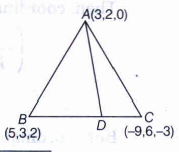
Since, AD is the bisector of \(\angle B A C\)
\(\Rightarrow \ \frac{B D}{D C}=\frac{A B}{A C}\)
\(\text { Now, } A B=\sqrt{(5-3)^{2}+(3-2)^{2}+(2-0)^{2}} \)
\([\because \text { distance } \left.=\sqrt{\left(x_{2}-x_{1}\right)^{2}+\left(y_{2}-y_{1}\right)^{2}+\left(z_{2}-z_{1}\right)^{2}}\right] \)
\(=\sqrt{2^{2}+1^{2}+2^{2}}=\sqrt{4+1+4}=\sqrt{9}=3 \text { units } \)
\(\text { and } A C =\sqrt{(-9-3)^{2}+(6-2)^{2}+(-3-0)^{2}}\)
\(=\sqrt{(-12)^{2}+(4)^{2}+(-3)^{2}} \)
\(=\sqrt{144+16+9}=\sqrt{169}=13 \text { units }\)
\(Then, from Eq. (i), \frac{B D}{D C}=\frac{3}{13}\)
\(\left[\frac{3(-9)+13(5)}{3+13}, \frac{3(6)+13(3)}{3+13}, \frac{3(-3)+13(2)}{3+13}\right]\)
\(=\left(\frac{-27+65}{16}, \frac{18+39}{16}, \frac{-9+26}{16}\right)=\left(\frac{38}{16}, \frac{57}{16}, \frac{17}{16}\right)=\left(\frac{19}{8}, \frac{57}{16}, \frac{17}{16}\right)\)
36.
16x2 + 7y2 = 688
37.
Here x-intercept, a = 12 and y-intercept, b=-5
Length of the proportion =\(\sqrt { a^{ 2 }+b^{ 2 } } \)
\(\frac { x }{ 12 } +\frac { y }{ -5 } =1;\) 13 units.
38.
Here, sum = \( \frac{a}{r}\) + a + ar = \(\frac{13}{2}\)
\(\Rightarrow\) a(1r+ r2)= \(\frac{13}{12}r \) .... (i)
Their product = \( \frac{a}{r}\).a ar = -1
\(\Rightarrow\) a3 = -1
\(\Rightarrow\) a = -1 [ taking cube root on both sides ]...(ii)
On putting the value of a in Eq.(i), we get
( -1 )[ 1 + r + r2 ] = \(\frac{13}{12}\)r
\(\Rightarrow \) 12r2 + 25r + 12 =0
r = -\( \frac{4}{3}\) \(\Rightarrow \) r = - {3}{4}
When a = -1 and r = -\(\frac{4}{3}\) , then the numbers are \( \frac{3}{4}\),-1, \(\frac{4}{3}\)
When a = -1 and r = -\(\frac{3}{4}\) , then the numbers are \(\frac{4}{3}\),-1, \(\frac{3}{4}\)
39.
Middle term in \({ \left( 1+\alpha x \right) }^{ 4 }\) = \(\left( \frac { 4 }{ 2 } +1 \right) \)th = 3rd term
\(\therefore \) Coefficient of middle term = 4C2 (\(\alpha \))2
Middle term in \({ \left( 1-\alpha x \right) }^{ 6 }\)= \(\left( \frac { 6 }{ 2 } +1 \right) \)th = 4th term
\(\therefore \) Coefficient of middle term = (-1)3 6C3 (\(\alpha \))3
Now, 4C2 (\(\alpha \))2 = - 6C3 (\(\alpha \))3
\(\Rightarrow 6{ \alpha }^{ 2 }+20\alpha ^{ 3 }=0\Rightarrow 2{ \alpha }^{ 2 }\left( 3+10\alpha \right) =0\)
\( \Rightarrow \alpha =0,\frac { -3 }{ 10 } \)
40.
Selection of three balls, consisting of atleast one black ball can be done in following ways
(i) Selecting 1 black ball and 2 non-black balls
(ii) Selecting 2 black ball and 1 non-black balls
(iii) Selecting 3 black ball and 0 non-black ball
required number od ways 3C1 X 6C2+3C2 X6C1 +3C3
Ans. 64
41.
Let length and breadth of a rectangle is x and y
\(\because \) x = 3y
\(\therefore \) 2(x + y)\(\ge \)160 \(\Rightarrow \) 2(3y + y)\(\ge \)160\(\Rightarrow \) y \(\ge \) 20
20 cm
42.
\(x+iy=\sqrt { \frac { 1+i }{ 1-i } } \Rightarrow x+iy=\sqrt { \frac { 1+i }{ 1-i } \times \frac { 1+i }{ 1+i } } \)
[by rationalising the denominator]
\(\Rightarrow x+iy=\sqrt { \frac { { (1+i) }^{ 2 } }{ 1-{ i }^{ 2 } } } \quad [\because ({ z }_{ 1 }-{ z }_{ 2 })({ z }_{ 1 }+{ z }_{ 2 })={ z }_{ 1 }^{ 2 }-{ z }_{ 2 }^{ 2 }]\)
\( \Rightarrow x+iy =\frac { 1+i }{ \sqrt { 1+1 } } =\frac { 1+i }{ \sqrt { 2 } } \quad [\because { i }^{ 2 }=-1]\)
\(=\frac { 1 }{ \sqrt { 2 } } +\frac { i }{ \sqrt { 2 } } \quad ......(i)\)
Now, taking conjugate on both sides, we get
\(\overset { \_ \_ \_ \_ \_ }{ \ x+iy } =\left( \frac { 1 }{ \sqrt { 2 } } +\frac { i }{ \sqrt { 2 } } \right) \Rightarrow x-iy=\frac { 1 }{ \sqrt { 2 } } -\frac { i }{ \sqrt { 2 } } \quad ....(ii)\)
On multiplying Eqs. (i) and (ii), we get
\((x+iy)(x-iy)=\left( \frac { 1 }{ \sqrt { 2 } } +\frac { i }{ \sqrt { 2 } } \right) \left( \frac { 1 }{ \sqrt { 2 } } -\frac { i }{ \sqrt { 2 } } \right) \)
\(\Rightarrow { x }^{ 2 }-{ (iy) }^{ 2 }={ \left( \frac { 1 }{ \sqrt { 2 } } \right) }^{ 2 }-{ \left( \frac { i }{ \sqrt { 2 } } \right) }^{ 2 }\)
\([\because ({ z }_{ 1 }+{ z }_{ 2 })({ z }_{ 1 }-{ z }_{ 2 })={ z }_{ 1 }^{ 2 }-{ z }_{ 2 }^{ 2 }]\)
\(\Rightarrow { x }^{ 2 }-{ i }^{ 2 }{ y }^{ 2 }=\frac { 1 }{ 2 } -\frac { { i }^{ 2 } }{ 2 } \Rightarrow { x }^{ 2 }+{ y }^{ 2 }=\frac { 1 }{ 2 } +\frac { 1 }{ 2 } =1[\because { i }^{ 2 }=-1]\)
43.
-160
44.
We have, \( \frac { 1 }{ a+b } +\frac { 1 }{ b+c } +\frac { 3 }{ a+b+c } \)
\(\Rightarrow \frac { b+c+a+c }{ (a+c)(b+c) } =\frac { 3 }{ a+b+c } \Rightarrow \frac { a+b+2c }{ (a+c)(b+c) } =\frac { 3 }{ a+b+c } \)
\( \Rightarrow (a+b+2c)(a+b+c)=3(a+c)(b+c)\)
\(\Rightarrow { a }^{ 2 }+b^{ 2 }-{ c }^{ 2 }=ab\)
\(\Rightarrow \frac { \quad { a }^{ 2 }+b^{ 2 }-{ c }^{ 2 } }{ 2ab } =\frac { ab }{ 2ab } \)
\(\Rightarrow cosC=\frac { 1 }{ 2 } =cos60°\quad \therefore \angle C=60°\)
45.
Domain \((f)\cap \) Domain \((g)=\left[ -1,3 \right] \)
\((g-f)(x)=\sqrt { 9-{ x }^{ 2 } } -\sqrt { x+1 } \)
46.
Let E and F denote the can owner owned XUV and TATA NANO, respectively.
Then, n(E)=500, n(F)=200,
n(E\(\cup \)F)=600, n(E\(\cap \)F)=50
Now, n(E\(\cup \)F)=500+200-50
\(\Rightarrow \) 600\(\neq \)650
Given data is incorrect.
47.
Either \(\triangle ABC\) is isosceles and \(\angle B\neq \angle C\) or \(\triangle ABC\) is not isosceles and \(\angle B=\angle C\)
48.
Consider \(P(k) : \frac { { k }^{ 7 } }{ 7 } +\frac { { k }^{ 5 } }{ 5 } +\frac { 2 }{ 3 } k^{ 3 }-\frac { k }{ 105 } \lambda \in I\)
Now,
P(k+1):\(\frac { ({ k+1) }^{ 7 } }{ 7 } +\frac { { (k }+1)^{ 5 } }{ 5 } +\frac { 2 }{ 3 } (k+1)^{ 3 }-\frac { k+1 }{ 105 } \)
\(=\frac { 1 }{ 7 } ({ k }^{ 7 }+{ 7k }^{ 6 }+{ 21k }^{ 5 }{ +35k }^{ 4 }{ +35k }^{ 3 }+{ 21k }^{ 2 }{ +7k }+1)+\frac { 1 }{ 5 } ({ k }^{ 5 }+{ 5k }^{ 4 }+{ 10k }^{ 3 }{ +10k }^{ 2 }{ +5k })+{ 1 }\)
\(+\frac { 2 }{ 3 } ({ k }^{ 3 }+{ 3k }^{ 2 }+{ 3k }+{ 1 })-\frac { k+1 }{ 105 } \)
=\(+\lambda +({ k }^{ 6 }+{ 3k }^{ 5 }+{ { 6k }^{ 4 }+{ 7k }^{ 3 } }+{ { 7k }^{ 2 }+4k })\)= Integer
49.
Let P(n) be the given statement,
i.e. P(n) : (ab)n=an b n
We note that P(n) is true For n=1, (ab)1 =ab=a1 b1
Let P(k) be true, i.e.,
Then, we have (ab)k =ak bk ..(i)
We shall now prove that P(k + 1) is true whenever P(k) is true.
Now, we have
(ab)k + 1 = (ab)k (ab)
=( ak bk ) (ab) [using Eq.(i)]
=(ak .a1) (bk.b1)=ak+1.bk+1
Thus, P(K+1) is also true, whenever P(k) is true. Hence, by principle of mathematical induction, P(n) is true for all \(n \in N\)
50.
Let rth, (r + 1)th and (r + 2)th be three consecutive terms in the expansion of (1 + x)n. Then their coefficients are nC r-1,n C r and nCr+1 respectively.
∴ nCr-1:nCr:nCr+1=1:6:30
Now \(\frac { ^{ n }{ C }_{ r-1 } }{ ^{ n }{ C }_{ r } } =\frac { 1 }{ 6 } \)
\(\Rightarrow \frac { r }{ n-r+1 } =\frac { 1 }{ 6 } \)
⇒ n -7r =-1 ....(i)
Also \(\frac { ^{ n }{ C }_{ r } }{ ^{ n }{ C }_{ r+1 } } =\frac { 6 }{ 30 } \)
\(\Rightarrow \frac { r+1 }{ n-r } =\frac { 1 }{ 5 } \)
n - 6r = 5 ...(ii)
Solving (i) and (ii), we have
n = 41 and r = 6.
51.
Here f(x)=\(\frac { a+b\quad sin\quad x }{ c+d\quad cos\quad x } \)
\(\therefore f'(x)=\frac { d }{ dx } \left[ \frac { a+b\quad sin\quad x }{ c+d\quad cos\quad x } \right] \)
= \(\frac { (c+dcosx)\frac { d }{ dx } (a+b\quad sinx)-(a+b\quad sinx)\frac { d }{ dx } (c+d\quad cosx) }{ c+d\quad cosx^{ 2 } } \)
\(=\frac { (a-b\quad sinx)(-d\quad sinx) }{ (c+d\quad cosx)^{ 2 } } \)
\(=\frac { bc\quad cosx+bd\quad cos^{ 2 }x+\quad ad\quad sinx+bd\quad sin^{ 2 }x }{ (c+d\quad cosx)^{ 2 } } \)
\(=\frac { bc\quad cosx+bd\quad sinx+\quad bd(cos^{ 2 }x+sin^{ 2 }x) }{ (c+d\quad cosx)^{ 2 } } \)
\(=\frac { bd(cos^{ 2 }x+sin^{ 2 }x) }{ (c+d\quad cosx)^{ 2 } } \)
\(=\frac { bc\quad cosx+ad\quad sinx+bd }{ (c+d\quad cosx)^{ 2 } } \)
52.
Since the axes of the parabola is a line perpendicular to the directrix and passing through the vertex (2,1).
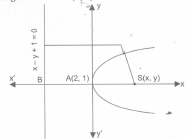
So the equation of lines is x+y+λ=0.
∴ 2+1+λ=0⇒λ=−3
∴ equation of directrix is x+y−3=0....(i)
equation of directrix is x−y+1=0....(ii)
Solving (i) and (ii),we have
x=1 and y=2
So the co−ordinate of B are(1,2)
Now A is mid point of BS
\( \therefore \frac { { x }_{ 1 }+1 }{ 2 } =2\quad and\frac { { y }_{ 1 }+2 }{ 2 } =1\)
\(\Rightarrow { x }_{ 1 }=3\quad and\quad { y }_{ 1 }=0\)
\(So\quad co-ordinates\quad of\quad focus\quad are\quad (3,0)\)
\(Now\quad PS=PM\Rightarrow { PS }^{ 2 }={ PM }^{ 2 }\)
\(\Rightarrow { \left( x-3 \right) }^{ 2 }+{ \left( y-0 \right) }^{ 2 }={ \left[ \frac { x-y+1 }{ \sqrt { { \left( 1 \right) }^{ 2 }+{ -1 }^{ 2 } } } \right] }^{ 2 }\)
\(\Rightarrow { x }^{ 2 }+9-6x+{ y }^{ 2 }\)
\(=\frac { { x }^{ 2 }+{ y }^{ 2 }+1-2xy+2x-2y }{ 2 }\)
\(\Rightarrow 2({ x }^{ 2 }+{ y }^{ 2 }-6x+9)={ x }^{ 2 }{ y }^{ 2 }+1-2xy+2x-2y\)
\(\Rightarrow { x }^{ 2 }+{ y }^{ 2 }-14x+2y+2xy+17=0.\)
53.
Total letters in the word PERMUTATIONS = 12.
Here T = 2.
(i) Now first letter is P and last letter is S, which are fixed.
So the remaining 10 letters are to be arranged between P and S
∴ Number of permutations = \(10!\over 2!\)
\(={10\times9\times8\times7\times6\times5\times4\times3\times2!\over 2!}\)
=1814400
(ii) There are 5 vowels in the word PERMUTATIONS. All vowels can be put together.
∴ Number of permutations of all vowels together = 5p5
\(={5!\over 0!}=5 \times 4 \times 3 \times 2 \times 1 = 120\)
Now consider the 5vowels together as one letter. Sothe number of letters in the word when all vowels are together = 8.
∴ Number of permutations \(={8!\over 2!}\)
\(={8\times7\times6\times5\times4\times3\times2!\over 2!}\)
=20160
Hence the total number of permutations
= 120 x 20160 = 2419200
(iii) Here P and S are on 1st and 6th places
P and S are on 2nd and 7th places
P and S are on 3rd and 8th places P and S are on 4th and 9th places
P and S are on 5th and 10th places P and S are on 6th and 11th places
P and S are on 7th and 12th places
Now we see that P and S can be put in 7 ways and also P and S can interchange their positions.
∴ Number of permutations = 2 x 7 = 14
Now the remaining 10 places can be filled with remaining 10 letters.
∴ Number of permutations = \(10!\over 2!\)
\(={10\times9\times8\times7\times6\times5\times4\times3\times2!\over 2!}\)
=1814400
Thus total number of permutations = 14 x 1814400= 25401600
54.
Here A (3a, 4, -5), B (-2, 4b, 6), and C (6, 10, c) be three vertices of \(\triangle \)ABC, then coordinates of centroid are
\(\left[ \frac { 3a-2+6 }{ 3 } ,\frac { 4+4b+10 }{ 3 } ,\frac { -5+6+c }{ 3 } \right] \)
But it is given that co-ordinates of centroid are (0, 0, 0).
\(\therefore \frac { 3a-2+6 }{ 3 } =0\Rightarrow 3a=-4.\Rightarrow a=-\frac { 4 }{ 3 } \\ \frac { 4+4b+10 }{ 3 } =0\Rightarrow 4b=-14\Rightarrow -\frac { 7 }{ 2 } \\ \frac { -5+6+c }{ 3 } =0\Rightarrow c=-1\)
55.
(b-c)2, (c-a)2,(a-b)2 are in A.P
\(\Rightarrow\) (c- a)2 - (b - c)2 = (a - b)2 - (c - a)2
\(\Rightarrow\) c2 + a2 - 2ac - b2 - c2 + 2bc = a2 + b2 - 2ab - c2 - a2 + 2ac
\(\Rightarrow\) a2 - b2 -2ab + 2bc = b2 - c2 - 2ab + 2ac
\(\Rightarrow\) (a+ b) (a -b) - 2c (a- b) = (b + c) (b -c) - 2a (b -c)
\(\Rightarrow\) (a - b)(a + b -2c) = (b -c) (b + c - 2a)
Now \(\frac { 1 }{ b-c } ,\frac { 1 }{ c-a } ,\frac { 1 }{ a-b } \) will be in A.P
if \(\frac { 1 }{ c-a } -\frac { 1 }{ b-c } =\frac { 1 }{ a-b } \frac { 1 }{ c-a } \)
if \(\frac { b-c-c+a }{ \left( c-a \right) \left( b-c \right) } \frac { c-a-a+b }{ \left( a-b \right) \left( c-a \right) } \)
if \(\frac { a+b-2c }{ \left( c-a \right) \left( b-c \right) } =\frac { b+c-2a }{ \left( a-b \right) \left( c-a \right) } \)
if (a - b)(a + b - 2c) = (b - c)(b + c - 2a) Which is true
56.
Let \(x+yi=\sqrt {-5+12i}\)
Squaring both sides, we get
x2 - y2 + 2xyi = -5 + 12i
Equating the real and imaginary parts
x2-y2=-5......(i)
2xy = 12 \(\Rightarrow\) xy = 6
Now from the identity, we have
(x2 + y2)2 = (x2 - y2)2 + 4x2y2
=(-5)2 + 4(6)2 = 25 + 144 = 169
\(\therefore\) x2 + y2 = 13....(ii) [Neglecting (-) sign as x2+y2>0]
Solving (i) and (ii) we get
x2 = 4 and y2 = 9
\(\therefore\) x = 土2 and y = 土3
Since the sign of xy is (+),
\(\therefore\) if x = 2,y = 3
and if x = -2,y = -3
\(\therefore\sqrt {-5+12i}=\pm(2+3i)\)
57.
The equation of the given lines are 4x - 3y + 7 = 0 and 2x - 3y + 5 = 0
Equation ofany line passing through the point of intersection of the given lines is in the form
(4x - 3y + 7) + k (2x - 3y + 5) = 0 ... (i)
\(\Rightarrow\) (4 + 2k) x + (-3 - 3k) y + 7 + 5k = 0
Slope of the line is \(\frac{-(4+2k)}{-3-3k}i.e.,(\frac{4+2k}{3+3k})\)
But the slope of the equation (i) is given by tan 135o i.e., -1
\(\therefore \frac{4+2k}{3+3k}=-1\)
\(\Rightarrow\) 4 + 2k = -3 - 3k
\(\Rightarrow\) 5k = -7
\(\therefore k=\frac{-7}{5}\)
Now putting the value of k in equation (i), we get
\((4x-3y+7)-\frac{7}{5}(2x-3y+5)=0\)
\(\Rightarrow\) 20x - 15y + 35 - 14x + 21y - 35 = 0
\(\Rightarrow\) 6x + 6y = 0
\(\Rightarrow\) x + y = 0.
58.
Group A
| Marks | Mid Values xi | fi | \(u=\frac { x-45 }{ 10 } \) | fu | fu2 |
| 10-20 | 15 | 9 | -3 | -27 | 81 |
| 20-30 | 25 | 17 | -2 | -34 | 68 |
| 30-40 | 35 | 32 | -1 | -32 | 32 |
| 40-50 | 45 | 33 | 0 | 0 | 0 |
| 50-60 | 55 | 40 | 1 | 40 | 40 |
| 60-70 | 65 | 10 | 2 | 20 | 40 |
| 70-80 | 75 | 9 | 3 | 27 | 81 |
| 150 | -6 | 342 |
\(Mean\left( \bar { { x }_{ 1 } } \right) =A+\frac { \sum { fu } }{ N } \times h=45-\frac { 6 }{ 150 } \times 10=45-0.4=44.6\)
Stanard deviation \(\left( { \sigma }_{ 1 } \right) =\frac { h }{ N } \sqrt { N\sum { { fu }^{ 2 }-{ \left( \sum { fu } \right) }^{ 2 } } } =\frac { 10 }{ 150 } \sqrt { 150\times 342-{ (-6) }^{ 2 } } \)
\(=\frac { 1 }{ 15 } \sqrt { 51300-36 } =\frac { 1 }{ 15 } \times 226.41=15.09\)
Group B
| Marks | Mid Values xi | fi | \(u=\frac { x-45 }{ 10 } \) | fu | fu2 |
| 10-20 | 15 | 10 | -3 | -30 | 90 |
| 20-30 | 25 | 20 | -2 | -40 | 80 |
| 30-40 | 35 | 30 | -1 | -30 | 30 |
| 40-50 | 45 | 25 | 0 | 0 | 0 |
| 50-60 | 55 | 43 | 1 | 43 | 43 |
| 60-70 | 65 | 15 | 2 | 30 | 60 |
| 70-80 | 75 | 7 | 3 | 21 | 63 |
| 150 | -6 | 366 |
Mean\(\left( \bar { { x }_{ 2 } } \right) =A+\frac { \sum { fu } }{ N } \times h=45-\frac { 6 }{ 150 } \times 10=45-0.4=44.6\)
Standard deviation \(\left( { \sigma }_{ 2 } \right) =\frac { h }{ N } \sqrt { N\sum { { fu }^{ 2 } } -{ \left( \sum { fu } \right) }^{ 2 } } =\frac { 10 }{ 150 } \sqrt { 150\times 366-{ (-6) }^{ 2 } } \)
\(=\frac { 1 }{ 15 } \sqrt { 54900-36 } =\frac { 1 }{ 15 } \times 234.23=15.61\)
Since \(\bar { { x }_{ 1 } } =\bar { { x }_{ 2 } } \) . So the group which have greater S.D. is more variable. Thus group B is more variable.
59.
Here the sample space S = {I, 2, 3,4,5,6}
\(\therefore \) n(S) = 6
(i) Let A be the event of getting a prime number
A = {2, 3, 5} \(\Rightarrow \) n(A) = 3
\(Thus\ P(A)=\frac { n(A) }{ n(S) } =\frac { 3 }{ 6 } =\frac { 1 }{ 2 } \)
(ii) Let B be the event of getting a number greater than or equal to 3
B = {3, 4, 5, 6} \(\Rightarrow \) n(B) = 4
\(Thus\ P(B)=\frac { n(B) }{ n(S) } =\frac { 4 }{ 6 } =\frac { 2 }{ 3 } \)
Let C be the event of getting a number less than or equal to 1
C = {I} \(\Rightarrow \) n(C) = 1
\(Thus\ P(C)=\frac { n(C) }{ n(S) } =\frac { 1 }{ 6 } \)
(iv) Let D be the event of getting a number more than 6
\(D=\phi \Rightarrow n(D)=0\)
\(Thus\ P(D)=\frac { n(D) }{ n(S) } \frac { 0 }{ 6 } =0\)
Let E be the event of getting a number less than 6
E = {I, 2, 3, 4, 5} \(\Rightarrow \) n(E) = 5
\(Thus\ P(E)=\frac { n(E) }{ n(S) } \frac { 5 }{ 6 } \)
60.
The given inequality is 3x + 2y \(\le\)150.
Draw the graph of the line 3x + 2y = 150.
Table of values satisfying the equation 3x + 2y = 150
| x | 30 | 40 |
| y | 30 | 15 |
Putting (0,0) in the given inequation, we have 3 x 0 + 2 x 0 \(\le\)150 \(\Rightarrow\) 0 \(\le\)150, which is true.
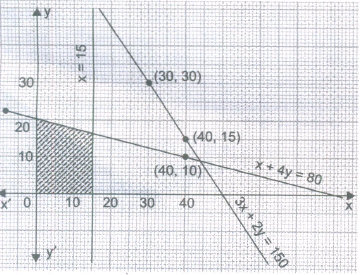
\(\therefore\) Half plane of 3x + 2y \(\le\)150 is towards origin.
Also the given inequality is x + 4y \(\le\) 80.
Draw the graph of the line x + 4y = 80.
Table of values satisfying the equation x + 4y = 80
| x | 0 | 40 |
| y | 20 | 10 |
Putting (0, 0) in the given inequation, we have o + 4 x 0 \(\le\) 80 \(\Rightarrow\) 0 \(\le\) 80, which is true.
\(\therefore\) Half plane of x + 4y \(\le\) 80 is towards origin.
The given inequality is x \(\le\)15.
Draw the graph of the line x = 15.
Putting (0, 0) in the given inequation, we have 0 \(\le\)15 which is true
\(\therefore\) Half plane of x \(\le\)15 is towards origin.
61.
2x3 + 7x2 + 5x, Domain = R
62.
(i) {3, 4} is a member of set A.
\(\therefore\) {3, 4} ∈ A
Hence {3, 4}⊂ A is incorrect.
(ii) {3, 4} is a member of set A.
\(\therefore\){3, 4} ∈ A is correct.
(iii) Here {3, 4} is a member of set A.
\(\therefore\) {{3,4}} is a set
\(\therefore\) {{3,4}} ⊂ A is correct.
(iv) 1 is a member of set A.
\(\therefore\) 1 ∈ A is correct.
(v) 1 is not a set, it is a member of set A.
\(\therefore\) 1⊂ A is incorrect.
(vi) 1, 2, 5 are members of set A.
\(\therefore\) {1, 2, 5} is a subset of set A.
\(\therefore\) {1, 2, 5} ⊂ A is correct.
(vii) 1, 2, 5 are members of set A.
\(\therefore\) {1, 2, 5} is a subset of set A.
\(\therefore\) {1, 2, 5} ∈ A is incorrect.
(viii) 3 is not a member of set A.
\(\therefore\) {1, 2, 3} is not a subset of set A.
\(\therefore\) {1, 2, 3} ⊂ A is incorrect.
(ix) ф is not a member of set A.
\(\therefore\) ф ∈ A is incorrect.
(x) Since ф is subset of every set,
\(\therefore\)ф ⊂ A is correct.
(xi)ф is not a member of set A.
\(\therefore\) {ф} ⊂ A is incorrect.
63.
Let \(\frac { 1 }{ 1.2 } +\frac { 1 }{ 2.3 } +\frac { 1 }{ 3.4 } +...+\frac { 1 }{ n(n+1) } =\frac { n }{ (n+1) } \)
For n =1
P(1) = \(\frac { 1 }{ 1(1+1) } =\frac { 1 }{ 1+1 } \Rightarrow \frac { 1 }{ 2 } =\frac { 1 }{ 2 } \)
∴ P(1) is true
Let P(n) be true for n = k
∴ P(k) = \(\frac { 1 }{ 1.2 } +\frac { 1 }{ 2.3 } +\frac { 1 }{ 3.4 } +...+\frac { 1 }{ k(k+1) } =\frac { k }{ (k+1) } \) ...(i)
For n = k+1
∴ P(k+1)= \(\frac { 1 }{ 1.2 } +\frac { 1 }{ 2.3 } +\frac { 1 }{ 3.4 } +...+\frac { 1 }{ k(k+1) } +\frac { 1 }{ (k+1)(k+2) } =\frac { k+1 }{ k+2 } \)
= \(\frac { k }{ k+1 } +\frac { 1 }{ (k+1)(k+2) } =\frac { k(k+2)+1 }{ (k+1)(k+2) } =\frac { { k }^{ 2 }+2k+1 }{ (k+1)(k+2) } \) [Using (i)]
= \(\frac { (k+1)^{ 2 } }{ (k+1)(k+2) } =\frac { k+1 }{ k+2 } \)= P(k+1) is true
Thus P(k) is true ⇒ P(k + 1) is true
Hence by principle of mathematical induction, P(n) is true for all n∊N.
64.
The given compound statement is of the form "if p then q".
p: x \(\in \)R such that x3+ 7x = 0
q: x= 0
(i) Direct method:
We assume that p is true, then
x\(\in \)R such that.x3 + 7x = 0
\(\Rightarrow \)X\(\in \)R such that x (x2+ 7) = 0
\(\Rightarrow \)X\(\in \)R such that x = 0 or x2+ 7 = 0
\(\Rightarrow \)x=o
p is true, q is true.
So when p is true, q is true.
Thus the given compound statement is true.
(ii) Method of contradiction:
We assume that p is true and q is false, then
x\(\in \)R such that x3+ 7x = 0
\(\Rightarrow \)X\(\in \)R such that x (x2 + 7) = o.
\(\Rightarrow \)X\(\in \)R such that x = 0 or x2+ 7 = 0
\(\Rightarrow \)x=o
which is a contradiction. Thus our assumption that X"#0 is false. Thus the given compound statement is true.
(iii) Method of contrapositive:
We assume that q is false then
x\(\neq \)0
\(\Rightarrow \)x\(\in \)R such that x3+ 7x\(\neq \)0
\(\Rightarrow \)p is false
So when q is false, p is false.
Thus the given compound statement is true.
65.
(c)
mn
66.
(c)
110
67.
(c)
300
68.
(b)
\(\frac{a}{1-r}\)
69.
(c)
nan-1
70.
(a)
323
71.
(b)
7,16
72.
(d)
r+1
73.
(c)
planes
74.
(d)
90°
75.
(b)
4
76.
(d)
\(\frac { 2 }{ 7 } \)

11th Standard CBSE Syllabus & Materials
11th Standard CBSE
CBSE 11th Business Studies Forms of Business Organisation Sample Question Papers Study Material - QB365 Set A
NEW11th Standard CBSE
CBSE 11th Business Studies Business, Trade and Commerce Sample Question Papers Study Material - QB365 Set A
NEW11th Standard CBSE
CBSE 11th Physics Waves Sample Question Papers Study Material - QB365 Set A
NEW11th Standard CBSE
CBSE 11th Physics Kinetic Theory Sample Question Papers Study Material - QB365 Set A



CBSE 11th Standard CBSE Subjects
CBSE Standards









