
 100% FREE ACCESS
11th Standard CBSE Syllabus & Materials
11th Standard CBSE
CBSE 11th Economics PART-A - Presentation of Data - New Sample Question Papers Study Material - QB365 Set A
NEW11th Standard CBSE
CBSE 11th Economics PART-A - Organisation of Data - New Sample Question Papers Study Material - QB365 Set A
NEW11th Standard CBSE
CBSE 11th Economics PART-A - Collection of Data - New Sample Question Papers Study Material - QB365 Set A
NEW11th Standard CBSE
CBSE 11th Economics PART-A - Introduction to Economics and Statistics - New Sample Question Papers Study Material - QB365 Set A
NEW11th Standard CBSE
CBSE 11th Business Studies International Trade Sample Question Papers Study Material - QB365 Set A
NEW11th Standard CBSE
CBSE 11th Business Studies Evolution and Fundamentals of Business Sample Question Papers Study Material - QB365 Set A

Published on: 30/09/2019
Sets
Download CBSE Class 11th Standard CBSE Mathematics question papers, sample papers, important questions, and previous year solved papers in PDF format. Get free study materials, NCERT solutions, and exam preparation resources for Class 11th Standard CBSE Mathematics
Questions + Answers key
Take MCQ Mathematics Test
1.
Two finite sets have m and n elements. The total number of subsets of the first set is 56 more than the total number of subsets of the second set. Find the values of m and n.
2.
If X={1,2,3} and n represents any member of X, write the following sets containing all numbers represented by n-1
3.
If X={1,2,3} and n represents any member of X, write the following sets containing all numbers represented by \(\frac { n }{ 2 } \)
4.
If X={1,2,3} and n represents any member of X, write the following sets containing all numbers represented by 4n
5.
If n(A)=4, n(B)=6, then what can be the minimum number of elements in A\(\cup \) B?
6.
In a survey of 25 students, it was found that 15 had taken mathematics, 12 had taken physics and 11 had taken chemistry. 5 had taken mathematics and chemistry, 9 had taken mathematics and physics, 4 had taken physics and chemistry and 3 had taken all the three subjects. Find the number of students who had
(i) only chemistry
(ii) only physics
(iii) only mathematics
(iv) physics and chemistry but not mathematics
(v) mathematics and physics but not chemistry
(vi) at least one of the three subjects.
(vii) only one of the subjects.
(viii) none of the subjects.
7.
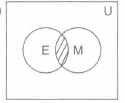
Draw the Venn diagrams to illustrate the following relationship among sets, E, M and U, where E is the set of students studying English in a school, M is the set of students studying Mathematics in the same school, U is the set of all students in that school.
Some of the students study Mathematics but do not study English, some study English but do not study Mathematics, and some study both.
8.
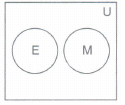
Draw the Venn diagrams to illustrate the following relationship among sets, E, M and U, where E is the set of students studying English in a school, M is the set of students studying Mathematics in the same school, U is the set of all students in that school.
There is no student who studies both Mathematics and English.
9.
Let A = {I, 3, 5, 7, 9}, B = {2, 4, 6, 8, 10}, C = {2, 3, 4, 5}, Find.
(i) A - (B \(\cup\) C)
(ii) A-(B \(\cap\) C)
(iii) A \(\cap\) (B-C)
(iv) B-(A-C)
10.
Find the intersection of each pair of sets of question 1above.
11.
Let A = {1, 2, {3, 4}, 5}. Which of the following statements are incorrect and why?
(i) {3, 4} ⊂ A
(ii) {3, 4} ∈ A
(iii) {{3, 4}} ⊂ A
(iv) 1 ∈ A
(v) 1⊂ A
(vi) {1, 2, 5} ⊂ A
(vii) {1, 2, 5} ∈ A
(viii) {1, 2, 3} ⊂ A
(ix) ¢ ∈ A
(x) ¢⊂ A
(xi) {¢} ⊂ A.
1.
2m=56+2n\(\Rightarrow \)2m-2n=56
Ans. m-6,n=3
2.
{0,1,2}
3.
{\(\frac { 1 }{ 2 } ,1,\frac { 3 }{ 2 } \)}
4.
{4,8,12}
5.
n(A\(\cup \)B)\(\ge \)n(B)=6
6.
Let M be the set of students who had taken mathematics, Pbe the set of students who had taken physics and C be the set of students who had taken chemistry.
Here n(U) = 25, n(M) = 15, n(P) = 12, n(C) = 11, n(M \(\cap\) C) = 5, n(M \(\cap\) P) = 9, n(P \(\cap\) C) = 4, n(M \(\cap\) P \(\cap\) C)= 3
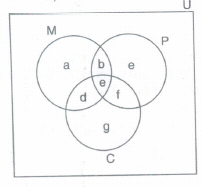
From the Venn diagram, we have
n(M) = a + b + d + e = 15
n(P) = b + c + e + f = 12
n(C) = d + e + f + g = 11
n(M \(\cap\) C) = d + e = 5
n(M \(\cap\) P) = b + e = 9
n(P \(\cap\) C) = e + f = 4
n(M \(\cap\) P \(\cap\) C) = e = 3
Now e = 3
d + e = 5 \(\Rightarrow\) d + 3 = 5 \(\Rightarrow\) d = 5 - 3 \(\Rightarrow\) d = 2
b + e = 9 \(\Rightarrow\) b + 3 = 9 \(\Rightarrow\) b = 9 - 3 \(\Rightarrow\) b = 6
e + f = 4 \(\Rightarrow\) 3 + f = 4 \(\Rightarrow\) f = 4 - 3 \(\Rightarrow\) f = 1
a + b + d + e = 15
\(\Rightarrow\) a + 6 + 2 + 3 = 15 \(\Rightarrow\) a = 15 - 11 = 4
b + c + e + f = 12
\(\Rightarrow\) 6 + c + 3 + 1 = 12 \(\Rightarrow\) c = 12 - 10 = 2
d + e + f + g = l1
\(\Rightarrow\) 2 + 3 + 1 + g = 11\(\Rightarrow\) g = 11 - 6 = 5
\(\therefore\) (i) g = 5
(ii) c = 2
(iii) a = 4
(iv) f = 1
(v) b = 6
(vi) a + b + c + d + e + f + g = 4 + 6 + 2 + 2 + 3 + 1 + 5 = 23
(vii) a + c + g = 4 + 2 + 5 = 11
(viii) 25 - (a + b + c + d + e + f + g) = 25 - 23 = 2
7.
8.
9.
(i) {1,7,9}
(ii) {1,3,5,7,9}
(iii) ф
(iv) {2,4,6,8,10}
10.
(i) Here X = {1, 3, 5}and Y = {1, 2, 3}
\(\therefore\) X \(\cap\)Y = {1, 3}
(ii) Here A = {a, e, i, o, u} and B = {a, b, c}
\(\therefore\) A \(\cap\) B= {a}
(iii) Here A = {x : x is a natural number and multiple of 3}
= {3, 6, 9, 12,...........} and
B = {x : x is a natural number less than 6}
= {1, 2, 3, 4, 5}
\(\therefore\) A \(\cap\) B = {3}
(iv) Here A = {x : x is a natural number and 1 < x \(\le\) 6}
= {2, 3, 4, 5, 6}
and B = {x : x is a natural number and 6 < x < 10}
= {7, 8, 9}
\(\therefore\) A \(\cap\) B=ф
(v) Here A = {1, 2, 3} and B =ф
\(\therefore\) A \(\cap\) B=ф
11.
(i) {3, 4} is a member of set A.
\(\therefore\) {3, 4} ∈ A
Hence {3, 4}⊂ A is incorrect.
(ii) {3, 4} is a member of set A.
\(\therefore\){3, 4} ∈ A is correct.
(iii) Here {3, 4} is a member of set A.
\(\therefore\) {{3,4}} is a set
\(\therefore\) {{3,4}} ⊂ A is correct.
(iv) 1 is a member of set A.
\(\therefore\) 1 ∈ A is correct.
(v) 1 is not a set, it is a member of set A.
\(\therefore\) 1⊂ A is incorrect.
(vi) 1, 2, 5 are members of set A.
\(\therefore\) {1, 2, 5} is a subset of set A.
\(\therefore\) {1, 2, 5} ⊂ A is correct.
(vii) 1, 2, 5 are members of set A.
\(\therefore\) {1, 2, 5} is a subset of set A.
\(\therefore\) {1, 2, 5} ∈ A is incorrect.
(viii) 3 is not a member of set A.
\(\therefore\) {1, 2, 3} is not a subset of set A.
\(\therefore\) {1, 2, 3} ⊂ A is incorrect.
(ix) ф is not a member of set A.
\(\therefore\) ф ∈ A is incorrect.
(x) Since ф is subset of every set,
\(\therefore\)ф ⊂ A is correct.
(xi)ф is not a member of set A.
\(\therefore\) {ф} ⊂ A is incorrect.

11th Standard CBSE Syllabus & Materials
11th Standard CBSE
CBSE 11th Business Studies Forms of Business Organisation Sample Question Papers Study Material - QB365 Set A
NEW11th Standard CBSE
CBSE 11th Business Studies Business, Trade and Commerce Sample Question Papers Study Material - QB365 Set A
NEW11th Standard CBSE
CBSE 11th Physics Waves Sample Question Papers Study Material - QB365 Set A
NEW11th Standard CBSE
CBSE 11th Physics Kinetic Theory Sample Question Papers Study Material - QB365 Set A



CBSE 11th Standard CBSE Subjects
CBSE Standards









