
 100% FREE ACCESS
11th Standard CBSE Syllabus & Materials
11th Standard CBSE
CBSE 11th Economics PART-A - Presentation of Data - New Sample Question Papers Study Material - QB365 Set A
NEW11th Standard CBSE
CBSE 11th Economics PART-A - Organisation of Data - New Sample Question Papers Study Material - QB365 Set A
NEW11th Standard CBSE
CBSE 11th Economics PART-A - Collection of Data - New Sample Question Papers Study Material - QB365 Set A
NEW11th Standard CBSE
CBSE 11th Economics PART-A - Introduction to Economics and Statistics - New Sample Question Papers Study Material - QB365 Set A
NEW11th Standard CBSE
CBSE 11th Business Studies International Trade Sample Question Papers Study Material - QB365 Set A
NEW11th Standard CBSE
CBSE 11th Business Studies Evolution and Fundamentals of Business Sample Question Papers Study Material - QB365 Set A

Published on: 20/09/2019
Sets
Download CBSE Class 11th Standard CBSE Mathematics question papers, sample papers, important questions, and previous year solved papers in PDF format. Get free study materials, NCERT solutions, and exam preparation resources for Class 11th Standard CBSE Mathematics
Questions + Answers key
Take MCQ Mathematics Test
1.
Let \(T=[x:\frac{x+5}{x-7}-5=\frac{4x-40}{13x-x}]\) Is T an empty set? Justify your answer.
2.
Let A, Band C be three sets, then prove that:
A - (B - C) = (A - B) \(\cup\) (A \(\cap\) C)
3.
Let A, B and C be three sets, then prove that: A - (B \(\cup\) C) = (A - B) \(\cap\) (A - C)
4.
Decide among the following sets, which sets are subsets of one and another:
A = {x : x ∈ R and x satisfies x2 - 8x + 12 =0}
B = {2,4, 6}, C = {2, 4, 6, 8,............}, D = {6}
5.
If A and B be two sets having 4 and 8 distinct elements respectively, find the minimum and maximum number of elements in A \(\cup\) B
[ Hint: For minimum n(A \(\cap\) B) = 0 and for maximum n(A \(\cap\) B) = 4]
6.
In a group of 800 people, 550 can speak Hindi and 450 can speak English. How many can speak both Hindi and English?
7.
If S and T are two sets such that S has 21 elements T has 32 elements and S \(\cap\) T has 11 elements, how many elements does S \(\cup\) T have?
8.
Draw the Venn diagram of the following:
A' \(\cap\) (C - B)
9.
Draw the Venn diagram of the following:
A' \(\cap\) (B \(\cup\) C)
10.
Find the symmetric difference of sets A={1,3,5,6,7} and B ={3,7,8,9}
11.
Describe the following set in Roster form. {X: X is positive integer and a divisor of 9}
12.
In a class of 60 students, 25 students play cricket, 20 students play Tennis and 10 students play both the gmes. Then, find the number of students who play neither games.
13.
If n(A) = 4, n(B) = 5, n(U) = 7 and n(A\(\cap \)B) = 2, then find the value of n(A\(\cup \)B)'
14.
Let A={1,2,{3,4},5}.Which of the following statements are incorrect and why?
{3,4}\(\subset\)A
1.
Y={10}
2.
A - (B - C) = A - (B \(\cap\) C') [\(\because\) A - B = A \(\cap\) B']
= A \(\cap\) (B \(\cap\) C')'
= A \(\cap\) (B' \(\cup\) C) [\(\because\) (A \(\cap\) B)'=A' \(\cup\) B']
= (A \(\cap\) B') \(\cup\) (A \(\cap\) C) = (A - B) \(\cup\) (A \(\cap\) C)
3.
Here
A - (B \(\cup\) C) = A \(\cap\) (B \(\cup\) C)' [\(\because\) A-B=AnB']
\(\Rightarrow\) A \(\cap\) (B' \(\cap\) C') [\(\because\) (A\(\cup\)B)'=A' \(\cap\) B']
(A \(\cap\) B') \(\cap\) (A \(\cap\) C')
\(\Rightarrow\) (A - B) \(\cap\) (A - C)
Thus A - (B \(\cup\) C) = (A - B) \(\cap\) (A - C).
4.
Here A = {x : x ∈ R and x satisfies x2 - 8x + 12 = 0}
= {x:x ∈ Rand (x-6)(x-2)=0}
= {2, 6}
B = {2, 4, 6}
C = {2, 4, 6, 8, } and D = {6}
Now A ⊂ B, A ⊂ C, B ⊂ C, D ⊂ A, D ⊂ B and D ⊂ C.
5.
Max.12 and Min. 4
6.
200
7.
Here
n( S) = 21, n(T) = 32
and n(S \(\cap\) T) = 11
We know that
n(S \(\cup\) T) = n(S) + n (T) - n(S \(\cap\) T)
\(\therefore\) n(S \(\cup\) T) = 21 + 32 -11 = 42.
8.
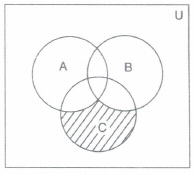
9.
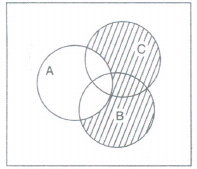
10.
Given sets are A = {1,3,5,6,7} and B={3,7,8,9}.
Now, A-B={1,3,5,6,7} - {3,7,8,9} ={1,5,6}
[set of those elements of A, which are not present in B]
and, B-A={3,7,8,9} - {1,3,5,6,7} ={8,9}
[set of those elements of B, which are not present in A]
\(\because \) Required symmetric difference,
\(A\triangle B=(A-B)\cup (B-A)\quad =\{ 1,5,6\} U\{ 8,9\} =\{ 1,5,6,8,9\} \)
11.
Here, x is a positive and a divisor of 9.
So, x can take values 1, 3, 9.
{x: X is a positive integer and a divisor of 9} = {1, 3, 9}
12.
Let C and T respectively donote the set of students who play Cricket and Tennis, and set U donotes the set of all students in a class.
Then n(C) = 25, n(T) = 20, n(C\(\)\(\cap \)T) = 10 and n (U)= 60
We know that, n(C\(\)\(\cup \)T) = n(C) + n(T) - n(C\(\)\(\cap \)T)
\( \Rightarrow \) n(C\(\)\(\cup \) T) = 25 + 20 - 10 = 45 - 10 = 35
Now the Number of students who play neither game
n(C'\(\cap \)T' ) = n(C'\(\cup \)T' )
= n (U) - n(C\(\cup \)T) = 60 - 35= 25
Hence, 25 students play neither games.
13.
Given, n (A) = 4, n(B) =5, n(U) =7
and n(A\(\cup \)B) = 2
ஃ n(A\(\cup \)B) = n(A) + n(B) - n(A\(\cap \)B)
ஃ n(A\(\cup \)B) = 4+5-2 = 7
Now,n(A\(\cup \)B)' = n(U)-n(A\(\cup \)B) = 7-7 = 0
14.
Wehave, A={1,2,{3,4},5}
Since,{3,4} is a member of set A.
\(\therefore\) {3,4}\(\in\) A
Hence,{3,4} \(\subset\) A is incorrect.

11th Standard CBSE Syllabus & Materials
11th Standard CBSE
CBSE 11th Business Studies Forms of Business Organisation Sample Question Papers Study Material - QB365 Set A
NEW11th Standard CBSE
CBSE 11th Business Studies Business, Trade and Commerce Sample Question Papers Study Material - QB365 Set A
NEW11th Standard CBSE
CBSE 11th Physics Waves Sample Question Papers Study Material - QB365 Set A
NEW11th Standard CBSE
CBSE 11th Physics Kinetic Theory Sample Question Papers Study Material - QB365 Set A



CBSE 11th Standard CBSE Subjects
CBSE Standards









