
 100% FREE ACCESS
11th Standard CBSE Syllabus & Materials
11th Standard CBSE
CBSE 11th Economics PART-A - Presentation of Data - New Sample Question Papers Study Material - QB365 Set A
NEW11th Standard CBSE
CBSE 11th Economics PART-A - Organisation of Data - New Sample Question Papers Study Material - QB365 Set A
NEW11th Standard CBSE
CBSE 11th Economics PART-A - Collection of Data - New Sample Question Papers Study Material - QB365 Set A
NEW11th Standard CBSE
CBSE 11th Economics PART-A - Introduction to Economics and Statistics - New Sample Question Papers Study Material - QB365 Set A
NEW11th Standard CBSE
CBSE 11th Business Studies International Trade Sample Question Papers Study Material - QB365 Set A
NEW11th Standard CBSE
CBSE 11th Business Studies Evolution and Fundamentals of Business Sample Question Papers Study Material - QB365 Set A

Published on: 05/03/2020
11th Standard CBSE Physics Annual Exam Model Question 2020
Download CBSE Class 11th Standard CBSE Physics question papers, sample papers, important questions, and previous year solved papers in PDF format. Get free study materials, NCERT solutions, and exam preparation resources for Class 11th Standard CBSE Physics
Questions + Answers key
Take MCQ Physics Test
1.
What will be the time period of oscillation, if the length of a second pendulum is one third?
2.
Two satellites of equal masses are orbiting at different heights. Will their moments of inertia be the same or different?
3.
What is the angle between frictional force and instantaneous velocity of the body moving over a rough surface?
4.
In a longitudinal wave, what is the distance between a compression and its nearest rarefraction ?
5.
What should be the angle between the force and the displacement for maximum and minimum work?
6.
What is the condition for the difference between the length of a certain brass rod and that of a steel rod to be constant at all temperature?
7.
What is the shape of stress-strain graph within elastic limit?
8.
Which one among a solid, liquid and gas of the same mass and at the same temperature has the greatest internal energy and which one has the least?
9.
A satellite revolving around earth loses height. How will its time period be changed?
10.
A gas is contained in a closed vessel. How pressure due to the gas will be affected if force of attraction between the molecules disseppear sudenly?
11.
In deriving Bernoulli's equation, we equated the work done on the fluid in the tube to its change in the potential and kinetic energy.
Do the dissipative forces become more important as the fluid velocity increases? Discuss qualitatively.
12.
John and Kuldeep are good friends.Both were driving their bikes.Speed thrill Kuldeep.Suddenly, Kuldeep met an accident.He was injured.When John heard about accident,he reached at the site of the accident and noticed that Kuldeep was lying on the roadside John informed the PCR that was petrolling.Kuldeep was taken to the city hospital,where he was treated by doctors.The speedometer of the bike of Kuldeep was reading 110km/h at the time of accident.
Comment on the attitude of Kuldeep.
13.
A famous relation in physics relates ‘moving mass’ m to the ‘rest mass’ mo of a particle in terms of its speed v and the speed of light, c. (This relation first arose as a consequence of special relativity due to Albert Einstein). A boy recalls the relation almost correctly but forgets where to put the constant c. He writes : \(m=\frac { { m }_{ 0 } }{ (1-{ \nu }^{ 2 })^{ 1/2 } } \). Guess where to put the missing c.
14.
The industrial revolution in England and Western Europe more than two centuries ago was triggered by some key scientific and technological advances. What were these advances?
15.
Suppose a tunnel is dug through the earth from one side to the other side along a diameter. Show that the motion of a particle dropped into the tunnel is simple harmonic motion. Find the time period. Neglect all the frictional forces and assume that the earth has a uniform density. G = 6.67 x 10⁻¹¹ Nm2 kg-2; density of earth = 5.51 x 10³ kg m-3
16.
How does the velocity-time graph for uniform motion give a geometrical way of calculating the displacement covered during a given time t?
17.
It is required to find the volume of a rectangular block. A Vernier Caliper is used to measure the length, width and height of the block. The measured values are found to be 1.37 cm, 4.11 cm and 2.56 cm respectively.
18.
The coefficient of apparent expansion of a liquid when determined using two different vessels A and Bare \(\gamma\)l and \(\gamma\)2 respectively. If the coefficient of linear expansion of vessel A is a, find the coefficient of linear expansion of vessel B.
19.
Define the following terms:
(i) elastic limit
(ii) elastic fatigue
(iii) breaking stress
A steel wire of cross-sectional area 0.5 mm2 is held between two fixed supports. If the tension in the wire is negligible and it is just taut at a temperature of 20°C, determine the tension when the temperature falls to O°C. Young's modulus of steel is 21 x 1011 dyne cm-2 and the coefficient of linear expansion of steel is 12 x 10-6 per 0C. Assume that the distance between the supports remains unchanged.
20.
A Carnot engine whose heat sink is at 27°C has an efficiency of 40%. By how many degrees should the temperature of source be changed to increase the efficiency by 10% of the original efficiency?
21.
Two particles A and B of masses m and 2m, are moving along the X and Y-axes, respectively with the same speed of v. They collide at the origin and coalesce into one body after the collision. What is the velocity of the coulesced mass? What is the loss of energy during this collission?
22.
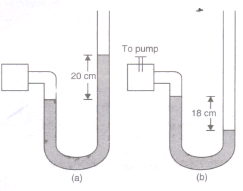
A manometer reads the pressure of a gas in an enclosure as shown in Fig. (a). When a pump removes some of the gas, the manometer reads as in Fig. (b). The liquid used in the manometers is mercury and the atmospheric pressure is 76 cm of mercury.
(a) Give the absolute and gauge pressure of the gas in the enclosure for cases (a) and (b), in units of cm of mercury.
(b) How would the levels change in case (b) if 13.6 cm of water (immiscible with mercury) is poured into the right limb of the manometer? Ignore the small change in the volume of the gas.
23.
A metre stick is balanced on a knife edge at its centre. When two coins, each of mass 5 g are put one on top of the other at the 12.0 cm mark, the stick is found to be balanced at 45.0 cm. What is the mass of the metre stick?
24.
Two waves of equal frequencies have their amplitudes in the ration of 3:5. They are superimposed on each other.Calculate the ratio of Imax/Imin.
25.
A particle set to be in SHM having two types of energies, potential and kinetic. The potential energy is on account of displacement of the particle from the mean position and kinetic energy is on account of the velocity of the particle. At any instant of time t, these are
\(PE=U=\frac { 1 }{ 2 } m{ \omega }^{ 2 }{ x }^{ 2 }=\frac { 1 }{ 2 } { m\omega }^{ 2 }{ A }^{ 2 }{ sin }^{ 2 }\omega t\)
\(\\ KE=K=\frac { 1 }{ 2 } m{ \omega }^{ 2 }({ A }^{ 2 }-{ x }^{ 2 })=m{ \omega }^{ 2 }{ A }^{ 2 }{ cos }^{ 2 }\omega t\)
and TE = PE + KE = \(\frac { 1 }{ 2 } m{ \omega }^{ 2 }{ A }^{ 2 }\) = Constant where, m = mass of the particle
(a) At what distance from the mean position ( a fixed point) will KE of the particle would be twice of its PE?
(b) What are the applications of this study in our day-to-day life?
26.
Four moles of an ideal gas having \(\gamma \) = 1.67 are mixed with 2 moles of another ideal gas having\(\gamma \) = 1.4.Find the value of \(\gamma \) for resulting mixture of gases
27.
Two syringes of different cross-section(without needles) filled with water are connected with a tightly fitted rubber tube.Diameters of the smaller and larger piston are 1.0 cm and 3.0 cm, respectively.
If the smaller piston is pushed in through 6.0 cm, how much does the larger piston move out?
28.
Ajay was a very naughty boy. One day , he bought a rubber cord catapult from market and started hitting passerby . When his father came to know about this, he immediately called Ajay and scolled him. He made him realise what damage his act could do. Ajay realised his mistake and apologised for his mistake.
A rubber cord catapult a cross-section area of 1mm2 and total unstreched length 10cm. It is stretched to 12 cm and then released to project a missile of mass 5g. Taking Young's modulus for rubber as 5.0x10⁸Nm-2 , find the tension in the cord,Also, find the velocity of projection of the projectile.
29.
Shweta was reading a book on the biography of Issac Newton. She read that Newton was sitting under an apple tree when a falling apple led him to develop a whole new science of gravity. After reading the book, shweta realised that every phenomenon in universe has some scientific fact associated with it, it depends on us whether we look for a scientific fact or associate a superstition with it.
How can you find the mass of the earth using law of gravitation?
30.
Find the torque of a force \(7\hat { i } +3\hat { j } -5\hat { k } \) about the origin. The force acts on a particle whose position vector is \(\hat { i } -\hat { j } +\hat { k } \)
31.
A Force Applied on a sledge
A horizontal force of 980 N is required to slide a sledge weighing 1200 kgf over a flat surface. Calculate the coefficient of friction.
32.
A hammer weighing 1 kg moving with the speed of 20 m / s strikes the head of a nail driving it 20 cm into a wall. Neglecting the mass of the nail, calculate
(i) the acceleration during the impact
(ii) the time interval during the impact
(iii) the impulse.
33.
A body of mass 10 kg revolves in a circle of diameter 0.4m making 1000 revolutions per minute. Calculate its linear velocity and centripetal acceleration.
34.
Science, like any knowledge, can be put to good or bad use, depending on the user. Given below are some of the application of science. Formulate your views on whether the particular application is good, bad or something that cannot be so clearly categorized.
(i) Mass vaccination against small pox to curb and finally eradicate this disease from the population.
(ii) Television for eradication of illiteracy and for mass communication for news and ideas.
(iii) Prenatal sex determination.
(iv) Computers for increase in work efficiency.
(v) Putting artificial satellites around the earth.
(vi) Development of nuclear weapons.
(vii) Development of new and powerful techniques of chemical and biological warfare.
(viii) Purification of water for drinking.
(ix) Plastic surgery.
(x) Cloning.
35.
A helicopter of mass 500 kg rises with a vertical acceleration of 10 ms-2. The weight of pilot is 60 kg. Give the magnitude and direction of
(i) force on the floor of the helicopter by the pilot
(ii) action of the rotor of the helicopter on the surrounding air
(iii) force on the helicopter due to the surrounding air.
(Take g = 10 ms-2).
36.
When 0.2 kg of a body at 100°C is dropped into 0..5 kg of water at 10°C, the resulting temperature is 16°C. Find the specific heat of the body. Specific heat of water is 4.2 x 10³ J/kg/0c.
37.
Draw a graph showing variation of potential energy, kinetic energy and the total energy of a body freely falling on Earth from a height h.
38.
Calculate
(i) r.m.s. velocity
(ii) mean kinetic energy of one gram molecule of hydrogen at S.T.P. Given density of hydrogen at S. T.P. is 0.09 kg m-3.
39.
Read the following two statements below carefully and state, with reasons, if it is true or false.
(a) The Young’s modulus of rubber is greater than that of steel;
(b) The stretching of a coil is determined by its shear modulus.
40.
Briefly explain how physics is related to technology.
41.
In the HCl molecule, the separation between the nuclei of the two atoms is about 1.27 Å (1 Å = 10-10 m). Find the approximate location of the CM of the molecule, given that a chlorine atom is about 35.5 times as massive as a hydrogen atom and nearly all the mass of an atom is concentrated in its nucleus.
42.
Earthquakes generate sound waves inside the earth. Unlike a gas, the earth can experience both transverse (S) and longitudinal (P) sound waves. Typically the speed of S wave is about 4.0 km s–1, and that of P wave is 8.0 km s–1. A seismograph records P and S waves from an earthquake. The first P wave arrives 4 min before the first S wave. Assuming the waves travel in straight line, at what distance does the earthquake occur?
43.
Answer the following question
(i) Time period of a particle in SHM depends on the force constant k and miss m of the particle \({ T }=2\pi \sqrt { \frac { m }{ k } } \). A simple pendulum executes SHM approximately. Then why is the time period of a pendulum independent of the mass of the pendulum?
(ii) The motion of a simple pendulum is approximately simple harmonic for small angle oscillations. For larger angles of oscillation, a more involved analysis shows that T is greater than \(2\pi \sqrt { \frac { l }{ g } } \) .Think of a qualitative argument to appreciate this result.
(iii) A man with a wristwatch on his hand falls from the top of a tower. Does the watch give correct time during the free fall?
(iv) What is the frequency of oscillation of a simple pendulum mounted in a cabin that is freely falling under gravity?
44.
A Lawn Roller
A lawn roller has been pushed by a gardener through a distance of 30 m. What will be the work done by him if he applies a force of 30 kg -wt in the direction inclined at 60o to the ground? Take g = 10 m/s2
45.
Explain why
(a) Two bodies at different temperatures T1 and T2 if brought in thermal contact do not necessarily settle to the mean temperature (T1 + T2 )/2.
(b) The coolant in a chemical or a nuclear plant (i.e., the liquid used to prevent the different parts of a plant from getting too hot) should have high specific heat.
(c) Air pressure in a car tyre increases during driving. (d) The climate of a harbour town is more temperate than that of a town in a desert at the same latitude.
46.
The flow rate of water from a tap of diameter 1.25 cm is 0.48 L/min. The coefficient of viscosity of water is 1O-3Pa-s. After some time the flow rate is increased to 3 L / min. Characterize the flow for both the flow rates.
47.
The distances of two planets from the sun are 1013 m and 1012 m, respectively. Calculate the ratio of time period and the speeds of the two planets
48.
To simulate car accidents, auto manufacturers study the collisions of moving cars with mounted springs of different spring constants. Consider a typical simulation with a car of mass 1000 kg moving with a speed 18.0 km/h on a smooth road and colliding with a horizontally mounted spring of spring constant 5.25 × 10 3 N m–1 . What is the maximum compression of the spring ?
49.
The ceiling of a long hall is 25 m high. What is the maximum horizontal distance that a ball thrown with a speed of 40 m s-1 can go without hitting the ceiling of the hall ?
50.
Compute the following with regards to significant figures.
(i) \(4.6\times 0.128\).
(ii) \(\frac { 0.9995\times 1.53 }{ 1.592 } \).
(iii) 876 + 0.4382.
51.
A particle moves on a given line with a constant speed \(\upsilon \). At a certain time it is at a point P on its straight line path. O is fixed point. The value of \(\overrightarrow { OP } \times \overrightarrow { \upsilon } \) is (where y is perpendicular distance from O to given line)
- y\(\upsilon \)\(\hat{k}\)
-2y\(\upsilon \)\(\hat{k}\)
-3y \(\upsilon \)\(\hat{k}\)
none
52.
A loaded spring gun of mass M fires a 'shot' of mass m with a velocity \(\vartheta \) at an angle of elevation \(\theta\). The gun is initially at rest on a horizontal frictionless surface. After firing, the centre of mass of the gun-shot system
moves with a velocity \(\vartheta \) m / M
moves with velocity \(\frac { \vartheta m }{ M } \)cos \(\theta\) in the horizontal direction
remains at rest
moves with a velocity \(\frac { \vartheta (M-m) }{ (M+m) } \) in the horizontaI direction.
53.
According to kinetic theory of gases the r.m.s. velocity of the gas molecules is directly proportional to
\(\sqrt { T } \)
T4
T
T2
54.
In case of a moving body
displacement > distance
displacement < distance
displacement ≥ distance
displacement ≤ distance
55.
A heavy brass sphere is hung from a spring and it executes vertical vibrations with period T. The sphere is now immersed in a non-viscous liquid with a density (1/10)th that of brass. When set into vertical vibrations with the sphere remaining inside liquid all the time, the time period will be
\(\sqrt{9\over 10T}\)
\(\sqrt{10\over 9T}\)
\(\sqrt{\left(9\over 10\right)r}\)
unchanged
56.
The density of a cube is measured by measuring its mass and the length of its sides. If the maximum errors in the measurement of mass and length are 3% and 2% respectively, then the maximum error in the measurement of density is _____.
9%
9%
9%
9%
57.
An empty vessel is partially filled with water. The frequency of vibration of air column in the vessel
decreases
increases
depends on the purity of water
remains the same.
58.
The scale on a steel meter rod is calibrated at 20°C. What will be the error in the reading of 50 ern at 27°C? Take, a = 1.2 x 10.5 °C-1
0.042CM
0.0042
0.021 CM
0.0021 CM
59.
Young's modulus of a material has the same unit as
stress
energy
compressibility
pressure
60.
If g is the acceleration due to gravity on the earth's surface, the gain in the potential energy of an object of mass m raised from the earth's surface to a height equal to the radius R of the earth,is
\(\frac{1}{2}mgR\)
2mgR
mgR
\(\frac{1}{4}mgR\)
61.
Two small drops of mercury, each of radius R, coalesce to form a single large drop. The ratio of the total surface energies before and after the change is:
1: 21/3
22/3 : 1
2: 1
1: 2
62.
An insect is crawling up on the concave surface of a fixed hemispherical bowl of radius R. If the coefficient of friction is \({1\over3}\) then the height up to which the insect can crawl is nearly,_______.
5% of R
6% of R
6.5% of R
7.5% of R
63.
The S.l. unit of mechanical equivelent of heat is _______.
Joule/Calorie
Calorie
Calorie x erg
erg/calorie
64.
The range of strong nuclear force is about
10-15 m
10-14 m
10-16 m
10-10 m
65.
A body is moving unidirectionally under the influence of a source of constant power. Its displacement in time t is proportional to
t1/2
t
t3/2
t2
1.
\(\frac { { T }_{ 2 }^{ 2 } }{ { T }_{ 1 }^{ 2 } } =\frac { { l }_{ 2 } }{ { l }_{ 1 } } =\frac { \left( \frac { l }{ 3 } \right) }{ l } =\frac { 1 }{ 3 } \quad or\quad \frac { { T }_{ 2 }^{ 2 } }{ { T }_{ 1 }^{ 2 } } =\frac { { (2) }^{ 2 } }{ 3 } or\ { T }_{ 2 }=\frac { 2 }{ \sqrt { 3 } } s\)
2.
The moments of inertia will be different on account of different distances.
3.
The angle is 180°, because force of friction always opposes the relative motion.
4.
Distance between a compression and adjoining rarefaction is\(\frac {\lambda}{2}\)
5.
For maximum work, \(\theta\) = 0° and for minimum work, \(\theta\)= 90°.
6.
The condition is that the lengths of the rods are inversely proportional to the coefficients of linear expansion of the materials of the rods
7.
A straight line.
8.
A gas has greatest internal energy and a solid has the least internal energy.
9.
Time period of satellite is, given by \(T=2\pi\sqrt {\frac{(R+h)^3}{GM}}\)
Therefore, T will decrease if h decreases.
10.
As force of attraction between molecules disappears, then the molecules will hit the wall with more speeds, hence , F = \(\frac{\Delta p}{\Delta t}\) , where F is average force on the wall due to the molecules.
\(\Delta\) p is change in momentum and \( \Delta \)t is the time duration . Due to increase in \(\Delta\) p, force F will also increase, hence pressure, p = \(\frac{F}{A}\) will increase. Here, A is area of one wall.
11.
Yes, the dissipative forces become more important as the fluid velocity increases.
The viscous drag is given by
F =- \(\eta\) A \(\frac{dv}{dx}\)
As the velocity of fluid increases, the velocity gradient increases and hence, viscous drag increases i.e. dissipative force also increases.
12.
Kuldeep does not obey trafic rules.He must learn a lesson from this accident that rash driving is dangerous.
13.
The relation is written by the boy
\(m=\frac { { m }_{ 0 } }{ (1-{ \nu }^{ 2 })^{ 1/2 } } \)
According to the principle of homogeneity of dimensions, the dimensions on either side of a relation must be same i.e., the powers of M, L, T on either side of a relation must be same.
Dimension of m is equal to the dimension of \( { m }_{ 0 } \), therefore, the denominator \({ (1-{ \nu }^{ 2 })^{ 1/2 } } \) should be dimensionless. In denominator 1 is dimensionless but factor \({ \nu }^{ 2 }\)is not dimensionless.
To make it dimensionless, we have to divide it by the same physical quantity with same power, therefore, it should be \({ { \nu }^{ 2 } }/{ { c }^{ 2 } }\), to become dimensionless.
Hence, the correct relation should be \(m=\frac { { m }_{ 0 } }{ (1-\frac { { \nu }^{ 2 } }{ { c }^{ 2 } } )^{ 1/2 } } \)
14.
The industrial revolution in England and Western Europe more than two centuries ago was triggered by some key scientific and technological advances.
A few of which are given below
(i) Discovery of electricity
(ii) Invention of powerloom, safety lamp, cotton gin, steam engine, etc.
15.
Figure shows a tunnel dug along the diameter of the earth. Consider the case of a particle of mass m at a distance y from the centre of the earth. There will be a gravitational attraction of the earth on this particle due to the portion of matter contained in a sphere of radius y. The mass of the sphere of radius y is given by
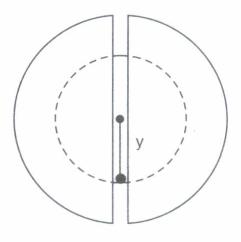
M=Volume x density
or M=\(\frac { 4 }{ 3 } \pi { y }^{ 3 }\times d\)
(where d = density of earth).
This mass can be regarded as concentrated at the centre of the earth. The force F between this mass and the particle of mass m is given by
\(F=-\frac { GMm }{ { y }^{ 2 } } \)
Negative sign shows that the force is of attraction.
\(\therefore F=-G\left( \frac { 4 }{ 3 } \pi { y }^{ 3 }d \right) \frac { m }{ { y }^{ 2 } } =-G\times \left( \frac { 4 }{ 3 } \pi md \right) y\)
or F∝y.
The force is directly proportional to the displacement, hence the motion is simple harmonic motion.
Here ,the constant k=\(\frac { 4 }{ 3 } \pi mdG\)
The time period, T=\(2\pi \sqrt { (m/k) } \)
\(=2\pi \sqrt { \left( \frac { 3m }{ 4\pi mdG } \right) } =2\pi \sqrt { \left( \frac { 3 }{ 4\pi dG } \right) } \)
\(=\sqrt { \left( \frac { 3\pi }{ dG } \right) } =\sqrt { \left( \frac { 3\times 3.14 }{ 5.51\times { 10 }^{ 3 }\times 6.67\times { 10 }^{ -11 } } \right) } \)
= 42.2 minutes.
16.
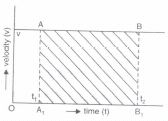
Consider velocity-time graph for uniform motion along a straight path. The graph is a straight line parallel to the time axis as shown in following Fig. Let A and B be two points on velocity-time graph corresponding to the instants tl and t2. As the motion is uniform, hence, AAI = BBI = V.
∴ Area under v-t graph between t1 and t2 = area ABB1A1
=AA1 x A1B1 = V (t2 - t1)
But velocity is defined as v =\(\frac { Displacement }{ Time } =\frac { x_{ 2 }-x_{ 1 } }{ t_{ 2 }-t_{ 1 } } \)
∴ V (t2 - t1) = x2 - x1
∴ area ABB1A1 = (x2 - x1)
Hence, displacement of a particle in time interval (t2 - t1)is numerically equal to the area under velocity-time graph between the instants t1 and t2.
17.
The measured (nominal) volume of the block is,
V = l x w x h
= (1.37 x 4.11 x 2.56) cm3
= 14.41 cm3
The least count of Vernier Caliper is ± 0.01 cm
\(\therefore\) Uncertain values can be written as
l = (1.37 ± 0.01) cm
w = (4.11 ± 0.01) cm
h = (2.56 ± 0.01) cm
Lower limit of the volume of the block is,
V(min) = (1.37 - 0.01) x (4.11 - 0.01) x (2.56 - 0.01) cm3
= (1.36 x 4.10 x 2.55) cm3
= 14.22 cm3
This is 0.19 cm3 lower than the nominal measured value.
Similarly the upper limit can also be calculated as follows.
V(max) = (1.37 + 0.01) x (4.11 + 0.01) x (2.56 + 0.01) cm3
= (1.38 x 4.12 x 2.57) cm3
= 14.61 cm3
This is 0.20 cm3 higher than the measured value.
But we choose the higher of these two values as the uncertainty i.e. (14.41 ± 0.20) cm3.
18.
We know that coefficient of real expansion of liquid (\(\gamma\)r)= Coefficient of apparent expansion of the liquid (\(\gamma\)a) + coefficient of volume expansion (\(\gamma\)v).
i..e \(\gamma +{ \gamma }_{ a }+{ \gamma }_{ v }={ \gamma }_{ a }+3a\)
Since the liquid is same in both the vessel, so value of Yr is same
For vessel A, \({ \gamma }_{ r }={ \gamma }_{ 1 }+{ \gamma }_{ a1 }=\gamma _{ 1 }+3a\)
For vesseal B = \({ \gamma }_{ r }={ \gamma }_{ 2 }+{ 3a }_{ 2 }\)
\(\therefore\) \({ \gamma }_{ 1 }+3a={ \gamma }_{ 2 }+{ 3a }_{ 2 }\)
or \({ a }_{ 2 }=\frac { { \gamma }_{ 1 }-{ \gamma }_{ 2 } }{ 3 } +a\)
19.
Numerical: Let I be the length of the wire at 20°C and ley the length at O°C. Then
l-l0 = ∝l0 ΔT = 20 ∝.l0
Compressive strain =\(\frac { l-{ l }_{ 0 } }{ { l }_{ 0 } } \) =20∝ = 20 x 12 x 10-6 = 2.4 x 10⁻⁴
\(\Upsilon \)= \(\frac { Stress }{ Strain } \)
Stress = \(\Upsilon \) x strain = \(\frac{F}{A}\)
Hence, tension T=\(\Upsilon \)A x Strain
= 21 x 1011 x 0.5 x 10-2 x 2.4 x10-4
= 2.52 x 10⁶ dyne
= 25.2 N
This is the tension in the wire when the temperature falls to O°C.
20.
T2 = 27°C = 27 + 273
= 300K
η = 40%, T22 = ?
From \(η = 1-{T_2\over T_1}\)
\({T_2\over T_1}=1-η=1-{40\over 100}={60\over 100}={3\over 5}\)
\(T_1={5\over 3}T_2={5\over 3}\times300=500K\)
Increase in efficiency 10% of 40 = 4%
∴ New efficiency 'Y]' 40 + 4 = 44%
Let T1 be the new temperature of the source
As \(η'=1-{T_2\over T_1'}\)
\({T_2\over T_1'}=1-η'=1-{44\over 100}={56\over 100}\)
\(T_1'={100\over 56}T_2={100\over 56}\times300=535.7K\)
∴ Increase in temp. of source
= 535.7 - 500 = 35.7 K
21.
Let a be the angle of scattering of the coalesced mass (m + 2m) i.e. 3m and V be the velocity after the collision at the origin.
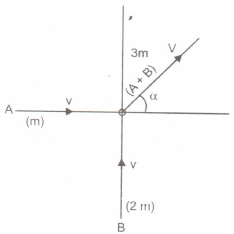
\(\therefore\) According to law of conservation of momentum, for x-component.
mv = 3mV cos \(\alpha\)
v = 3V cos \(\alpha\) (i)
For y-component
2mv = 3mV sin \(\alpha\)
2v = 3V sin \(\alpha\) (ii)
Dividing eq. (ii) by eq. (i) we get
\({ tan\quad \alpha =\frac { 2mv }{ mv } =2 }\)
\(\therefore \quad \alpha ={ tan }^{ -1 }(2)\)
= 63.4°
Squaring eq. (i) and eq. (ii) we get,
v2 + (2v)2 = (3V cos \(\alpha\))2 + (3V sin \(\alpha\))2
\(\Rightarrow\) v2 + 4v2 = 9V2 cos2 \(\alpha\) + 9 V2 sin2 \(\alpha\)
\(\Rightarrow\) 5v2 = 9V2
\(\therefore\) \({ V }^{ 2 }=\frac { 5 }{ 9 } { v }^{ 2 }\)
or \(V=\frac { \sqrt { 5 } }{ 3 } v\) (iii)
Now the K.E. before the collision = \(\frac { 1 }{ 2 } { mv }^{ 2 }+\frac { 1 }{ 2 } (2m){ v }^{ 2 }\)
\(=\frac { 3 }{ 2 } { mv }^{ 2 }\)
and the K.E. after the collision \(=\frac { 1 }{ 2 } (3m){ V }^{ 2 }\)
\(=\frac { 1 }{ 2 } \times 3m\times \frac { 5 }{ 9 } { v }^{ 2 }\) [From (iii)]
\(=\frac { 5 }{ 6 } { mv }^{ 2 }\)
\(\therefore\) Loss of K.E. during the collission = \(\frac { 3 }{ 2 } { mv }^{ 2 }-\frac { 5 }{ 6 } { m }^{ 2 }\)
\(=\frac { 2 }{ 3 } { mv }^{ 2 }\)
22.
The atmospheric pressure, P = 76 cm of mercury
(a) From figure (a),
Pressure head, h 20 cm of mercury
\(\therefore\) Absolute pressure p + h = 76 + 20 = 96 cm of mercury
Also, Gauge pressure h = 20 cm of mercury
From figure (b),
pressure head, h -18 cm of mercury
\(\therefore\) Absolutepressure p + h = 76 + (-18) = 58 cm of mercury
Also, Gauge pressure h = -18 cm of mercury
(b) When 13.6 cm of water is poured into the right limb of the manometer of figure (b), then, using the relation:
Pressure = pgh = p'g'h'
We get h' = \(\frac{ph}{p'}=\frac{1\times 13.6}{13.6}=1\)cm of mercury
Therefore, pressure at the point B,
PB = P + h' = 76 + 1 = 77 cm of mercury
If h" is the difference in the mercury levels in the two limbs, then taking PA = PB
\(\Rightarrow\) 58 + h" = 77 \(\Rightarrow\) h" = 77 - 58 = 19 cm of mercury.
23.
Let m be the mass of the stick concentrated at C, the 50 cm mark, see fig.
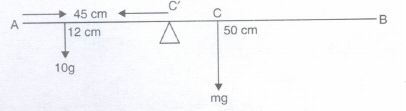
For equilibrium about C', the 45 cm mark
10g (45-12) = mg (50-45)
10g 33 = mg\(\times\)5
⇒ m= \(\frac { 10\times 33 }{ 5 } \)
or m = 66 grams
24.
\(\frac { { A }_{ 1 } }{ { A }_{ 2 } } =\frac { 3 }{ 5 } \Rightarrow \sqrt { \frac { { I }_{ 1 } }{ { I }_{ 2 } } } =\frac { 3 }{ 5 }\)
Now, \(\frac { { I }_{ max } }{ { I }_{ min } } =\left( \frac { \sqrt { { I }_{ 1 } } +\sqrt { { I }_{ 2 } } }{ \sqrt { { I }_{ 1 } } -{ I }_{ 2 } } \right) =\left( \frac { \sqrt { { I }_{ 1 }/{ I }_{ 2 } } +1 }{ \sqrt { { I }_{ 1 } } /{ I }_{ 2 }-1 } \right) ^{ 2 }\)
\(\\ =\left( \frac { { 3 }/{ 5 }+1 }{ { 3 }/{ 5 }-1 } \right) ^{ 2 }=\frac { 64 }{ 4 } =\frac { 16 }{ 1 } \)
25.
(a) As condition is, KE = 2PE
\(\frac { 1 }{ 2 } m{ \omega }^{ 2 }({ A }^{ 2 }-{ x }^{ 2 })=2\times \frac { 1 }{ 2 } m{ \omega }^{ 2 }{ A }^{ 2 }{ x }^{ 2 }\)
\(\\ \Rightarrow { A }^{ 2 }-{ x }^{ 2 }=2{ x }^{ 2 }\)
\(\Rightarrow x=\pm \frac { A }{ \sqrt { 3 } } \)
(b) This study shows that sum total of PE and KE of a particle in SHM stays constant at all positions and at all times. However, PE and KE both keep on changing with position or time. The same is true in day to day life. We can acquire one form of energy by spending some other form of energy and vice-versa.
26.
Let
CV´= molar heat capacity of the first gas,
CV´´ = molar heat capacity of the second gas,
CV = molar heat capacity of the mixture,
and similar symbols for other quantities. Then,
γ= C′p/C′V=1.67
and
C′P=C′V+R
This gives
C′V=3/2R and C′P=5/2R
Similarly, γ = 1.4 gives C′′V=5/2R
and C′′P=7/2R
Suppose the temperature of the mixture is increased by dT. The increase in the internal energy of the first gas = n1C′VdT.
The increase in internal energy of the second gas = n2C′′VdT.
Thus, \(\left(n_1+n_2\right) C_V d T=n_1 C_V^{\prime} d T+n_2 C V " d T
\)
or, \(C_V=\frac{n_1 C_v^{\prime}+n_2 C_v^{\prime \prime}}{n_1+n_2}\)
\( C_P=C_V+R=\frac{n_1 C_v^{\prime}+n_2 C_v^{\prime \prime}}{n_1+n_2}+R \)
\( =\frac{n_1\left(C_v^{\prime}+R\right)+n_2\left(C_v^{\prime \prime}+R\right)}{n_1+n_2} \)
\(=\frac{n_1 C_p^{\prime}+n_2 C_p^{\prime \prime}}{n_1+n_2} \ldots(2)\)
From (1) and (2),
\( Y=\frac{C_p}{C_V}=\frac{n_1 C_p^{\prime}+n_2 C_p^{\prime \prime}}{n_1 C_V^{\prime}+n_2 C_V^{\prime \prime}} \)
\( \frac{4 \times \frac{5}{2} R+2 \times \frac{7}{2} R}{4 \times \frac{3}{2} R+2 \times \frac{5}{2} R}=1.54
\)
27.
Volume covered by the movement of smaller piston inwards is equal to volume moved out wards due to the larger piston.
\(\because \) water is incompressible
L1A1 = L2A2
\({ { L }_{ 2 } }=\frac { { A }_{ 1 } }{ { A }_{ 1 } } { L }_{ 1 }=\frac { \pi \left( \frac { 1 }{ 2 } \times { 10 }^{ -2 } \right) ^{ 2 } }{ \pi \left( \frac { 3 }{ 2 } \times { 10 }^{ -2 } \right) ^{ 2 } } \times 6\times { 10 }^{ -2 }\)
\(\\ { L }_{ 2 }=0.67\times { 10 }^{ -2 }m=0.67\ m\)
Atmospheric pressure is common to both piston and has been ignored.
28.
\(\triangle l=12-10=2cm=0.02m,\ l=10cm=0.1m\)
\(\\ a=1mm^{ 2 }=10^{ 6 }m^{ 2 } \ and \ Y=5\times 10^{ 8 }N/m^{ 2 }\)
\(\\ As, \ Y=\frac { F }{ a } \times \frac { l }{ \triangle l }\)
\( \\ \therefore F=\frac { Ya\triangle l }{ l } =\frac { 5\times 10^{ 8 }\times 10^{ -6 }\times 0.02 }{ 0.1 } =100N\)
KE of missile = elastic potential energy
Given m = 5g
From Eq (i), we have tension = 100N
\(\frac { 1 }{ 2 } mv^{ 2 }=\frac { 1 }{ 2 } \times tension\times extension\)
\(\\ v=\sqrt { \frac { tension\times 0.02 }{ m } } =\sqrt { \frac { 100\times 0.02 }{ 5/1000 } } =20m/s\)
29.
From law of gravitation, \(F=\frac { GMm }{ { R }^{ 2 } } \)
Where, m = mass of object on surface of the earth.
R = radius of the earth.
M = mass of the earth.
Force experienced by object, F = mg
Using the two forces, we have
\(mg=\frac { GMm }{ { R }^{ 2 } } \quad or\quad M=\frac { gR^{ 2 } }{ G } \)
30.
Here \(\mathbf{r}=\overline{\mathbf{i}}-\hat{\mathbf{j}}+\hat{\mathbf{k}}\)
and \(\mathbf{F}=7 \hat{\mathbf{i}}+3 \hat{\mathbf{j}}-5 \hat{\mathbf{k}}\)
We shall use the determinant rule to find the torque τ = r x F
\(\tau=\left|\begin{array}{ccc} \hat{\mathbf{i}} & \hat{\mathbf{j}} & \hat{\mathbf{k}} \\ 1 & -1 & 1 \\ 7 & 3 & -5 \end{array}\right|=(5-3) \hat{\mathbf{i}}-(-5-7) \hat{\mathbf{j}}+(3-(-7)) \hat{\mathbf{k}}\)
or \(\boldsymbol{\tau}=2 \overrightarrow{\mathbf{i}}+12 \hat{\mathbf{j}}+10 \hat{\mathbf{k}}\)
31.
Given fs = 980 N, R = Mg = 1200 kgf = 1200 x 9.8 N
Now, coefficient of static friction
i.e. \({ \mu }_{ s }\) = \(\frac { { f }_{ s } }{ R } \) = \(\frac { 980 }{ 1200\times 9.8 } \)
= 0.83
32.
Here, m = 1kg, u = 20 m/s
s = 10 cm = 0.1 m
v = 0, a= ?
(a) As,
\(v^2=u^2+2 a s\)
\( \therefore 0=(20)^2+2 . a \cdot(0.1) \)
\( \Rightarrow a=-\frac{400}{2 \times 0.1}=-2000 \mathrm{~m} / \mathrm{s}^2 \)
b) v=u+a t
\( \therefore 0=20+(-2000) t \)
\( \Rightarrow t=\frac{20}{2000} \)
\(=\frac{1}{100}=0.01 \mathrm{sec}\)
c) Impulse = F. t
=m(v-u)
=1(0-20)
=-20 N.s.
33.
m =10 kg, d = 0.4m, r = 0.2m
Revolutions per min, \(\nu =1000/min=\frac { 1000 }{ 60 } s,Linear\)
velocity, v=?,centripetal acceleration, a=?
\(\\ \omega =2\pi \nu =2\pi \times \frac { 1000 }{ 60 } =\frac { 100\pi }{ 3 } rad/s\)
\(\\ v=r\omega =0.2\times \frac { 100\pi }{ 3 } =\frac { 20\pi }{ 3 } m/s\)
\(\\ a=r\omega ^{ 2 }=0.2\times \left( \frac { 100\pi }{ 3 } \right) ^{ 2 }=\frac { 2000\pi ^{ 2 } }{ 9 } m/s^{ 2 }\)
34.
(i) Mass vaccination is good as, it is used to make the socity free from the diseases like small pox.
(ii) Television for eradication of illiteracy and for mass communication of news and ideas is good as, it is a medium which is easily within the reach of common man and also they are very habitual to it.
(iii) Prenatal sex determination is bad because people are misusing it. Some of the people after determination of sex of child, think to abort. They do it especially with girl child.
(iv) Computer for increase in work efficiency is good as using the computer, a man can do much more work with greater efficiency and accuracy.
(v) Putting artificial satellite into orbits around the Earth is good for development as these satellites serve many purpose like remote sensing, weather foresting.
(vi) Development of nuclear weapons is bad as they can be used in mass destruction.
(vii) Development of new and powerful tool of chemical and biological warfare are bad, as they can also be used for mass destruction.
(viii) Purification of water for drinking purpose is good as we can save ourself from the diseases which we can have due to drinking of the water.
(ix) Plastic surgery is good as with the help of it a man or women can remove the skin defects occurring due to accident or some other reasons. It has some bad effects too but they are not very considerable.
(x) Cloning is good as far as animals are concerned. With the help of it, we can develop some species of animals which can be used to serve some specific purpose. But it is not good for human beings.
35.
(i) Force on the floor by the pilot
= mg + ma
= m(g + a) = 60 (10 + 10)
= 1200 N (downward)
(ii) Force of helicopter on the surrounding air = (m1 + m2) (g + a)
= (500 + 60) (10 + 10)
= 11200N (downwards)
(iii) According to Newton's third law of motion, action and reaction are equal and opposite.
\(\therefore\) Force on the helicopter due to surrounding air = 11200 N (upwards).
36.
For the body,
m1 = 0.2 kg; \(\triangle\)T1 = 1000 - 160 = 840C
S1 = ?
For water,
m2 = 0.5 kg; \(\triangle\)T2 = 160 - 100 =60C;
S2 = 4.2 103J/Kg/0C
From law of conservation of energy;
heat lost by body = heat gained by water
i...e, m1s1 \(\triangle\)T1 = m2S2 \(\triangle\)T2
or S1 = \(\frac { { m }_{ 2 }s_{ 2 }\triangle { T }_{ 2 } }{ { m }_{ 1 }\triangle { T }_{ 1 } } =\frac { 0.5\times \left( 4.2\times { 10 }^{ 3 } \right) \times 6 }{ 0.2\times 84 } \)
= 0.75 x 10³ J/Kg/0C
37.
Graphs depicting variation of (i) gravitational potential energy (P.E.), (ii) kinetic energy (K.E.),and (iii) the total sum of potential and kinetic energies for a freely falling body are as shown in adjoining Fig. From the graphs, it is clear that:
(a) Gravitational potential energy decreases as the body falls downwards and is zero at the Earth.
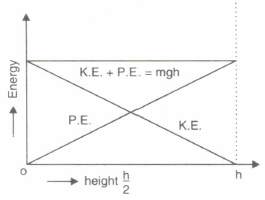
(b) Kinetic energy increases as the body falls downwards and is maximum when the body just strikes the ground.
(c) The sum of kinetic and potential energies remains constant at all points during its free fall.
38.
Here, \(\rho\) = 0.09 kg m-3
At S.T.P., Pressure P = 1.01 x 10⁵ pa.
According to kinetic theory of gases.
\(p=\frac { 1 }{ 3 } \rho { C }^{ 2 }\quad or\quad C=\sqrt { \frac { 3p }{ \rho } } \)
\(=\sqrt { \frac { 3\times 1.01\times { 10 }^{ 5 } }{ 0.09 } } =1837.5\quad { ms }^{ -1 }\)
Volume occupied by one mole of hydrogen at S.T.P. = 22.4 liters = 22.4 x 10⁻³ m3
\(\therefore \) Mass of hydrogen, M = volume x density
= 22.4 x 10-3 x 0.09
= 2.016 x 10⁻³kg
Average K.E/mole =\(\frac { 1 }{ 2 } \)MC2
=\(\frac { 1 }{ 2 } \) x (2.016 x 10-3) x (1837.5)2
= 3403.4 J
39.
(a) False. The Young's modulus is defined as the ratio of stress to the strain within elastic limit. For a given stretching force elongation is more in rubber and quite less in steel. Hence, rubber is less elastic than steel.
(b) True. Stretching of a coil is determined by its shear modulus. When equal and opposite forces are applied at opposite ends of a coil, the distance as well as shape of helicals of the coil change and it involves shear modulus.
40.
Progress in the field of science and technology is interrelated. Sometimes technology gives rise to new physics and at other times physics generates new technology. The discipline of thermodynamics arose mainly to understand and improve the working of heat engines. Similarly discovery of basic laws of electricity and magnetism led to development of wireless communication technology. Therefore, we can conclude that physics and technology are closely related.
41.
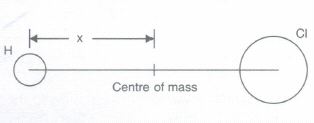
Let us choose the nucleus of the hydrogen atom as the origin for measuring distance. Mass of hydrogen atom, m1 = 1 unit (say) Since cholorine atom is 35.5 times as massive as hydrogen atom,
mass of cholorine atom, m2 = 35.5 units
Now, x1 = 0 and x2 = 1.27\(\mathring { A } \) =1.27\(\times\)10-10 m
Distance of centre of m~ss of HCl molecule from the origin is given by
X = \(\frac { { m }_{ 1 }{ x }_{ 1 }+{ m }_{ 2 }{ x }_{ 2 } }{ { m }_{ 1 }+{ m }_{ 2 } } =\frac { 1\times 0+35.5\times 1.27\times 10 }{ 1+35.5 } m\)
= \(\frac { 35.5\times 1.27 }{ 36.5 } \times { 10 }^{ -10 }m\)
= 1.235\(\times\)10-10m
= 1.235\(\mathring { A } \)
42.
Let v1,v2 be the velocities of S wave and P wave and t1, t2 be the time taken by these waves to reach the seismograph
l= distance of occurrence of earthquake from the seismograph
\(v_{ 1 }t_{ 1 }=v_{ 2 }t_{ 2 }\)
\( \Rightarrow v_{ 1 }=4kms^{ -1 },v_{ 2 }=8kms^{ -1 }\)
\( \Rightarrow 4t_{ 1 }=8t_{ 2 }\Rightarrow t_{ 1 }=2t_{ 2 }\)
\( t_{ 1 }-t_{ 2 }=4min=\ 240s\)
\(On\ solving\ Eqs.\ (i)\ and\ (ii),\ t_{ 2 }=240s\)
\(\Rightarrow t_{ 1 }=2t_{ 2 }=2\times 240=480s\)
\(\Rightarrow l=v_{ 1 }t_{ 1 }=4\times 480=1920km\)
43.
(i) For a simple pendulum k is proportional to m the mass of the particle hence \(\frac { m }{ k } \) becomes constant and does not affect the time period.
(ii) If we replace \(sin\theta \approx \theta \) for large angles, then actually \(sin\theta <\theta \)
Now since this factor is multiplied to the restoring force mg\(sin\theta \) is replaced by \(mg\theta \) which means an effective reduction in g for large angles. hence, there is an increase in time period T over that given by the formula
\(T=2\pi \sqrt { \frac { l }{ g } } \)
as compared to the case which it is assumed \(sin\theta \simeq \theta \)
(iii) Yes, since the motion of hands of a wristwatch to indicate time depends on action of the spring and has nothing to do with acceleration due to gravity.
(iv) In a free fall the effective g = 0,i.e. gravity disappears
Time period \(T=2\pi \sqrt { \frac { l }{ g } } =2\pi \sqrt { \frac { l }{ 0 } } =\infty \)
Frequency, \(v=\frac { 1 }{ T } =0\)
i.e. frequency of oscillation is zero.
44.
Given, Displacement s = 30 m
Force, F = 30 kg - wt = 30 x 10 = 300N
Angle between force and ground , \(\theta\) = 60o
The work done by the gardener,
W = F.s = Fscos \(\theta\) = 300 x 30 x cos 60o
W = 4500 J
45.
(a) When two bodies at different temperatures T1 and T2 are brought in thermal contact, heat flows from the body at the higher temperature to the body at the lower temperature till equilibrium is achieved, i.e., the temperatures of both the bodies become equal. The equilibrium temperature is equal to the mean temperature (T1 + T2)/2 only when the thermal capacities of both the bodies are equal.
(b) The coolant in a chemical or nuclear plant should have a high specific heat. This is because higher the specific heat of the coolant, higher is its heat-absorbing capacity and vice versa. Hence, a liquid having a high specific heat is the best coolant to be used in a nuclear or chemical plant. This would prevent different parts of the plant from getting too hot.
(c) When a car is in motion, the air temperature inside the car increases because of the motion of the air molecules. According to Charles’ law, the temperature is directly proportional to pressure. Hence, if the temperature inside a tyre increases, then the air pressure in it will also increase.
(d) A harbour town has a more temperate climate (i.e., without the extremes of heat or cold) than a town located in a desert at the same latitude. This is because the relative humidity in a harbour town is more than it is in a desert town.
46.
Let the speed of the flow be v.
Given, diameter of tap = d = 1.25 cm
Volume of water flowing out per second.
Q = v \( \times\) \(\frac{\pi d^2}{4} \) \(\Rightarrow\) v = \(\frac{4Q}{d^2\pi}\)
Estimate Reynold's number, Re = \(\frac{4 \rho Q}{\pi d \eta}\)
Q = 0.48 L / min
= 8 \(\times\) 10-3 L/s
= 8 \(\times\)10-6 m3/s
Re = \(\frac{4\times10^3\times8\times10^{-6}}{3.14\times1.25\times10^{-2}\times10^{-3}} \)
Re = 815 [ i.e below 1000, the flow is steady ]
After some time, when
Q = 3L/min
= 5\(\times\)10-5m3/s,
Re = \(\frac{4\times10^3\times5\times10^{-5}}{3.14\times1.25\times10^{-2}\times10{-3}} \)
= 5095
ஃ The flow will be turbulent.
47.
\( T \propto r^{3 / 2} \)
\( \therefore \frac{T_1}{T_2}=\left(\frac{10^{13}}{10^{12}}\right)^{3 / 2}=10 \sqrt{10} .
\)
48.
At maximum compression the kinetic energy of the car is converted entirely into the potential energy of the spring.
The kinetic energy of the moving car is
\(K=\frac{1}{2} m v^{2}\)
\(=\frac{1}{2} \times 10^{3} \times 5 \times 5\)
K = 1.25 x 10⁴ J
where we have converted 18 km h–1 to 5 m s–1 [It is useful to remember that 36 km h–1 = 10 m s–1]. At maximum compression xm , the potential energy V of the spring is equal to the kinetic energy K of the moving car from the principle of conservation of mechanical energy.
\(V=\frac{1}{2} k x_{m}^{2}\)
= 1.25 x 10⁴ J
We obtain
xm = 2.00 m
We note that we have idealised the situation. The spring is considered to be massless. The surface has been considered to possess negligible friction.
49.
Given, initial velocity (u) = 40m/s
Height of the hall (H) = 25m
Let the angle of projection of the ball be \(\theta \), when maximum height attained by it be 25m.
Maximum height attained by the ball
\(H=\frac { { u }^{ 2 }{ sin }^{ 2 }\theta }{ 2g } \Rightarrow 25=\frac { { (40) }^{ 2 }{ sin }^{ 2 }\theta }{ 2\times 9.8 }\)
\(or\ { \sin }^{ 2 }\theta =\frac { 25\times 2\times 9.8 }{ 1600 } =0.3068\)
\(or\ \sin\theta =0.5534=\sin{ 33.6 }^{ 0 }\)
\(or\ \theta ={ 33.6 }^{ 0 }\)
\( \therefore \text{ Horizontal range (R)}=\frac { { u }^{ 2 }\sin2\theta }{ g }\)
\( \\ =\frac { { (40) }^{ 2 }sin2\times { 33.6 }^{ 0 } }{ 9.8 } =\frac { 1600\times sin{ 67.2 }^{ 0 } }{ 9.8 } \)
\(\\ =\frac { 1600\times 0.9219 }{ 9.8 } =150.5m\)
50.
(i) \(4.6\times 0.128\) = 0.5888 = 0.59.
The result has been rounded off to have two significant digits (as in 4.6).
(ii) \(\frac { 0.9995\times 1.53 }{ 1.592 } \) = 0.96057 = 0.961
The result has been rounded off to three significant digits (as in 1.53).
(iii) 876 + 0.4382.
876 + 0.4382 = 876.4382 = 876
As, there is no decimal point in 876, therefore, result of addition has been rounded off to no decimal point.
51.
(a)
- y\(\upsilon \)\(\hat{k}\)
52.
(c)
remains at rest
53.
(c)
T
54.
(d)
displacement ≤ distance
55.
(b)
\(\sqrt{10\over 9T}\)
56.
(d)
9%
57.
(a)
decreases
58.
(b)
0.0042
59.
(a)
stress
60.
(a)
\(\frac{1}{2}mgR\)
61.
(b)
22/3 : 1
62.
(a)
5% of R
63.
(a)
Joule/Calorie
64.
(a)
10-15 m
65.
(b)
t

11th Standard CBSE Syllabus & Materials
11th Standard CBSE
CBSE 11th Business Studies Forms of Business Organisation Sample Question Papers Study Material - QB365 Set A
NEW11th Standard CBSE
CBSE 11th Business Studies Business, Trade and Commerce Sample Question Papers Study Material - QB365 Set A
NEW11th Standard CBSE
CBSE 11th Physics Waves Sample Question Papers Study Material - QB365 Set A
NEW11th Standard CBSE
CBSE 11th Physics Kinetic Theory Sample Question Papers Study Material - QB365 Set A



CBSE 11th Standard CBSE Subjects
CBSE Standards









