
 100% FREE ACCESS
11th Standard CBSE Syllabus & Materials
11th Standard CBSE
CBSE 11th Economics PART-A - Presentation of Data - New Sample Question Papers Study Material - QB365 Set A
NEW11th Standard CBSE
CBSE 11th Economics PART-A - Organisation of Data - New Sample Question Papers Study Material - QB365 Set A
NEW11th Standard CBSE
CBSE 11th Economics PART-A - Collection of Data - New Sample Question Papers Study Material - QB365 Set A
NEW11th Standard CBSE
CBSE 11th Economics PART-A - Introduction to Economics and Statistics - New Sample Question Papers Study Material - QB365 Set A
NEW11th Standard CBSE
CBSE 11th Business Studies International Trade Sample Question Papers Study Material - QB365 Set A
NEW11th Standard CBSE
CBSE 11th Business Studies Evolution and Fundamentals of Business Sample Question Papers Study Material - QB365 Set A

Published on: 05/09/2019
Gravitation
Download CBSE Class 11th Standard CBSE Physics question papers, sample papers, important questions, and previous year solved papers in PDF format. Get free study materials, NCERT solutions, and exam preparation resources for Class 11th Standard CBSE Physics
Questions + Answers key
Take MCQ Physics Test
1.
Find the percentage decrease in the weight of a body when taken 10 km below the surface of the earth.
2.
Which of the following symptoms is likely to affect an astronaut in space
headache
3.
If the earth is regarded as a hollow sphere, then what is the weight of an object below surface of the earth?
4.
What is a parking orbit?
5.
A mass of 1 g is separated from another mass of 1 g by a distance of 1 cm. How many g-wt of force exists between them?
6.
Can we determine the mass of a satellite by measuring its time period?
7.
Two particular of equal mass m go round a circle of radius R under the action of their mutual gravitational attraction. What is the speed of each particle?
8.
Are the Kepler's laws applicable only to the solar system?
9.
From Kepler's second law and observations of the sun's motion as seen from the earth, we can conclude that the earth is closer to the sun during winter in the Northern hemisphere than during sumer. Explain
10.
Choose the correct alternatives.
Acceleration due to gravity increases/decreases with increasing depth(assume the earth to be a sphere of uniform density).
11.
Consider two solid uniform spherical object of the same density \(\rho \) . One has a radius R and the other a radius 2R. They are in outer space where the gravitational field from other objects are negligible. If they are at rest with their surfaces touching, then what is the contact force between the objects due to their gravitational attraction?
12.
Kabir was feeling very hungry. He had not eaten since morning. He asked his mother for food but she refused saying that solar eclipse is occurring and she would not cook till that got over. Then, kabir went to drink water and saw that water had tulsi leaves in it. He was frustrated as he had studied that solar and lunar eclipse are natural phenomena and has no ill effects on anyone.
When he told this to his mother, she didn't listen to him and asked him not to be orthodox. He went to his friend's house and on the way, he saw that prayers were being done at various place to keep away the ill effects of solar eclipse. Kabir felt embarrassed at the superstitious of people and went to study.
Time period of jupiter is 11.6 years. How far is jupiter from the sun? The distance of the earth from the sun is \(1.5\times 10^{ 11 }m.\)
13.
An earth's satellite has a period of 90 min.Assuming the orbit to be circular, calculate its height.Take radius of the earth equal to 6380 km and g at the surface of the earth equal 9.8m/s2 .
14.
In the following two exercises, choose the correct answer from among the given ones: The gravitational intensity at the centre of a hemispherical shell of uniform mass density has the direction indicated by the arrow (see Fig.) (i) a, (ii) b, (iii) c, (iv) 0.
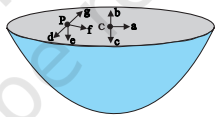
15.
A comet orbits the sun in highly elliptical orbit. Does the comet has a constant potential energy
16.
Choose the correct alternatives
The energy required to rocket an orbiting satellite out of the earth's gravitational influence is more/less than the energy required in project a stationary object at the same height(as the satellite) of the earth's influence
17.
Does the escape speed of a body from the earth depends on the direction of the projection
18.
A sphere of mass 40 kg is attracted by another sphere of mass 15 kg, eith a force of 1/40 mg-wt. Find the value of the gravitational constant if their centres are 0.40 m apart.
1.
0.25
2.
Headache is due to mental strain.It will persist whether a person in an astronaut in space or he is on earth.It means headache will have the same effect on the astronaut in space as on a person on earth.
3.
The weight of an object below surface of the earth is zero.
4.
Parking orbit that orbit in which the period of revolution of a satellite is equal to the period of rotation of the earth about its axis.
5.
\(F=G\frac { { m }_{ 1 }{ m }_{ 2 } }{ { r }^{ 2 } }\)
\( \\ =6.67\times 10^{ -8 })\left( \frac { 1\times 1 }{ 1^{ 2 } } \right) dyne\)
\(\\ =6.67\times 10^{ -8 }\quad dyne=\frac { 6.67\times 10^{ -8 } }{ 980 } \)
\(=7\times 10^{ -11 }g-wt\)
6.
No,we cannot determined the mass of a satellite by measuring its time period
7.
Step 1: Given
1. The equal mass of the particles is m
2. The radius of the circle is R.
Step 2: Formula used
1. Gravitational force \(=\frac{G M m}{R^2}\)
2. Centrifugal force \(=m \omega^2 R\)
Step 3: Solution
Let the speed of rotation of each particle be v.
By equating gravitational force with centrifugal force
\(\frac{G m^2}{(2 R)^2}=m \omega^2 R \)
\(G=\text { Gravitational constant }\)
2R = The distance between the center of the two particles.
\(\omega=\) Angular velocity of the particles
Now,
\(\Rightarrow \frac{G m^2}{4 R^2}=m \omega^2 R \)
\(\Rightarrow \frac{G m^2}{4 R^2 \cdot m R}=\omega^2 \)
\(\Rightarrow \frac{G m}{4 R^3}=\omega^2 \)
\(\Rightarrow \omega =\sqrt{\frac{G m}{4 R^3}}\)
From the relation between angular velocity and linear velocity
\( v=\omega R \)
\( \Rightarrow v=\sqrt{\frac{G m}{4 R^3} \times R} \)
\( \Rightarrow v=\sqrt{\frac{G m R^2}{4 R^3}} \)
\( \Rightarrow v=\sqrt{\frac{G m}{4 R}}\)
[Putting value of \(\omega\) from (1)]
Hence the required answer is \(v=\sqrt{\frac{G m}{4 R}}\).
8.
No, they are applicable to the artificial satellite too.
9.
The earth is closer to the sun during winter. But heating effect is less because the sun's fall obliquely.
10.
Acceleration due to gravity at depth d from the earth's surface is given by
\({ g }^{ ' }=g\left( 1-\frac { d }{ { R }_{ e } } \right) \)
Therefore, acceleration due to gravity decreases with increasing depth.
11.
Gravitational attraction between two point objects are given as:
\(F = \dfrac{{G{M_1}{M_2}}}{{{r^2}}}\)…….(1)
Where,
F is the attractive force,
G is gravitational constant,
M1 and M2 are the masses of two objects,
r is the distance between the center of masses of the two objects.
The volume of a sphere of radius R is given by:
\(V = \dfrac{4}{3}\pi {R^3}\)……. (2)
Where,
V is the volume of the sphere,
R is the radius of the sphere.
Mass of an object with given density and volume:
\(M = \rho .V\)……. (3)
Where,
M is the mass of the object,
ρ is the density of the object,
Complete step by step solution:
Given:
The radius of the smaller sphere is R.
The radius of a larger sphere is 2R.
The density of both spheres is ρ.
The spheres are kept with their surface touching each other.
To find: Contact force between the spheres.
Step 1:
Use eq.(2) in eq.(3) to get the mass of the first sphere of R as:
\(M_1=\rho \times\left(\frac{4}{3} \pi R^3\right) \)
\(\therefore M_1=\frac{4}{3} \pi \rho R^3\)
Step 2:
Similarly, Use eq.(2) in eq.(3) to get the mass of the first sphere of $2 R$ as:
\(M_2=\rho \times\left(\frac{4}{3} \pi(2 R)^3\right) \)
\(\therefore M_2=\frac{32}{3} \pi \rho R^3\)
Step 3:
For a uniform sphere, its center of mass always stays at its center. As they are kept just in touch so the distance between their center is r=R+2R=3R. Now, substitute r and the values of M1 and M2 obtained from eq.(4) and eq.(5) in eq.(1) to get the attractive force value as:
\(F=\frac{G \times\left(\frac{4}{3} \pi \rho R^3\right) \times\left(\frac{32}{3} \pi \rho R^3\right)}{(3 R)^2} \)
\( \therefore F=\frac{128}{81} G \pi^2 R^4 \rho^2
\)
12.
\({ T }_{ j }=11.6yr,{ r }_{ j }=?,{ T }_{ e }=1yr,{ r }_{ e }=1.5\times { 10 }^{ 11 }m\)
\(\\ \frac { { T }_{ j }^{ 2 } }{ { T }_{ e }^{ 2 } } =\frac { { r }_{ j }^{ 3 } }{ { r }_{ e }^{ 3 } } \)
\(\\ \Rightarrow \quad { r }_{ j }={ r }_{ e }\left( \frac { { { T }_{ j } } }{ { T }_{ e } } \right) ^{ 2/3 }=1.5\times 10^{ 11 }\times \left( \frac { 11.6 }{ 1 } \right) ^{ 2/3 }\)
\(\\ { r }_{ j }=7.68\times 10^{ 11 }m\)
13.
Height of the earth's satellite\(h=\left( \frac { { T }^{ 2 }R^{ 2 }g }{ 4\pi ^{ 2 } } \right) -R\)
Given,T= 90 min = \(90\times 60=5400s,R=6380km\)
\(g=9.8m/{ s }^{ 2 }=9.8\times { 10 }^{ -3 }km/{ s }^{ 2 }\)
Thus
\(h=\left[ \frac { (5400)^{ 2 }\times (6380)^{ 2 }\times (9.8\times { 10 }^{ -3 } }{ 4\times 9.87 } \right] ^{ 1/3 }km-6380\quad km\)
or h = (6655 - 6380)km = 275 km
14.
At all points inside a hollow spherical shell, potential is same. So, gravitational intensity, which is negative of gravitational potential gradient, is zero. Due to zero gravitational intensity, the gravitational forces acting on any particle at any point inside a spherical shell will be symmetrically placed. It follows from here that if we remove the upper hemispherical shell, the net gravitational force acting on a particle at P will be downwards. Since gravitational intensity is gravitational force per unit mass therefore, the direction of gravitational intensity will be along c. So, option (iii) is correct.
15.
Potential energy of the comet changes as its kinetic energy changes.
16.
The energy required to rocket an orbiting satellite out of gravitational influence is less than the energy required to project a stationary object,because incase of orbiting satelite,the gravitational pull of the earth acting on it is balanced by centripetal force,so work is required only in rocketing it(no work is required against the gravitational pull)
17.
No, escape velocity is independent of the direction of projection
18.
Step 1: Given
Mass of 1 st sphere, \(M_1=40 \mathrm{~kg}\)
Mass of 2nd sphere, \(M_2=15 \mathrm{~kg}\)
Gravitation force, \(F=\frac{1}{10} m g w t\)
Dis tan ce between centres of both spheres, R=0.2 m Universal gravitational cons \(\tan t, G=\) ?
Step 2: Formula used
Converting the value of force in SI unit (Newton),
\(F =\frac{1}{10} \text { milligram wt } \)
\(=\frac{1}{10} \times 10^{-3} \mathrm{gwt} \)
\(=\frac{1}{10} \times 10^{-3} \times 10^{-3} \mathrm{kgwt}\)
\( =10^{-7} \times 9.8 \mathrm{~N} \)
\( =9.8 \times 10^{-7} \mathrm{~N}\)
Step 3: Calculations
Rearranging the Universal law of gravitation to find the value of G,
\(F =G \times \frac{M_1 \times M_2}{R^2} \)
\(G =\frac{F \times R^2}{M_1 \times M_2}\)
Substituting the values in the expression,
\(G =\frac{F \times R^2}{M_1 \times M_2} \)
\(=\frac{9.8 \times 10^{-7} \mathrm{~N} \times(0.2 \mathrm{~m})^2}{40 \mathrm{~kg} \times 15 \mathrm{~kg}} \)
\(=6.533 \times 10^{-11} \mathrm{~N} \mathrm{~m}^2 \mathrm{~kg}^{-2}\)
Hence, the value of G is \(6.533 \times 10^{-11} \mathrm{~N} \mathrm{~m}^2 \mathrm{~kg}^{-2}\).

11th Standard CBSE Syllabus & Materials
11th Standard CBSE
CBSE 11th Business Studies Forms of Business Organisation Sample Question Papers Study Material - QB365 Set A
NEW11th Standard CBSE
CBSE 11th Business Studies Business, Trade and Commerce Sample Question Papers Study Material - QB365 Set A
NEW11th Standard CBSE
CBSE 11th Physics Waves Sample Question Papers Study Material - QB365 Set A
NEW11th Standard CBSE
CBSE 11th Physics Kinetic Theory Sample Question Papers Study Material - QB365 Set A



CBSE 11th Standard CBSE Subjects
CBSE Standards









