
 100% FREE ACCESS
11th Standard CBSE Syllabus & Materials
11th Standard CBSE
CBSE 11th Economics PART-A - Presentation of Data - New Sample Question Papers Study Material - QB365 Set A
NEW11th Standard CBSE
CBSE 11th Economics PART-A - Organisation of Data - New Sample Question Papers Study Material - QB365 Set A
NEW11th Standard CBSE
CBSE 11th Economics PART-A - Collection of Data - New Sample Question Papers Study Material - QB365 Set A
NEW11th Standard CBSE
CBSE 11th Economics PART-A - Introduction to Economics and Statistics - New Sample Question Papers Study Material - QB365 Set A
NEW11th Standard CBSE
CBSE 11th Business Studies International Trade Sample Question Papers Study Material - QB365 Set A
NEW11th Standard CBSE
CBSE 11th Business Studies Evolution and Fundamentals of Business Sample Question Papers Study Material - QB365 Set A

Published on: 05/08/2019
Gravitation
Download CBSE Class 11th Standard CBSE Physics question papers, sample papers, important questions, and previous year solved papers in PDF format. Get free study materials, NCERT solutions, and exam preparation resources for Class 11th Standard CBSE Physics
Questions + Answers key
Take MCQ Physics Test
1.
A plant moving along an elliptical orbit is closet to the Sun at a distance r1 and farthest away at a distance of r2 . If V1 and V2 are the linear velocities at these points respectively, then find the ratio v1/v2
2.
Two satellites have their masses in the ratio of 3:1. The radii of their circular orbits are in the ratio of 1:4. What is the ratio of total mechanical energy of A and B?
3.
An artificial satellite moving in a circular orbit around the earth has a total energy \({ E }_{ 0 }\) . What is its potential energy?
4.
Two particular of equal mass m go round a circle of radius R under the action of their mutual gravitational attraction. What is the speed of each particle?
5.
Is the Kepler's law kinematic?
6.
Do the force of friction and other contact forces arise due to gravitational attraction? If not, then what is the origin of these forces?
7.
By which law is the Kepler's law of areas identical?
8.
If earth be at one half its present distance from the sun, then how many days will there be in a year?
9.
How earth retains most of the atmosphere?
10.
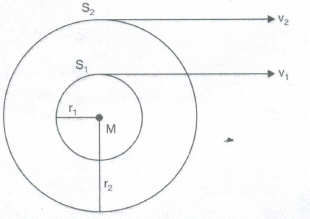
Two satellites S1 and S2 revolve round a planet in coplanar circular orbit in the same sense. Their periods of revolution are one hour and 8 hours respectively. The radius of the orbit of S1 is 104 km. When S2 is close to S1 find
(i) the speed of S2 relative to S1
(ii) the angular speed of S2 as actually observed by an astronaut in S1.
11.
Consider two solid uniform spherical object of the same density \(\rho \) . One has a radius R and the other a radius 2R. They are in outer space where the gravitational field from other objects are negligible. If they are at rest with their surfaces touching, then what is the contact force between the objects due to their gravitational attraction?
12.
Kabir was feeling very hungry. He had not eaten since morning. He asked his mother for food but she refused saying that solar eclipse is occurring and she would not cook till that got over. Then, kabir went to drink water and saw that water had tulsi leaves in it. He was frustrated as he had studied that solar and lunar eclipse are natural phenomena and has no ill effects on anyone.
When he told this to his mother, she didn't listen to him and asked him not to be orthodox. He went to his friend's house and on the way, he saw that prayers were being done at various place to keep away the ill effects of solar eclipse. Kabir felt embarrassed at the superstitious of people and went to study.
Time period of jupiter is 11.6 years. How far is jupiter from the sun? The distance of the earth from the sun is \(1.5\times 10^{ 11 }m.\)
13.
Estimate the size of a rockey sphere a density of 3.0g/cm3 from the surface of which you could barely throw a golf ball and have it never back(assume your best throw is 40m/s)
14.
The distances of two planets from the sun are 1013 m and 1012 m, respectively. Calculate the ratio of time period and the speeds of the two planets
15.
An artificial satellite is going round the earth, close to the surface. What is the time taken by it to complete one round?
16.
If the earth has a mass nine times and radius twice that of the planet Mars, calculate the maximum velocity by a rocket to pull out of the gravitational force of the Mars.
17.
The world's first artificial satellite launched by USSR was circling the earth at a distance of 896 km. Calculate its orbital speed and period of revolution.
18.
A 400 kg satellite is in circular orbit of radius \(2{ R }_{ E }\) about the earth. How much energy is required to transfer it to a circular orbit of radius \(4{ R }_{ E }\) ? What are the change in the kinetic and potential energies?
19.
A satellite is launched into a circular orbit of radius R around the earth. A second satellite launched into an orbit of radius 1.01 R. The time period of the second satellite is larger than that of the first one by approximately
0.5%
1.5%
1%
3.0%
20.
If M is the mass of the earth and R its radius, the ratio of the gravitational acceleration and the gravitational constant is
\(\frac{R^2}{M}\)
\(\frac{M}{R^2}\)
MR2
\(\frac{M}{R}\)
21.
If a particle is fired vertically upwards from the surface of earth and reaches a height of 6400 km, the initial velocity of the particle is (assume R = 6400 km and g = 10 ms-2)
4 km/ sec
2 km/ sec
8 km/ sec
16 km/ sec
22.
A satellite of mass m revolves around the earth of radius R at a height x from its surface. If g is the acceleration due to gravity on the surface of the earth, the orbital speed of the satellite is
gx
\(\frac{gR}{R-x}\)
\(\frac{gR^2}{R+x}\)
\((\frac{gR^2}{R+x})^{\frac{1}{2}}\)
23.
A satellite is orbiting the earth. If its distance from the earth is increased, its
angular velocity would increase
linear velocity would increase
angular velocity would decrease
time period would increase
1.
From the law of conservation of angular momentum
\(m{ r }_{ 1 }{ v }_{ 1 }=m{ r }_{ 2 }{ v }_{ 2 }\quad \Rightarrow \quad { r }_{ 1 }{ v }_{ 1 }={ r }_{ 2 }{ v }_{ 2 }\ \ or\quad \frac { { v }_{ 1 } }{ { v }_{ 2 } } =\frac { { r }_{ 2 } }{ { r }_{ 1 } } \)
2.
The total mechanical energy of a satellite of mass m in a circular orbit of radius r around a planet of mass M is given by
\(E=-\frac{G M m}{2 r}\)
So, \(E \propto \frac{m}{r}\)
Given,
Ratio of the masses of the satellites, \(\frac{m_A}{m_B}=\frac{3}{1}\)
Ratio of the orbits of the satellites,
\(\frac{r_A}{r_B}=\frac{r}{4 r}=\frac{1}{4}\)
Now, the ratio of the total meachanical energy,
\(\frac{E_A}{E_B}=\frac{m_A}{m_B} \times \frac{r_B}{r_A}\)
\( \Rightarrow \frac{E_A}{E_B}=\frac{3}{1} \times \frac{4}{1} \)
\( \Rightarrow \frac{E_A}{E_B}=12: 1
\)
3.
\(\because\) Total energy, \(E_0=-\frac{G M m}{2 r}\)
Potential energy, \(U=-\frac{G M m}{r}=2 E_0\)
Kinetic energy, \(K=+\frac{G M m}{2 r}=-E_0\).
4.
Step 1: Given
1. The equal mass of the particles is m
2. The radius of the circle is R.
Step 2: Formula used
1. Gravitational force \(=\frac{G M m}{R^2}\)
2. Centrifugal force \(=m \omega^2 R\)
Step 3: Solution
Let the speed of rotation of each particle be v.
By equating gravitational force with centrifugal force
\(\frac{G m^2}{(2 R)^2}=m \omega^2 R \)
\(G=\text { Gravitational constant }\)
2R = The distance between the center of the two particles.
\(\omega=\) Angular velocity of the particles
Now,
\(\Rightarrow \frac{G m^2}{4 R^2}=m \omega^2 R \)
\(\Rightarrow \frac{G m^2}{4 R^2 \cdot m R}=\omega^2 \)
\(\Rightarrow \frac{G m}{4 R^3}=\omega^2 \)
\(\Rightarrow \omega =\sqrt{\frac{G m}{4 R^3}}\)
From the relation between angular velocity and linear velocity
\( v=\omega R \)
\( \Rightarrow v=\sqrt{\frac{G m}{4 R^3} \times R} \)
\( \Rightarrow v=\sqrt{\frac{G m R^2}{4 R^3}} \)
\( \Rightarrow v=\sqrt{\frac{G m}{4 R}}\)
[Putting value of \(\omega\) from (1)]
Hence the required answer is \(v=\sqrt{\frac{G m}{4 R}}\).
5.
Yes, because kepler's third law is the relation between distance and time.
6.
Contact forces have electrical region.
7.
The law of conservation of angular momentum.
8.
\(T^{ 2 }\alpha R^{ 3 }\)
Hence, \(\frac { { T }_{ 1 }^{ 2 } }{ { T }_{ 2 }^{ 2 } } =\frac { { R }_{ 1 }^{ 3 } }{ { R }_{ 2 }^{ 3 } } \Rightarrow { T }_{ 2 }^{ 2 }=\left[ \frac { { R }_{ 2 } }{ { R }_{ 1 } } \right] ^{ 3 }T_{ 1 }^{ 2 }\)
\(\Rightarrow T_{ 2 }=T_{ 1 }\left[ \frac { R_{ 2 } }{ { R }_{ 1 } } \right] ^{ 3/2 }=365\left( \frac { R/2 }{ R } \right) ^{ 3/2 }
\)
\(=365\times \frac { 1 }{ \sqrt [ 2 ]{ 2 } } =129\ days\)
9.
Earth retains most of the atmosphere due to force of gravity.
10.
The centripetal force required by a satellite of mass m revolving in a circular orbit of radius r with a speed v is supplied by the gravitational force extended by the planet of mass M on the satellite. Thus
\(\frac{Mv^2}{r}=G\frac{Mm}{r^2}\)
\(v=\sqrt {\frac{Gm}{r}}\)
The period of revolution of the satellite is
\(T=\frac{2\pi r}{v}=2\pi\sqrt {\frac{r^3}{GM}}\)
For satellite S1 let T=T1,r=r1,v=v1
Then \(T_1^2=\frac{4\pi^2r_1^3}{GM}\)
For satellite S2 , \(T_2^2=\frac{4\pi^2r_2^2}{GM}\therefore \frac{T_1^2}{T_2^2}=\frac{r_1^3}{r_2^3}\)
\(r_2=r_1(\frac{T_2}{T_1})^{\frac{2}{3}}\)
\(=10^4(\frac{8}{1})^{\frac{2}{3}}\)
\(=4\times10^4\ km\)
\(v_1=\frac{2\pi r_1}{T_1}\)
\(=\frac{2\pi\times10^4}{1}=2\pi\times10^4\ km/hr\)
\(v_2=\frac{2\pi r_2}{T_2}\)
\(=\frac{2\pi\times4\times10^4}{8}\)
\(=\pi\times10^4\ km/hour\)
Velocity of S2 relative to \(S_1=v_2-c_1=\theta_r(say)\)
\(v_r=(\pi\times10^4-2\pi\times10^4)\ km/hr\)
\(=-\pi\times10^4\ km/hour\)
Let r2-r1 = r
The angular velocity of S2 relative to S1 is given by
\(\omega=\frac{v_r}{r}=\frac{\pi\times10^4}{(4-1)10^4}\ rad/hour\)
\(\omega=\frac{\pi}{3}\ rad/hour\)
11.
Gravitational attraction between two point objects are given as:
\(F = \dfrac{{G{M_1}{M_2}}}{{{r^2}}}\)…….(1)
Where,
F is the attractive force,
G is gravitational constant,
M1 and M2 are the masses of two objects,
r is the distance between the center of masses of the two objects.
The volume of a sphere of radius R is given by:
\(V = \dfrac{4}{3}\pi {R^3}\)……. (2)
Where,
V is the volume of the sphere,
R is the radius of the sphere.
Mass of an object with given density and volume:
\(M = \rho .V\)……. (3)
Where,
M is the mass of the object,
ρ is the density of the object,
Complete step by step solution:
Given:
The radius of the smaller sphere is R.
The radius of a larger sphere is 2R.
The density of both spheres is ρ.
The spheres are kept with their surface touching each other.
To find: Contact force between the spheres.
Step 1:
Use eq.(2) in eq.(3) to get the mass of the first sphere of R as:
\(M_1=\rho \times\left(\frac{4}{3} \pi R^3\right) \)
\(\therefore M_1=\frac{4}{3} \pi \rho R^3\)
Step 2:
Similarly, Use eq.(2) in eq.(3) to get the mass of the first sphere of $2 R$ as:
\(M_2=\rho \times\left(\frac{4}{3} \pi(2 R)^3\right) \)
\(\therefore M_2=\frac{32}{3} \pi \rho R^3\)
Step 3:
For a uniform sphere, its center of mass always stays at its center. As they are kept just in touch so the distance between their center is r=R+2R=3R. Now, substitute r and the values of M1 and M2 obtained from eq.(4) and eq.(5) in eq.(1) to get the attractive force value as:
\(F=\frac{G \times\left(\frac{4}{3} \pi \rho R^3\right) \times\left(\frac{32}{3} \pi \rho R^3\right)}{(3 R)^2} \)
\( \therefore F=\frac{128}{81} G \pi^2 R^4 \rho^2
\)
12.
\({ T }_{ j }=11.6yr,{ r }_{ j }=?,{ T }_{ e }=1yr,{ r }_{ e }=1.5\times { 10 }^{ 11 }m\)
\(\\ \frac { { T }_{ j }^{ 2 } }{ { T }_{ e }^{ 2 } } =\frac { { r }_{ j }^{ 3 } }{ { r }_{ e }^{ 3 } } \)
\(\\ \Rightarrow \quad { r }_{ j }={ r }_{ e }\left( \frac { { { T }_{ j } } }{ { T }_{ e } } \right) ^{ 2/3 }=1.5\times 10^{ 11 }\times \left( \frac { 11.6 }{ 1 } \right) ^{ 2/3 }\)
\(\\ { r }_{ j }=7.68\times 10^{ 11 }m\)
13.
Let us consider that the rockey sphere has mass M and radius R.The escape speed for such a sphere is given by
\(x = {-b \pm \sqrt{b^2-4ac} \over 2a}{ V }_{ e }=\sqrt { \frac { 2GM }{ R } } =\sqrt { \frac { 2G\left( \frac { 4\pi }{ 3 } \right) { R }^{ 2 }P }{ R } } =\sqrt { \frac { 8\pi Gp }{ 3 } } R\quad or\quad R={ v }_{ e }=\sqrt { \frac { 3 }{ 8\pi Gp } } \)
Here, \(p=3.0g/cm^{ 2 }=3.0\times { 10 }^{ 3 }kg/{ m }^{ 3 },{ v }_{ e }=40\quad m/s\)
Thus \(R=40\sqrt { \frac { 3 }{ 8\times 3.14\times 6.67\times { 10 }^{ -11 }\times 3\times { 10 }^{ 3 } } } m\)
or \(R=40\times 776.6m=30904m=30.904km\)
14.
\( T \propto r^{3 / 2} \)
\( \therefore \frac{T_1}{T_2}=\left(\frac{10^{13}}{10^{12}}\right)^{3 / 2}=10 \sqrt{10} .
\)
15.
Here \(R=6400 \mathrm{~km}=6.4 \times 10^6 \mathrm{~m}\)
g = 9.8 m s-2
Orbital velocity near the earth's surface is \(v_0=\sqrt{g R}=\sqrt{9.8 \times 6.4 \times 10^6}=7290 \mathrm{~ms}^{-1}\) Time period,
\( T=\frac{2 \pi R}{v_0}=\frac{2 \times 22 \times 6.4 \times 10^6}{7 \times 7290}=5079 \mathrm{~s} \)
\( =1.411 \mathrm{~h}\)
16.
Here, \(M_e=9 M_m\), and \(R_e=2 R_m\)
ve (escape speed on surface of Earth) \(=11.2 \mathrm{~km} / \mathrm{s}\)
Let Vm be the speed required to pull out of the gravitational force of mars.
We know that
\(v_e=\sqrt{\frac{2 G M_e}{R_e}}\) and \(v_m=\sqrt{\frac{2 G M_m}{R_m}}\)
Dividing, we get \(\frac{v_m}{v_e}=\sqrt{\frac{2 G M_m}{R_m} \times \frac{R_e}{2 G M_e}}\)
\( =\sqrt{\frac{M_m}{M_e} \times \frac{R_e}{R_m}}=\sqrt{\frac{1}{9} \times 2}=\frac{\sqrt{2}}{3} \)
\( \Rightarrow v_m=\frac{\sqrt{2}}{3}(11.2 \mathrm{~km} / \mathrm{s})=5.3 \mathrm{~km} / \mathrm{s}
\)
17.
7.417 km/s, 1 h 43 min 3 s
18.
Given mass of satelite m=400 kg
initial energy is given by \(E_i=\frac{-G M m}{4 R}\)
final energy is givne by \(E_f=\frac{-G M m}{8 R}\)
\( \triangle E=\frac{G M m}{8 R}=\frac{G M}{R^2} \frac{m R}{8} \)
\(=\frac{g m R}{8} \)
\(=\frac{9.81 \times 400 x 6.37 \times 10^6}{8} \)
\( \triangle E=3.13 \times 10^9 j\)
\(-3.13\times 10^{ 9 }J,\ -6.26\times 10^{ 9 }J\)
19.
(b)
1.5%
20.
(b)
\(\frac{M}{R^2}\)
21.
(c)
8 km/ sec
22.
(d)
\((\frac{gR^2}{R+x})^{\frac{1}{2}}\)
23.
(a)
angular velocity would increase

11th Standard CBSE Syllabus & Materials
11th Standard CBSE
CBSE 11th Business Studies Forms of Business Organisation Sample Question Papers Study Material - QB365 Set A
NEW11th Standard CBSE
CBSE 11th Business Studies Business, Trade and Commerce Sample Question Papers Study Material - QB365 Set A
NEW11th Standard CBSE
CBSE 11th Physics Waves Sample Question Papers Study Material - QB365 Set A
NEW11th Standard CBSE
CBSE 11th Physics Kinetic Theory Sample Question Papers Study Material - QB365 Set A



CBSE 11th Standard CBSE Subjects
CBSE Standards









