
 100% FREE ACCESS
11th Standard CBSE Syllabus & Materials
11th Standard CBSE
CBSE 11th Economics PART-A - Presentation of Data - New Sample Question Papers Study Material - QB365 Set A
NEW11th Standard CBSE
CBSE 11th Economics PART-A - Organisation of Data - New Sample Question Papers Study Material - QB365 Set A
NEW11th Standard CBSE
CBSE 11th Economics PART-A - Collection of Data - New Sample Question Papers Study Material - QB365 Set A
NEW11th Standard CBSE
CBSE 11th Economics PART-A - Introduction to Economics and Statistics - New Sample Question Papers Study Material - QB365 Set A
NEW11th Standard CBSE
CBSE 11th Business Studies International Trade Sample Question Papers Study Material - QB365 Set A
NEW11th Standard CBSE
CBSE 11th Business Studies Evolution and Fundamentals of Business Sample Question Papers Study Material - QB365 Set A

Published on: 27/09/2019
Gravitation
Download CBSE Class 11th Standard CBSE Physics question papers, sample papers, important questions, and previous year solved papers in PDF format. Get free study materials, NCERT solutions, and exam preparation resources for Class 11th Standard CBSE Physics
Questions + Answers key
Take MCQ Physics Test
1.
The magnitude of gravitational field at distances r1 and r2 from the centre of a uniform sphere of radius R and mass M are l1 and l2 respectively. Find the ratio of (I1/I2) if r1 > R and r2 < R.
2.
A satellite is revolving just near the Earth's surface. Compute its orbital velocity. Given that radius of Earth R = 6400 km and g = 9.8 ms-2.
3.
Find an expression for the orbital velocity of a satellite revolving around the earth in a circular orbit at a height h above the surface of earth.
4.
The planet Saturn has a mass 95 times that of the earth, and its radius is 9.5 times the earth's radius. Calculate the escape speed of a body from Saturn's surface, if the escape speed from the earth's surface is 11.2 kms-1.
5.
Taking the moon's orbit around earth to be r and mass of earth 81 times the mass of the moon. Find the position of the point from the earth, where the net gravitational field is zero.
6.
A satellite is revolving around the earth, close to the surface of earth with a kinetic energy E. How much kinetic energy should be given to it so that it escapes from the surface of earth?
7.
Compute the mass of a planet that has a satellite whose time period is T and orbital radius is r.
8.
What is the height at which the value of g is the same as at a depth of \(\frac{R}{2}?\)
9.
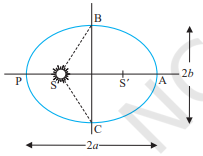
Let the speed of the planet at the perihelion P in Fig. be vP and the Sun-planet distance SP be rP. Relate {rP, vP} to the corresponding quantities at the aphelion {rA, vA}. Will the planet take equal times to traverse BAC and CPB ?
10.
Viscous force increases the velocity of a satellite.Discuss
11.
What will be the potential energy of a body of mass 67kg at a distance of \(6.6{ \times 10 }^{ 10 }m\)from the centre of the earth? Find gravitational potential at this distance.
12.
The mass of a spaceship is 1000 kg. It is to be launched from the earth's surface out into free space. The value of g and R(radius of earth) are 10\({ m }/{ { s }^{ 2 } }\)and 6400km, respectively.What is the required energy for this work done?
13.
If the earth is 1/4 of its present distance from the sun, then what is the duration of he year?
14.
The distances of two planets from the sun are 1013 m and 1012 m, respectively. Calculate the ratio of time period and the speeds of the two planets
15.
An artificial satellite is going round the earth, close to the surface. What is the time taken by it to complete one round?
1.
When r1 > R, the point lies outside the sphere. Then sphere can be considered to be a point mass body whose whole mass can be supposed to be concentrated at its centre. Then gravitational intensity at a point distance r1 from the centre of sphere will be,
\(I_1=\frac{GM}{r_1^2}\)........(1)
When r2 < R, the point P lies inside the sphere. The unit mass body placed at P, will experience gravitational pull due to sphere of radius r2, whose mass is
\(M'=\frac{M\times\frac{4}{3}\pi r_2^3}{\frac{4}{3}\pi R^3}=\frac{Mr_2^3}{R^3}\)
Therefore the gravitational intensity at P will be \(l_2=\frac{GMr_2^3}{R^3}\times\frac{1}{r_2^2}=\frac{GMr_2}{R^3}\) ........(2)
\(\frac{I_1}{I_2}=\frac{GM}{r_1^2}\times\frac{R^3}{GMr_2}=\frac{R^3}{r_1^2r_2}\)
2.
For a satellite revolving just near the Earth's surface, the orbital velocity has a magnitude given by
\(v_{orb}=\sqrt {gR}\)
\(\therefore v_{orb}=\sqrt {9.8\times6400\times1000}\) = 7.92 x 10³ms-1 or 7.92 km s-1.
3.
Consider a satellite of mass m revolving around the earth at a height h from its surface so that radius of its orbit r = R + h. If vo be the orbital velocity of satellite then centripetal force needed by it for its uniform circular motion is
\(F=\frac{mv_0^2}{r}\)
This value of centripetal force is provided by the gravitational pull of the earth acting on the satellite i.e.,
\(F=\frac{GMm}{r^2}\)
For equilibrium, \(\frac{mv_0^2}{r}=\frac{GMm}{r^2}\)
\(\Rightarrow v_0=\sqrt {\frac{GM}{r}}=\sqrt {\frac{GM}{(R+h)}}\)
But \(g=\frac{GM}{R^2},\ hence\ GM=gR^2\)
\(\therefore v_0=\sqrt {\frac{gR^2}{(R+h)}}=R\sqrt {\frac{g}{(R+h)}}.\)
4.
Escape speed from the earth's surface is
\(v_e=[\frac{2GM}{R}]^{\frac{1}{2}}\)
or \([\frac{2GM}{R}]^{\frac{1}{2}}=11.2\) ...........(1)
Escape speed from Saturn's surface will be,
\(v=[\frac{2GM'}{R'}]^{\frac{1}{2}}\)
Now,M' = 95M, R' = 9.5R
\(v=[\frac{2\times95GM}{9.5R}]^{\frac{1}{2}}=3.16\times\sqrt {2\frac{GM}{R}}\)
\([\frac{2GM}{R}]^{\frac{1}{2}}=11.2\ kms^{-1} \)
\(\therefore\) v = 3.16 x 11.2 = 35.4 km s-1.
5.
Let x be the distance of a point from the earth where resultant gravitational field intensity is zero. So
\(\frac{GM_e}{x^2}=\frac{GM_e}{(r-x)^2}\ or\ \frac{81Mm}{x^2}=\frac{Mm}{(r-x)^2}\ or\frac{9}{x}=\frac{1}{(r-x)}\)
or 9r = 10x or x = 9r/10 = 0.9 r.
6.
Let v0, ve be the orbital and escape speeds of the satellite, then \(v_e=\sqrt 2v_0.\)
Energy in the given orbit \(E_1=\frac{1}{2}mv_0^2=E\) .............(1)
Energy for the escape speed, \(E_2=\frac{1}{2}mv_e^2=\frac{1}{2}m(\sqrt 2v_0)^2=2E\)
\(\therefore\) Energy required to be supplied = E2 - E1 = E.
7.
Suppose that a satellite of mass m described a circular orbit around a planet of Mass M. The force of attraction between the planet and its satellite is
\(F=-g\frac{Mm}{r^2}\)
This force must be mass times the centripetal acceleration, i.e.,
\(\frac{v^2}{r}=\omega^2r\)
Thus \(m\omega^2r=\frac{4\pi^2mr}{T^2}=G\frac{mM}{r^2}\)
\(M=\frac{4\pi^2r^3}{GT^2}\)
8.
At depth \(=\frac{R}{2}\) value of acceleration due to gravity,
\(g'=g(1-\frac{R}{2R})=\frac{g}{2}\)
At height x,
\(g'=g(1-\frac{2x}{R})\)
\(\therefore g(1-\frac{2x}{R})=\frac{g}{2}\)
\(\frac{1}{2}=\frac{2x}{R}\Rightarrow x=\frac{R}{4}.\)
9.
The magnitude of the angular momentum at P is Lp = mpTpvp, since inspection tells us that rp and vp are mutually perpendicular. Similarly, LA = mprAvA From angular momentum conservation
mprpvp = mprAvA
or \(\frac { { v }_{ p } }{ { v }_{ A } } =\frac { { r }_{ A } }{ { r }_{ p } } \)
Since rA > rp, vp > vA . The area SBAC bounded by the ellipse and the radius vectors SB and SC is larger than SBPC in Fig.. From Kepler’s second law, equal areas are swept in equal times. Hence the planet will take a longer time to traverse BAC than CPB.
10.
Imagine a satellite of mass m moving with a velocity v in an orbit of radius r around a planet mass M.
PE of the satellite , \(U=-\frac { GMn }{ r } \)
KE of the satellite, \(K=\frac { 1 }{ 2 } { mv }^{ 2 }=\frac { GMn }{ 2r } \quad \quad [as\ v=\sqrt { Gm/r] } \)
Total energy of the satellite,i.e
\(E=K+U=\frac { GMn }{ 2r } -\frac { GMn }{ r } =-\frac { GMn }{ 2r } \)
For the sake of clarity,take \(\frac { GMn }{ 2r } =x\)
Clearly, \(U=-2x,K=x,E=-x\)
The orbitting satellite losses energy due to viscous force acting on it due to Let the new orbital radiuatmosphere and as such it loses height.
Let the new orbital radius be \(\frac { r }{ 2 } \) (say)
Clearly, \({ U }^{ ' }=-4x\)
\({ K }^{ ' }=2x\)
\({ E }^{ ' }=-2x\)
Clearly \(\ { E }^{ ' } \) and \({ K }^{ ' }>K\) ,Since ,kinetic energy has incresed,the velocity of the satellite increases.
11.
Mass of the earth,
\(M=6.0\times 10^{ 24 }kg,\quad m=67kg\)
\(G=6.67\times { 10 }^{ -11 }N{ m }^{ 2 }{ kg }^{ -2 }\)
Gravitational potential,
\(V=-\frac { GM }{ R }\)
\( =-\frac { 6.67\times { 10 }^{ -11 }\times 6\times { 10 }^{ 24 } }{ 6.6\times { 10 }^{ 10 } } \)
\( V=-6.1\times { 10 }^{ 3 }J{ kg }^{ -1 }\)
12.
\(W=0-\left[ \frac { -GMm }{ R } \right] =\frac { GMm }{ R } \)
\(=g{ R }^{ 2 }\times \frac { m }{ R } =mgR\)
\(\\ =1000\times 10\times 6400\times { 10 }^{ 3 }=64\times { 10 }^{ 9 }J=6.4\times 10^{ 10 }J\)
13.
One-eighth the present year
Since \(T^2 \propto r^3 \therefore\left(\frac{T}{T}\right)^2=\left(\frac{1}{4}\right)^3 \Rightarrow T^{\prime}=\frac{1}{8} T\)
14.
\( T \propto r^{3 / 2} \)
\( \therefore \frac{T_1}{T_2}=\left(\frac{10^{13}}{10^{12}}\right)^{3 / 2}=10 \sqrt{10} .
\)
15.
Here \(R=6400 \mathrm{~km}=6.4 \times 10^6 \mathrm{~m}\)
g = 9.8 m s-2
Orbital velocity near the earth's surface is \(v_0=\sqrt{g R}=\sqrt{9.8 \times 6.4 \times 10^6}=7290 \mathrm{~ms}^{-1}\) Time period,
\( T=\frac{2 \pi R}{v_0}=\frac{2 \times 22 \times 6.4 \times 10^6}{7 \times 7290}=5079 \mathrm{~s} \)
\( =1.411 \mathrm{~h}\)

11th Standard CBSE Syllabus & Materials
11th Standard CBSE
CBSE 11th Business Studies Forms of Business Organisation Sample Question Papers Study Material - QB365 Set A
NEW11th Standard CBSE
CBSE 11th Business Studies Business, Trade and Commerce Sample Question Papers Study Material - QB365 Set A
NEW11th Standard CBSE
CBSE 11th Physics Waves Sample Question Papers Study Material - QB365 Set A
NEW11th Standard CBSE
CBSE 11th Physics Kinetic Theory Sample Question Papers Study Material - QB365 Set A



CBSE 11th Standard CBSE Subjects
CBSE Standards









