
 100% FREE ACCESS
11th Standard CBSE Syllabus & Materials
11th Standard CBSE
CBSE 11th Economics PART-A - Presentation of Data - New Sample Question Papers Study Material - QB365 Set A
NEW11th Standard CBSE
CBSE 11th Economics PART-A - Organisation of Data - New Sample Question Papers Study Material - QB365 Set A
NEW11th Standard CBSE
CBSE 11th Economics PART-A - Collection of Data - New Sample Question Papers Study Material - QB365 Set A
NEW11th Standard CBSE
CBSE 11th Economics PART-A - Introduction to Economics and Statistics - New Sample Question Papers Study Material - QB365 Set A
NEW11th Standard CBSE
CBSE 11th Business Studies International Trade Sample Question Papers Study Material - QB365 Set A
NEW11th Standard CBSE
CBSE 11th Business Studies Evolution and Fundamentals of Business Sample Question Papers Study Material - QB365 Set A

Published on: 18/10/2019
Kinetic Theory
Download CBSE Class 11th Standard CBSE Physics question papers, sample papers, important questions, and previous year solved papers in PDF format. Get free study materials, NCERT solutions, and exam preparation resources for Class 11th Standard CBSE Physics
Questions + Answers key
Take MCQ Physics Test
1.
Explain the pressure exerted by an ideal gas and also find the average kinetic energy per molecule of the gas
2.
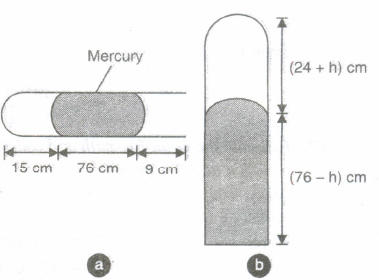
A meter long narrow bore held horizontally (and closed at one end) contains a 76 Cm long mercury thread which traps a 15 Cm column of air. What happens if the tube is held vertically with the open end at the bottom?
3.
Four moles of an ideal gas having \(\gamma \) = 1.67 are mixed with 2 moles of another ideal gas having\(\gamma \) = 1.4.Find the value of \(\gamma \) for resulting mixture of gases
4.
You are given, the following data about a group of particles, where ni represents the number of molecules with speed vi
| ni | 2 | 4 | 8 | 6 | 3 |
| vi(ms-1) | 1.0 | 2.0 | 3.0 | 4.0 | 5.0 |
Calculate
(i) average speed
(ii) rms speed
(iii) most probable speed
5.
Given below are densities of some solids and liquids.Give rough estimate of the size of their atoms.
| Substance | Atomic Mass(u) | Density (10-3 kgm-3) |
| (i) Carbon(diamond) | 12.01 | 2.22 |
| (ii) Gold | 197.00 | 19.32 |
| (iii) Nitrogrn(liquid) | 14.01 | 1.00 |
| (iv) Lithium | 6.94 | 0.53 |
| (v) Fluorine(liquid) | 19.00 | 1.14 |
[Hint : Assume the atoms to be ‘tightly packed’ in a solid or liquid phase, and use the known value of Avogadro’s number. You should, however, not take the actual numbers you obtain for various atomic sizes too literally. Because of the crudeness of the tight packing approximation, the results only indicate that atomic sizes are in the range of a few Å].
6.
A box of 1.00 m3 is filled with nitrogen at 1.5 atm at 300 K. The box has a hole of an area 0.010 mm2 . How much time is required for the pressure to reduce by 0.10 atm, if the pressure outside is 1 atm.
1.
From kinetic theory of gases, the pressure P exerted by an ideal gas of density p and r.m.s. velocity of its gas molecules C is given by
\(p=\frac { 1 }{ 3 } \rho C^{ 2 }\)
Mass of unit volume of the gas = 1 x P = P
Mean kinetic energy of translation per unit volume of the gas is
\(E=\frac { 1 }{ 2 } \rho C^{ 2 }\)
\(\\ \therefore \frac { P }{ E } =\frac { (1/3)\rho C^{ 2 } }{ (1/2)\rho C^{ 2 } } =\frac { 2 }{ 3 } \)
\(\\ or\ P=\frac { 2 }{ 3 } E\)
The pressure exerted by an ideal gas is numerically equal to two third of the mean kinetic energy of translation per unit volume of the gas. " Average Kinetic Energy per Molecule of the Gas
Consider one gram mole of an ideal gas occupying a volume V at temperature T. Let m be the mass of each molecule of the gas. Then
M = m x NA
where NA is Avogadro's number.
If C is the r.m.s. velocity of the gas molecules, then pressure P exerted by ideal gas is
\(P=\frac { 1 }{ 3 } { PC }^{ 2 }=\frac { 1 }{ 3 } \frac { M }{ V } { C }^{ 2 }\)
\(\\ or\ PV=\frac { 1 }{ 3 } M{ C }^{ 2 }\)
From perfect gas equation, PV = RT, where R is a universal gas constant for one gram mole of the gas
\(\therefore \) \(\frac { 1 }{ 3 } { MC }^{ 2 }=RT\quad OR\quad \frac { 1 }{ 3 } { MC }^{ 2 }=\frac { 3 }{ 2 } RT\)
\(\therefore \) Average kinetic energy of translation of one mole of the gas
\(\frac { 1 }{ 3 } { MC }^{ 2 }=\frac { 3 }{ 2 } RT\)
\(or\frac { 1 }{ 2 } mN_{ A }{ C }^{ 2 }=\frac { 3 }{ 2 } RT\)
\(\\ or\ \frac { 1 }{ 2 } mC^{ 2 }=\frac { 3 }{ 2 } \left( \frac { R }{ N_{ A } } \right) T=\frac { 3 }{ 2 } k_{ B }T\)
where k8 is called Boltzmann constant.
\(\therefore \) Average K.E. of translation per molecule of gas
\(\frac { 1 }{ 2 } mC^{ 2 }=\frac { 3 }{ 2 } k_{ B }T\)
2.
When the tube is held horizontally, the mercury thread of length 76 cm traps a length of air = 15 cm. A length of 9 Cm of the tube will be left at the open end. The pressure of air enclosed in
tube will be atmospheric pressure. Let area of cross-section of the tube be 1sq. cm.
\(\therefore \) P1 = 76 Cm and V1 = 15 Cm3
When the tube is held vertical1y, 15 em air gets another 9 cm of air (filled in the right handside in the horizontal position) and let h cm of mercury flows out to balance the atmospheric pressure. Then the heights of air column and mercury column are (24 + h) cm and (76 - h) cm respectively.
The pressure of air = 76 - (76 - h) -h cm of mercury.
\(\therefore \) V2 = (24 + h) CM3 and P2 = h cm
If we assume that temperature remains constant, then
P1V1 =P2 V2 or 76 x 15 = h x (24 + h) or h2 + 24h - 1140 = 0
\(or \ h=\frac { -24\pm \sqrt { \left( { 24 } \right) ^{ 2 }+4\times 1140 } }{ 2 } =23.8\ cm\ or\ -47.8cm\)
Since h cannot be negative(because more mercury cannot flow into the tube), therefore h = 23.8 cm thus in the vertical position of the tube, 23.8 cm of mercury flows out.
3.
Let
CV´= molar heat capacity of the first gas,
CV´´ = molar heat capacity of the second gas,
CV = molar heat capacity of the mixture,
and similar symbols for other quantities. Then,
γ= C′p/C′V=1.67
and
C′P=C′V+R
This gives
C′V=3/2R and C′P=5/2R
Similarly, γ = 1.4 gives C′′V=5/2R
and C′′P=7/2R
Suppose the temperature of the mixture is increased by dT. The increase in the internal energy of the first gas = n1C′VdT.
The increase in internal energy of the second gas = n2C′′VdT.
Thus, \(\left(n_1+n_2\right) C_V d T=n_1 C_V^{\prime} d T+n_2 C V " d T
\)
or, \(C_V=\frac{n_1 C_v^{\prime}+n_2 C_v^{\prime \prime}}{n_1+n_2}\)
\( C_P=C_V+R=\frac{n_1 C_v^{\prime}+n_2 C_v^{\prime \prime}}{n_1+n_2}+R \)
\( =\frac{n_1\left(C_v^{\prime}+R\right)+n_2\left(C_v^{\prime \prime}+R\right)}{n_1+n_2} \)
\(=\frac{n_1 C_p^{\prime}+n_2 C_p^{\prime \prime}}{n_1+n_2} \ldots(2)\)
From (1) and (2),
\( Y=\frac{C_p}{C_V}=\frac{n_1 C_p^{\prime}+n_2 C_p^{\prime \prime}}{n_1 C_V^{\prime}+n_2 C_V^{\prime \prime}} \)
\( \frac{4 \times \frac{5}{2} R+2 \times \frac{7}{2} R}{4 \times \frac{3}{2} R+2 \times \frac{5}{2} R}=1.54
\)
4.
(i) Average speed
\(=\frac { { n }_{ 1 }{ v }_{ 1 }+{ n }_{ 2 }{ v }_{ 2 }+{ n }_{ 3 }{ v }_{ 3 }+{ n }_{ 4 }{ v }_{ 4 }+{ n }_{ 5 }{ v }_{ 5 } }{ n_{ 1 }+{ n }_{ 2 }+{ n }_{ 3 }+{ n }_{ 4 }+{ n }_{ 5 } }\)
\( \\ =\frac { 2\times 1+4\times 2+8\times 3+6\times 4+3\times 5 }{ 2+4+8+6+3 }\)
\( \\ =3.17\ m/s\)
(ii) Root mean square speed
\(=\sqrt { \frac { { n }_{ 1 }{ v }_{ 1 }^{ 2 }+{ n }_{ 2 }{ v }_{ 2 }^{ 2 }+{ n }_{ 3 }{ v }_{ 3 }^{ 2 }+{ n }_{ 4 }{ v }_{ 4 }^{ 2 }+n_{ 5 }{ v }_{ 5 }^{ 2 } }{ { n }_{ 1 }+{ n }_{ 2 }+{ n }_{ 3 }+{ n }_{ 4 }+{ n }_{ 5 } } } \)
\(\\ =\sqrt { \frac { 2\times { 1 }^{ 2 }+4\times { 2 }^{ 2 }+8\times { 3 }^{ 2 }+6\times 4^{ 2 }+3\times { 5 }^{ 2 } }{ 2+4+8+6+3 } }\)
\(=3.36\ m/s\)
(iii)The most probable speed is that speed which is possessed by maximum of molecules.
\(Most\ protable\ speed\ ({ V }_{ mp })=\sqrt { \frac { 2{ K }_{ B }T }{ m } } =\sqrt { \frac { 3{ K }_{ B }T }{ 3 } \times 2/3 } \)
\(\\ { v }_{ mp }=\sqrt { \frac { 2 }{ 3 } } \times \sqrt { \frac { 3{ K }_{ B }T }{ 3 } } =\sqrt { \frac { 2 }{ 3 } { V }_{ rms } } =\sqrt { \frac { 2 }{ 3 } } \times 3.36\ m/s\)
\(=0.816\times 3.36\ m/s\ =2.74\ m/s\)
5.
We know, that density of an element
\(\rho =\frac { Mass }{ Volume } =\frac { Mass\ of\ 1\ mole }{ Total\ volume\ of\ molecules\ in\ 1\ mole\ when\ closely\ packed } \)
\( \rho =\frac { M(in\ grams) }{ \left( \frac { 4 }{ 3 } \pi { r }^{ 3 } \right) { N }_{ A } } =\frac { 3M\times { 10 }^{ -3 }kg }{ 4\pi { r }^{ 3 }.{ N }_{ A } }\)
\( \\ \Rightarrow r=\left[ \frac { 3M\times { 10 }^{ -3 } }{ 4\pi { N }_{ A }.\rho } \right] ^{ \frac { 1 }{ 3 } },\)
\(\\ where,{ N }_{ A }=Avogardo's\ number\simeq 6\times { 10 }^{ 23 }\)
(i) \(For\quad carbon\ (diamond),\)
\(\\ M=12.01,\rho =2.22\times { 10 }^{ 3 }kg/{ m }^{ 3 }\)
\(\\ \therefore Radius\ of\ carbon\ atom\)
\(\\ r=\left[ \frac { 3\times 12.01\times { 10 }^{ -3 } }{ 4\times 3.14\times 6\times \times { 10 }^{ 23 }\times 2.22\times { 10 }^{ 3 } } \right] ^{ \frac { 1 }{ 3 } }\)
\(\\ \ =1.29\times { 10 }^{ -10 }m=1.29\overset { 0 }{ A } .\)
(ii) For gold, M = 197.00,p = 19.32 x 10 3 kg/m3
\(\therefore\) Radius of gold atom
\(r=\left[\frac{3 \times 197 \times 10^{-3}}{4 \times 3.14 \times 6 \times 10^{23} \times 19.32 \times 10^{3}}\right]^{\frac{1}{3}}\)
= 1.59 x 10- 10 m = 1.59 \(\overset { 0 }{ A } \)
(iii) For nitrogen (liquid)
M = 14.01, P = 1.00 x 10³ kg / m3
\(\therefore\) Radius of nitrogen atom
\(r=\left[\frac{3 \times 14.01 \times 10^{-3}}{4 \times 3.14 \times 6 \times 10^{23} \times 1.0 \times 10^{3}}\right]^{ \frac { 1 }{ 3 } }\)
= 1.77 x 10- 7 m = 1.77 \(\overset { 0 }{ A } \)
(iv) For lithium, M = 6.94, P = 0.53 c 103 kg/ m3
\(\therefore\) Radius of lithium atom
\(r=\left[\frac{3 \times 6.94 \times 10^{-3}}{4 \times 3.14 \times 6 \times 10^{23} \times 0.53 \times 10^{3}}\right]^{ \frac { 1 }{ 3 } }\)
= 1.73 x 10- 10 m = 1.73 \(\overset { 0 }{ A } \)
(v) For flourine (liquid),
M = 19.00 and p = 1.14 x 10³ kg / m3
\(\therefore\) Radius of fluorine atom
\(r=\left[\frac{3 \times 19.0 \times 10^{-3}}{4 \times 3.14 \times 6 \times 10^{23} \times 1.14 \times 10^{3}}\right]^{\frac{1}{3}}\)
= 1.88 x 10- 10 m= 1.88 \(\overset { 0 }{ A } \)
6.
Given, volume of the box, V = 1.00 m 3
Area, a = 0.010 mm2 = 10 -8m2
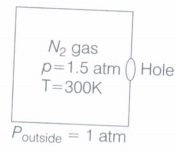
Temperature outside = Temperature inside
Initial pressure inside the box = 1.50 atm.
Final pressure inside the box = 0.10 atm
Assuming,
vix = Speed of nitrogen molecule inside the box along x-direction
n1= Number of molecules per unit volume in a time interval of \(\triangle\)t, all the particles at a distance (vix\(\triangle\) t) will collide the hole and the wall, the particle colliding along the hole will escape out reducing the pressure in the box.
Let area of the wall is A, number of particles colliding in time, \(\triangle\)t
\(=\frac{1}{2} n_{1}\left(v_{i x} \Delta t\right) A\)
\(\frac{1}{2}\) is the factor because all the particles along x- direction are behaving randomly. Hence, half of these are colliding against the walls on either side.
Inside the box \(v_{i x}^{2}+v_{i y}^{2}+v_{i z}^{2}=v_{\mathrm{rms}}^{2}\)
\(\Rightarrow \quad v_{i x}^{2}=\frac{v_{\mathrm{rms}}^{2}}{3} \quad\left[\because v_{i x}=v_{i y}=v_{i z}\right]\)
If particles collide along hole, they move out. Similarly, outer particles colliding along hole will move in.
If a = area of hole
Then, net particle flow in time,
\(\Delta t=\frac{1}{2}\left(n_{1}-n_{2}\right) \frac{k_{B} T}{m} \Delta t a \quad\left[\because v_{\mathrm{rms}}=\sqrt{\frac{3 k_{B} T}{m}}\right]\)
[Temperature inside and outside the box are equal]
Let n = number of density of nitrogen
\(n=\frac{\mu N_{A}}{V}=\frac{p N_{A}}{R T} \quad\left[\because \frac{\mu}{V}=\frac{p}{R T}\right]\)
Where, NA = Avogadro's number
If after time \(\triangle\)t , pressure inside changes from P to p'1
\(\therefore \quad n_{1}^{\prime}=\frac{p_{1}^{\prime} N_{A}}{R T}\)
Now, number of molecules gone out = \(n_{1} V-n_{1}^{\prime} V\)
\(=\frac{1}{2}\left(n_{1}-n_{2}\right) \sqrt{\frac{k_{B} T}{m}} \Delta t a\)
\(\therefore \frac{p_{1} N_{A}}{R T} V-\frac{p_{1}^{\prime} N_{A}}{R T} V=\frac{1}{2}\left(p_{1}-p_{2}\right) \frac{N_{A}}{R T} \sqrt{\frac{k_{B} T}{m}} \Delta t a\)
\(\Rightarrow \quad \Delta t=2\left(\frac{p_{1}-p_{1}^{\prime}}{p_{1}-p_{2}}\right) \frac{V}{a} \sqrt{\frac{m}{k_{B} T}}\)
Putting the values from the data given,
\(\Delta t=2\left(\frac{1.5-1.4}{1.5-1.0}\right) \frac{1 \times 1.00}{0.01 \times 10^{-6}} \sqrt{\frac{46.7 \times 10^{-27}}{1.38 \times 10^{-23} \times 300}}\)
\(=\frac{2}{5} \times 3.358 \times 10^{5}=\frac{6.717}{5} \times 10^{5}\)
\(\tau\) = 1.34 x 10⁵ s.

11th Standard CBSE Syllabus & Materials
11th Standard CBSE
CBSE 11th Business Studies Forms of Business Organisation Sample Question Papers Study Material - QB365 Set A
NEW11th Standard CBSE
CBSE 11th Business Studies Business, Trade and Commerce Sample Question Papers Study Material - QB365 Set A
NEW11th Standard CBSE
CBSE 11th Physics Waves Sample Question Papers Study Material - QB365 Set A
NEW11th Standard CBSE
CBSE 11th Physics Kinetic Theory Sample Question Papers Study Material - QB365 Set A



CBSE 11th Standard CBSE Subjects
CBSE Standards









