
 100% FREE ACCESS
11th Standard CBSE Syllabus & Materials
11th Standard CBSE
CBSE 11th Economics PART-A - Presentation of Data - New Sample Question Papers Study Material - QB365 Set A
NEW11th Standard CBSE
CBSE 11th Economics PART-A - Organisation of Data - New Sample Question Papers Study Material - QB365 Set A
NEW11th Standard CBSE
CBSE 11th Economics PART-A - Collection of Data - New Sample Question Papers Study Material - QB365 Set A
NEW11th Standard CBSE
CBSE 11th Economics PART-A - Introduction to Economics and Statistics - New Sample Question Papers Study Material - QB365 Set A
NEW11th Standard CBSE
CBSE 11th Business Studies International Trade Sample Question Papers Study Material - QB365 Set A
NEW11th Standard CBSE
CBSE 11th Business Studies Evolution and Fundamentals of Business Sample Question Papers Study Material - QB365 Set A

Published on: 05/10/2019
Laws of Motion
Download CBSE Class 11th Standard CBSE Physics question papers, sample papers, important questions, and previous year solved papers in PDF format. Get free study materials, NCERT solutions, and exam preparation resources for Class 11th Standard CBSE Physics
Questions + Answers key
Take MCQ Physics Test
1.
State Newton's third law of motion. Discuss its consequences
2.
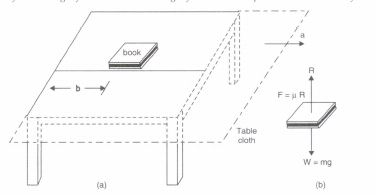
A book rests on a tablecloth spread over a table as shown in Fig. The centre of the book is at a distance of b from the edge of the table at time t = 0; the tablecloth is suddenly pulled at this instant with an acceleration a. Show that the cloth will slip from under the book if a > \(\mu\)g, where \(\mu\) is the coefficient of sliding friction between the tablecloth and the book. Assuming this condition to be satisfied, calculate
(i) time instant,
(ii) the velocity, and
(iii) the distance of the centre of the book from the edge of the table when the edge of the tablecloth passes over the centre of the book
3.
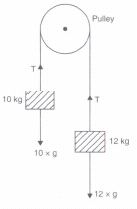
Two bodies with masses 10 kg and 12 kg are connected by a light inextensible string passing over a smooth fixed pulley. Find (a) the velocity at the end of 3 s, (b) the distance covered in 3 s, (c) if, at the end of 3 s the string is cut, find the distance moved by the bodies in the next 6 s.
4.
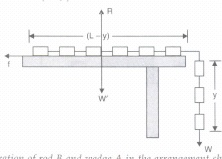
Assuming the length of a chain to be L and coefficient of static friction μ, calculate the maximum length of the chain which can be held outside a table without sliding.
5.
State Newton's second law of motion. How does it help to measure force? Also state the units of force.
6.
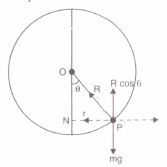
A thin circular loop of radius R rotates about its vertical diameter with an angular frequency \(\omega\) .Show that a small bead on the wire loop remains at its lowermost point for \(\omega \sqrt{g/R}\) . What is the angle made by the radius vector joining the centre to the bead with the vertical downward direction for \(\omega\)= \(\sqrt{2g / R}\) ? Neglect friction.
7.
Vipul was driving on the road with his old grandmother. She was sitting on the front seat with him. When vipul was about to reach his destination, he stopped the engine and did not apply the brakes. Even then the car was running on the road for sometimes.
His grandmother surprised and asked her grandson the reason the car running without the engine on. Vipul was the student of science studying in class XIth. He explained his grandmother that it is only the momentum due to which the car is going on.
(i) What values Vipul exhibit here ?
(ii) What is momentum and on which factor it depends ?
8.
A girl riding a bicycle along a straight road with a speed of 5 m/ s throws a stone of mass 0.5 kg which has a speed of 15 m /s with respect to the ground along her direction of motion. The mass of the girl and bicycle is 50 kg. Does the speed of the bicycle change after the stone is thrown ? What is the change in speed, if so ?
9.
The radius of curvature of a railway track at a place, where the train is moving at a speed of 72kmh-1 is 625m. The distance between the rails is 1.5m. Find the angle and the elevation of the out rails so that there may be no side pressure on the rails. Take, g = 9.8 \({ m }/{ { { s }^{ 2 } } }\)
\(\left[ { tan }^{ -1 }(0.00653)=3.7{ 4 }^{ o },sin3.7{ 4 }^{ o }=0.06522 \right] \)
10.
A circular racetrack of radius 300 m is banked at an angle of 15°. If the coefficient of friction between the wheels of a race-car and the road is 0.2, what is the (a) optimum speed of the racecar to avoid wear and tear on its tyres, and (b) maximum permissible speed to avoid slipping ?
11.
A cyclist speeding at 18 km/h on a level road takes a sharp circular turn of radius 3 m without reducing the speed. The co-efficient of static friction between the tyres and the road is 0.1. Will the cyclist slip while taking the turn?
1.
Newton's third law of motion states that for any action, there is equal and opposite reaction.
So, if a body applies a force F12 on body 2 (action), then body 2 also applies a force F21 on body 1 but in opposite direction, then
F21 = - F12
In terms of magnitude
|F21| = |F12|
It is very important to note that F12 and F21 though are equal in magnitude and opposite in direction yet act on different points or else no motion will be possible.
For example, hands pull up a chest expander (spring) and spring in turn exerts force on the arms. A football pressed reacts on the foot with the same force and so on.
The most important consequence of the third law of motion is the law of conservation of linear momentum and its application in collision problems.
Since F12 - F21 and F = m\(\triangle v\over \triangle t\)
\(\therefore m_1{\triangle v_1\over \triangle t}=-m_2{\triangle v_2\over \triangle t}\)
Here \(\triangle t\) is the time for which the bodies come in contact during impact. This is same for the two bodies of masses m1and m2 and having velocity changes \(\triangle v_1\) and\(\triangle v_2\) respectively.
Therefore,
m1\(\triangle v_1\)= m2 \(\triangle v_2\)
or m1 \(\triangle v_1\)+ m2 \(\triangle v_2\) = 0
Let u1, u2 and v1,v2 be the initial and final velocities of the two masses before and after collision, then,
m1 (v1 -u1) = - m2 (v2 - u2)
or m1 u1 + m2 u2 = m1 v1 + m2 v2
Momentum before impact = Momentum after impact.
(This is known as the law of conservation of momentum).
2.
The forward pulling of the tablecloth will tend to push the book backwards. The force of friction on the book will, therefore, be in the forward direction and will have a magnitude
\(F=\mu R =\mu m g\)
where m is the mass of the book. The acceleration of the book will, therefore, be
\({F\over m}={\mu m g \over m}=\mu g\)
Thus if,\(\mu\)g < a, the acceleration of the tablecloth, the cloth will slip from under the book. At the instant (say t = t), the edge of the tablecloth comes under the centre of the book, the distance of the tablecloth edge and the centre of the book from the edge of the table must be the same. Now the distance moved by the edge of the tablecloth (the initial distance from the edge of the table is zero) in a time t is
\(x'={0+{1\over2}a t^2}\) (the tablecloth is at rest at t = 0)
The distance moved by the centre of the book in time t is
\(x'={b+{1\over2}(\mu g)t^2}\) (acceleration of the book =\(\mu\),g)
The time instant t is, therefore, given by
\({1\over 2}a \ t^2={1\over2}\mu g t^2 +b\)
or t2 (a -\(\mu\)g)=2 b
or \(t=\sqrt{2b\over (a-\mu g)}\)
The velocity of the book and the distance of its centre from the edge of the table at this instant are given by
\(v=0+\mu g \sqrt{2b\over (a-\mu g)}\)
\(=\sqrt{2b\mu^2 g^2\over (a-\mu g)}\)
and \(s=b+{1\over2}\mu g{2b\over(a-\mu g)}\)
\(=b\{ {1+{\mu g\over (a- \mu g)}} \}\)
\(={ab\over (a-\mu g)}\)
3.
Let T be the tension in the string and a the common acceleration of the two masses.
Writing the equations of motion of the two masses, we have
12 x g - T = 12 x a
and T - 10 x g = 10 x a
Adding these equations, we get
\(a={9\over11}={9.8\over11}=0.89 ms^{-2}\)
(a) Since the bodies start from rest, their velocity at the end of 3 s is
v3 = 0 + 0.89 x (3)2 = 2.67 ms-2
(b) The distance moved by each body in 3s is
S3 = 0 + \({1\over2}\)x 0.89 x (3)2= 4.005 m
(c) At the end of 3s, the string is cut. The bodies now fall freely under gravity. We now have for the 10 kg mass
u =2.67 ms-1 upwards
a = 9.8 ms-2 downwards
t=6 s
\(\therefore\) s = \(({2.67\times 6+{1\over2}\times 9.8\times 6^2})\)
=192.4 m
4.
Let y be the maximum length of the chain, which can be held outside the table without sliding.
Length of the chain on the table = (L-y)
Weight of this part of chain, W'= \(\frac{M}{L}\)(L-y)g
Weight of hanging part of chain W=\(\frac{M}{L}\)g
For equilibrium, according to Fig.
force of friction (f) = wt. of hanging part of chain
μR = W
μW' = W
μ.\(\frac{M}{L}\)(L-y)g
μ mg-μ\(\frac{Myg}{L}\) = \(\frac{M}{L}\)yg
μ Mg = \(\frac{M}{L}\) yg (1+μ)
u = \(\frac { \mu L }{ (1+\mu ) } \)
5.
Newton's second law of motion states that the rate of change of momentum of a rigid body is directly proportional to the force applied on it.
The law implies that when a bigger force is applied on a body of given mass, its linear momentum changes faster and vice-versa. The momentum will change in the direction of the applied force.
Let, m = mass of a body,
\(\overrightarrow{v}\)= velocity of the body
\(\therefore\)The linear momentum of the body
\(\overrightarrow{p}=m\overrightarrow{v}\) .............(i)
Now, suppose \(\overrightarrow{F}\) = external force applied on the body in the direction of motion of the body.
\(\triangle \overrightarrow{p}\)= a small change in linear momentum of the body in a small time \(\triangle t\).
Rate of change of linear momentum of the body = \({\triangle \overrightarrow{p}\over \triangle t}\)
According to Newton's second law,
\({\triangle \overrightarrow{p}\over \triangle t} \propto \overrightarrow{F} \ or \ \overrightarrow{F} \propto {\triangle \overrightarrow{p}\over \triangle t} \)
or \(\overrightarrow {F}=k{\triangle \overrightarrow{p}\over \triangle t}\) ..................(ii)
where k is a constant of proportionality.
Taking the\(\triangle t \rightarrow 0,\) the term \(={\triangle \overrightarrow{p}\over \triangle t}\) becomes the derivative or differential coefficient of \(\overrightarrow{p}\) w.r.t. time t. It is denoted by \({d\overrightarrow{p}\over dt}\) .
\(\therefore \overrightarrow{F}=k{d\overrightarrow p \over dt}\)
Using eqn (i), \(\overrightarrow{F}=k{d \over dt}(m\overrightarrow{v})=km{d\overrightarrow{v}\over dt}\)
\(\overrightarrow {F}=km\overrightarrow{a}\)
where \(\overrightarrow{a}={d\overrightarrow{v}\over dt}\) represents acceleration of the body
The value of constant of proportionality k depends on the units adopted for measuring the force.
Now, putting k=1
\(\overrightarrow{F}=m\overrightarrow{a},\) This gives mean of measuring force.
Units of Force: Force in SI units is measured in 'newton' or N. From the relation \(\overrightarrow{F}=m\overrightarrow{a},\) we can see that a newton force is that force which produces 1 ms-2 acceleration in a body of mass 1 kg.
1 newton = 1 kilogram x 1 metre/ second2
\(\Rightarrow\) 1 N = 1 kg x 1 ms-2 = 1 kg x ms-2=1kg ms-2
In CGS system, force is measured in 'dyne'.
1 dyne = 1 gram x 1 cm s-2 = 1 g cm s-2
Since 1 N = 1 kg ms-2 = 1000 g x 100 cm s-2
= 105 g cm s-2= 105 dyne.
\(\Rightarrow\)IN = 105 dyne.
or 1 dyne = 10-5 N.
6.
Let the radius vector joining the bead to the centre of the wire make an angle \(\theta\) with the vertical downward direction. If N is normal reaction,
mg = N cos\(\theta\) ...(i)
mr\(\omega ^2\) = N sin \(\theta\) ...(ii)
or m (R sin \(\theta\)) \(\omega ^2\)= N sin \(\theta\)
or mR\(\omega ^2\) = N
From equation (i), mg = mR\(\omega ^2\)cos\(\theta\)
or \(cos \theta ={g\over R\omega ^2}\) ......(iii)
As\(|cos \theta| \le 1\),therefore bead will remain at its lowermost point for \({g\over R \omega ^2 }\le 1 or \ \omega \le \sqrt{{g\over R}}\)
When \(\omega =\sqrt{2g\over R}\) from equation (iii),
\(cos \theta ={g\over R}({R\over 2g})={1\over 2}\)
\(\therefore \ \theta =60^o\)
7.
(i) The values displayed by vipul are intelligence and awarness.
(ii) Momentum of a body is defined as the product of its mass and velocity with which it is moing.
Momentum = Mass x Velocity
Momentum of body depends upon its mass and the velocity.
8.
Total mass of girl, bicycle and stone, m1 = ( 50 + 0.5 ) kg = 50.5 kg
Velocity of bicycle, u1 = 5 m/ s
Mass of stone, m2 = 0.5 kg
Velocity of stone, u2 = 15 m /s
Mass of girl and bicycle, m = 50 kg
Yes, the speed of the bicycle changes after the stone is thrown.
Let, after throwing the stone the speed of bicycle be \(\nu \) m /s.
According to the law of conservation of linear momentum,
m1u1 = m2u2 + m\(\nu \)
50.5 x 5 = 0.5 x 15 + 50 x \(\nu \)
252.5 - 705 = 50\(\nu \) or \(\nu \) = \(\frac { 245.0 }{ 50 } \)
\(\nu \) = 4.9 m/ s
Change in speed = 5 - 4.9 = 0.1 m / s
9.
Here, r = 625m, v = 72kmh-1
\(v=72\times \frac { 5 }{ 18 } { m }/{ s }\)
\(v=20{ m }/{ s },g=9.5{ m }/{ { s }^{ 2 },l=1.5m }\)
Now. angle of elevation of outer rail i.e.\(\tan { \theta =\frac { { v }^{ 2 } }{ rg } } \)
\(\tan { \theta =\frac { 20\times 20 }{ 625\times 9.8 } } =0.00653\)
\(\\ \theta \tan { ^{ -1 }=(0.00653 } )\)
\(\\ \theta \ =37.{ 4 }^{ o }\)
Also, elevation of outer rail h =l \(\sin { \theta } \)
h = 1.5 sin 3.74o
h = 0.0978 m = 9.78 cm
10.
On a banked road, the horizontal component of the normal force and the frictional force contribute to provide centripetal force to keep the car moving on a circular turn without slipping. At the optimum speed, the normal reaction’s component is enough to provide the needed centripetal force, and the frictional force is not needed. The optimum speed vo is given by Eq
\({ v }_{ o }\) = \((Rg\tan { \theta { ) }^{ { 1 }/{ 2 } } } \)
Here R = 300 m, θ = 15°, g = 9.8 m s-2;
we have vo = 28.1 m s-1 .
The maximum permissible speed vmax is given by Eq
\({ v }_{ max }\quad =\left( Rg\frac { { \mu }_{ s }+\tan { \theta } }{ 1-{ \mu }_{ s }\tan { \theta } } \right) ^{ { 1 }/{ 2 } } = 38.1 ms^{-1}\)
11.
On an unbanked road, frictional force alone can provide the centripetal force needed to keep the cyclist moving on a circular turn without slipping. If the speed is too large, or if the turn is too sharp (i.e. of too small a radius) or both, the frictional force is not sufficient to provide the necessary centripetal force, and the cyclist slips. The condition for the cyclist not to slip is given by Eq.
v2 ≤ µs R g
Now, R = 3 m, g = 9.8 m s-2 , µs = 0.1. That is, µs R g = 2.94 m2 s-2. v = 18 km/h = 5 m s-1; i.e., v 2 = 25 m2 s-2. The condition is not obeyed. The cyclist will slip while taking the circular turn.

11th Standard CBSE Syllabus & Materials
11th Standard CBSE
CBSE 11th Business Studies Forms of Business Organisation Sample Question Papers Study Material - QB365 Set A
NEW11th Standard CBSE
CBSE 11th Business Studies Business, Trade and Commerce Sample Question Papers Study Material - QB365 Set A
NEW11th Standard CBSE
CBSE 11th Physics Waves Sample Question Papers Study Material - QB365 Set A
NEW11th Standard CBSE
CBSE 11th Physics Kinetic Theory Sample Question Papers Study Material - QB365 Set A



CBSE 11th Standard CBSE Subjects
CBSE Standards









