
 100% FREE ACCESS
11th Standard CBSE Syllabus & Materials
11th Standard CBSE
CBSE 11th Economics PART-A - Presentation of Data - New Sample Question Papers Study Material - QB365 Set A
NEW11th Standard CBSE
CBSE 11th Economics PART-A - Organisation of Data - New Sample Question Papers Study Material - QB365 Set A
NEW11th Standard CBSE
CBSE 11th Economics PART-A - Collection of Data - New Sample Question Papers Study Material - QB365 Set A
NEW11th Standard CBSE
CBSE 11th Economics PART-A - Introduction to Economics and Statistics - New Sample Question Papers Study Material - QB365 Set A
NEW11th Standard CBSE
CBSE 11th Business Studies International Trade Sample Question Papers Study Material - QB365 Set A
NEW11th Standard CBSE
CBSE 11th Business Studies Evolution and Fundamentals of Business Sample Question Papers Study Material - QB365 Set A

Published on: 27/09/2019
Mechanical Properties of Fluids
Download CBSE Class 11th Standard CBSE Physics question papers, sample papers, important questions, and previous year solved papers in PDF format. Get free study materials, NCERT solutions, and exam preparation resources for Class 11th Standard CBSE Physics
Questions + Answers key
Take MCQ Physics Test
1.
vertical barometer tube 100 cm in length and dipping into mercury contains a small quantity of air. When the open end is 15 cm below the surface of mercury the meniscus is 30 cm from the upper closed end. When the tube is pushed into the mercury so that the open end is 35 cms below the surface, the meniscus is 20 cm from the closed end. Calculate the atmospheric pressure.
2.
Find the height to which water at 4°C will rise in a capillary tube of 10-3 m diameter. Take g = 9.8 ms-2. Angle of contact, \(\theta\) = 0 and T = 0.072 Nm-1.
3.
Derive the condition of floatation of a body.
4.
Two soap bubbles in vacuum having radii 3 cm and 4 cm respectively coalesce under isothermal conditions to from a single bubble. What is the radius of the new bubble?
5.
If work required to blow a soap bubble of radius r is W, then uihat additional work is required to be done to blow it to a radius 3r?
6.
Why are the wings of an aeroplane rounded outwards while flattened inwards?
7.
it piece of an alloy of mass 96 gm is composed of two metals whose specific gravities are 11.4 and 7.4. If the weight of the alloy is 86 gm in water, find the mass of each metal in the alloy.
8.
The excess pressure inside a soap bubble is thrice the excess pressure inside a second soap bubble. What is the ratio between the volume of the first and the second bubble?
9.
A U-tube contains water and methylated spirit separated by mercury. The mercury columns in the two arms are in level with 10.0 cm of water in one arm and 12.5 cm of spirit in the other. What is the specific gravity of spirit ?
10.
The flow rate of water from a tap of diameter 1.25 cm is 0.48 L/min. The coefficient of viscosity of water is 1O-3Pa-s. After some time the flow rate is increased to 3 L / min. Characterize the flow for both the flow rates.
11.
Show that ifn equal rain droplets falling through air with equal steady velocity ono cms-1 coalesce, the resultant drop attains a new terminal velocity ono n2/3cms- 1.
12.
What is the corresponding flow rate? (Take viscosity of blood to be 2.084\(\times\) 10- 3Pa-s)
13.
(a) What is the largest average velocity of blood flow in an artery of radius 2 \(\times\) 10- 3m, if the flow must remain laminar?
(b) What is the corresponding flow rate ? (Take viscosity of blood to be 2.084 x 10⁻³ Pa -s)
14.
Two soap bubbles have radii in the ratio2:3.Compare the excess of pressure inside these bubbles.
15.
27 identical drops of water are falling down vertically in air each with a terminal velocity 0.15\(ms^{ -1 }\)>if they combine to form a single bigger drop, what will be its terminal velocity?
1.
Let the atmospheric pressure be P and area of cross section of the tube be a.
Case (i): Length of air column = 30 cm
\(\therefore\) Volume of air, V1 = (20 x a) c.c,
Length of mercury column = 100 - (30 + 15) = 55 cm.
Pressure P1 of air in tube = (P - 55) cm
Case (ii): Length of air column = 20 cm.
\(\therefore\) Volume of air, V2 = (20 x a) c.c.
Length of mercury column = 100 - (20 + 35) = 45 cm.
Pressure P2 of air in tube = (P - 45) cm.
Applying Boyle's law,
P1V1 = P2V2
(P - 55) x 30 a = (P - 45) x 20 a
Solving, we get, P = 75 cm.
2.
Here D = 10-3 m
r = \({D\over 2}\) = 0.5 x 10⁻³ m
g = 9.8 ms-2, \(\theta\) = 0, T = 72 x 10-3 Nm-1
cos\(\theta\) = 1
Density of water at 4°C = 103 kg m-3
Using the relation
\(h=\frac{2T\cos\theta}{r\rho g}=\frac{2\times 72\times 10^{-3}\times 1}{5\times 10^{-4}\times 10^3\times 9.8}\)
= 2.939 x 10⁻² m.
3.
When a body floats in a liquid with a part submerged in the liquid, the weight of the liquid displaced by the submerged part is always equal to the weight of the body.
Let V = volume of the body
\(\sigma\) = density of its material
\(\rho\) = density of the liquid in which the body floats such that its
volume V' is outside the liquid.
Then volume of the body inside the liquid = V - V'
Weight of the displaced liquid = (V - V') Pg
Also weight of the body = V \(\sigma\) g
For the body to float,
weight of the liquid displaced by the submerged part = weight of the body
i.e., (V - V') \(\rho g\) = V \(\sigma\) g
or \(V'=\frac{(\rho-\sigma)V}{\rho}\)
4.
Surface energy of first bubble
= Surface area x surface tension
= 2 x 4\(\pi r_1^2\)T = 8\(\pi r_1^2\)T
Surface energy of second bubble = 8n\(\pi r_2^2\)T
Let r be the radius of the coalseced bubble.
\(\therefore\) Surface energy of new bubble = 8\(\pi\)r2T
According to the law of conservation of energy,
8\(\pi\)r2T = 8\(\pi r_1^2\)T + 8\(\pi r_2^2\)T
= \(8\pi(r_1^2 + r_2^2)T\)
\(\therefore\) r2 = \(r_1^2+r_2^2\) = 32 + 42 = 9 + 16 = 25
\(\therefore\) r = 5 cm.
5.
Increase in surface area = 2[4\(\pi\)(3r)2 - 4\(\pi\)r2]
Increase in surface energy = \(\sigma\) x 2 x 4\(\pi\) x 8r2 = 8W
Additional work done = 8W.
6.
The special design of the wings increases velocity at the upper surface and decreases velocity at the lower surface. So, according to Bernoulli's theorem, the pressure on the upper side is less than the pressure on the lower side. This difference of pressure provides lift.
7.
Suppose the mass of the metal of specific gravity 11.4 be m. Now the mass of the second metal of specific gravity 7.4 will be (96 - m).
Volume of first metal = \(\frac{m}{11.4}cm^3\)
Volume of second metal = \(\frac{96-m}{7.4}cm^3\)
Total volume = \(\frac{m}{11.4}+\frac{96-m}{7.4}\)
Apparent loss of wt. in water = \((\frac{m}{11.4}+\frac{96-m}{7.4})\) gm wt.
Apparent wt. in water = \(96-[(\frac{m}{11})+\frac{(96-m)}{7.4}]\)
According to the given problem,
\(96-[(\frac{m}{11})+\frac{(96-m)}{7.4}]=86\)
or \(\frac{m}{11.4}+\frac{(96-m)}{7.4}=10\)
Solving we get, m = 62.7 gm.
\(\therefore\) Mass of second metal = 96 - 62.7 = 33.3 gm.
8.
Given \(\frac{4T}{r_1}=\frac{3\times 4T}{r_2}\) or r2 = 3r1
\(\frac{V_1}{V_2}=\frac{(\frac{4}{3})\pi r_1^3}{(\frac{4}{3})\pi r_2^3}=(\frac{r_1}{r_2})^3=(\frac{1}{3})^3=\frac{1}{27}\)
9.
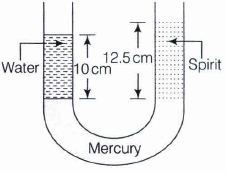
Height of water column, h1 = 10.0 cm
Density of water, \({ \rho }_{ 1 }\) = 1g/ cm 3
Height of spirit column, h2 = 12.S cm
Density of spirit,\({ \rho }_{ 2 }\) =?
The mercury column in both arms of the U-tube are at same level, therefore, pressure in both arms will be same.
Pressure exerted by water column = pressure exerted by spirit column
p1= p2
\({ h }_{ 1 }{ \rho }_{ 1 }g={ h }_{ 2 }{ \rho }_{ 2 }g\ or\ { \rho }_{ 2 }=\frac { { h }_{ 1 }{ \rho }_{ 1 } }{ { h }_{ 2 } } =\frac { 10\times 1 }{ 12.5 } =0.80g/{ cm }^{ 3 }\)
Specific gravity of spirit=\(\frac { Density\ of\ spirit }{ Density\ of\ water } =\frac { 0.80 }{ 1 } =0.80\)
10.
Let the speed of the flow be v.
Given, diameter of tap = d = 1.25 cm
Volume of water flowing out per second.
Q = v \( \times\) \(\frac{\pi d^2}{4} \) \(\Rightarrow\) v = \(\frac{4Q}{d^2\pi}\)
Estimate Reynold's number, Re = \(\frac{4 \rho Q}{\pi d \eta}\)
Q = 0.48 L / min
= 8 \(\times\) 10-3 L/s
= 8 \(\times\)10-6 m3/s
Re = \(\frac{4\times10^3\times8\times10^{-6}}{3.14\times1.25\times10^{-2}\times10^{-3}} \)
Re = 815 [ i.e below 1000, the flow is steady ]
After some time, when
Q = 3L/min
= 5\(\times\)10-5m3/s,
Re = \(\frac{4\times10^3\times5\times10^{-5}}{3.14\times1.25\times10^{-2}\times10{-3}} \)
= 5095
ஃ The flow will be turbulent.
11.
Volume of a bigger drop = n \(\times\) Volume of a smaller droplet
or\( \frac{4}{3} \) \(\pi\) R3 = n\(\times\) \(\frac{4}{3}\) \(\pi \)r3 or R3 = nr3
or R = n1/3 r
Terminal velocity of a small droplet is given by
vs = \(\frac{2}{9}\)\(\frac{R^2}{\eta}\)( \(\rho - rho ^{'}\) ) g .........(i)
Terminal velocity of a bigger drop is given by
vb = \(\frac{2}{9}\)\(\frac{r^2}{\eta}\)(\(\rho - rho^{'}\))g .............(ii)
Dividing Eq. (ii) by Eq. (i), we get
\(\frac{v_b}{v_s}\) = \(\frac{R^2}{r^2}\)
But R = n1/3 r
and vs = 10 cm/s
vb = vs \( \times\) ( \(\frac{R^2}{r^2}\))
= 10 \( \times\) \( \frac{n^{2/3}r^2}{r^2}\)
vb = 10 n2/3 cm/s
12.
Flow rate of blood = Volume of blood flowing per second
= Avc
= \(\pi\)r2\(\times\)vc
= 3.14\(\times\)(2\(\times\)10-3)2\(\times\)9.83\(\times\)105
= 12.35 m3/s
13.
(a) Given, radius of artery ( r ) = 2 \(\times\) 10- 3 m
\(\therefore \) Diameter of artery D = 2r = 4 \(\times\) 10-3m
Density of whole blood ( \(\rho\) ) = 1.06 \(\times\) 103 kg / m3
Coefficient of viscosity of blood ( \(\eta\) ) = 2.084 \(\times\)103 Pa - s
For laminar flow, maximum value of Reynold's number
Re = 2000
Critical velocity ( vc ) = \(\frac{R_e\eta}{\rho D} \)
= \(\frac{2000\times2.084\times10^3}{1.06\times10^3\times4\times10^{-3}} \)
= 9.83 \(\times\)105m / s
(b) Flow rate of blood = Volume of blood flowing per second
= Avc
= \(\pi\)r2\(\times\)vc
= 3.14\(\times\)(2\(\times\)10-3)2\(\times\)9.83\(\times\)105
= 12.35 m3/s
14.
Let R1 and R2 be the radii of the two bubbles.
Then, R1/R2 =2/3
If S is the surface tension of soap solution, then excess of pressure inside the soap bubble of radius R1 is \(p_1=\frac{4 S}{R_1}\)
Excess of pressure inside the soap bubble of
\( \text { radius } R_2 \text { is } p_2=\frac{4 S}{R_2} \)
\(\therefore \frac{p_1}{p_2}=\frac{R_2}{R_1}=\frac{3}{2}\)
Work done in blowing up the soap bubble is
W=S xsurface area of bubble
\( \therefore W_1=S \times\left(2 \times 4 \pi R_1^2\right) \)
\( \text { and } W_2=S \times\left(2 \times 4 \pi R_2^2\right) \)
\( \frac{W_1}{W_2}=\frac{R_1^2}{R_2^2}=\left(\frac{2}{3}\right)^2=\frac{4}{9} .\)
15.
Let R, and r be the radii of the big and small drops respectively.
The volume of the big drop =27 x volume of one small drops
\(\therefore \frac{4}{2} \pi R^3=27 \times \frac{4}{3} \pi r^3 \)
\( \therefore R^3=27 r^3 \ \therefore R=3 r\)
The terminal velocity of a drop \(v \propto{\text { (radius })^2}^2\)
\( \therefore \frac{v_2}{v_1}=\frac{R^2}{r^2}=\frac{(3 r)^2}{r^2}=9 \)
\( \therefore \frac{v_2}{0.15}=9 \ \therefore \ v_2=9 \times 0.15=1.35 \mathrm{~m} / \mathrm{s}\)

11th Standard CBSE Syllabus & Materials
11th Standard CBSE
CBSE 11th Business Studies Forms of Business Organisation Sample Question Papers Study Material - QB365 Set A
NEW11th Standard CBSE
CBSE 11th Business Studies Business, Trade and Commerce Sample Question Papers Study Material - QB365 Set A
NEW11th Standard CBSE
CBSE 11th Physics Waves Sample Question Papers Study Material - QB365 Set A
NEW11th Standard CBSE
CBSE 11th Physics Kinetic Theory Sample Question Papers Study Material - QB365 Set A



CBSE 11th Standard CBSE Subjects
CBSE Standards









