
 100% FREE ACCESS
11th Standard CBSE Syllabus & Materials
11th Standard CBSE
CBSE 11th Economics PART-A - Presentation of Data - New Sample Question Papers Study Material - QB365 Set A
NEW11th Standard CBSE
CBSE 11th Economics PART-A - Organisation of Data - New Sample Question Papers Study Material - QB365 Set A
NEW11th Standard CBSE
CBSE 11th Economics PART-A - Collection of Data - New Sample Question Papers Study Material - QB365 Set A
NEW11th Standard CBSE
CBSE 11th Economics PART-A - Introduction to Economics and Statistics - New Sample Question Papers Study Material - QB365 Set A
NEW11th Standard CBSE
CBSE 11th Business Studies International Trade Sample Question Papers Study Material - QB365 Set A
NEW11th Standard CBSE
CBSE 11th Business Studies Evolution and Fundamentals of Business Sample Question Papers Study Material - QB365 Set A

Published on: 16/09/2019
Mechanical Properties of Fluids
Download CBSE Class 11th Standard CBSE Physics question papers, sample papers, important questions, and previous year solved papers in PDF format. Get free study materials, NCERT solutions, and exam preparation resources for Class 11th Standard CBSE Physics
Questions + Answers key
Take MCQ Physics Test
1.
For the model of a plane in a wind tunnel, turbulence occurs at a ... speed for turbulence for an actual plane (greater / smaller)
2.
For a fluid in a steady flow, the increase in flow speed at a constriction follows (conservation of mass / Bernoulli’s principle)
3.
Why is it that a liquid set in rotation comes to rest after some time?
4.
Why does air bubble in a liquid rise up?
5.
How does the rate of flow of a liquid through a tube depend on the radius of its bore?
6.
Why is the dam of water reservoir thick at the bottom?
7.
Why is the nib of a pen split?
8.
What is (i) velocity head (ii) pressure head?
9.
How excess pressure varies with the radius of bubble of drop?
10.
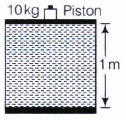
A container of area 0.02 m 2 is filled with water. Find the pressure at the bottom of the container if a weight is placed on the piston. (as shown in the figure).
11.
What should be the average velocity of water in a tube of radius 0.005m so that the flow is just turbulent?The viscosity of water is 0.001 Pa-s.
12.
A balloon with hydrogen in it rises up but a balloon with air comes down, Why?
13.
A vertical off-shore structure is built to withstand a maximum stress of 109 Pa. Is the structure suitable for putting up on top of an oil well in the ocean ? Take the depth of the ocean to be roughly 3 km, and ignore ocean currents.
14.
A hydraulic automobile lift is designed to lift cars with a maximum mass of 3000 kg. The area of cross-section of the piston carrying the load is 425 cm2 . What maximum pressure would the smaller piston have to bear ?
15.
If the required pressure in the tyre of a car is 199 kPa, then what is the absolute pressure?
1.
greater
2.
conservation of mass, Bernoulli's principle
3.
The liquid comes to rest due to the viscous force i.e., due to internal fluid friction between its different layers.
4.
Because terminal velocity of air bubble is negative.
5.
Rate of flow of a liquid through a tube is directly proportional to the fourth power of the radius of its bore i.e., V \(\propto\) r4.
6.
It is so because the pressure of water in reservoir increases with depth.
7.
For capillary action.
8.
(i) \(\frac{v^2}{2g}\)
(ii) \(\frac{p}{\rho g}\)
9.
\(p\propto\frac {1}{r}\)
10.
The net force acting on the base
\(=\left( \rho gh \right) A+mg\)
\(F=1000\times 9.8\times 1\times 0.02+10\times 9.8=294N\)
Pressure =\(\quad \frac { thrust }{ area } =\frac { 294N }{ 0.02 } =14700N\)
11.
Here, r = 0.005 m , diameter D = 2 r = 0.010m
\(\eta\) = 0.001 Pa-s, \(\rho\) = 1000 kgm-3
For flow to be just turbulent , Re = 3000
\(\therefore\) v = \( \frac{Re\eta}{\rho D}\)
= \(\frac{3000\times0.001}{1000\times0.010} \)
= 0.3 ms-1
12.
The density of hydrogen is less than air. So, the buoyant force on the balloon will be more than its weight in case of the hydrogen. So, in this case the balloon is more than the buoyant force acting on it, so balloon will come down.
13.
Given, depth of ocean (h) = 3km = 3000m
Density of water\((\rho )\) = \({ 10 }^{ 3 }kg/m^{ 3 }\)
Pressure exerted by water column
\(p=h\rho g=3000\times 10^{ 3 }9.8\)
\(\\=29.4\times 10^{ 6 }Pa=2.94\times 10^{ 7 }Pa\)
Maxim stress which can be withstand by the vertical off-shore structure = \({ 10 }^{ 9 }Pa\)
As, \({ 10 }^{ 9 }Pa>2.9\times { 10 }^{ 7 }Pa\)
Therefore, the vertical structure is suitable for putting up in top of an oil well in the ocean.
14.
Given, maximum mass that can be lifted (m) = 3000 kg
Area of cross-section (A) = 425\({ cm }^{ 2 }\) = 4.25\(\times 10^{ -2 }m^{ 2 }\)
\(\therefore \)Maximum pressure on the bigger piston
\(p=\frac { F }{ A } =\frac { mg }{ A } =\frac { 3000\times 9.8 }{ 4.25\times 10^{ -2 } } =6.92\times 10^{ 5 }Pa\)
According to Pascal's law, the pressure applied on an enclosed liquid is transmitted equally in all directions.
\(\therefore \)Maximum pressure on smaller piston = maximum pressure on bigger piston
\({ p }^{ ' }=p=6.92\times 10^{ 5 }Pa\)
15.
Absolute pressur
\(p={ p }_{ a }+{ p }_{ g }\ \ [\because \ from\ Eq.(I)]\)
\(\\ =101\ kPa+199kPa=300kPa\)

11th Standard CBSE Syllabus & Materials
11th Standard CBSE
CBSE 11th Business Studies Forms of Business Organisation Sample Question Papers Study Material - QB365 Set A
NEW11th Standard CBSE
CBSE 11th Business Studies Business, Trade and Commerce Sample Question Papers Study Material - QB365 Set A
NEW11th Standard CBSE
CBSE 11th Physics Waves Sample Question Papers Study Material - QB365 Set A
NEW11th Standard CBSE
CBSE 11th Physics Kinetic Theory Sample Question Papers Study Material - QB365 Set A



CBSE 11th Standard CBSE Subjects
CBSE Standards









